
Species profileIUCN: VU

Nurse Shark

Ginglymostoma cirratum

A powerful suction-feeding shark that rests in groups by day and hunts tropical shallows at night.

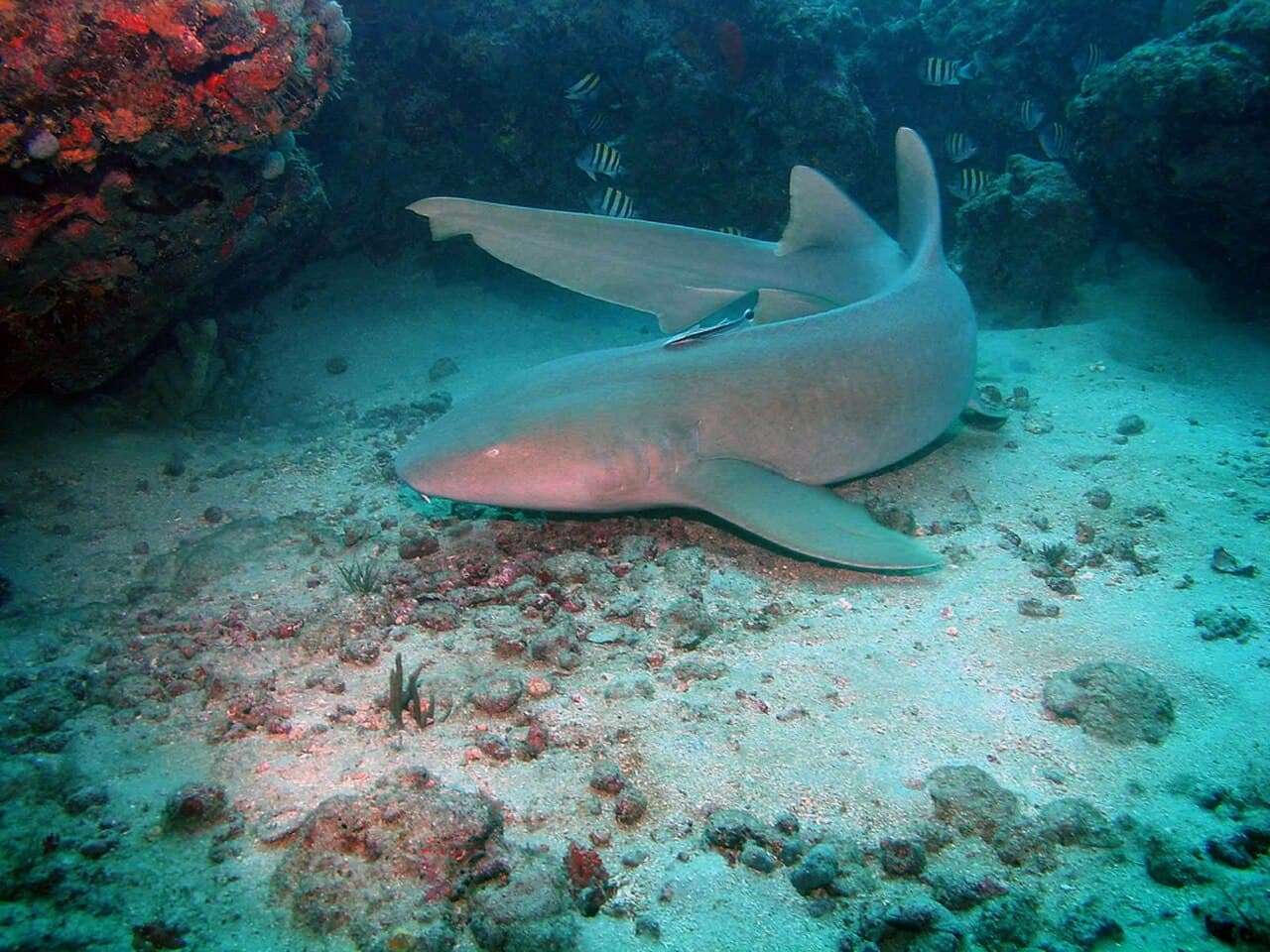
Nurse shark swimming just above a tropical reef seafloor
Gary Rinaldi / Wikimedia Commons / CC BY-SA 2.0
๐ŸŒ Read in Language:

โšก At a Glance

Species profile
Diet Category
Carnivorous bottom feeder
Activity Rhythm
Mostly nocturnal, with long resting periods during daylight.
Wild Lifespan
At least several decades; exact wild maximum remains uncertain
Typical Weight
large adults commonly exceed 90 kg
Conservation Status
VU
๐Ÿ’ก Key Biological Insight: A nurse shark can actively pump water across its gills, allowing it to lie still under a ledge instead of swimming continuously to breathe.

๐ŸŒณ Scientific Taxonomy Hierarchy

The nurse shark is a carpet shark in family Ginglymostomatidae. Ginglymostoma cirratum occupies the Atlantic and eastern Pacific and must not be confused with the tawny nurse shark, Nebrius ferrugineus, of the Indo-Pacific.

KingdomAnimalia
PhylumChordata
ClassChondrichthyes
OrderOrectolobiformes
FamilyGinglymostomatidae
GenusGinglymostoma
SpeciesGinglymostoma cirratum

Distinguishing Anatomical Features

  • โœ“A robust shark with a broad flattened head, small eyes, a mouth near the snout tip, two fleshy nasal barbels and rounded dorsal fins set far back. Adults are yellow-brown to gray-brown; juveniles may carry small dark spots.
  • โœ“Barbels detect prey near the bottom
  • โœ“Muscular pharynx creates powerful suction
  • โœ“Small replaceable teeth crush hard prey
  • โœ“Buccal pumping allows rest on the seafloor
  • โœ“Broad rounded fins support slow maneuvering

๐Ÿ“ Physical Measurements

Total Lengthadults commonly 7.2โ€“8.9 ft; maximum reliably documented near 10.2 ft
Body Weightlarge adults commonly exceed 200 lb
Tail LengthLong upper caudal lobe with little distinct lower lobe
WingspanNot applicable
Top SpeedNo dependable universal maximumMovement changes with context and conditions.

๐ŸŽจ Appearance & Distinctive Markings

Yellow brownGray brownDark brownPale undersideJuvenile black spots

Skin / Covering: Tough skin covered in placoid scales

Sexual Dimorphism: Females grow larger and heavier than males; external claspers identify mature males.

๐Ÿ—บ๏ธ Geographic Distribution & Habitat

Warm coastal waters of the western Atlantic from Florida and the Bahamas through the Caribbean and Gulf of Mexico to Brazil, the tropical eastern Atlantic including island and West African sites, and a separate eastern Pacific population from Baja California toward Peru.

Coral and rocky reefs, mangrove channels, seagrass beds, sandy lagoons, caves, ledges and continental-shelf bottoms, generally in shallow coastal water.

Country-level distribution map

Native range
FijiTanzaniaWestern SaharaCanadaUnited States โ€” Native rangeKazakhstanUzbekistanPapua New GuineaIndonesiaArgentinaChileCongo - KinshasaSomaliaKenyaSudanChadHaitiDominican RepublicRussiaBahamas โ€” Native rangeFalkland IslandsNorwayGreenlandFrench Southern TerritoriesTimor-LesteSouth AfricaLesothoMexico โ€” Native rangeUruguayBrazil โ€” Native rangeBoliviaPeruColombia โ€” Native rangePanama โ€” Native rangeCosta Rica โ€” Native rangeNicaragua โ€” Native rangeHonduras โ€” Native rangeEl SalvadorGuatemala โ€” Native rangeBelize โ€” Native rangeVenezuela โ€” Native rangeGuyana โ€” Native rangeSuriname โ€” Native rangeFranceEcuadorPuerto RicoJamaicaCuba โ€” Native rangeZimbabweBotswanaNamibiaSenegal โ€” Native rangeMaliMauritaniaBeninNigerNigeriaCameroonTogoGhana โ€” Native rangeCรดte dโ€™Ivoire โ€” Native rangeGuinea โ€” Native rangeGuinea-BissauLiberia โ€” Native rangeSierra Leone โ€” Native rangeBurkina FasoCentral African RepublicCongo - BrazzavilleGabon โ€” Native rangeEquatorial GuineaZambiaMalawiMozambiqueEswatiniAngolaBurundiIsraelLebanonMadagascarPalestinian TerritoriesGambia โ€” Native rangeTunisiaAlgeriaJordanUnited Arab EmiratesQatarKuwaitIraqOmanVanuatuCambodiaThailandLaosMyanmar (Burma)VietnamNorth KoreaSouth KoreaMongoliaIndiaBangladeshBhutanNepalPakistanAfghanistanTajikistanKyrgyzstanTurkmenistanIranSyriaArmeniaSwedenBelarusUkrainePolandAustriaHungaryMoldovaRomaniaLithuaniaLatviaEstoniaGermanyBulgariaGreeceTรผrkiyeAlbaniaCroatiaSwitzerlandLuxembourgBelgiumNetherlandsPortugalSpainIrelandNew CaledoniaSolomon IslandsNew ZealandAustraliaSri LankaChinaTaiwanItalyDenmarkUnited KingdomIcelandAzerbaijanGeorgiaPhilippinesMalaysiaBruneiSloveniaFinlandSlovakiaCzechiaEritreaJapanParaguayYemenSaudi ArabiaCyprusMoroccoEgyptLibyaEthiopiaDjiboutiUgandaRwandaBosnia & HerzegovinaNorth MacedoniaSerbiaMontenegroKosovoTrinidad & Tobago โ€” Native rangeSouth Sudan
Highlighted countries are recorded profile locations, not precise biological range boundaries.Map boundaries: Natural Earth

๐Ÿ’ก Did You Know?

  • ๐Ÿ’กBarbels detect prey near the bottom
  • ๐Ÿ’กMuscular pharynx creates powerful suction
  • ๐Ÿ’กSmall replaceable teeth crush hard prey
  • ๐Ÿ’กBuccal pumping allows rest on the seafloor
  • ๐Ÿ’กBroad rounded fins support slow maneuvering

๐ŸŒฟ Conservation Status & Threats

IUCN: VU โ€” Vulnerable

โ€œThe current global assessment lists the nurse shark as Vulnerable, reflecting fishing pressure, slow life history and degradation of shallow coastal habitat, with conditions varying among regions.โ€

Population Trend๐Ÿ“‰ Decreasing
Wild Population EstimateNo reliable global total exists; local abundance ranges from common at protected resting sites to severely depleted.

โš ๏ธ Major Threats to Nurse Shark

  • โ€ขTargeted and incidental fishing
  • โ€ขMangrove and reef loss
  • โ€ขCoastal development
  • โ€ขTourism harassment
  • โ€ขPollution
  • โ€ขSlow reproduction

๐Ÿ”„ Life Cycle & Reproduction

Wild vs. Captivity Lifespan Comparison

๐ŸŒฟ In the WildAt least several decades; exact wild maximum remains uncertain
๐Ÿ  In Captivity (with veterinary care)Can differ under managed care.
Clutch / Litter SizeUsually about 20โ€“30 pups
Incubation / GestationGestation about five to six months, followed by a resting interval before the next reproductive cycle
Fledging / WeaningPups are roughly 27โ€“30 cm long at birth and immediately independent. Shallow reef, mangrove and seagrass areas provide shelter and abundant small prey, but juvenile survival is threatened by coastal development and fishing.
Sexual MaturityMales mature around 2.1โ€“2.2 m and females around 2.2โ€“2.3 m, after many years of growth
Mating SystemPolyandrous mating can occur, with females storing sperm
Nesting / Den TypeNo nest; live-bearing after retained egg development

๐Ÿฆ… Behavior & Field Ecology

Carnivorous bottom feeder

๐ŸŒ Ecological Food Web & Relationships: As a benthic predator, the nurse shark links crustaceans, mollusks and reef fishes to higher trophic levels and moves nutrients across reef, mangrove and seagrass habitats.

Social Group SizeAggregates at daytime resting sites but hunts mostly alone
Activity RhythmMostly nocturnal, with long resting periods during daylight.
Feeding StrategyCarnivorous bottom feeder

๐Ÿฅฉ Primary Prey & Preferred Diet

โœ“ Crabsโœ“ Lobstersโœ“ Shrimpโœ“ Octopusesโœ“ Squidโœ“ Conchsโœ“ Sea urchinsโœ“ Small fishโœ“ Stingrays

๐Ÿ“ข Communication & Territorial Signals

  • Scent cues
  • Electroreception
  • Courtship contact
  • Body posture

๐Ÿพ Wild Temperament & Traits

โ€ข Usually placid when undisturbedโ€ข Strongly defensive if restrainedโ€ข Nocturnal forager

๐Ÿค Human Interaction & Pet Advisory

โš ๏ธ Strictly Wild Species
๐Ÿšซ

Can You Keep a Nurse Shark as a Pet?

A very large, long-lived shark requiring an enormous licensed public-aquarium system, never a home pet.

Domestication StatusWild and not domesticated
Danger to HumansUsually nonaggressive but capable of a severe defensive bite
Economic & Ecotourism RoleReef predator, tourism species and important subject for research on shark reproduction, nursery habitat and movement.

โš ๏ธ Behavioral Risk Factors & Wildlife Safety

  • Powerful jaws can maintain a prolonged grip
  • Bites often follow close handling or harassment
  • Resting camouflage can lead to accidental contact

๐ŸŒ Ecological Food Web & Relationships

๐Ÿฆ… Natural Predators (3)

Tiger SharkGaleocerdo cuvier
Bull SharkCarcharhinus leucas
HumansHomo sapiens

๐Ÿงฌ Related Species (3)

Tawny Nurse SharkNebrius ferrugineusIndo-Pacific relative
Short-Tail Nurse SharkPseudoginglymostoma brevicaudatumWestern Indian Ocean relative
Whale SharkRhincodon typusRelated carpet shark

Nurse Shark (Ginglymostoma cirratum) is a broad-headed bottom-dwelling shark of warm Atlantic and eastern Pacific coasts. This guide separates well-supported biology from common assumptions and covers identification, range, habitat, diet, behavior, reproduction and conservation.

Identification

A robust shark with a broad flattened head, small eyes, a mouth near the snout tip, two fleshy nasal barbels and rounded dorsal fins set far back. Adults are yellow-brown to gray-brown; juveniles may carry small dark spots. Females grow larger and heavier than males; external claspers identify mature males.

Identification should combine body shape, markings, size, voice or movement, and location. One feature by itself can overlap with a related animal, a juvenile, or an individual in unusual light.

Photographs are most useful when they preserve scale and show several diagnostic features. Handling or repositioning a wild nurse shark for identification can cause stress and is unnecessary.

Size and physical adaptations

Nurse Shark typically measures adults commonly 2.2โ€“2.7 m; maximum reliably documented near 3.1 m and weighs large adults commonly exceed 90 kg. Old reports of much greater lengths are unreliable; regional growth and maturity differ.

Its useful adaptations include barbels detect prey near the bottom, muscular pharynx creates powerful suction, small replaceable teeth crush hard prey, buccal pumping allows rest on the seafloor, broad rounded fins support slow maneuvering. These traits work together in the animal’s normal setting rather than serving as isolated curiosities.

Published measurements may use different methods, life stages or sample locations. Comparing figures responsibly means checking what was measured rather than selecting the largest number available.

Range and distribution

Warm coastal waters of the western Atlantic from Florida and the Bahamas through the Caribbean and Gulf of Mexico to Brazil, the tropical eastern Atlantic including island and West African sites, and a separate eastern Pacific population from Baja California toward Peru. The native range includes United States, Mexico, Bahamas, Cuba, Belize, Honduras, Costa Rica, Panama, Colombia, Venezuela, Trinidad and Tobago, Brazil, Cabo Verde, Senegal, The Gambia, Ghana, Gabon.

A country-level map indicates broad distribution, not continuous occupation. Climate, elevation, water, vegetation, prey, breeding sites, barriers and survey effort all affect where records occur.

Records near the edge of the range deserve careful documentation because they may reflect natural movement, improved survey coverage, accidental transport or a genuine distribution change.

Habitat

Coral and rocky reefs, mangrove channels, seagrass beds, sandy lagoons, caves, ledges and continental-shelf bottoms, generally in shallow coastal water.

By day nurse sharks often return to favored caves, crevices or reef ledges and may lie piled together. At night they spread across reefs, sand and seagrass to search for prey, with young sharks making especially heavy use of shallow protective habitat. Protecting a population therefore requires the feeding, shelter and breeding features that make a site usable, along with connections that allow movement.

Microhabitat matters. Shade, soil, current, moisture, shelter or host plants can determine whether a small area is usable even when the surrounding landscape appears suitable.

Diet and feeding

Nurse Shark is a carnivorous bottom feeder. Important foods include crabs, lobsters, shrimp, octopuses, squid, conchs, sea urchins, small fish, stingrays. Barbels and smell help locate hidden prey. The shark seals its mouth close to the target, rapidly expands the throat and sucks prey from a crevice or sediment. Dense bands of small teeth grip and crush shells; the shark may use pectoral fins to brace while pulling an octopus from cover.

Diet changes with age, season, location and food supply. A dramatic prey record does not establish what most individuals eat most of the time; repeated field observations provide a stronger picture.

Feeding opportunities also create risk. An animal focused on prey may be less alert to predators, traffic or people, while contaminated prey can transfer pollutants through the food web.

Behavior and communication

Mostly nocturnal, with long resting periods during daylight. Nurse sharks are slow-moving but strong and flexible in confined reef spaces. Individuals show fidelity to resting shelters, and multiple sharks may share one site without forming a coordinated hunting group. During courtship males grasp a femaleโ€™s pectoral fin and maneuver beside her.

Chemical and electrical senses help locate prey and other sharks. Close-range courtship uses touch, biting and synchronized swimming; posture and rapid movement communicate disturbance. Behavior should be interpreted in context: alarm, courtship, feeding and temperature regulation can produce very different actions from the same animal.

Daily schedules are flexible responses, not rigid rules. Weather, breeding condition, disturbance, tides or food can move activity into a different part of the day.

Reproduction and development

Females mate with one or more males in shallow water. Fertilized eggs develop inside egg cases retained in the uterus; embryos rely on yolk and are born alive after a long gestation. Usually about 20โ€“30 pups undefined

Young animals face different risks and may use different microhabitats or food than adults. Breeding success depends on adult condition, suitable sites and the survival of offspring through vulnerable early stages.

Counts of eggs or young describe reproductive output, not the number expected to reach adulthood. Mortality is normally greatest during eggs, larval or juvenile stages.

Predators and ecological role

As a benthic predator, the nurse shark links crustaceans, mollusks and reef fishes to higher trophic levels and moves nutrients across reef, mangrove and seagrass habitats. Documented or likely predators include Tiger Shark, Bull Shark, Humans.

This animal is both a consumer and a food source. Its influence comes through many repeated interactions, so ecological claims should be based on measured populations rather than assumptions drawn from appearance.

Predator and prey relationships differ among places. A species can be ecologically influential without being abundant everywhere, and its role can change across its range.

Relationship with people

Divers often encounter resting nurse sharks at close range, which can create a false impression that touching is safe. Most bites follow harassment, feeding, stepping on or attempted handling. The species is also caught in coastal fisheries and vulnerable to habitat loss because it matures slowly and repeatedly uses shallow sites.

Never touch, feed, corner, ride or pull a nurse shark. Give resting animals an open escape route, watch where you place hands and feet, and follow local dive guidance. A bite can clamp firmly and requires emergency medical care. Responsible observation means keeping an appropriate distance, avoiding capture or feeding, protecting habitat and following local wildlife or invasive-species guidance.

Wildlife guidance should come from the responsible local agency because collection rules, reporting requests and appropriate responses differ between native and introduced ranges.

Conservation

The current global assessment lists the nurse shark as Vulnerable, reflecting fishing pressure, slow life history and degradation of shallow coastal habitat, with conditions varying among regions. The reported global trend is Decreasing overall.

Important pressures include targeted and incidental fishing, mangrove and reef loss, coastal development, tourism harassment, pollution, slow reproduction. Global status can hide local decline or recovery, so current regional monitoring and habitat management remain necessary.

The most useful conservation action follows the documented pressure. Protecting breeding sites, reducing road deaths or limiting pollutants can require different tools in different populations.

Sources and further reading

โ“ Frequently Asked Questions

Answers to frequently asked questions verified against peer-reviewed zoological research.

The origin is uncertain. One leading explanation traces nurse to an older word used for catsharks rather than to any nursing behavior.