
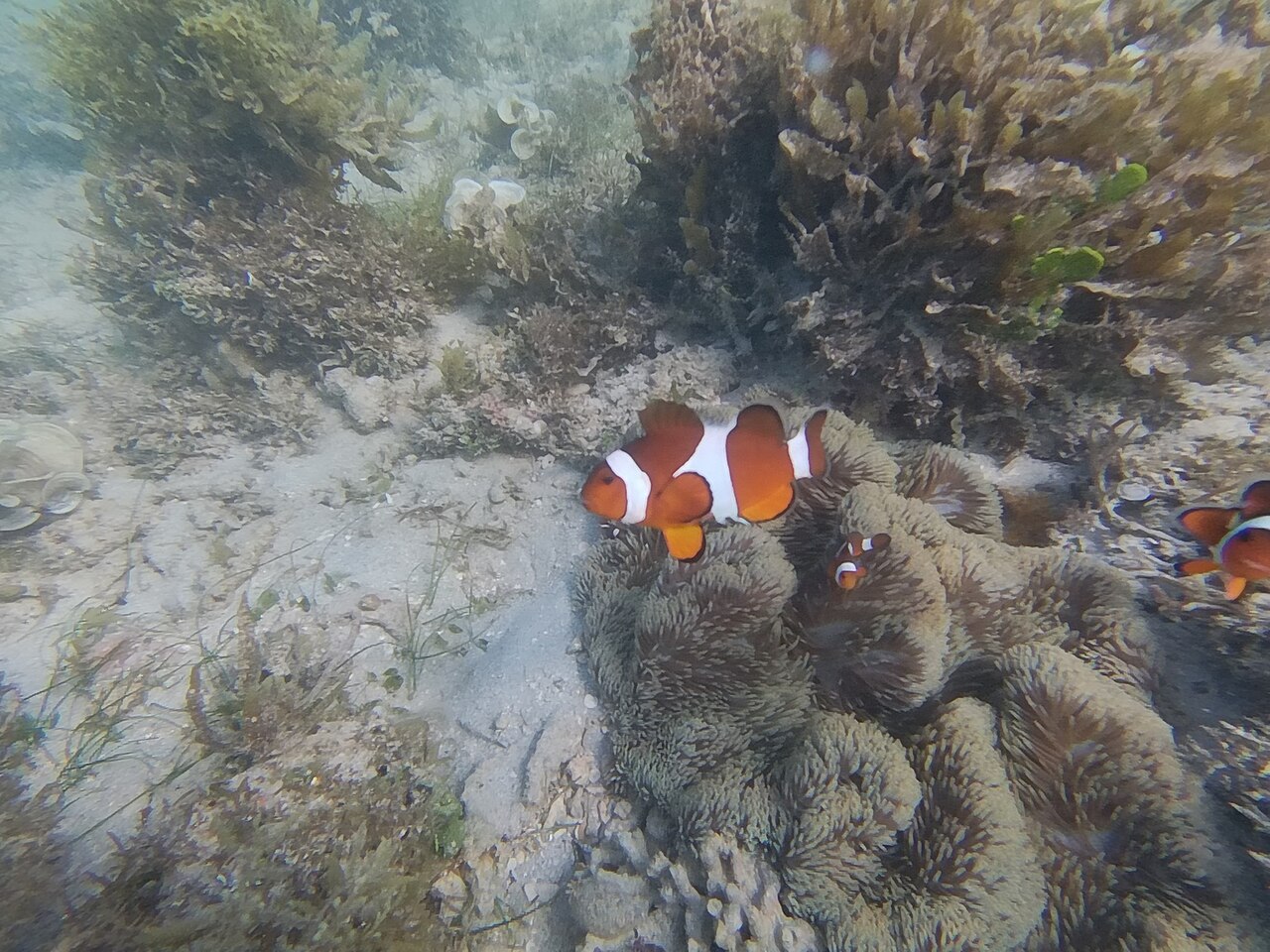
Ocellaris Clownfish (Amphiprion ocellaris) is an orange-and-white damselfish of shallow Indo-Pacific reefs, best known for its mutualism with sea anemones. This guide separates well-supported biology from common assumptions and covers identification, range, habitat, diet, behavior, reproduction and conservation.
Identification
A compact oval fish with orange body, three vertical white bars and black edging on the fins and bars. The first white band sits behind the eye, the second crosses the middle and bulges forward, and the third lies near the tail base. Some regional populations are largely black. The dominant breeding female is the largest fish in a group; the breeding male is second largest, while nonbreeders remain smaller.
Identification should combine body shape, markings, size, voice or movement, and location. One feature by itself can overlap with a related animal, a juvenile, or an individual in unusual light.
Photographs are most useful when they preserve scale and show several diagnostic features. Handling or repositioning a wild ocellaris clownfish for identification can cause stress and is unnecessary.
Size and physical adaptations
Ocellaris Clownfish typically measures usually 7–9 cm; maximum about 11 cm and weighs commonly under 20 g. Females grow larger than males; captive strains vary greatly in color but not basic body form.
Its useful adaptations include protective mucus reduces anemone stings, sequential sex change preserves a breeding pair, deep body allows tight turns among tentacles, small teeth graze algae and capture plankton, social hierarchy limits conflict. These traits work together in the animal’s normal setting rather than serving as isolated curiosities.
Published measurements may use different methods, life stages or sample locations. Comparing figures responsibly means checking what was measured rather than selecting the largest number available.
Range and distribution
Tropical eastern Indian Ocean and western Pacific from the Andaman Sea through Southeast Asia and Indonesia to the Philippines, northwestern Australia and parts of the western Pacific. The native range includes India, Sri Lanka, Myanmar, Thailand, Malaysia, Singapore, Indonesia, Philippines, Brunei, Vietnam, Cambodia, Australia, Taiwan, Japan.
A country-level map indicates broad distribution, not continuous occupation. Climate, elevation, water, vegetation, prey, breeding sites, barriers and survey effort all affect where records occur.
Records near the edge of the range deserve careful documentation because they may reflect natural movement, improved survey coverage, accidental transport or a genuine distribution change.
Habitat
Protected coral reefs and lagoons, generally 1–15 m deep, wherever compatible host anemones grow in adequate light and water flow.
The fish rarely travels far from its host. Tentacles provide a refuge from predators, while nearby reef water supplies drifting plankton. Common hosts include magnificent, giant carpet and Mertens’ carpet anemones. Protecting a population therefore requires the feeding, shelter and breeding features that make a site usable, along with connections that allow movement.
Microhabitat matters. Shade, soil, current, moisture, shelter or host plants can determine whether a small area is usable even when the surrounding landscape appears suitable.
Diet and feeding
Ocellaris Clownfish is a omnivore feeding on plankton, small invertebrates and algae. Important foods include copepods, amphipods, fish eggs, tunicate larvae, algae, anemone food scraps. Individuals dart from the tentacles to take drifting zooplankton and pick algae or small benthic items. They may carry food toward the host, while waste nutrients from the fish can fertilize anemone tissues and resident symbiotic algae.
Diet changes with age, season, location and food supply. A dramatic prey record does not establish what most individuals eat most of the time; repeated field observations provide a stronger picture.
Feeding opportunities also create risk. An animal focused on prey may be less alert to predators, traffic or people, while contaminated prey can transfer pollutants through the food web.
Behavior and communication
Diurnal, staying within a few metres of the host anemone. A host contains a strict size-based hierarchy: one breeding female, one breeding male and several smaller immature males. Subordinates restrain growth, reducing challenges. The fish acclimates to a host through cautious contact and mucus chemistry and vigorously drives away many intruders.
Visual size differences organize rank. Chasing and body displays enforce position, while popping and chirping sounds help signal submission or threat during close encounters. Behavior should be interpreted in context: alarm, courtship, feeding and temperature regulation can produce very different actions from the same animal.
Daily schedules are flexible responses, not rigid rules. Weather, breeding condition, disturbance, tides or food can move activity into a different part of the day.
Reproduction and development
The pair spawns on a cleaned rock beside the anemone, often timed near a lunar phase. The female deposits adhesive eggs and the male fertilizes them. He performs most cleaning, fanning and removal of dead eggs. Several hundred to more than 1,000 eggs depending on female size undefined
Young animals face different risks and may use different microhabitats or food than adults. Breeding success depends on adult condition, suitable sites and the survival of offspring through vulnerable early stages.
Counts of eggs or young describe reproductive output, not the number expected to reach adulthood. Mortality is normally greatest during eggs, larval or juvenile stages.
Predators and ecological role
The clownfish gains protection and food access from its anemone. The host may gain nutrients, water circulation, defense from some butterflyfishes and removal of debris, though the strength of each benefit depends on the host anemone and local conditions. Documented or likely predators include Larger Reef Fish, Wrasses, Damselfishes.
This animal is both a consumer and a food source. Its influence comes through many repeated interactions, so ecological claims should be based on measured populations rather than assumptions drawn from appearance.
Predator and prey relationships differ among places. A species can be ecologically influential without being abundant everywhere, and its role can change across its range.
Relationship with people
The species is one of the most popular marine aquarium fish and is widely bred in captivity. Captive breeding supplies many color varieties and can reduce pressure on wild reefs. Poor collection practices, anemone removal, warming seas and bleaching still threaten local habitat.
Buy captive-bred fish from a transparent source, maintain mature stable saltwater conditions, and avoid purchasing a wild host anemone without the lighting, flow and long-term expertise it requires. Responsible observation means keeping an appropriate distance, avoiding capture or feeding, protecting habitat and following local wildlife or invasive-species guidance.
Wildlife guidance should come from the responsible local agency because collection rules, reporting requests and appropriate responses differ between native and introduced ranges.
Conservation
Listed as Least Concern globally, but local populations and host anemones are exposed to reef degradation, bleaching, pollution and collection. The reported global trend is Stable globally with local declines possible.
Important pressures include coral and anemone bleaching, coastal pollution, destructive fishing, unsustainable local collection, loss of host anemones, ocean warming. Global status can hide local decline or recovery, so current regional monitoring and habitat management remain necessary.
The most useful conservation action follows the documented pressure. Protecting breeding sites, reducing road deaths or limiting pollutants can require different tools in different populations.