
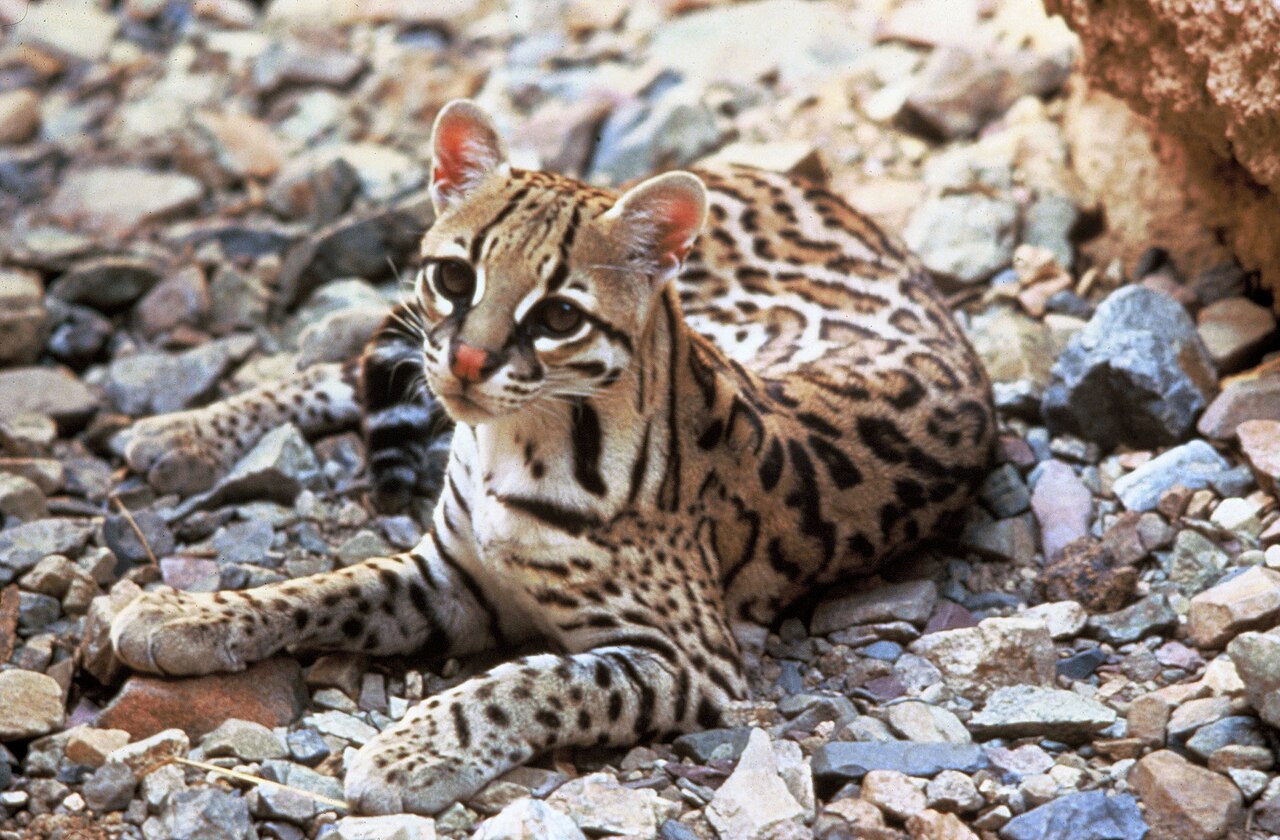
Ocelot (Leopardus pardalis) is a medium-sized spotted cat of forests, wetlands, savannas and thorn scrub from the southern United States to northern Argentina. This guide separates well-supported biology from common assumptions and covers identification, range, habitat, diet, behavior, reproduction and conservation.
Identification
A long-bodied, short-legged cat with rounded ears, large paws and a coat of black-edged rosettes, elongated blotches and chain-like stripes on a tawny, gray or reddish background. The cheeks carry two dark lines, and the tail is barred or ringed. Males average larger and heavier than females, but coat pattern and body form are alike.
Identification should combine body shape, markings, size, voice or movement, and location. One feature by itself can overlap with a related animal, a juvenile, or an individual in unusual light.
Photographs are most useful when they preserve scale and show several diagnostic features. Handling or repositioning a wild ocelot for identification can cause stress and is unnecessary.
Size and physical adaptations
Ocelot typically measures head and body 65–97 cm; tail 27–40 cm and weighs about 8–16 kg, with males often heavier. Body size varies geographically; tropical forest populations and the small U.S. population are not identical in average size.
Its useful adaptations include large eyes aid low-light hunting, whiskers detect close obstacles, rosettes disrupt outline in dappled cover, sensitive hearing locates small prey, strong forelimbs seize and climb, padded feet support silent movement. These traits work together in the animal’s normal setting rather than serving as isolated curiosities.
Published measurements may use different methods, life stages or sample locations. Comparing figures responsibly means checking what was measured rather than selecting the largest number available.
Range and distribution
From remnant populations in southern Texas through Mexico, Central America and most of tropical South America to northern Argentina, absent from high cold Andes and open southern grasslands. The native range includes United States, Mexico, Belize, Guatemala, Honduras, El Salvador, Nicaragua, Costa Rica, Panama, Colombia, Venezuela, Guyana, Suriname, French Guiana, Ecuador, Peru, Bolivia, Brazil, Paraguay, Argentina.
A country-level map indicates broad distribution, not continuous occupation. Climate, elevation, water, vegetation, prey, breeding sites, barriers and survey effort all affect where records occur.
Records near the edge of the range deserve careful documentation because they may reflect natural movement, improved survey coverage, accidental transport or a genuine distribution change.
Habitat
Tropical and subtropical forest, mangrove, marsh edge, wooded savanna, dry forest and thorn scrub with dense ground-level cover.
Dense vegetation is the key requirement across otherwise varied ecosystems. Ocelots rest in thickets, hollow trees or shaded ground by day and patrol paths, stream edges and forest openings at night. Males use larger ranges overlapping several females. Protecting a population therefore requires the feeding, shelter and breeding features that make a site usable, along with connections that allow movement.
Microhabitat matters. Shade, soil, current, moisture, shelter or host plants can determine whether a small area is usable even when the surrounding landscape appears suitable.
Diet and feeding
Ocelot is a carnivore specializing in small and medium prey. Important foods include rats, mice, opossums, rabbits, armadillos, birds, lizards, snakes, fish, crabs. An ocelot searches slowly, pauses to listen and may sit at one site for an extended ambush. It kills with a bite to the neck or skull and can climb or swim when prey requires it. Rodents dominate many studies, but diet shifts with local abundance.
Diet changes with age, season, location and food supply. A dramatic prey record does not establish what most individuals eat most of the time; repeated field observations provide a stronger picture.
Feeding opportunities also create risk. An animal focused on prey may be less alert to predators, traffic or people, while contaminated prey can transfer pollutants through the food web.
Behavior and communication
Mostly nocturnal and crepuscular, with daytime activity where disturbance is low. Ocelots are solitary and territorial. They scent-mark travel routes with urine, feces and scrapes, use repeated paths through cover and communicate at range through odor. Although capable climbers, most hunting occurs on the ground.
Urine sprays, fecal sites, scrapes and cheek rubbing advertise identity and reproductive state. Close encounters add growls, yowls, meows and posture, while mothers and kittens use softer contact calls. Behavior should be interpreted in context: alarm, courtship, feeding and temperature regulation can produce very different actions from the same animal.
Daily schedules are flexible responses, not rigid rules. Weather, breeding condition, disturbance, tides or food can move activity into a different part of the day.
Reproduction and development
Females advertise estrus chemically and vocally. After mating, the female selects a secluded den and raises the litter alone. Slow kitten development and long intervals between litters limit population recovery. Usually one kitten, occasionally two or three undefined
Young animals face different risks and may use different microhabitats or food than adults. Breeding success depends on adult condition, suitable sites and the survival of offspring through vulnerable early stages.
Counts of eggs or young describe reproductive output, not the number expected to reach adulthood. Mortality is normally greatest during eggs, larval or juvenile stages.
Predators and ecological role
Ocelots regulate rodents and other small vertebrates. Where abundant they may suppress smaller cats through competition and predation, an ecological effect called the ocelot influence. Documented or likely predators include Jaguar, Puma, Harpy Eagle, Humans.
This animal is both a consumer and a food source. Its influence comes through many repeated interactions, so ecological claims should be based on measured populations rather than assumptions drawn from appearance.
Predator and prey relationships differ among places. A species can be ecologically influential without being abundant everywhere, and its role can change across its range.
Relationship with people
International trade controls ended the large commercial fur market, allowing recovery across much of Latin America. In the United States, fewer than 100 animals survive in isolated South Texas populations where road deaths and habitat fragmentation are acute. Wildlife crossings and connected thorn scrub are conservation priorities.
Never feed or corner a wild cat. Keep poultry and small pets secured at night, drive slowly in signed habitat and report sightings to wildlife agencies without approaching. Responsible observation means keeping an appropriate distance, avoiding capture or feeding, protecting habitat and following local wildlife or invasive-species guidance.
Wildlife guidance should come from the responsible local agency because collection rules, reporting requests and appropriate responses differ between native and introduced ranges.
Conservation
Globally listed as Least Concern because of its broad range, but habitat loss and fragmentation cause regional declines. The tiny U.S. population is federally endangered. The reported global trend is Decreasing overall.
Important pressures include forest and thorn-scrub clearing, road mortality, fragmented populations, illegal trade, retaliatory killing, declining prey. Global status can hide local decline or recovery, so current regional monitoring and habitat management remain necessary.
The most useful conservation action follows the documented pressure. Protecting breeding sites, reducing road deaths or limiting pollutants can require different tools in different populations.