
Species profileIUCN: EN

Okapi

Okapia johnstoni

The giraffeโ€™s forest-dwelling relative, with a velvet-brown coat, striped legs and a long grasping tongue.

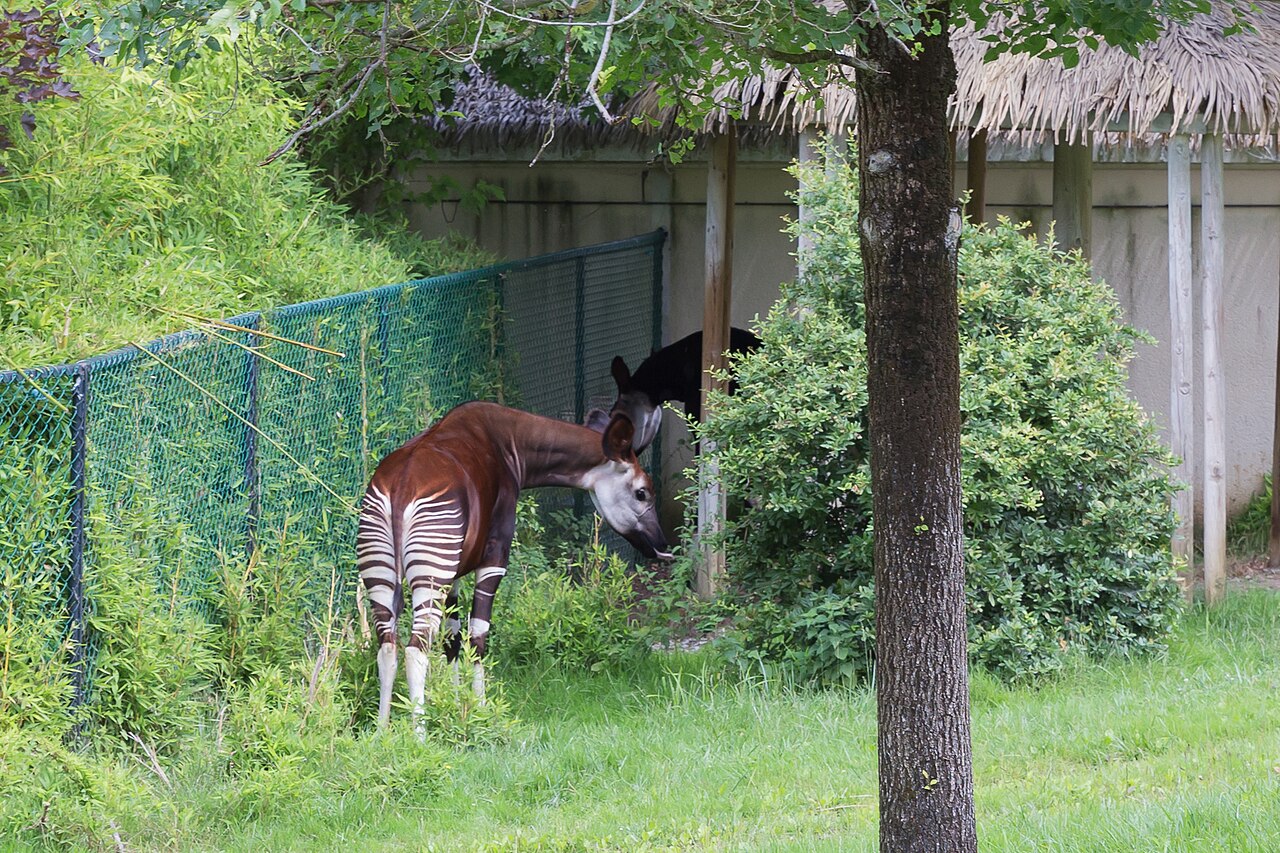
Adult okapi standing in shade, showing reddish-brown coat and white-striped legs
William Crochot / Wikimedia Commons / CC BY-SA 4.0
๐ŸŒ Read in Language:

โšก At a Glance

Species profile
Diet Category
Herbivorous forest browser
Activity Rhythm
Most active from afternoon into evening, with movement also occurring by day and night.
Wild Lifespan
Often around 15โ€“20 years; can exceed 25 in managed care
Typical Weight
males about 200โ€“300 kg; females about 225โ€“350 kg
Conservation Status
EN
๐Ÿ’ก Key Biological Insight: Okapi mothers and calves produce infrasonic calls below the usual range of human hearing, potentially keeping contact without advertising the calf to predators.

๐ŸŒณ Scientific Taxonomy Hierarchy

The okapi is the only living species in genus Okapia and, with giraffes, one of two living lineages in family Giraffidae. Its short neck and compact body reflect forest life rather than close kinship with zebras.

KingdomAnimalia
PhylumChordata
ClassMammalia
OrderArtiodactyla
FamilyGiraffidae
GenusOkapia
SpeciesOkapia johnstoni

Distinguishing Anatomical Features

  • โœ“A large forest browser with a deep reddish-brown to nearly black body, creamy face, enormous ears and bold white horizontal stripes across the rump and upper legs. Males usually carry short skin-covered ossicones; females generally have hair whorls instead.
  • โœ“Large mobile ears detect faint forest sounds
  • โœ“Striped legs camouflage in broken light
  • โœ“Oily coat sheds heavy rain
  • โœ“Prehensile tongue strips leaves
  • โœ“Splayed cloven hooves cross soft ground
  • โœ“Multi-chambered stomach digests foliage

๐Ÿ“ Physical Measurements

Total Lengthbody about 5.9โ€“8.2 ft; shoulder height around 5 ft
Body Weightmales about 440โ€“660 lb; females about 495โ€“770 lb
Tail LengthAbout 12โ€“17 in with a terminal tuft
WingspanNot applicable
Top SpeedNo dependable universal maximumMovement changes with context and conditions.

๐ŸŽจ Appearance & Distinctive Markings

Reddish brownChocolate brownBlackWhiteCream

Skin / Covering: Dense velvety oil-coated fur

Sexual Dimorphism: Females are taller and heavier; adult males usually have short ossicones and a thicker neck.

๐Ÿ—บ๏ธ Geographic Distribution & Habitat

Endemic to central and northeastern Democratic Republic of the Congo, mainly north and east of the Congo River in the Ituri and adjacent forests.

Dense lowland and montane tropical rainforest, usually with tree-fall gaps, river edges and secondary growth that provide reachable young leaves.

Country-level distribution map

Native range
FijiTanzaniaWestern SaharaCanadaUnited StatesKazakhstanUzbekistanPapua New GuineaIndonesiaArgentinaChileCongo - Kinshasa โ€” Native rangeSomaliaKenyaSudanChadHaitiDominican RepublicRussiaBahamasFalkland IslandsNorwayGreenlandFrench Southern TerritoriesTimor-LesteSouth AfricaLesothoMexicoUruguayBrazilBoliviaPeruColombiaPanamaCosta RicaNicaraguaHondurasEl SalvadorGuatemalaBelizeVenezuelaGuyanaSurinameFranceEcuadorPuerto RicoJamaicaCubaZimbabweBotswanaNamibiaSenegalMaliMauritaniaBeninNigerNigeriaCameroonTogoGhanaCรดte dโ€™IvoireGuineaGuinea-BissauLiberiaSierra LeoneBurkina FasoCentral African RepublicCongo - BrazzavilleGabonEquatorial GuineaZambiaMalawiMozambiqueEswatiniAngolaBurundiIsraelLebanonMadagascarPalestinian TerritoriesGambiaTunisiaAlgeriaJordanUnited Arab EmiratesQatarKuwaitIraqOmanVanuatuCambodiaThailandLaosMyanmar (Burma)VietnamNorth KoreaSouth KoreaMongoliaIndiaBangladeshBhutanNepalPakistanAfghanistanTajikistanKyrgyzstanTurkmenistanIranSyriaArmeniaSwedenBelarusUkrainePolandAustriaHungaryMoldovaRomaniaLithuaniaLatviaEstoniaGermanyBulgariaGreeceTรผrkiyeAlbaniaCroatiaSwitzerlandLuxembourgBelgiumNetherlandsPortugalSpainIrelandNew CaledoniaSolomon IslandsNew ZealandAustraliaSri LankaChinaTaiwanItalyDenmarkUnited KingdomIcelandAzerbaijanGeorgiaPhilippinesMalaysiaBruneiSloveniaFinlandSlovakiaCzechiaEritreaJapanParaguayYemenSaudi ArabiaCyprusMoroccoEgyptLibyaEthiopiaDjiboutiUgandaRwandaBosnia & HerzegovinaNorth MacedoniaSerbiaMontenegroKosovoTrinidad & TobagoSouth Sudan
Highlighted countries are recorded profile locations, not precise biological range boundaries.Map boundaries: Natural Earth

Recorded Native Countries & Territories:

๐Ÿ’ก Did You Know?

  • ๐Ÿ’กLarge mobile ears detect faint forest sounds
  • ๐Ÿ’กStriped legs camouflage in broken light
  • ๐Ÿ’กOily coat sheds heavy rain
  • ๐Ÿ’กPrehensile tongue strips leaves
  • ๐Ÿ’กSplayed cloven hooves cross soft ground
  • ๐Ÿ’กMulti-chambered stomach digests foliage

๐ŸŒฟ Conservation Status & Threats

IUCN: EN โ€” Endangered

โ€œListed as Endangered after a severe decline. Its limited range is fragmented by armed conflict, mining, roads, settlement and poaching, and reliable population surveys remain difficult.โ€

Population Trend๐Ÿ“‰ Decreasing
Wild Population EstimateThe exact total is unknown; estimates are uncertain because dense forest and insecurity make surveys difficult, but the decline is believed to exceed 50 percent over three generations.

โš ๏ธ Major Threats to Okapi

  • โ€ขPoaching
  • โ€ขIllegal mining
  • โ€ขArmed conflict
  • โ€ขLogging and settlement
  • โ€ขRoad expansion
  • โ€ขHabitat fragmentation
  • โ€ขWeak enforcement in insecure regions

๐Ÿ”„ Life Cycle & Reproduction

Wild vs. Captivity Lifespan Comparison

๐ŸŒฟ In the WildOften around 15โ€“20 years; can exceed 25 in managed care
๐Ÿ  In Captivity (with veterinary care)Can differ under managed care.
Clutch / Litter SizeOne calf; twins are rare
Incubation / GestationGestation about 14โ€“16 months
Fledging / WeaningThe newborn stands within about 30 minutes and nurses soon after. Its mother leaves it concealed while foraging and returns to feed it. Calves may delay defecation for weeks, reducing odor around the hiding site, then gradually begin following the mother.
Sexual MaturityFemales often mature near 1.5โ€“2 years; males near 2โ€“3 years
Mating SystemPolygynous encounters within overlapping ranges
Nesting / Den TypeNo nest; calf is hidden in dense vegetation

๐Ÿฆ… Behavior & Field Ecology

Herbivorous forest browser

๐ŸŒ Ecological Food Web & Relationships: Okapis browse understory vegetation, disperse some seeds and create trails used through the forest. Protecting their broad home ranges also protects many species within the Congo Basin, making the okapi an umbrella species.

Social Group SizeMostly solitary; mother and calf remain associated
Activity RhythmMost active from afternoon into evening, with movement also occurring by day and night.
Feeding StrategyHerbivorous forest browser

๐Ÿฅฉ Primary Prey & Preferred Diet

โœ“ Young leavesโœ“ Budsโœ“ Twigsโœ“ Fruitโœ“ Fernsโœ“ Fungiโœ“ Clayโœ“ Charcoal from burned trees

๐Ÿ“ข Communication & Territorial Signals

  • Foot-gland scent
  • Urine marking
  • Bleats
  • Coughs
  • Infrasonic calls

๐Ÿพ Wild Temperament & Traits

โ€ข Solitaryโ€ข Secretiveโ€ข Alert

๐Ÿค Human Interaction & Pet Advisory

โš ๏ธ Strictly Wild Species
๐Ÿšซ

Can You Keep a Okapi as a Pet?

An endangered protected giraffid requiring specialist forest habitat and coordinated zoo management, never a pet.

Domestication StatusWild and not domesticated
Danger to HumansNormally avoids people but is a powerful hoofed mammal
Economic & Ecotourism RoleEndemic Congolese flagship, forest browser, seed disperser and umbrella species for Congo Basin rainforest protection.

โš ๏ธ Behavioral Risk Factors & Wildlife Safety

  • Can kick forcefully if cornered
  • Close pursuit causes severe stress
  • Field habitat may include security risks unrelated to wildlife

๐ŸŒ Ecological Food Web & Relationships

๐Ÿฆ… Natural Predators (2)

LeopardPanthera pardus
HumansHomo sapiens

๐Ÿงฌ Related Species (2)

Northern GiraffeGiraffa camelopardalisClosest living lineage
Southern GiraffeGiraffa giraffaTall savanna giraffid relative

Okapi (Okapia johnstoni) is an elusive browsing mammal found only in the rainforests of the Democratic Republic of the Congo. This guide separates well-supported biology from common assumptions and covers identification, range, habitat, diet, behavior, reproduction and conservation.

Identification

A large forest browser with a deep reddish-brown to nearly black body, creamy face, enormous ears and bold white horizontal stripes across the rump and upper legs. Males usually carry short skin-covered ossicones; females generally have hair whorls instead. Females are taller and heavier; adult males usually have short ossicones and a thicker neck.

Identification should combine body shape, markings, size, voice or movement, and location. One feature by itself can overlap with a related animal, a juvenile, or an individual in unusual light.

Photographs are most useful when they preserve scale and show several diagnostic features. Handling or repositioning a wild okapi for identification can cause stress and is unnecessary.

Size and physical adaptations

Okapi typically measures body about 1.8โ€“2.5 m; shoulder height around 1.5 m and weighs males about 200โ€“300 kg; females about 225โ€“350 kg. Females are among the uncommon mammals in which average body mass exceeds that of males.

Its useful adaptations include large mobile ears detect faint forest sounds, striped legs camouflage in broken light, oily coat sheds heavy rain, prehensile tongue strips leaves, splayed cloven hooves cross soft ground, multi-chambered stomach digests foliage. These traits work together in the animal’s normal setting rather than serving as isolated curiosities.

Published measurements may use different methods, life stages or sample locations. Comparing figures responsibly means checking what was measured rather than selecting the largest number available.

Range and distribution

Endemic to central and northeastern Democratic Republic of the Congo, mainly north and east of the Congo River in the Ituri and adjacent forests. The native range includes Democratic Republic of the Congo.

A country-level map indicates broad distribution, not continuous occupation. Climate, elevation, water, vegetation, prey, breeding sites, barriers and survey effort all affect where records occur.

Records near the edge of the range deserve careful documentation because they may reflect natural movement, improved survey coverage, accidental transport or a genuine distribution change.

Habitat

Dense lowland and montane tropical rainforest, usually with tree-fall gaps, river edges and secondary growth that provide reachable young leaves.

Okapis follow long-established paths through thick understory and browse from ground level to head height. Females occupy overlapping ranges; adult males range more widely and mark travel corridors. Salt licks and mineral-rich clay are visited where available. Protecting a population therefore requires the feeding, shelter and breeding features that make a site usable, along with connections that allow movement.

Microhabitat matters. Shade, soil, current, moisture, shelter or host plants can determine whether a small area is usable even when the surrounding landscape appears suitable.

Diet and feeding

Okapi is a herbivorous forest browser. Important foods include young leaves, buds, twigs, fruit, ferns, fungi, clay, charcoal from burned trees. The long dark tongue curls around shoots and draws them into the mouth. Okapis select numerous plant species and may consume fungi, fallen fruit and mineral sources. Like giraffes, they are ruminants that regurgitate and rechew cud to extract nutrients from fibrous food.

Diet changes with age, season, location and food supply. A dramatic prey record does not establish what most individuals eat most of the time; repeated field observations provide a stronger picture.

Feeding opportunities also create risk. An animal focused on prey may be less alert to predators, traffic or people, while contaminated prey can transfer pollutants through the food web.

Behavior and communication

Most active from afternoon into evening, with movement also occurring by day and night. Okapis are quiet, wary and mostly solitary. Each foot leaves a tar-like scent from interdigital glands, creating chemical trails. Large independently rotating ears continually scan for leopards and people, and dense cover allows the animal to disappear at short range.

Foot glands, urine and dung communicate presence and reproductive state. Audible coughs, bleats and whistles occur, while infrasonic calls may travel between mothers and hidden calves beneath the frequency range humans normally hear. Behavior should be interpreted in context: alarm, courtship, feeding and temperature regulation can produce very different actions from the same animal.

Daily schedules are flexible responses, not rigid rules. Weather, breeding condition, disturbance, tides or food can move activity into a different part of the day.

Reproduction and development

Adults meet briefly to mate. Following a pregnancy longer than a year, the female gives birth in dense cover and raises the calf without a permanent male partner. One calf; twins are rare undefined

Young animals face different risks and may use different microhabitats or food than adults. Breeding success depends on adult condition, suitable sites and the survival of offspring through vulnerable early stages.

Counts of eggs or young describe reproductive output, not the number expected to reach adulthood. Mortality is normally greatest during eggs, larval or juvenile stages.

Predators and ecological role

Okapis browse understory vegetation, disperse some seeds and create trails used through the forest. Protecting their broad home ranges also protects many species within the Congo Basin, making the okapi an umbrella species. Documented or likely predators include Leopard, Humans.

This animal is both a consumer and a food source. Its influence comes through many repeated interactions, so ecological claims should be based on measured populations rather than assumptions drawn from appearance.

Predator and prey relationships differ among places. A species can be ecologically influential without being abundant everywhere, and its role can change across its range.

Relationship with people

Okapis have long been known to Indigenous forest communities and are a national symbol of the Democratic Republic of the Congo. Armed conflict, illegal mining, settlement, logging and hunting make field protection dangerous. Community conservation and the Okapi Wildlife Reserve safeguard habitat while supporting local livelihoods.

Observe only with trained guides or in accredited facilities. Never pursue, feed or block a wild okapi; support conservation groups that work with Congolese communities and avoid minerals linked to destructive illegal mining. Responsible observation means keeping an appropriate distance, avoiding capture or feeding, protecting habitat and following local wildlife or invasive-species guidance.

Wildlife guidance should come from the responsible local agency because collection rules, reporting requests and appropriate responses differ between native and introduced ranges.

Conservation

Listed as Endangered after a severe decline. Its limited range is fragmented by armed conflict, mining, roads, settlement and poaching, and reliable population surveys remain difficult. The reported global trend is Decreasing.

Important pressures include poaching, illegal mining, armed conflict, logging and settlement, road expansion, habitat fragmentation, weak enforcement in insecure regions. Global status can hide local decline or recovery, so current regional monitoring and habitat management remain necessary.

The most useful conservation action follows the documented pressure. Protecting breeding sites, reducing road deaths or limiting pollutants can require different tools in different populations.

Sources and further reading

โ“ Frequently Asked Questions

Answers to frequently asked questions verified against peer-reviewed zoological research.

It is the giraffeโ€™s closest living relative. The zebra-like stripes are camouflage and do not indicate close kinship with zebras.