
Home/Animals/Reptilia/Olive Ridley Sea Turtle
Species profileIUCN: VU

Olive Ridley Sea Turtle

Lepidochelys olivacea

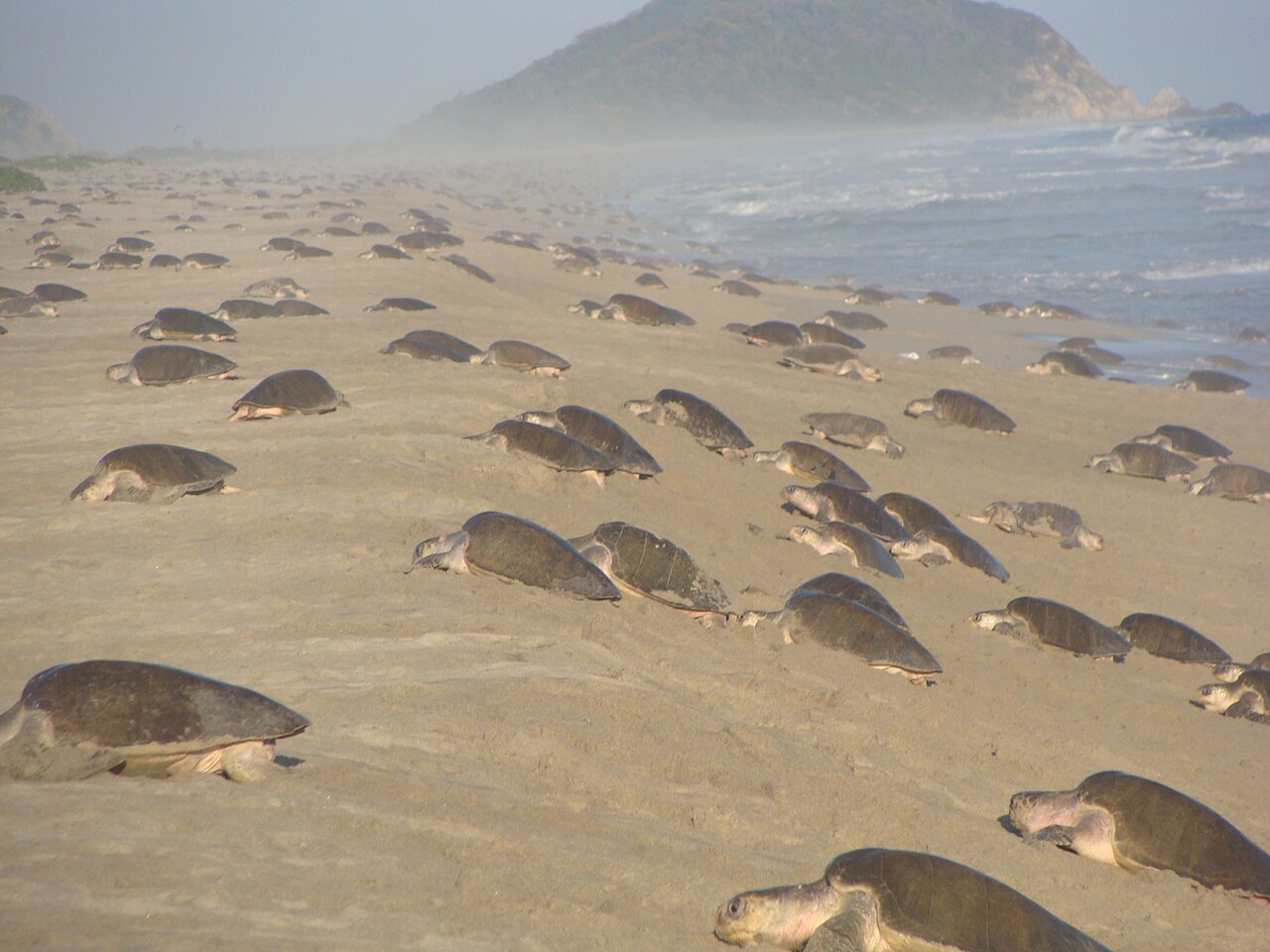
A small, ocean-roaming sea turtle famous for mass nesting events called arribadas.

Large arribada of olive ridley sea turtles nesting together on a sandy beach
Bernard Gagnon / Wikimedia Commons / CC BY-SA 3.0
๐ŸŒ Read in Language:

โšก At a Glance

Species profile
Also Known As
Olive Ridley Turtle; Pacific Ridley
Diet Category
Omnivorous marine forager with a strong invertebrate component
Activity Rhythm
Active day and night at sea; nesting females usually emerge at night, although arribadas can continue by day.
Wild Lifespan
Unknown; commonly estimated at 30โ€“50 years or more
Typical Weight
commonly 35โ€“45 kg; large adults approach 50 kg
Conservation Status
VU
๐Ÿ’ก Key Biological Insight: At a major arribada, tens of thousands of females can nest on the same beach over only a few nights.

๐ŸŒณ Scientific Taxonomy Hierarchy

Lepidochelys olivacea is a full species in Cheloniidae and one of two living ridley turtles. Its closest relative is the Kempโ€™s Ridley, Lepidochelys kempii. This profile covers Olive Ridleys across the Atlantic, Indian and Pacific oceans and does not combine the two species.

KingdomAnimalia
PhylumChordata
ClassReptilia
OrderTestudines
FamilyCheloniidae
GenusLepidochelys
SpeciesLepidochelys olivacea

Distinguishing Anatomical Features

  • โœ“Adults have a broad, nearly circular to heart-shaped shell colored olive gray or green. Most shells carry five to nine pairs of lateral scutes, often with unequal counts on opposite sides. The head is moderately triangular with two pairs of prefrontal scales. Each paddle-shaped front flipper has one or two claws. Hatchlings are charcoal gray to black.
  • โœ“Flippers power long ocean migrations
  • โœ“Streamlined shell reduces drag
  • โœ“Salt glands remove excess seawater
  • โœ“Lungs support deep breath-hold dives
  • โœ“Strong jaws crush shelled prey
  • โœ“Magnetic navigation guides migration
  • โœ“Dark hatchlings absorb warmth rapidly

๐Ÿ“ Physical Measurements

Total Lengthadult curved shell commonly 24โ€“30 in
Body Weightcommonly 77โ€“100 lb; large adults approach 110 lb
Tail LengthShort in females; long and thick in adult males
WingspanNot applicable
Top SpeedNo dependable universal maximumMovement changes with context and conditions.

๐ŸŽจ Appearance & Distinctive Markings

Olive greenGray-greenYellowish whiteDark grayBlackGrayYellowWhite

Skin / Covering: Large scales and hard keratin scutes over a bony shell

Sexual Dimorphism: Adult males have a long thick tail extending beyond the shell and enlarged curved claws used during mating. Females have a short tail and come ashore to nest; otherwise the sexes are similar in shell color and size.

๐Ÿ—บ๏ธ Geographic Distribution & Habitat

Olive Ridleys occupy tropical and subtropical waters of the Pacific, Indian and southern Atlantic oceans. Major nesting occurs along Pacific Mexico and Central America, Odisha in India, and parts of West Africa, with solitary nesting scattered across roughly forty countries. Oceanic migrants travel thousands of kilometres between breeding and feeding areas.

Open tropical ocean, continental shelf, coastal bay, estuary, reef margin, soft seafloor and sandy nesting beach.

Country-level distribution map

Native range
FijiTanzaniaWestern SaharaCanadaUnited StatesKazakhstanUzbekistanPapua New Guinea โ€” Native rangeIndonesia โ€” Native rangeArgentinaChile โ€” Native rangeCongo - KinshasaSomaliaKenyaSudanChadHaitiDominican RepublicRussiaBahamasFalkland IslandsNorwayGreenlandFrench Southern TerritoriesTimor-LesteSouth AfricaLesothoMexico โ€” Native rangeUruguayBrazil โ€” Native rangeBoliviaPeru โ€” Native rangeColombia โ€” Native rangePanama โ€” Native rangeCosta Rica โ€” Native rangeNicaragua โ€” Native rangeHondurasEl SalvadorGuatemalaBelizeVenezuelaGuyana โ€” Native rangeSuriname โ€” Native rangeFranceEcuador โ€” Native rangePuerto RicoJamaicaCubaZimbabweBotswanaNamibiaSenegalMaliMauritaniaBeninNigerNigeriaCameroonTogoGhanaCรดte dโ€™IvoireGuineaGuinea-BissauLiberiaSierra LeoneBurkina FasoCentral African RepublicCongo - BrazzavilleGabon โ€” Native rangeEquatorial GuineaZambiaMalawiMozambiqueEswatiniAngolaBurundiIsraelLebanonMadagascarPalestinian TerritoriesGambiaTunisiaAlgeriaJordanUnited Arab EmiratesQatarKuwaitIraqOmanVanuatuCambodiaThailandLaosMyanmar (Burma) โ€” Native rangeVietnamNorth KoreaSouth KoreaMongoliaIndia โ€” Native rangeBangladesh โ€” Native rangeBhutanNepalPakistanAfghanistanTajikistanKyrgyzstanTurkmenistanIranSyriaArmeniaSwedenBelarusUkrainePolandAustriaHungaryMoldovaRomaniaLithuaniaLatviaEstoniaGermanyBulgariaGreeceTรผrkiyeAlbaniaCroatiaSwitzerlandLuxembourgBelgiumNetherlandsPortugalSpainIrelandNew CaledoniaSolomon IslandsNew ZealandAustralia โ€” Native rangeSri Lanka โ€” Native rangeChinaTaiwanItalyDenmarkUnited KingdomIcelandAzerbaijanGeorgiaPhilippines โ€” Native rangeMalaysia โ€” Native rangeBruneiSloveniaFinlandSlovakiaCzechiaEritreaJapanParaguayYemenSaudi ArabiaCyprusMoroccoEgyptLibyaEthiopiaDjiboutiUgandaRwandaBosnia & HerzegovinaNorth MacedoniaSerbiaMontenegroKosovoTrinidad & TobagoSouth Sudan
Highlighted countries are recorded profile locations, not precise biological range boundaries.Map boundaries: Natural Earth

๐Ÿ’ก Did You Know?

  • ๐Ÿ’กFlippers power long ocean migrations
  • ๐Ÿ’กStreamlined shell reduces drag
  • ๐Ÿ’กSalt glands remove excess seawater
  • ๐Ÿ’กLungs support deep breath-hold dives
  • ๐Ÿ’กStrong jaws crush shelled prey
  • ๐Ÿ’กMagnetic navigation guides migration
  • ๐Ÿ’กDark hatchlings absorb warmth rapidly

๐ŸŒฟ Conservation Status & Threats

IUCN: VU โ€” Vulnerable

โ€œThe IUCN lists the Olive Ridley as Vulnerable after a large historic global reduction. Some rookeries are stable or increasing, while others have collapsed. Fisheries bycatch and direct harvest remain major threats, joined by beach loss, pollution, warming sand and severe storms.โ€

Population TrendGlobally reduced from historic abundance, with strongly different regional trends
Wild Population EstimateNo single reliable global total; major arribada beaches hold hundreds of thousands of nesting females
CITESAppendix I

โš ๏ธ Major Threats to Olive Ridley Sea Turtle

  • โ€ขFisheries bycatch
  • โ€ขEgg and adult harvest
  • โ€ขBeach development
  • โ€ขArtificial lighting
  • โ€ขPlastic and ghost gear
  • โ€ขVessel strikes
  • โ€ขWarming sand and sea-level rise

๐Ÿ”„ Life Cycle & Reproduction

Wild vs. Captivity Lifespan Comparison

๐ŸŒฟ In the WildUnknown; commonly estimated at 30โ€“50 years or more
๐Ÿ  In Captivity (with veterinary care)Kept only by permitted conservation, research and rehabilitation programs with suitable outdoor habitat.
Clutch / Litter SizeUsually about 80โ€“120 eggs
Incubation / GestationApproximately 45โ€“65 days depending on sand temperature and moisture
Fledging / WeaningHatchling shell roughly 4 cm long and weighing about 15โ€“20 g
Sexual MaturityApproximately 13โ€“30 years; NOAA cites around 14 years for some populations
Mating SystemInternal fertilization; egg-laying
Nesting / Den TypeSandy tropical beach, singly or in synchronized arribadas

๐Ÿฆ… Behavior & Field Ecology

Omnivorous marine forager with a strong invertebrate component

๐ŸŒ Ecological Food Web & Relationships: Olive Ridleys transfer energy between open ocean, coastal seabeds and nesting beaches. They consume abundant invertebrates and provide prey for sharks and killer whales. Eggs and hatchlings feed crabs, birds, mammals and fish, while unhatched eggs enrich beach vegetation. Their migrations connect ecosystems separated by entire ocean basins.

Social Group SizeMostly solitary, with overlapping neighborhoods and shared burrow associates
Activity RhythmActive day and night at sea; nesting females usually emerge at night, although arribadas can continue by day.
Feeding StrategyOmnivorous marine forager with a strong invertebrate component

๐Ÿฅฉ Primary Prey & Preferred Diet

โœ“ Crabsโœ“ Shrimpโœ“ Jellyfishโœ“ Tunicatesโœ“ Mollusksโœ“ Small fishโœ“ Algae

๐Ÿ“ข Communication & Territorial Signals

  • Magnetic navigation
  • Visual cues
  • Chemical cues
  • Water vibration
  • Tactile courtship
  • Embryonic vibration

๐Ÿพ Wild Temperament & Traits

โ€ข Wide-rangingโ€ข Marineโ€ข Strong swimmerโ€ข Usually solitary at seaโ€ข Synchronized at some rookeriesโ€ข Vulnerable on land

๐Ÿค Human Interaction & Pet Advisory

โš ๏ธ Strictly Wild Species
๐Ÿšซ

Can You Keep a Olive Ridley Sea Turtle as a Pet?

Olive Ridleys are internationally protected wildlife and cannot be kept as pets. They need an ocean-scale environment, migrate enormous distances and mature slowly. Rehabilitation requires permits, veterinary teams, large saltwater systems and release planning; healthy animals belong in the sea.

Domestication StatusWild protected species; not domesticated
Danger to HumansLow direct risk; strong jaws and flippers can injure handlers
Economic & Ecotourism RoleA wide-ranging marine consumer, nutrient carrier to nesting beaches and flagship for reducing fisheries bycatch and plastic pollution.

โš ๏ธ Behavioral Risk Factors & Wildlife Safety

  • Powerful bite can crush fingers
  • Flippers can strike at close range
  • Crowding disrupts nesting
  • Improper rescue may worsen injury
  • Handling protected wildlife may be illegal

๐ŸŒ Ecological Food Web & Relationships

๐Ÿฆ… Natural Predators (5)

Tiger SharkGaleocerdo cuvier
Killer WhaleOrcinus orca
Black VultureCoragyps atratus
Ghost CrabOcypode species
Feral DogCanis lupus familiaris

๐Ÿงฌ Related Species (4)

Kemp's Ridley Sea TurtleLepidochelys kempiiClosest living relative
Loggerhead Sea TurtleCaretta carettaHard-shelled relative
Green Sea TurtleChelonia mydasMarine turtle relative
Hawksbill Sea TurtleEretmochelys imbricataTropical marine relative

Olive Ridley Sea Turtle (Lepidochelys olivacea) is Lepidochelys olivacea, one of the smallest and most widespread sea turtles. It crosses tropical oceans, dives for crustaceans and other invertebrates, and returns to sandy coasts to reproduce. Some females nest alone, while thousands may emerge together during spectacular arribadas. This guide separates well-supported biology from common assumptions and covers identification, range, habitat, diet, behavior, reproduction and conservation.

Identification

Adults have a broad, nearly circular to heart-shaped shell colored olive gray or green. Most shells carry five to nine pairs of lateral scutes, often with unequal counts on opposite sides. The head is moderately triangular with two pairs of prefrontal scales. Each paddle-shaped front flipper has one or two claws. Hatchlings are charcoal gray to black. Adult males have a long thick tail extending beyond the shell and enlarged curved claws used during mating. Females have a short tail and come ashore to nest; otherwise the sexes are similar in shell color and size.

Identification should combine body shape, markings, size, voice or movement, and location. One feature by itself can overlap with a related animal, a juvenile, or an individual in unusual light.

Photographs are most useful when they preserve scale and show several diagnostic features. Handling or repositioning a wild olive ridley sea turtle for identification can cause stress and is unnecessary.

Size and physical adaptations

Olive Ridley Sea Turtle typically measures adult curved shell commonly 60โ€“75 cm and weighs commonly 35โ€“45 kg; large adults approach 50 kg. Olive and Kempโ€™s ridleys are the smallest living sea turtles, though size varies among ocean regions.

Its useful adaptations include flippers power long ocean migrations, streamlined shell reduces drag, salt glands remove excess seawater, lungs support deep breath-hold dives, strong jaws crush shelled prey, magnetic navigation guides migration, dark hatchlings absorb warmth rapidly. These traits work together in the animal’s normal setting rather than serving as isolated curiosities.

Published measurements may use different methods, life stages or sample locations. Comparing figures responsibly means checking what was measured rather than selecting the largest number available.

Range and distribution

Olive Ridleys occupy tropical and subtropical waters of the Pacific, Indian and southern Atlantic oceans. Major nesting occurs along Pacific Mexico and Central America, Odisha in India, and parts of West Africa, with solitary nesting scattered across roughly forty countries. Oceanic migrants travel thousands of kilometres between breeding and feeding areas. The native range includes Mexico, Costa Rica, Nicaragua, Panama, Colombia, Ecuador, Peru, Chile, Brazil, French Guiana, Suriname, Guyana, Gabon, India, Sri Lanka, Bangladesh, Myanmar, Malaysia, Indonesia, Philippines, Papua New Guinea, Australia.

A country-level map indicates broad distribution, not continuous occupation. Climate, elevation, water, vegetation, prey, breeding sites, barriers and survey effort all affect where records occur.

Records near the edge of the range deserve careful documentation because they may reflect natural movement, improved survey coverage, accidental transport or a genuine distribution change.

Habitat

Open tropical ocean, continental shelf, coastal bay, estuary, reef margin, soft seafloor and sandy nesting beach.

Most life is spent at sea, where turtles forage in surface waters and dive to the seabed. Adults move between oceanic feeding zones, productive coastal waters and breeding areas. Females require accessible sandy beaches above the tide line. Hatchlings enter currents and may remain in floating oceanic habitat before recruiting toward coastal feeding grounds. Protecting a population therefore requires the feeding, shelter and breeding features that make a site usable, along with connections that allow movement.

Microhabitat matters. Shade, soil, current, moisture, shelter or host plants can determine whether a small area is usable even when the surrounding landscape appears suitable.

Diet and feeding

Olive Ridley Sea Turtle is a omnivorous marine forager with a strong invertebrate component. Important foods include crabs, shrimp, jellyfish, tunicates, mollusks, small fish, algae. Powerful jaws crush crabs, shrimp, snails and other hard-bodied prey. Turtles also eat jellyfish, tunicates, fish eggs, small fish and algae. They forage near the surface and over soft bottoms, with documented dives to roughly 150 metres. Diet shifts with region, age and whatever productive currents make available.

Diet changes with age, season, location and food supply. A dramatic prey record does not establish what most individuals eat most of the time; repeated field observations provide a stronger picture.

Feeding opportunities also create risk. An animal focused on prey may be less alert to predators, traffic or people, while contaminated prey can transfer pollutants through the food web.

Behavior and communication

Active day and night at sea; nesting females usually emerge at night, although arribadas can continue by day. Olive Ridleys migrate between feeding and breeding areas and regularly surface to breathe. They may rest while floating or beneath ledges. Females navigate to nesting regions near where they hatched. Most nest alone, but at a few beaches changing winds, tides and lunar conditions help synchronize massive arribadas.

Adults rely on vision, smell, touch and sensitivity to water movement. Earthโ€™s magnetic field supplies map and compass information during migration. Courtship involves close swimming and tactile contact. Embryos may exchange vibration cues that help synchronize hatching, and hatchlings orient toward the bright open horizon and descending beach slope. Behavior should be interpreted in context: alarm, courtship, feeding and temperature regulation can produce very different actions from the same animal.

Daily schedules are flexible responses, not rigid rules. Weather, breeding condition, disturbance, tides or food can move activity into a different part of the day.

Reproduction and development

Adults gather near nesting coasts and mate in the water. Females crawl ashore, dig a flask-shaped chamber with their rear flippers, lay soft-shelled eggs and cover the nest. Many females nest more than once in a season. Sand temperature affects development rate and hatchling sex. Arribadas occur only at a small number of beaches. Usually about 80โ€“120 eggs Hatchlings work upward together, usually emerge during cooler darkness and race toward the sea. Birds, crabs and fish take many. Survivors spend juvenile years in oceanic and coastal habitats before joining adult migrations. They receive no parental care and mature only after many years.

Young animals face different risks and may use different microhabitats or food than adults. Breeding success depends on adult condition, suitable sites and the survival of offspring through vulnerable early stages.

Counts of eggs or young describe reproductive output, not the number expected to reach adulthood. Mortality is normally greatest during eggs, larval or juvenile stages.

Predators and ecological role

Olive Ridleys transfer energy between open ocean, coastal seabeds and nesting beaches. They consume abundant invertebrates and provide prey for sharks and killer whales. Eggs and hatchlings feed crabs, birds, mammals and fish, while unhatched eggs enrich beach vegetation. Their migrations connect ecosystems separated by entire ocean basins. Documented or likely predators include Tiger Shark, Killer Whale, Black Vulture, Ghost Crab, Feral Dog.

This animal is both a consumer and a food source. Its influence comes through many repeated interactions, so ecological claims should be based on measured populations rather than assumptions drawn from appearance.

Predator and prey relationships differ among places. A species can be ecologically influential without being abundant everywhere, and its role can change across its range.

Relationship with people

Coastal communities and conservation teams protect nests, manage arribada beaches and release hatchlings under regulated programs. Fisheries reduce bycatch with turtle excluder devices, circle hooks and time-area closures. Beach lighting, vehicles, plastics and unmanaged tourism can disrupt nesting. People should keep distance, use red-filtered light only where authorized and report stranded turtles.

The turtle is not aggressive, but a stressed adult has strong jaws and flippers. Never ride, restrain or crowd a nesting female, and do not push a stranded turtle back to sea without professional direction. At sea, slow vessels near turtles and remove fishing line only when trained responders advise it. Responsible observation means keeping an appropriate distance, avoiding capture or feeding, protecting habitat and following local wildlife or invasive-species guidance.

Wildlife guidance should come from the responsible local agency because collection rules, reporting requests and appropriate responses differ between native and introduced ranges.

Conservation

The IUCN lists the Olive Ridley as Vulnerable after a large historic global reduction. Some rookeries are stable or increasing, while others have collapsed. Fisheries bycatch and direct harvest remain major threats, joined by beach loss, pollution, warming sand and severe storms. The reported global trend is Globally reduced from historic abundance, with strongly different regional trends.

Important pressures include fisheries bycatch, egg and adult harvest, beach development, artificial lighting, plastic and ghost gear, vessel strikes, warming sand and sea-level rise. Global status can hide local decline or recovery, so current regional monitoring and habitat management remain necessary.

The most useful conservation action follows the documented pressure. Protecting breeding sites, reducing road deaths or limiting pollutants can require different tools in different populations.

Sources and further reading

โ“ Frequently Asked Questions

Answers to frequently asked questions verified against peer-reviewed zoological research.

It covers Lepidochelys olivacea, the widely distributed tropical sea turtle also called the Pacific ridley.