
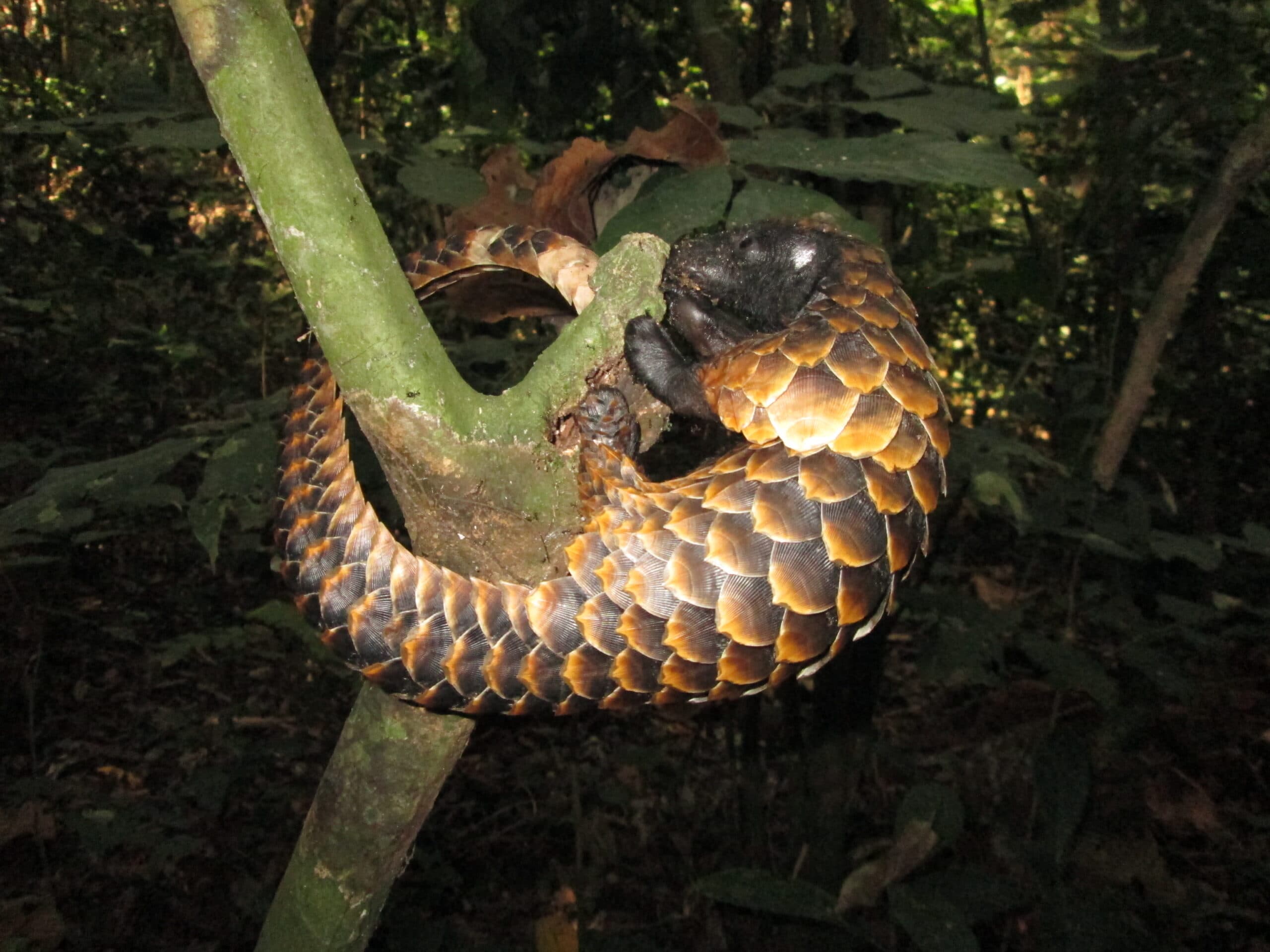
Pangolin (Manidae) is the common name for eight living species in the mammal family Manidae and order Pholidota. Four live in Africa and four in Asia. All share scales, powerful digging claws and a long sticky tongue, but body size, tail form, climbing ability, range and Red List category are species-specific. This guide separates well-supported biology from common assumptions and covers identification, range, habitat, diet, behavior, reproduction and conservation.
Identification
Pangolins are toothless mammals with overlapping hard scales covering most of the head, back, flanks, limbs and tail. The underside and parts of the face carry sparse hair rather than scales. A narrow head, very long protrusible tongue, stout claws and tapering tail reflect ant-and-termite feeding. Species are separated using range, tail-to-body proportions, scale pattern, ear structures, foot shape and whether bristles grow between scales. Males are often larger than females, but the size difference and external clues differ among species. Sex should not be guessed from size alone.
Identification should combine body shape, markings, size, voice or movement, and location. One feature by itself can overlap with a related animal, a juvenile, or an individual in unusual light.
Photographs are most useful when they preserve scale and show several diagnostic features. Handling or repositioning a wild pangolin for identification can cause stress and is unnecessary.
Size and physical adaptations
Pangolin typically measures roughly 60–145 cm total length across living species and weighs about 1.5–35 kg across species and adults. These family-level endpoints combine small tree pangolins with giant ground pangolins; each species occupies a narrower range.
Its useful adaptations include overlapping keratin scales armor the upper body, the body curls into a tight defensive ball, a long sticky tongue collects social insects, large claws break open nests and excavate burrows, thick eyelids help protect against biting insects, muscular tails support climbing in arboreal species. These traits work together in the animal’s normal setting rather than serving as isolated curiosities.
Published measurements may use different methods, life stages or sample locations. Comparing figures responsibly means checking what was measured rather than selecting the largest number available.
Range and distribution
The family occurs naturally in sub-Saharan Africa and across parts of South and Southeast Asia. African and Asian species do not overlap naturally, and each of the eight species has its own country list and habitat limits. The map therefore represents the combined family range. The native range includes Sub-Saharan Africa, South Asia, Southern China, Mainland Southeast Asia, The Sunda Islands, Palawan in the Philippines.
A country-level map indicates broad distribution, not continuous occupation. Climate, elevation, water, vegetation, prey, breeding sites, barriers and survey effort all affect where records occur.
Records near the edge of the range deserve careful documentation because they may reflect natural movement, improved survey coverage, accidental transport or a genuine distribution change.
Habitat
Tropical forest, woodland, savanna, grassland, scrub, plantations and other landscapes with adequate ant or termite prey and secure shelter.
Ground species dig burrows or use existing refuges, while tree pangolins rest in hollows and climb with grasping feet and tails. Even adaptable species need prey-rich soil or vegetation and protection from hunting. Habitat descriptions cannot substitute for species-level range maps because forest, savanna and dry-country pangolins use very different microhabitats. Protecting a population therefore requires the feeding, shelter and breeding features that make a site usable, along with connections that allow movement.
Microhabitat matters. Shade, soil, current, moisture, shelter or host plants can determine whether a small area is usable even when the surrounding landscape appears suitable.
Diet and feeding
Pangolin is a specialized insectivore focused on ants and termites. Important foods include ant workers and brood, termites, occasional other small invertebrates encountered in nests. A pangolin locates colonies mainly by smell, tears into soil, wood or mounds with its foreclaws, and rapidly flicks a sticky tongue through galleries. It has no teeth. Swallowed grit and keratinized structures in the muscular stomach help grind prey. A meal may target particular insect species and castes rather than every ant or termite available.
Diet changes with age, season, location and food supply. A dramatic prey record does not establish what most individuals eat most of the time; repeated field observations provide a stronger picture.
Feeding opportunities also create risk. An animal focused on prey may be less alert to predators, traffic or people, while contaminated prey can transfer pollutants through the food web.
Behavior and communication
Mostly nocturnal and solitary, although black-bellied pangolins may also be active by day. A threatened pangolin may tuck its head beneath the tail and curl into an armored ball. This discourages many natural predators but makes capture by people easy. Individuals walk on the outer edges of the forefeet to protect digging claws, scent-mark routes and shelters, and may climb or swim according to species.
Chemical signals from scent glands, urine and feces convey identity and reproductive condition. Smell guides foraging, while touch and body posture matter at close range. Pangolins are generally quiet and do not maintain social groups through loud calls. Behavior should be interpreted in context: alarm, courtship, feeding and temperature regulation can produce very different actions from the same animal.
Daily schedules are flexible responses, not rigid rules. Weather, breeding condition, disturbance, tides or food can move activity into a different part of the day.
Reproduction and development
Pangolin reproductive biology is incompletely documented in the wild. After internal fertilization, a female gives birth to a well-developed young animal, usually one. The newborn has soft scales that harden, remains in a shelter early on, and later rides on the mother while she forages. Usually one young; occasional twins are reported in some species A newborn pangolin nurses and depends on its mother for protection. As mobility improves it clings to her back or tail. Young learn foraging routes and shelter use before independence; the timing of weaning and dispersal must be reported for the relevant species.
Young animals face different risks and may use different microhabitats or food than adults. Breeding success depends on adult condition, suitable sites and the survival of offspring through vulnerable early stages.
Counts of eggs or young describe reproductive output, not the number expected to reach adulthood. Mortality is normally greatest during eggs, larval or juvenile stages.
Predators and ecological role
By excavating ant and termite colonies, pangolins influence insect populations and turn soil. Their abandoned burrows may shelter other animals, and digging redistributes organic material. They are prey for large cats, hyenas, pythons and crocodiles, although curled scales protect against many attacks. Documented or likely predators include Leopards, Lions, Spotted Hyenas, Pythons, Humans.
This animal is both a consumer and a food source. Its influence comes through many repeated interactions, so ecological claims should be based on measured populations rather than assumptions drawn from appearance.
Predator and prey relationships differ among places. A species can be ecologically influential without being abundant everywhere, and its role can change across its range.
Relationship with people
Pangolins are hunted for meat and scales and trafficked across borders despite strong legal protection. Keratin scales have no proven medical property beyond ordinary keratin. Never buy pangolin products, share precise locations of wild animals publicly, or attempt a rescue without wildlife authorities because mishandling can injure the animal and compromise an investigation.
Pangolins do not have teeth and rarely threaten people. Their claws are strong, but the main concern in an encounter is protecting the animal and contacting the responsible wildlife agency. A stressed pangolin should not be uncurled, fed or transported by an untrained person. Responsible observation means keeping an appropriate distance, avoiding capture or feeding, protecting habitat and following local wildlife or invasive-species guidance.
Wildlife guidance should come from the responsible local agency because collection rules, reporting requests and appropriate responses differ between native and introduced ranges.
Conservation
Manidae is not assigned one IUCN category. The IUCN SSC Pangolin Specialist Group reports that the eight species are individually categorized as Vulnerable, Endangered or Critically Endangered. A family page must preserve those differences instead of applying one status to every pangolin. The reported global trend is Declining across all eight species according to current species assessments.
Important pressures include illegal hunting for meat and scales, international wildlife trafficking, local subsistence use, habitat loss and fragmentation, road mortality and electric fencing, weak enforcement and limited monitoring. Global status can hide local decline or recovery, so current regional monitoring and habitat management remain necessary.
The most useful conservation action follows the documented pressure. Protecting breeding sites, reducing road deaths or limiting pollutants can require different tools in different populations.
Sources and further reading
- IUCN SSC Pangolin Specialist Group: The eight species
- IUCN SSC Pangolin Specialist Group: Pangolins and threats
- CITES Animals Committee: Listing of pangolins in the Appendices
- Smithsonian Q?rius: Pangolin feeding adaptations
- Smithsonian: Pangolin genetics and scales
- Wikimedia Commons image and license record
