
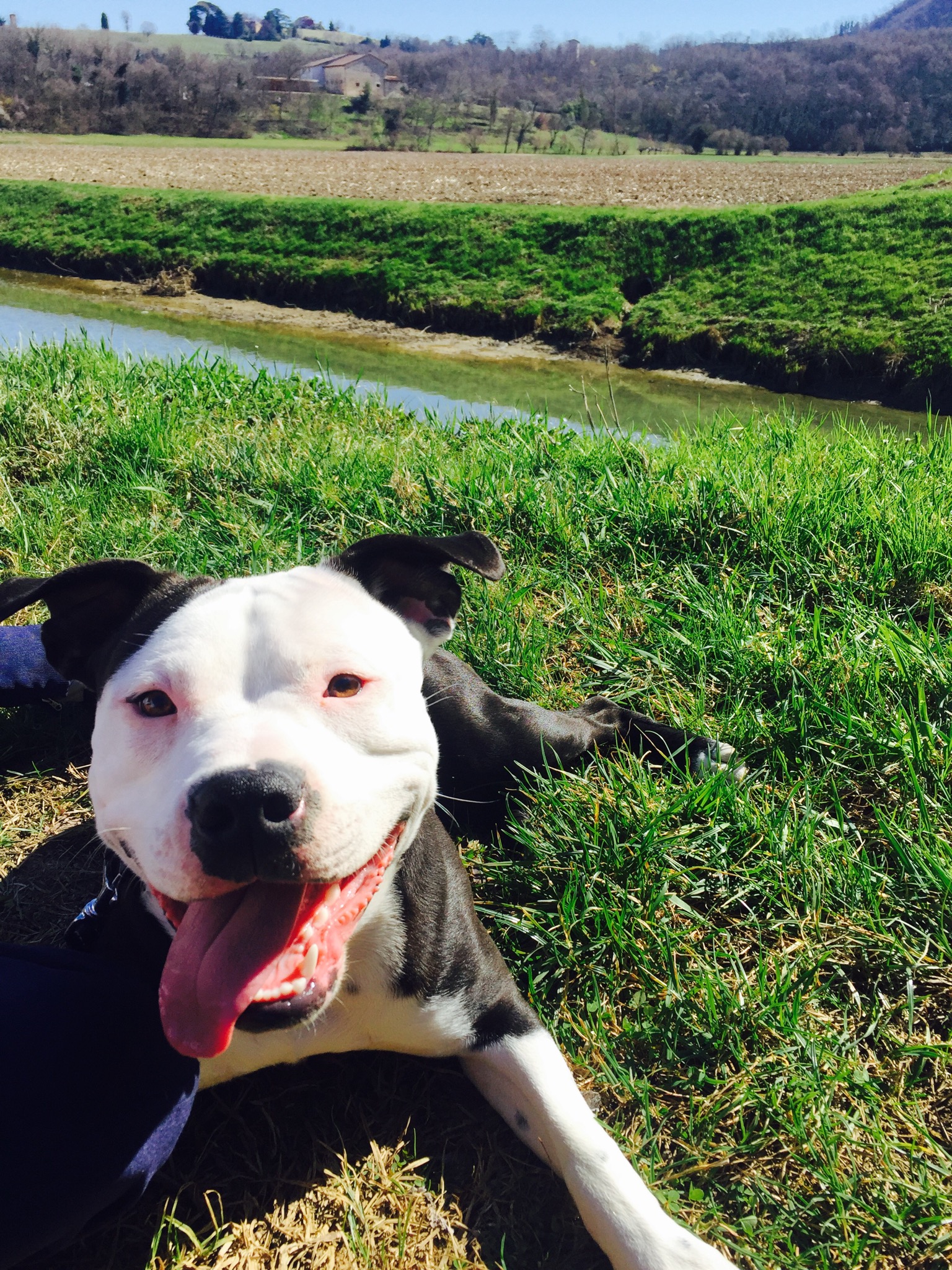
Pibble is an affectionate nickname for a pit bull or pit bull-type dog. It is not a scientific name, a kennel-club breed or a precise genetic category. People use the word warmly for American Pit Bull Terriers, American Staffordshire Terriers, Staffordshire Bull Terriers, mixes with similar ancestry and sometimes unrelated dogs with a broad-headed, muscular appearance.
That flexibility is the most important fact about the term. A “pibble” may be a registered American Pit Bull Terrier, a different recognized breed, a mixed-breed dog or simply a dog whose owner likes the nickname. Size, ancestry, health and behavior must be described for the individual dog rather than assigned from the nickname alone.
What does pibble mean?
“Pibble” is a playful alteration of “pit bull.” Its use became popular among owners and advocates who wanted a friendly, affectionate label for dogs that often face negative stereotypes. The word has social meaning, but it does not replace a pedigree, DNA result or veterinary assessment.
“Pit bull” itself has more than one meaning. In a narrow registry context it can mean the American Pit Bull Terrier, a breed recognized by the United Kennel Club. In shelters, housing rules and local laws it may be used as an umbrella label for several breeds and mixes. The exact definition can change from one organization or jurisdiction to another.
Which dogs are called pit bull-type dogs?
The American Pit Bull Terrier is a defined breed in the United Kennel Club, which first registered the breed in 1898. The American Kennel Club does not register dogs under that breed name. It recognizes the related American Staffordshire Terrier and Staffordshire Bull Terrier as separate breeds.
Some broad “pit bull-type” definitions include those three breeds. Others also include the American Bully or dogs believed to be crosses. These categories are not interchangeable, and registry standards differ. A responsible profile names the dog’s documented breed when known and uses “type” or “mix” when ancestry is uncertain.
Can appearance identify a pibble?
Muscular build, a short coat, a broad head and a deep chest are commonly associated with pit bull-type dogs. Those features occur in many breeds and mixes, so appearance alone cannot prove ancestry.
A 2015 study compared visual labels assigned by shelter staff with commercial DNA breed signatures. Agreement between observers was only moderate, and visual identification did not consistently match the DNA results. A larger study of shelter dogs also found that mixed ancestry was complex and that identifying multiple breeds by appearance was difficult.
DNA tests can add information, but products differ in reference data and method. Pedigree records from a recognized registry provide a different kind of evidence. For daily care, a dog’s measured size, health history and observed behavior are often more useful than a guessed label.
Appearance and size
No single pibble standard exists. Registered American Pit Bull Terriers are medium-sized, short-coated and athletic, but pit bull-type dogs in homes and shelters range from compact Staffordshire Bull Terriers to taller American Staffordshire Terriers and mixed dogs of many sizes.
Coats can be black, white, brown, red, fawn, blue-gray, brindle or patterned. Ear shape varies naturally and may also reflect cropping. Tails are usually muscular and tapering. Weight should be recorded for the individual instead of inferred from a photograph or nickname.
Temperament and behavior
A nickname cannot predict temperament. Genetics, early development, socialization, learning, health, housing and previous experiences all influence how a dog behaves. The ASPCA recommends evaluating dogs as individuals and notes substantial behavioral variation within every breed or breed type.
Some dogs are social with other dogs, while others need careful distance and structured introductions. Comfort with people also differs between individuals. A responsible owner watches body language, prevents uncontrolled encounters and seeks qualified help for fear, reactivity or aggression.
Claims that every pit bull-type dog is inherently dangerous are inaccurate. Claims that every one is automatically safe are also poor guidance. Any strong dog can cause injury, so humane training, secure handling and supervision matter.
Exercise, training and daily care
Many pit bull-type dogs are energetic and benefit from daily walks, play, scent games and reward-based training. The right amount depends on age, body condition, health and individual drive. Puppies need controlled activity that protects developing joints; older dogs may need shorter, gentler sessions.
Positive reinforcement builds useful skills without intimidation. Important behaviors include coming when called, walking on a loose leash, settling on a mat, releasing objects and remaining comfortable with routine handling. Socialization should create safe, positive experiences rather than forcing a puppy into overwhelming contact.
Short coats are usually easy to groom but provide limited protection from severe cold or heat. Routine veterinary care should include vaccination, parasite prevention, dental care, weight monitoring and spaying or neutering decisions discussed for the individual dog.
Health considerations
Health risks depend on actual ancestry. Conditions seen in one related breed cannot automatically be assigned to every dog called a pibble. Hip and elbow disease, cruciate ligament injury, skin allergies, heart disease and certain inherited disorders may occur in parts of the broader population.
A veterinarian can base screening on documented breed, family history, physical findings and DNA information when useful. Responsible breeders test breeding dogs for conditions recommended for their breed and make results available. Mixed-breed dogs still need preventive care and are not automatically free of inherited disease.
History of pit bull-type dogs
Modern bull-and-terrier breeds developed from British dogs that combined bulldog strength with terrier agility. Their history included bull baiting and dog fighting, both cruel activities, as well as farm work, hunting, livestock handling and companionship. Immigrants brought these dogs to North America, where lines developed under different registries.
The AKC recognized the Staffordshire Terrier in 1936 and renamed it the American Staffordshire Terrier in 1972 to distinguish it from the Staffordshire Bull Terrier. The UKC maintained the American Pit Bull Terrier name. This registry history explains why related dogs can have overlapping ancestry but different formal breed identities.
Housing, insurance and local law
Rules concerning pit bull-type dogs change by country, state, municipality, landlord and insurer. Some rules name specific breeds; others rely on appearance-based definitions that can be difficult to apply. Owners should check current local requirements before moving, adopting or traveling.
Identification affects real outcomes. Research shows that a pit bull-type label can influence shelter adoption and length of stay. Clear descriptions of an individual dog’s size, health, training and behavior give adopters more useful information than an uncertain breed guess.
Responsible ownership and adoption
Meet the individual dog more than once when possible. Ask for veterinary records, behavior observations and known history. A shelter or foster carer should explain how the dog responds to handling, strangers, other animals, alone time and common household situations.
Use secure fencing, an appropriate leash and collar or harness, identification and a microchip. Prevent roaming and supervise interactions with children and animals. Choose a qualified reward-based trainer or veterinary behavior professional when extra support is needed.