
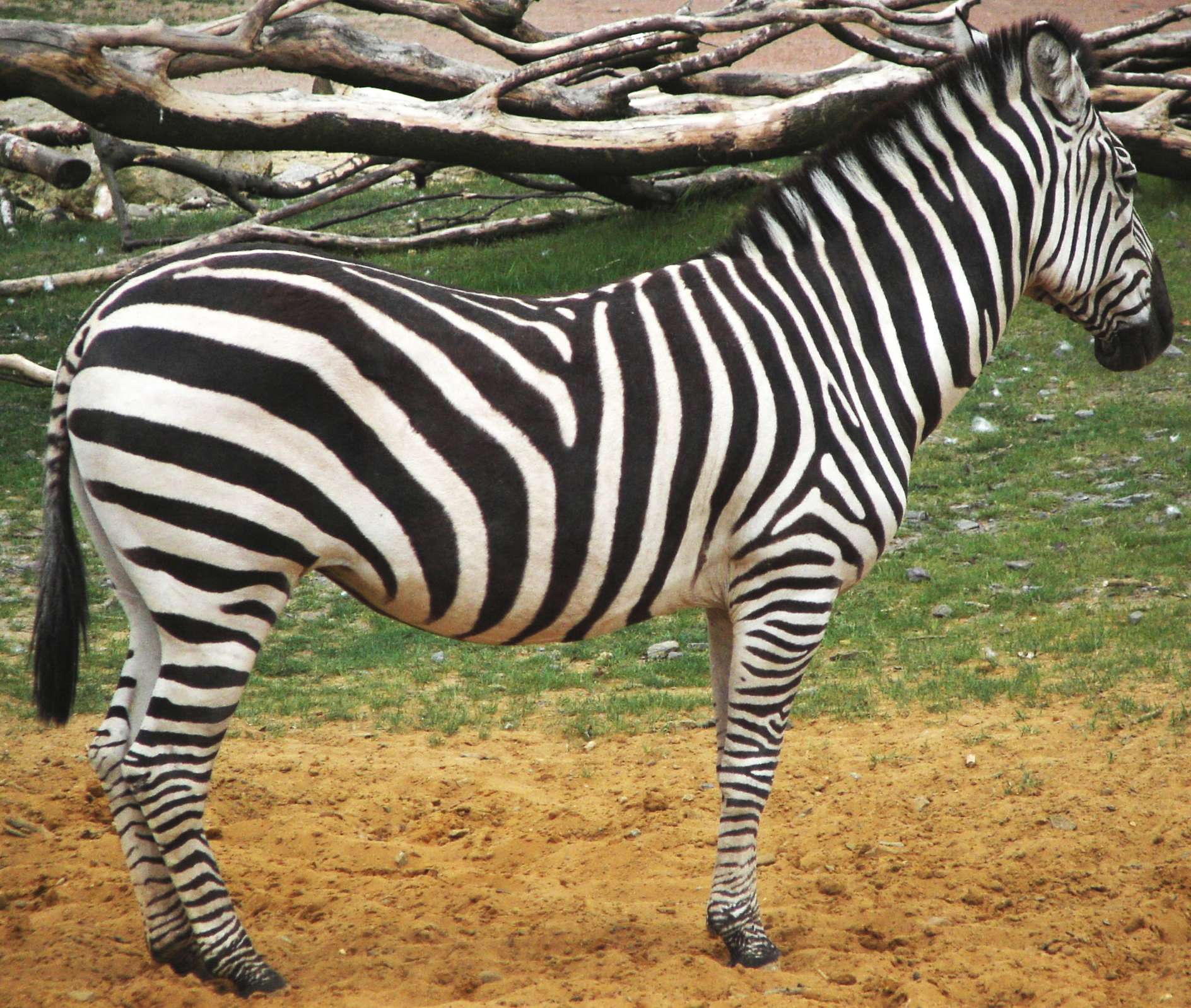
Plains Zebra (Equus quagga) is the most numerous and widely distributed living zebra species. Its bold stripes, upright mane and horse-like build are unmistakable, but every animal carries an individual pattern. Plains Zebras maintain close family bonds, travel to water and fresh pasture, and often mix with wildebeest and other grazers in eastern and southern Africa. This guide separates well-supported biology from common assumptions and covers identification, range, habitat, diet, behavior, reproduction and conservation.
Identification
Plains Zebras have black-and-white vertical stripes over the head, neck and body, horizontal or angled stripes on the rump and legs, an erect mane and a dark muzzle. Stripe width and shadow striping vary geographically, and some southern animals have paler legs. The belly is usually light. Compared with Grevy’s Zebra, the Plains Zebra has broader stripes, smaller rounder ears and a less uniformly white belly. Males and females overlap strongly in size and appearance; stallions tend to have thicker necks and may be slightly heavier.
Identification should combine body shape, markings, size, voice or movement, and location. One feature by itself can overlap with a related animal, a juvenile, or an individual in unusual light.
Photographs are most useful when they preserve scale and show several diagnostic features. Handling or repositioning a wild plains zebra for identification can cause stress and is unnecessary.
Size and physical adaptations
Plains Zebra typically measures About 2–2.6 m head and body and weighs About 175–385 kg. Size and stripe pattern vary among subspecies and regions.
Its useful adaptations include high-crowned teeth crop abrasive grasses, hindgut fermentation processes large quantities of coarse forage, long legs support efficient travel between pasture and water, powerful kicks deter predators, wide field of vision detects approaching danger, mobile ears track sounds independently, social vigilance spreads predator detection, distinct stripe patterns aid individual recognition. These traits work together in the animal’s normal setting rather than serving as isolated curiosities.
Published measurements may use different methods, life stages or sample locations. Comparing figures responsibly means checking what was measured rather than selecting the largest number available.
Range and distribution
Patchily distributed from parts of southern Ethiopia and South Sudan through East Africa to Angola, Namibia, Botswana and northeastern South Africa. Major strongholds include Serengeti–Mara, Etosha and other protected savanna systems. Historical range has contracted through parts of southern and eastern Africa. The native range includes Ethiopia, South Sudan, Kenya, Uganda, Tanzania, Rwanda, Burundi, Democratic Republic of the Congo, Zambia, Malawi, Mozambique, Zimbabwe, Botswana, Namibia, South Africa, Angola.
A country-level map indicates broad distribution, not continuous occupation. Climate, elevation, water, vegetation, prey, breeding sites, barriers and survey effort all affect where records occur.
Records near the edge of the range deserve careful documentation because they may reflect natural movement, improved survey coverage, accidental transport or a genuine distribution change.
Habitat
Tropical and subtropical grassland, wooded savanna, open woodland and seasonal floodplain near accessible water.
Plains Zebras favor landscapes with abundant grass and usually drink daily, though timing varies with season. They graze tall or coarse growth that smaller selective grazers may avoid, then move as forage dries. Some populations remain in stable home ranges; others migrate hundreds of kilometers following rain, surface water and new grass. Protecting a population therefore requires the feeding, shelter and breeding features that make a site usable, along with connections that allow movement.
Microhabitat matters. Shade, soil, current, moisture, shelter or host plants can determine whether a small area is usable even when the surrounding landscape appears suitable.
Diet and feeding
Plains Zebra is a herbivore. Important foods include tall grasses, short grasses, grass stems, grass leaves, occasional herbs, occasional browse. Plains Zebras are bulk grazers. Incisors crop grass close to the ground, while high-crowned cheek teeth grind silica-rich blades. Hindgut fermentation is less efficient per mouthful than ruminant digestion but lets zebras process large volumes quickly. They can therefore open tall pasture for wildebeest and gazelles that prefer shorter, higher-quality regrowth.
Diet changes with age, season, location and food supply. A dramatic prey record does not establish what most individuals eat most of the time; repeated field observations provide a stronger picture.
Feeding opportunities also create risk. An animal focused on prey may be less alert to predators, traffic or people, while contaminated prey can transfer pollutants through the food web.
Behavior and communication
Feeds by day and night, resting intermittently and traveling regularly to water. The core social unit is usually one stallion, several mares and their young. Family bonds can persist for years, with mares maintaining a hierarchy and the stallion guarding the group. Bachelor males form separate groups before acquiring mares. Multiple families aggregate into herds and migrations without losing their identity. Mutual grooming strengthens bonds and removes parasites.
Plains Zebras use barking or braying calls, snorts, squeals and soft contact sounds. Ear position, head carriage, open mouth and tail movement reveal attention or aggression. Family members identify one another by voice, odor and stripe pattern. Grooming and nose contact reinforce relationships, while stallions use threats, bites and kicks during contests. Behavior should be interpreted in context: alarm, courtship, feeding and temperature regulation can produce very different actions from the same animal.
Daily schedules are flexible responses, not rigid rules. Weather, breeding condition, disturbance, tides or food can move activity into a different part of the day.
Reproduction and development
Breeding can occur throughout the year, often peaking with favorable rains and forage. A stallion herds and mates with females in his family band. Mares normally produce a single foal after about one year and may remain with the same social group across multiple births. Usually one foal; twins are very rare A foal stands within minutes to an hour and soon follows its mother. During the first days, the mare keeps other zebras at a distance while the foal learns her stripe pattern, voice and smell. Foals begin nibbling grass early but nurse for many months. Young females may stay or transfer to another band; young males eventually join bachelor groups.
Young animals face different risks and may use different microhabitats or food than adults. Breeding success depends on adult condition, suitable sites and the survival of offspring through vulnerable early stages.
Counts of eggs or young describe reproductive output, not the number expected to reach adulthood. Mortality is normally greatest during eggs, larval or juvenile stages.
Predators and ecological role
Plains Zebras influence grass height, nutrient cycling and access to forage for other herbivores. Their dung feeds insects and returns nutrients to soil. They are major prey for lions and also support hyenas, wild dogs and crocodiles. Mixed herds can combine zebra eyesight and hearing with the senses and feeding strategies of wildebeest and antelope. Documented or likely predators include African Lion, Spotted Hyena, African Wild Dog, Nile Crocodile.
This animal is both a consumer and a food source. Its influence comes through many repeated interactions, so ecological claims should be based on measured populations rather than assumptions drawn from appearance.
Predator and prey relationships differ among places. A species can be ecologically influential without being abundant everywhere, and its role can change across its range.
Relationship with people
Plains Zebras support tourism and are culturally prominent symbols of African wildlife. Ranching, fencing, agriculture and settlement can block migrations or reduce water access, while hunting supplies meat and skins. Protected areas and connected community lands are essential because seasonal herds often cross administrative boundaries.
Plains Zebras are powerful wild equids. They can bite, kick and charge, especially when cornered, handled or protecting foals. Remain inside vehicles where required, keep the distance set by guides and parks, never feed or attempt to ride a zebra, and do not block a herd’s route to water. Responsible observation means keeping an appropriate distance, avoiding capture or feeding, protecting habitat and following local wildlife or invasive-species guidance.
Wildlife guidance should come from the responsible local agency because collection rules, reporting requests and appropriate responses differ between native and introduced ranges.
Conservation
The IUCN currently lists the Plains Zebra as Near Threatened. It remains widespread and abundant in major strongholds, but many populations face habitat loss, hunting, livestock competition, water restriction and fencing. The extinction of the quagga subspecies shows that common animals can be lost under sustained pressure. The reported global trend is Decreasing overall, with stable or recovering populations in some protected landscapes.
Important pressures include habitat conversion, hunting for meat and skins, livestock competition, fences blocking movement, drought and water loss, disease transmission from livestock. Global status can hide local decline or recovery, so current regional monitoring and habitat management remain necessary.
The most useful conservation action follows the documented pressure. Protecting breeding sites, reducing road deaths or limiting pollutants can require different tools in different populations.