
Species profileIUCN: NT

Platypus

Ornithorhynchus anatinus

An egg-laying freshwater mammal that hunts with electrical sensors and carries venomous ankle spurs in males.

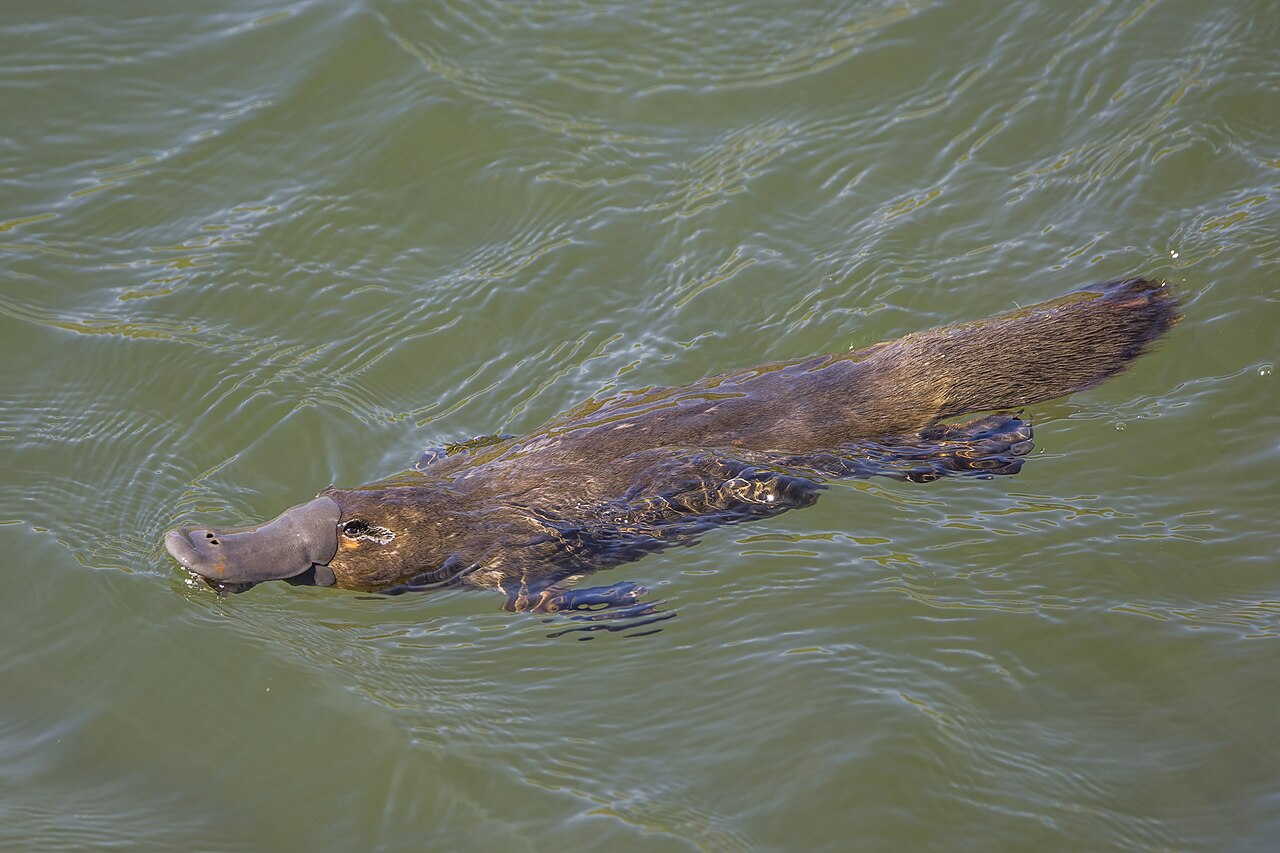
Wild platypus swimming at the surface in Tasmania, showing its broad bill and waterproof brown fur
Charles J. Sharp / Wikimedia Commons / CC BY-SA 4.0
๐ŸŒ Read in Language:

โšก At a Glance

Species profile
Diet Category
Carnivore specializing in freshwater invertebrates
Activity Rhythm
Mostly nocturnal and crepuscular, with daytime foraging common in cool weather or quiet habitat.
Wild Lifespan
Often 10โ€“15 years in the wild; records exceed 20 years
Typical Weight
about 0.7โ€“2.5 kg
Conservation Status
NT
๐Ÿ’ก Key Biological Insight: A submerged platypus closes its eyes, ears and nostrils and builds a sensory picture of prey almost entirely from touch and weak electrical signals detected by its bill.

๐ŸŒณ Scientific Taxonomy Hierarchy

The platypus is the only living species in family Ornithorhynchidae and one of five living monotremes, the mammal lineage that lays eggs. Its combination of inherited mammalian traits and highly specialized aquatic features does not make it a mixture of unrelated animals.

KingdomAnimalia
PhylumChordata
ClassMammalia
OrderMonotremata
FamilyOrnithorhynchidae
GenusOrnithorhynchus
SpeciesOrnithorhynchus anatinus

Distinguishing Anatomical Features

  • โœ“A streamlined low-bodied mammal with dense dark brown fur, pale belly, broad flexible bill, small eyes, webbed feet and a wide flattened tail. The bill is soft sensory skin rather than a hard duck beak. Males carry a movable spur on each hind ankle.
  • โœ“Electroreceptors detect prey muscle currents
  • โœ“Pressure receptors track water movement
  • โœ“Webbed forefeet power swimming
  • โœ“Dense double fur traps insulating air
  • โœ“Tail stores fat
  • โœ“Eyes, ears and nostrils close underwater
  • โœ“Male ankle spurs deliver venom

๐Ÿ“ Physical Measurements

Total Lengthabout 15โ€“24 in including tail
Body Weightabout 1.5โ€“5.5 lb
Tail LengthBroad, flat, furred and used for fat storage
WingspanNot applicable
Top SpeedNo dependable universal maximumMovement changes with context and conditions.

๐ŸŽจ Appearance & Distinctive Markings

Dark brownReddish brownSilver brown underside

Skin / Covering: Exceptionally dense waterproof fur

Sexual Dimorphism: Males are usually larger than females and possess venom-delivering ankle spurs; females lack functional spurs and produce milk from mammary patches without nipples.

๐Ÿ—บ๏ธ Geographic Distribution & Habitat

Freshwater catchments of eastern Australia from tropical Queensland through New South Wales and Victoria to Tasmania, with a small introduced population on Kangaroo Island.

Rivers, creeks, lakes and connected pools with reliable prey, stable earthen banks, roots or vegetation for burrows and enough water depth for diving.

Country-level distribution map

Native range
FijiTanzaniaWestern SaharaCanadaUnited StatesKazakhstanUzbekistanPapua New GuineaIndonesiaArgentinaChileCongo - KinshasaSomaliaKenyaSudanChadHaitiDominican RepublicRussiaBahamasFalkland IslandsNorwayGreenlandFrench Southern TerritoriesTimor-LesteSouth AfricaLesothoMexicoUruguayBrazilBoliviaPeruColombiaPanamaCosta RicaNicaraguaHondurasEl SalvadorGuatemalaBelizeVenezuelaGuyanaSurinameFranceEcuadorPuerto RicoJamaicaCubaZimbabweBotswanaNamibiaSenegalMaliMauritaniaBeninNigerNigeriaCameroonTogoGhanaCรดte dโ€™IvoireGuineaGuinea-BissauLiberiaSierra LeoneBurkina FasoCentral African RepublicCongo - BrazzavilleGabonEquatorial GuineaZambiaMalawiMozambiqueEswatiniAngolaBurundiIsraelLebanonMadagascarPalestinian TerritoriesGambiaTunisiaAlgeriaJordanUnited Arab EmiratesQatarKuwaitIraqOmanVanuatuCambodiaThailandLaosMyanmar (Burma)VietnamNorth KoreaSouth KoreaMongoliaIndiaBangladeshBhutanNepalPakistanAfghanistanTajikistanKyrgyzstanTurkmenistanIranSyriaArmeniaSwedenBelarusUkrainePolandAustriaHungaryMoldovaRomaniaLithuaniaLatviaEstoniaGermanyBulgariaGreeceTรผrkiyeAlbaniaCroatiaSwitzerlandLuxembourgBelgiumNetherlandsPortugalSpainIrelandNew CaledoniaSolomon IslandsNew ZealandAustralia โ€” Native rangeSri LankaChinaTaiwanItalyDenmarkUnited KingdomIcelandAzerbaijanGeorgiaPhilippinesMalaysiaBruneiSloveniaFinlandSlovakiaCzechiaEritreaJapanParaguayYemenSaudi ArabiaCyprusMoroccoEgyptLibyaEthiopiaDjiboutiUgandaRwandaBosnia & HerzegovinaNorth MacedoniaSerbiaMontenegroKosovoTrinidad & TobagoSouth Sudan
Highlighted countries are recorded profile locations, not precise biological range boundaries.Map boundaries: Natural Earth

Recorded Native Countries & Territories:

๐Ÿ’ก Did You Know?

  • ๐Ÿ’กElectroreceptors detect prey muscle currents
  • ๐Ÿ’กPressure receptors track water movement
  • ๐Ÿ’กWebbed forefeet power swimming
  • ๐Ÿ’กDense double fur traps insulating air
  • ๐Ÿ’กTail stores fat
  • ๐Ÿ’กEyes, ears and nostrils close underwater
  • ๐Ÿ’กMale ankle spurs deliver venom

๐ŸŒฟ Conservation Status & Threats

IUCN: NT โ€” Near Threatened

โ€œListed globally as Near Threatened. Declines are linked to river regulation, drought, habitat degradation, entanglement and climate change, although status and legal listing differ among Australian jurisdictions.โ€

Population Trend๐Ÿ“‰ Decreasing
Wild Population EstimateNo precise national total exists because platypuses are difficult to survey and abundance varies greatly among catchments.

โš ๏ธ Major Threats to Platypus

  • โ€ขDams and water extraction
  • โ€ขDrought and climate change
  • โ€ขBank clearing and erosion
  • โ€ขEnclosed fishing traps
  • โ€ขFishing-line entanglement
  • โ€ขPollution
  • โ€ขFragmented river habitat

๐Ÿ”„ Life Cycle & Reproduction

Wild vs. Captivity Lifespan Comparison

๐ŸŒฟ In the WildOften 10โ€“15 years in the wild; records exceed 20 years
๐Ÿ  In Captivity (with veterinary care)Can differ under managed care.
Clutch / Litter SizeUsually two eggs, sometimes one or three
Incubation / GestationAbout 6โ€“10 days after eggs are laid
Fledging / WeaningNewly hatched young are naked, blind and tiny. Milk oozes from mammary ducts onto abdominal skin and fur for them to lap because the mother has no nipples. They remain in the burrow for roughly three to four months before entering water.
Sexual MaturityOften around two years, though many females first breed later
Mating SystemSeasonal and polygynous
Nesting / Den TypeLong plugged burrow in a stable riverbank

๐Ÿฆ… Behavior & Field Ecology

Carnivore specializing in freshwater invertebrates

๐ŸŒ Ecological Food Web & Relationships: Platypuses consume large quantities of aquatic insect larvae and crustaceans, linking riverbed production to riparian ecosystems. Their presence can indicate persistent water, productive benthic habitat and intact banks, though animals also occupy some urban waterways.

Social Group SizeMostly solitary with overlapping ranges
Activity RhythmMostly nocturnal and crepuscular, with daytime foraging common in cool weather or quiet habitat.
Feeding StrategyCarnivore specializing in freshwater invertebrates

๐Ÿฅฉ Primary Prey & Preferred Diet

โœ“ Caddisfly larvaeโœ“ Mayfly nymphsโœ“ Shrimpโœ“ Crayfishโœ“ Wormsโœ“ Water beetlesโœ“ Tadpolesโœ“ Small mollusks

๐Ÿ“ข Communication & Territorial Signals

  • Scent cues
  • Soft growls
  • Bill contact
  • Body posture

๐Ÿพ Wild Temperament & Traits

โ€ข Solitaryโ€ข Elusiveโ€ข Defensive when restrained

๐Ÿค Human Interaction & Pet Advisory

โš ๏ธ Strictly Wild Species
๐Ÿšซ

Can You Keep a Platypus as a Pet?

A protected specialist freshwater mammal with demanding foraging and burrowing needs, never a pet.

Domestication StatusWild and not domesticated
Danger to HumansMales are venomous and can cause severe pain
Economic & Ecotourism RoleUnique monotreme lineage, freshwater predator, cultural icon and indicator of connected river habitat.

โš ๏ธ Behavioral Risk Factors & Wildlife Safety

  • Hind-leg spurs inject venom
  • Handling risks stress and injury
  • Wild animals may scratch or bite

๐ŸŒ Ecological Food Web & Relationships

๐Ÿฆ… Natural Predators (4)

Red FoxVulpes vulpes
DingoCanis familiaris dingo
Water RatHydromys chrysogaster
Large Birds of PreyAccipitridae

๐Ÿงฌ Related Species (2)

Short-Beaked EchidnaTachyglossus aculeatusLiving egg-laying mammal relative
Long-Beaked EchidnaZaglossus speciesNew Guinean monotreme relative

Platypus (Ornithorhynchus anatinus) is a semiaquatic monotreme endemic to eastern Australia and Tasmania, uniquely adapted to find prey in dark river water. This guide separates well-supported biology from common assumptions and covers identification, range, habitat, diet, behavior, reproduction and conservation.

Identification

A streamlined low-bodied mammal with dense dark brown fur, pale belly, broad flexible bill, small eyes, webbed feet and a wide flattened tail. The bill is soft sensory skin rather than a hard duck beak. Males carry a movable spur on each hind ankle. Males are usually larger than females and possess venom-delivering ankle spurs; females lack functional spurs and produce milk from mammary patches without nipples.

Identification should combine body shape, markings, size, voice or movement, and location. One feature by itself can overlap with a related animal, a juvenile, or an individual in unusual light.

Photographs are most useful when they preserve scale and show several diagnostic features. Handling or repositioning a wild platypus for identification can cause stress and is unnecessary.

Size and physical adaptations

Platypus typically measures about 39โ€“60 cm including tail and weighs about 0.7โ€“2.5 kg. Southern animals generally average larger than tropical northern populations, and adult males exceed females in the same river system.

Its useful adaptations include electroreceptors detect prey muscle currents, pressure receptors track water movement, webbed forefeet power swimming, dense double fur traps insulating air, tail stores fat, eyes, ears and nostrils close underwater, male ankle spurs deliver venom. These traits work together in the animal’s normal setting rather than serving as isolated curiosities.

Published measurements may use different methods, life stages or sample locations. Comparing figures responsibly means checking what was measured rather than selecting the largest number available.

Range and distribution

Freshwater catchments of eastern Australia from tropical Queensland through New South Wales and Victoria to Tasmania, with a small introduced population on Kangaroo Island. The native range includes Australia.

A country-level map indicates broad distribution, not continuous occupation. Climate, elevation, water, vegetation, prey, breeding sites, barriers and survey effort all affect where records occur.

Records near the edge of the range deserve careful documentation because they may reflect natural movement, improved survey coverage, accidental transport or a genuine distribution change.

Habitat

Rivers, creeks, lakes and connected pools with reliable prey, stable earthen banks, roots or vegetation for burrows and enough water depth for diving.

A platypus rests in a bank burrow above water level and enters through one or more openings near the channel. It forages along the bottom in pools and runs, then surfaces to chew. Females excavate longer nesting burrows with plug sections that help protect eggs and young. Protecting a population therefore requires the feeding, shelter and breeding features that make a site usable, along with connections that allow movement.

Microhabitat matters. Shade, soil, current, moisture, shelter or host plants can determine whether a small area is usable even when the surrounding landscape appears suitable.

Diet and feeding

Platypus is a carnivore specializing in freshwater invertebrates. Important foods include caddisfly larvae, mayfly nymphs, shrimp, crayfish, worms, water beetles, tadpoles, small mollusks. During a dive the platypus sweeps its bill side to side, detects pressure and electrical signals, and scoops prey with gravel into cheek pouches. At the surface it crushes food between keratin grinding pads because adults lack functional teeth.

Diet changes with age, season, location and food supply. A dramatic prey record does not establish what most individuals eat most of the time; repeated field observations provide a stronger picture.

Feeding opportunities also create risk. An animal focused on prey may be less alert to predators, traffic or people, while contaminated prey can transfer pollutants through the food web.

Behavior and communication

Mostly nocturnal and crepuscular, with daytime foraging common in cool weather or quiet habitat. Platypuses are mainly solitary but several may use the same reach. They alternate short dives with surface chewing, groom trapped air back into the fur and dig burrows with strong claws. Home ranges overlap, while adult males can become aggressive during breeding.

Scent glands and chemical cues convey identity and breeding condition. Soft growls and vocal sounds occur during handling or close encounters, while touch and bill contact help young within the dark nesting burrow. Behavior should be interpreted in context: alarm, courtship, feeding and temperature regulation can produce very different actions from the same animal.

Daily schedules are flexible responses, not rigid rules. Weather, breeding condition, disturbance, tides or food can move activity into a different part of the day.

Reproduction and development

After mating, the female constructs a long nesting burrow, blocks sections with damp soil and vegetation, and lays soft-shelled eggs. She curls around them, holding them against her belly with the tail until they hatch. Usually two eggs, sometimes one or three undefined

Young animals face different risks and may use different microhabitats or food than adults. Breeding success depends on adult condition, suitable sites and the survival of offspring through vulnerable early stages.

Counts of eggs or young describe reproductive output, not the number expected to reach adulthood. Mortality is normally greatest during eggs, larval or juvenile stages.

Predators and ecological role

Platypuses consume large quantities of aquatic insect larvae and crustaceans, linking riverbed production to riparian ecosystems. Their presence can indicate persistent water, productive benthic habitat and intact banks, though animals also occupy some urban waterways. Documented or likely predators include Red Fox, Dingo, Water Rat, Large Birds of Prey.

This animal is both a consumer and a food source. Its influence comes through many repeated interactions, so ecological claims should be based on measured populations rather than assumptions drawn from appearance.

Predator and prey relationships differ among places. A species can be ecologically influential without being abundant everywhere, and its role can change across its range.

Relationship with people

Historic fur hunting ended, but dams, channel clearing, drought, fire, pollution and bank erosion continue to reduce habitat. Enclosed yabby traps can drown air-breathing platypuses, while discarded fishing line cuts limbs. Streamside vegetation and passage through river systems are essential.

Never handle a platypus. Male spurs can cause intense, long-lasting pain. Report injured animals to wildlife rescuers, remove fishing line safely, use wildlife-safe traps and watch quietly from the bank around dawn or dusk. Responsible observation means keeping an appropriate distance, avoiding capture or feeding, protecting habitat and following local wildlife or invasive-species guidance.

Wildlife guidance should come from the responsible local agency because collection rules, reporting requests and appropriate responses differ between native and introduced ranges.

Conservation

Listed globally as Near Threatened. Declines are linked to river regulation, drought, habitat degradation, entanglement and climate change, although status and legal listing differ among Australian jurisdictions. The reported global trend is Decreasing.

Important pressures include dams and water extraction, drought and climate change, bank clearing and erosion, enclosed fishing traps, fishing-line entanglement, pollution, fragmented river habitat. Global status can hide local decline or recovery, so current regional monitoring and habitat management remain necessary.

The most useful conservation action follows the documented pressure. Protecting breeding sites, reducing road deaths or limiting pollutants can require different tools in different populations.

Sources and further reading

โ“ Frequently Asked Questions

Answers to frequently asked questions verified against peer-reviewed zoological research.

Yes. A female usually lays two soft-shelled eggs in a plugged nesting burrow and curls around them until they hatch.