
Home/Animals/Mammalia/Pygmy Hippopotamus
Species profileIUCN: EN

Pygmy Hippopotamus

Choeropsis liberiensis

A secretive forest hippo of West Africa that rests in streams by day and browses alone after dark.

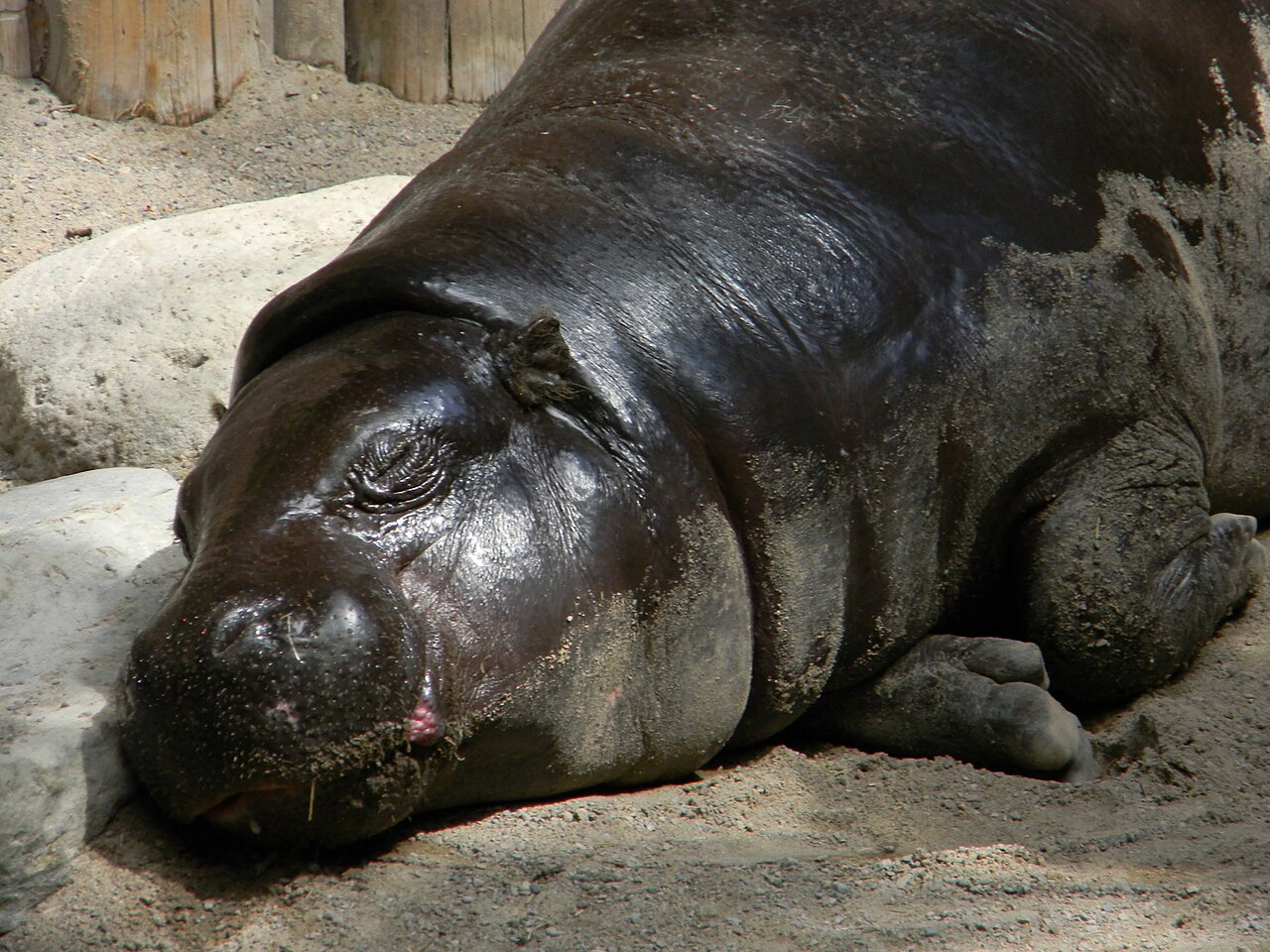
Pygmy hippopotamus standing beside water, showing its rounded body and relatively long legs
Laslovarga / Wikimedia Commons / CC BY-SA 3.0
🌐 Read in Language:

⚡ At a Glance

Species profile
Diet Category
Herbivorous browser and fallen-fruit feeder
Activity Rhythm
Nocturnal and crepuscular, resting in secluded wet sites by day.
Wild Lifespan
Often 25–35 years in managed care; wild longevity is poorly measured
Typical Weight
about 160–270 kg
Conservation Status
EN
💡 Key Biological Insight: The reddish fluid on pygmy hippo skin is not blood or sweat; it contains pigments that act as a natural sunscreen and may inhibit microbes.

🌳 Scientific Taxonomy Hierarchy

The pygmy hippopotamus is one of two living species in family Hippopotamidae. Current usage generally places it in genus Choeropsis, although older sources use Hexaprotodon. The separate Nigerian form has not been reliably recorded for decades and may be extinct.

KingdomAnimalia
PhylumChordata
ClassMammalia
OrderArtiodactyla
FamilyHippopotamidae
GenusChoeropsis
SpeciesChoeropsis liberiensis

Distinguishing Anatomical Features

  • ✓A barrel-bodied animal with smooth shiny dark gray to greenish-black skin, rounded back, relatively long legs and neck, small ears and eyes set more to the sides than in the common hippo. Each foot has four spreading toes with less webbing.
  • ✓Valves close ears and nostrils underwater
  • ✓Skin secretion reduces sun and microbial damage
  • ✓Spreading toes cross mud
  • ✓Longer legs navigate forest obstacles
  • ✓Sensitive hearing detects danger in cover
  • ✓Large canines provide defense

📏 Physical Measurements

Total Lengthabout 4.9–5.7 ft
Body Weightabout 350–600 lb
Tail LengthShort, about 6.3 in
WingspanNot applicable
Top SpeedNo dependable universal maximumMovement changes with context and conditions.

🎨 Appearance & Distinctive Markings

Greenish blackDark grayBrownPink skin secretion

Skin / Covering: Thin smooth skin kept moist by glandular secretion

Sexual Dimorphism: Males and females are similar in appearance; males may average slightly larger, but sex is difficult to judge at a distance.

🗺️ Geographic Distribution & Habitat

Fragmented forests of the Upper Guinea region, with the strongest remaining distribution in Liberia and smaller populations in Sierra Leone, Guinea and Côte d’Ivoire.

Lowland evergreen forest, swamp forest, river margins, shaded streams, wallows and dense secondary growth with permanent water nearby.

Country-level distribution map

Native range
FijiTanzaniaWestern SaharaCanadaUnited StatesKazakhstanUzbekistanPapua New GuineaIndonesiaArgentinaChileCongo - KinshasaSomaliaKenyaSudanChadHaitiDominican RepublicRussiaBahamasFalkland IslandsNorwayGreenlandFrench Southern TerritoriesTimor-LesteSouth AfricaLesothoMexicoUruguayBrazilBoliviaPeruColombiaPanamaCosta RicaNicaraguaHondurasEl SalvadorGuatemalaBelizeVenezuelaGuyanaSurinameFranceEcuadorPuerto RicoJamaicaCubaZimbabweBotswanaNamibiaSenegalMaliMauritaniaBeninNigerNigeriaCameroonTogoGhanaCôte d’Ivoire — Native rangeGuinea — Native rangeGuinea-BissauLiberia — Native rangeSierra Leone — Native rangeBurkina FasoCentral African RepublicCongo - BrazzavilleGabonEquatorial GuineaZambiaMalawiMozambiqueEswatiniAngolaBurundiIsraelLebanonMadagascarPalestinian TerritoriesGambiaTunisiaAlgeriaJordanUnited Arab EmiratesQatarKuwaitIraqOmanVanuatuCambodiaThailandLaosMyanmar (Burma)VietnamNorth KoreaSouth KoreaMongoliaIndiaBangladeshBhutanNepalPakistanAfghanistanTajikistanKyrgyzstanTurkmenistanIranSyriaArmeniaSwedenBelarusUkrainePolandAustriaHungaryMoldovaRomaniaLithuaniaLatviaEstoniaGermanyBulgariaGreeceTürkiyeAlbaniaCroatiaSwitzerlandLuxembourgBelgiumNetherlandsPortugalSpainIrelandNew CaledoniaSolomon IslandsNew ZealandAustraliaSri LankaChinaTaiwanItalyDenmarkUnited KingdomIcelandAzerbaijanGeorgiaPhilippinesMalaysiaBruneiSloveniaFinlandSlovakiaCzechiaEritreaJapanParaguayYemenSaudi ArabiaCyprusMoroccoEgyptLibyaEthiopiaDjiboutiUgandaRwandaBosnia & HerzegovinaNorth MacedoniaSerbiaMontenegroKosovoTrinidad & TobagoSouth Sudan
Highlighted countries are recorded profile locations, not precise biological range boundaries.Map boundaries: Natural Earth

💡 Did You Know?

  • 💡Valves close ears and nostrils underwater
  • 💡Skin secretion reduces sun and microbial damage
  • 💡Spreading toes cross mud
  • 💡Longer legs navigate forest obstacles
  • 💡Sensitive hearing detects danger in cover
  • 💡Large canines provide defense

🌿 Conservation Status & Threats

IUCN: EN — Endangered

“Listed as Endangered, with the wild population commonly estimated below 2,500 mature individuals. It survives in four West African countries in increasingly fragmented habitat.”

Population Trend📉 Decreasing
Wild Population EstimateFewer than 2,500 mature individuals are commonly estimated, but dense habitat and limited surveys make the exact total uncertain.

⚠️ Major Threats to Pygmy Hippopotamus

  • •Forest clearing
  • •Logging and mining
  • •Bushmeat hunting
  • •Fragmentation
  • •River pollution
  • •Road expansion
  • •Weak enforcement during conflict

🔄 Life Cycle & Reproduction

Wild vs. Captivity Lifespan Comparison

🌿 In the WildOften 25–35 years in managed care; wild longevity is poorly measured
🏠 In Captivity (with veterinary care)Can differ under managed care.
Clutch / Litter SizeUsually one calf; twins are rare
Incubation / GestationGestation about 190–210 days
Fledging / WeaningA calf is usually born on land, weighs about 3.4–6.4 kg and initially remains hidden while its mother feeds. It can nurse on land or underwater and grows rapidly during its first months.
Sexual MaturityUsually around four to five years
Mating SystemLikely polygynous where ranges overlap
Nesting / Den TypeNo nest; secluded dense vegetation near water

🦅 Behavior & Field Ecology

Herbivorous browser and fallen-fruit feeder

🌐 Ecological Food Web & Relationships: Pygmy hippos browse understory plants, disperse seeds through dung and create pathways between water and feeding areas. As an umbrella species, their conservation protects rare primates, birds and amphibians sharing Upper Guinean forests.

Social Group SizeMostly solitary; mother-calf pairs persist temporarily
Activity RhythmNocturnal and crepuscular, resting in secluded wet sites by day.
Feeding StrategyHerbivorous browser and fallen-fruit feeder

🥩 Primary Prey & Preferred Diet

✓ Leaves✓ Ferns✓ Shoots✓ Roots✓ Grasses✓ Fallen fruit✓ Aquatic plants

📢 Communication & Territorial Signals

  • Dung marking
  • Urine scent
  • Low grunts
  • High squeaks
  • Huffs and yawns

🐾 Wild Temperament & Traits

• Shy• Solitary• Defensive if cornered

🤝 Human Interaction & Pet Advisory

⚠️ Strictly Wild Species
🚫

Can You Keep a Pygmy Hippopotamus as a Pet?

An endangered heavy wild mammal requiring specialist water, forest habitat and professional care, never a pet.

Domestication StatusWild and not domesticated
Danger to HumansUsually avoids people but can cause severe injury if cornered
Economic & Ecotourism RoleForest browser, seed disperser, flagship for West African rainforest and focus of international conservation breeding.

⚠️ Behavioral Risk Factors & Wildlife Safety

  • Powerful jaws and large canines
  • Can lunge quickly at close range
  • Mothers may defend calves

🌐 Ecological Food Web & Relationships

🦅 Natural Predators (2)

LeopardPanthera pardus
HumansHomo sapiens

🧬 Related Species (2)

Common HippopotamusHippopotamus amphibiusLarger, more aquatic social relative
WhalesCetaceaClosest living lineage outside Hippopotamidae

Pygmy Hippopotamus (Choeropsis liberiensis) is an endangered, mostly solitary hoofed mammal of the Upper Guinean rainforest, far smaller and more terrestrial than the common hippopotamus. This guide separates well-supported biology from common assumptions and covers identification, range, habitat, diet, behavior, reproduction and conservation.

Identification

A barrel-bodied animal with smooth shiny dark gray to greenish-black skin, rounded back, relatively long legs and neck, small ears and eyes set more to the sides than in the common hippo. Each foot has four spreading toes with less webbing. Males and females are similar in appearance; males may average slightly larger, but sex is difficult to judge at a distance.

Identification should combine body shape, markings, size, voice or movement, and location. One feature by itself can overlap with a related animal, a juvenile, or an individual in unusual light.

Photographs are most useful when they preserve scale and show several diagnostic features. Handling or repositioning a wild pygmy hippopotamus for identification can cause stress and is unnecessary.

Size and physical adaptations

Pygmy Hippopotamus typically measures about 1.5–1.75 m and weighs about 160–270 kg. Roughly one-tenth the mass of a common hippopotamus, with proportions better suited to walking through dense forest.

Its useful adaptations include valves close ears and nostrils underwater, skin secretion reduces sun and microbial damage, spreading toes cross mud, longer legs navigate forest obstacles, sensitive hearing detects danger in cover, large canines provide defense. These traits work together in the animal’s normal setting rather than serving as isolated curiosities.

Published measurements may use different methods, life stages or sample locations. Comparing figures responsibly means checking what was measured rather than selecting the largest number available.

Range and distribution

Fragmented forests of the Upper Guinea region, with the strongest remaining distribution in Liberia and smaller populations in Sierra Leone, Guinea and Côte d’Ivoire. The native range includes Sierra Leone, Guinea, Liberia, Côte d’Ivoire.

A country-level map indicates broad distribution, not continuous occupation. Climate, elevation, water, vegetation, prey, breeding sites, barriers and survey effort all affect where records occur.

Records near the edge of the range deserve careful documentation because they may reflect natural movement, improved survey coverage, accidental transport or a genuine distribution change.

Habitat

Lowland evergreen forest, swamp forest, river margins, shaded streams, wallows and dense secondary growth with permanent water nearby.

A pygmy hippo rests in water, mud or thick cover during the hot day and follows tunnel-like paths through vegetation after dark. Streams protect its sensitive skin and provide travel corridors, but much feeding occurs on the forest floor. Protecting a population therefore requires the feeding, shelter and breeding features that make a site usable, along with connections that allow movement.

Microhabitat matters. Shade, soil, current, moisture, shelter or host plants can determine whether a small area is usable even when the surrounding landscape appears suitable.

Diet and feeding

Pygmy Hippopotamus is a herbivorous browser and fallen-fruit feeder. Important foods include leaves, ferns, shoots, roots, grasses, fallen fruit, aquatic plants. The animal plucks vegetation with muscular lips rather than grazing closely with the front teeth. It follows established forest paths, takes fallen fruit and low browse, and can rear on the hind legs to reach higher foliage.

Diet changes with age, season, location and food supply. A dramatic prey record does not establish what most individuals eat most of the time; repeated field observations provide a stronger picture.

Feeding opportunities also create risk. An animal focused on prey may be less alert to predators, traffic or people, while contaminated prey can transfer pollutants through the food web.

Behavior and communication

Nocturnal and crepuscular, resting in secluded wet sites by day. Unlike common hippos, pygmy hippos usually travel alone or as a mother with calf. Adults maintain overlapping home ranges and avoid prolonged contact. They swim capably but spend more time walking through forest and can retreat rapidly into water when disturbed.

Dung marking, urine, scent and path use carry information between solitary neighbors. Tail wagging scatters feces during marking. Close encounters include low grunts, squeaks, huffs, yawns and posture. Behavior should be interpreted in context: alarm, courtship, feeding and temperature regulation can produce very different actions from the same animal.

Daily schedules are flexible responses, not rigid rules. Weather, breeding condition, disturbance, tides or food can move activity into a different part of the day.

Reproduction and development

Little wild breeding behavior is documented. Mating can occur on land or in water, and the female raises one calf in dense cover after a pregnancy of roughly six to seven months. Usually one calf; twins are rare undefined

Young animals face different risks and may use different microhabitats or food than adults. Breeding success depends on adult condition, suitable sites and the survival of offspring through vulnerable early stages.

Counts of eggs or young describe reproductive output, not the number expected to reach adulthood. Mortality is normally greatest during eggs, larval or juvenile stages.

Predators and ecological role

Pygmy hippos browse understory plants, disperse seeds through dung and create pathways between water and feeding areas. As an umbrella species, their conservation protects rare primates, birds and amphibians sharing Upper Guinean forests. Documented or likely predators include Leopard, Humans.

This animal is both a consumer and a food source. Its influence comes through many repeated interactions, so ecological claims should be based on measured populations rather than assumptions drawn from appearance.

Predator and prey relationships differ among places. A species can be ecologically influential without being abundant everywhere, and its role can change across its range.

Relationship with people

Forest conversion for farming, logging, roads and mining fragments populations and makes hunting access easier. Civil conflict has weakened protection in parts of the range. Community-managed forests, national parks, camera-trap surveys and coordinated conservation breeding help retain the species.

Never approach or block a wild pygmy hippo. Give it access to cover or water, follow protected-area guidance and do not feed. Despite its shy nature, it has large canines and can charge when trapped. Responsible observation means keeping an appropriate distance, avoiding capture or feeding, protecting habitat and following local wildlife or invasive-species guidance.

Wildlife guidance should come from the responsible local agency because collection rules, reporting requests and appropriate responses differ between native and introduced ranges.

Conservation

Listed as Endangered, with the wild population commonly estimated below 2,500 mature individuals. It survives in four West African countries in increasingly fragmented habitat. The reported global trend is Decreasing.

Important pressures include forest clearing, logging and mining, bushmeat hunting, fragmentation, river pollution, road expansion, weak enforcement during conflict. Global status can hide local decline or recovery, so current regional monitoring and habitat management remain necessary.

The most useful conservation action follows the documented pressure. Protecting breeding sites, reducing road deaths or limiting pollutants can require different tools in different populations.

Sources and further reading

❓ Frequently Asked Questions

Answers to frequently asked questions verified against peer-reviewed zoological research.

Adults are about 1.5–1.75 metres long and weigh roughly 160–270 kilograms, about one-tenth as much as a common hippo.