
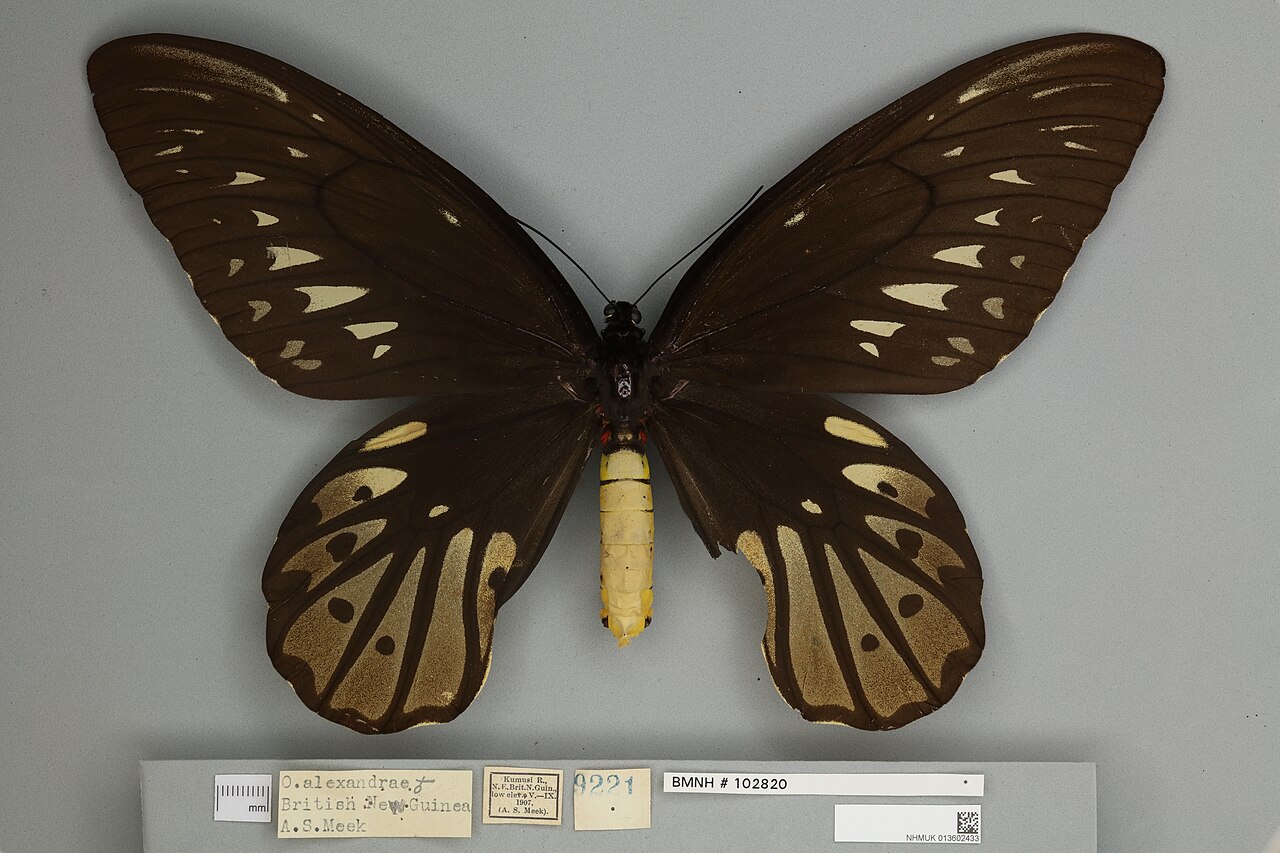
Queen Alexandra’s Birdwing (Ornithoptera alexandrae) is an endangered swallowtail butterfly found only in northern Oro Province, Papua New Guinea. This guide separates well-supported biology from common assumptions and covers identification, range, habitat, diet, behavior, reproduction and conservation.
Identification
Females are enormous brown-and-cream butterflies with broad rounded wings, pale patches and a yellow abdomen. Males are smaller and more slender, with black wings crossed by vivid blue-green bands and patches. Both sexes fly strongly high around the rainforest canopy. Females are substantially larger, broader-winged and brown with cream markings; males are smaller and strikingly iridescent blue-green and black.
Identification should combine body shape, markings, size, voice or movement, and location. One feature by itself can overlap with a related animal, a juvenile, or an individual in unusual light.
Photographs are most useful when they preserve scale and show several diagnostic features. Handling or repositioning a wild queen alexandra’s birdwing for identification can cause stress and is unnecessary.
Size and physical adaptations
Queen Alexandra’s Birdwing typically measures body roughly 7.5–8 cm; wingspan commonly 20–25 cm in females and smaller in males and weighs only a few grams; dependable wild mass ranges are not widely published. Females are regarded as the largest living butterflies by wingspan; quoted extremes vary with specimen and measurement method.
Its useful adaptations include large wings support strong canopy flight, sex-specific colors aid recognition and courtship, larvae tolerate toxins in aristolochia host vines, warning chemistry discourages many predators, long proboscis reaches nectar in flowers, egg-laying females locate the correct host plant. These traits work together in the animal’s normal setting rather than serving as isolated curiosities.
Published measurements may use different methods, life stages or sample locations. Comparing figures responsibly means checking what was measured rather than selecting the largest number available.
Range and distribution
Endemic to a restricted part of northern Oro Province in eastern Papua New Guinea, especially lowland rainforest around the Popondetta region. Populations are fragmented and separated by cleared or unsuitable land. The native range includes Papua New Guinea.
A country-level map indicates broad distribution, not continuous occupation. Climate, elevation, water, vegetation, prey, breeding sites, barriers and survey effort all affect where records occur.
Records near the edge of the range deserve careful documentation because they may reflect natural movement, improved survey coverage, accidental transport or a genuine distribution change.
Habitat
Humid lowland tropical rainforest with mature canopy, nectar sources and the larval host vine Aristolochia dielsiana climbing into sunlit forest gaps and edges.
Adults fly through and above the canopy, descending to nectar flowers and host plants. Females place eggs on suitable Aristolochia vines, so a forest patch without the vine cannot complete the butterfly life cycle even if adult nectar is available. Protecting a population therefore requires the feeding, shelter and breeding features that make a site usable, along with connections that allow movement.
Microhabitat matters. Shade, soil, current, moisture, shelter or host plants can determine whether a small area is usable even when the surrounding landscape appears suitable.
Diet and feeding
Queen Alexandra’s Birdwing is a herbivore as a larva and nectar feeder as an adult. Important foods include aristolochia dielsiana leaves as caterpillars, flower nectar as adults, host-vine tissues. Caterpillars eat the host vine and store defensive plant chemicals that make them unpalatable to many predators. Adults use a coiled proboscis to drink nectar and must move among scattered flowering plants while conserving energy for mating and egg production.
Diet changes with age, season, location and food supply. A dramatic prey record does not establish what most individuals eat most of the time; repeated field observations provide a stronger picture.
Feeding opportunities also create risk. An animal focused on prey may be less alert to predators, traffic or people, while contaminated prey can transfer pollutants through the food web.
Behavior and communication
Diurnal, with strongest flight and courtship in warm bright conditions. Adults are powerful high-flying butterflies and are difficult to count from the ground. Males patrol for females and may investigate moving objects, while females spend more time locating host vines and suitable leaves for eggs. Rain and cool conditions reduce flight.
Wing color and movement provide visual signals at close range, while chemical cues help males locate receptive females and females recognize host plants for egg laying. Behavior should be interpreted in context: alarm, courtship, feeding and temperature regulation can produce very different actions from the same animal.
Daily schedules are flexible responses, not rigid rules. Weather, breeding condition, disturbance, tides or food can move activity into a different part of the day.
Reproduction and development
After courtship and mating, the female lays eggs singly on or near the larval host vine. The caterpillar feeds through several growth stages before attaching itself and forming a chrysalis. Eggs are laid singly over time rather than as one exposed mass The life cycle includes egg, several caterpillar instars, chrysalis and adult. Caterpillars depend on Aristolochia dielsiana; after pupation the winged adult emerges, expands its wings and later reproduces.
Young animals face different risks and may use different microhabitats or food than adults. Breeding success depends on adult condition, suitable sites and the survival of offspring through vulnerable early stages.
Counts of eggs or young describe reproductive output, not the number expected to reach adulthood. Mortality is normally greatest during eggs, larval or juvenile stages.
Predators and ecological role
The butterfly links a specialized rainforest vine with nectar plants and insect predators. Its dependence on one limited landscape makes it a flagship for lowland forest protection and illustrates why conserving an insect requires its host plant, canopy and movement routes together. Documented or likely predators include Insect-eating Birds, Spiders, Parasitoid Wasps, Ants.
This animal is both a consumer and a food source. Its influence comes through many repeated interactions, so ecological claims should be based on measured populations rather than assumptions drawn from appearance.
Predator and prey relationships differ among places. A species can be ecologically influential without being abundant everywhere, and its role can change across its range.
Relationship with people
The species is internationally famous and historically sought by collectors. Commercial international trade in wild specimens is prohibited under CITES Appendix I. Conservation now depends on local communities, landowners and authorities retaining connected rainforest and restoring host vines rather than encouraging illegal collecting.
Observe and photograph without capture, touching or buying unverified specimens. Report suspected illegal trade to wildlife authorities and support habitat projects led with Oro Province communities. Responsible observation means keeping an appropriate distance, avoiding capture or feeding, protecting habitat and following local wildlife or invasive-species guidance.
Wildlife guidance should come from the responsible local agency because collection rules, reporting requests and appropriate responses differ between native and introduced ranges.
Conservation
Listed as Endangered because it has an extremely restricted, fragmented range and continuing loss or degradation of lowland rainforest and host vines. The reported global trend is Decreasing.
Important pressures include oil-palm expansion, logging and forest clearing, smallholder agricultural expansion, fragmentation of host-vine habitat, volcanic disturbance, illegal collection, low genetic diversity. Global status can hide local decline or recovery, so current regional monitoring and habitat management remain necessary.
The most useful conservation action follows the documented pressure. Protecting breeding sites, reducing road deaths or limiting pollutants can require different tools in different populations.