
Home/Animals/Actinopterygii/Queen Angelfish
Species profileIUCN: LC

Queen Angelfish

Holacanthus ciliaris

A vividly colored western Atlantic reef fish whose adults feed mainly on sponges.

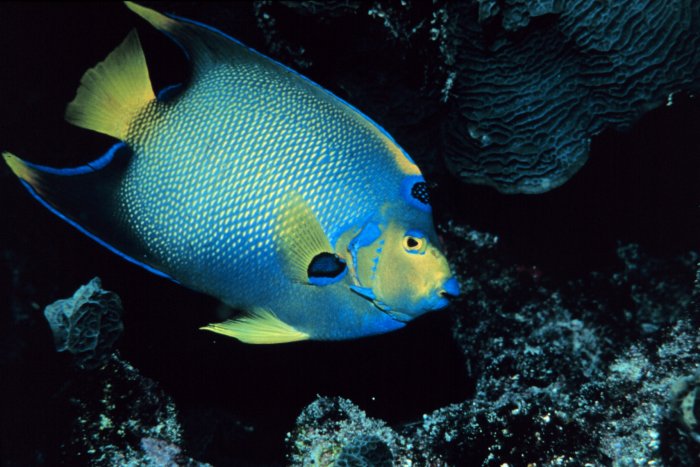
Adult queen angelfish swimming above a coral reef, showing its blue-and-yellow body and yellow tail
Chris Huss / Florida Keys National Marine Sanctuary / NOAA / Public domain
๐ŸŒ Read in Language:

โšก At a Glance

Species profile
Also Known As
Queen angel, yellow angelfish
Diet Category
Sponge-specialist omnivore
Activity Rhythm
Diurnal, feeding and interacting on reefs during daylight and sheltering at night.
Wild Lifespan
Often 10โ€“15 years; precise wild longevity is difficult to measure
Typical Weight
large adults can approach 1.6 kg
Conservation Status
LC
๐Ÿ’ก Key Biological Insight: The crown-like blue-ringed spot on the forehead is a dependable adult field mark and helps separate this species from the blue angelfish.

๐ŸŒณ Scientific Taxonomy Hierarchy

The queen angelfish is a species in the marine angelfish family Pomacanthidae. It belongs to genus Holacanthus and can hybridize with the closely related blue angelfish where their ranges overlap.

KingdomAnimalia
PhylumChordata
ClassActinopterygii
OrderAcanthuriformes
FamilyPomacanthidae
GenusHolacanthus
SpeciesHolacanthus ciliaris

Distinguishing Anatomical Features

  • โœ“Adults have a deep, laterally compressed body, long trailing dorsal and anal fins, yellow tail and electric-blue edging on many scales. A dark blue forehead patch ringed with bright blue forms the crown-like mark behind the common name. Juveniles are darker blue with curved pale-blue vertical bars.
  • โœ“Laterally compressed body maneuvers through reef structure
  • โœ“Strong jaws crop tough sponge tissue
  • โœ“Small protractile mouth reaches food on reef surfaces
  • โœ“Long dorsal and anal fins provide precise control
  • โœ“Juvenile pattern differs sharply from adult coloration
  • โœ“Preopercular spine helps distinguish marine angelfishes

๐Ÿ“ Physical Measurements

Total Lengthcommonly 12โ€“14 in; maximum reported total length about 18 in
Body Weightlarge adults can approach 3.5 lb
Tail LengthRounded yellow caudal fin
WingspanNot applicable
Top SpeedNo dependable universal maximumMovement changes with context and conditions.

๐ŸŽจ Appearance & Distinctive Markings

Royal blueYellowOrangeElectric blueDark blue

Skin / Covering: Small overlapping scales with a mucus coating

Sexual Dimorphism: Males and females look broadly alike externally; size, behavior and examination of reproductive condition are more useful than color for determining sex.

๐Ÿ—บ๏ธ Geographic Distribution & Habitat

Native to the tropical and subtropical western Atlantic, from Bermuda and Florida through the Bahamas, Gulf of Mexico and Caribbean, then south along coastal South America to Brazil. Records are concentrated where suitable coral or rocky reef habitat occurs.

Coral reefs, rocky reefs and adjacent clear-water habitats, usually from shallow water to about 70 m depth.

Country-level distribution map

Native range
FijiTanzaniaWestern SaharaCanadaUnited States โ€” Native rangeKazakhstanUzbekistanPapua New GuineaIndonesiaArgentinaChileCongo - KinshasaSomaliaKenyaSudanChadHaiti โ€” Native rangeDominican Republic โ€” Native rangeRussiaBahamas โ€” Native rangeFalkland IslandsNorwayGreenlandFrench Southern TerritoriesTimor-LesteSouth AfricaLesothoMexico โ€” Native rangeUruguayBrazil โ€” Native rangeBoliviaPeruColombia โ€” Native rangePanama โ€” Native rangeCosta Rica โ€” Native rangeNicaragua โ€” Native rangeHonduras โ€” Native rangeEl SalvadorGuatemala โ€” Native rangeBelize โ€” Native rangeVenezuela โ€” Native rangeGuyana โ€” Native rangeSuriname โ€” Native rangeFranceEcuadorPuerto Rico โ€” Native rangeJamaica โ€” Native rangeCuba โ€” Native rangeZimbabweBotswanaNamibiaSenegalMaliMauritaniaBeninNigerNigeriaCameroonTogoGhanaCรดte dโ€™IvoireGuineaGuinea-BissauLiberiaSierra LeoneBurkina FasoCentral African RepublicCongo - BrazzavilleGabonEquatorial GuineaZambiaMalawiMozambiqueEswatiniAngolaBurundiIsraelLebanonMadagascarPalestinian TerritoriesGambiaTunisiaAlgeriaJordanUnited Arab EmiratesQatarKuwaitIraqOmanVanuatuCambodiaThailandLaosMyanmar (Burma)VietnamNorth KoreaSouth KoreaMongoliaIndiaBangladeshBhutanNepalPakistanAfghanistanTajikistanKyrgyzstanTurkmenistanIranSyriaArmeniaSwedenBelarusUkrainePolandAustriaHungaryMoldovaRomaniaLithuaniaLatviaEstoniaGermanyBulgariaGreeceTรผrkiyeAlbaniaCroatiaSwitzerlandLuxembourgBelgiumNetherlandsPortugalSpainIrelandNew CaledoniaSolomon IslandsNew ZealandAustraliaSri LankaChinaTaiwanItalyDenmarkUnited KingdomIcelandAzerbaijanGeorgiaPhilippinesMalaysiaBruneiSloveniaFinlandSlovakiaCzechiaEritreaJapanParaguayYemenSaudi ArabiaCyprusMoroccoEgyptLibyaEthiopiaDjiboutiUgandaRwandaBosnia & HerzegovinaNorth MacedoniaSerbiaMontenegroKosovoTrinidad & Tobago โ€” Native rangeSouth Sudan
Highlighted countries are recorded profile locations, not precise biological range boundaries.Map boundaries: Natural Earth

๐Ÿ’ก Did You Know?

  • ๐Ÿ’กLaterally compressed body maneuvers through reef structure
  • ๐Ÿ’กStrong jaws crop tough sponge tissue
  • ๐Ÿ’กSmall protractile mouth reaches food on reef surfaces
  • ๐Ÿ’กLong dorsal and anal fins provide precise control
  • ๐Ÿ’กJuvenile pattern differs sharply from adult coloration
  • ๐Ÿ’กPreopercular spine helps distinguish marine angelfishes

๐ŸŒฟ Conservation Status & Threats

IUCN: LC โ€” Least Concern

โ€œAssessed as Least Concern. It remains widespread, although reef degradation and aquarium collection can affect local abundance.โ€

Population TrendGenerally stable at the global scale; local trends vary
Wild Population EstimateNo precise global count exists; the species is widespread but patchy around suitable reefs.

โš ๏ธ Major Threats to Queen Angelfish

  • โ€ขCoral-reef degradation
  • โ€ขOvercollection in localized aquarium fisheries
  • โ€ขPollution and sedimentation
  • โ€ขMarine heatwaves
  • โ€ขLoss of reef complexity

๐Ÿ”„ Life Cycle & Reproduction

Wild vs. Captivity Lifespan Comparison

๐ŸŒฟ In the WildOften 10โ€“15 years; precise wild longevity is difficult to measure
๐Ÿ  In Captivity (with veterinary care)Can exceed 15 years under expert aquarium care.
Clutch / Litter SizeMany tiny buoyant eggs released in a spawning event
Incubation / GestationEggs develop in open water and hatch rapidly; exact timing varies with temperature
Fledging / WeaningPelagic larvae later settle on reefs; juveniles have dark bodies crossed by curved blue bars and may behave as cleaners.
Sexual MaturitySize and age at maturity vary by region and are not represented by one dependable universal figure
Mating SystemPair spawning with external fertilization
Nesting / Den TypeNo nest; pelagic eggs

๐Ÿฆ… Behavior & Field Ecology

Sponge-specialist omnivore

๐ŸŒ Ecological Food Web & Relationships: Queen angelfish convert sponge production into fish biomass and influence competition for space among sponges, algae and corals. Juveniles can also participate in cleaning interactions, while eggs and larvae feed planktonic predators.

Social Group SizeAdults solitary or paired; juveniles usually solitary
Activity RhythmDiurnal, feeding and interacting on reefs during daylight and sheltering at night.
Feeding StrategySponge-specialist omnivore

๐Ÿฅฉ Primary Prey & Preferred Diet

โœ“ Spongesโœ“ Algaeโœ“ Tunicatesโœ“ Hydroidsโœ“ Bryozoansโœ“ Small reef invertebrates

๐Ÿ“ข Communication & Territorial Signals

  • Color display
  • Fin posture
  • Parallel swimming
  • Circling
  • Short chases

๐Ÿพ Wild Temperament & Traits

โ€ข Alertโ€ข Territorial toward some reef fishesโ€ข Usually avoids close human contact

๐Ÿค Human Interaction & Pet Advisory

โš ๏ธ Strictly Wild Species
๐Ÿšซ

Can You Keep a Queen Angelfish as a Pet?

Unsuitable for beginners because adults grow large, defend space, eat many sessile invertebrates and require an expert-maintained marine aquarium.

Domestication StatusWild marine fish; kept in specialist public and private aquariums
Danger to HumansHarmless to people in normal encounters
Economic & Ecotourism RoleReef grazer and sponge predator, aquarium-trade species and charismatic subject for diving tourism.

โš ๏ธ Behavioral Risk Factors & Wildlife Safety

  • Dorsal and preopercular spines can injure a handler
  • Capture and handling stress the fish

๐ŸŒ Ecological Food Web & Relationships

๐Ÿฆ… Natural Predators (3)

Caribbean Reef SharkCarcharhinus perezi
Nassau GrouperEpinephelus striatus
Great BarracudaSphyraena barracuda

๐Ÿงฌ Related Species (3)

Blue AngelfishHolacanthus bermudensisClosest look-alike and hybrid partner
Rock BeautyHolacanthus tricolorSmaller western Atlantic congener
French AngelfishPomacanthus paruLarge reef angelfish sharing much of the range

Queen Angelfish (Holacanthus ciliaris) is a large marine angelfish native to warm reefs of the western Atlantic Ocean. This guide separates well-supported biology from common assumptions and covers identification, range, habitat, diet, behavior, reproduction and conservation.

Identification

Adults have a deep, laterally compressed body, long trailing dorsal and anal fins, yellow tail and electric-blue edging on many scales. A dark blue forehead patch ringed with bright blue forms the crown-like mark behind the common name. Juveniles are darker blue with curved pale-blue vertical bars. Males and females look broadly alike externally; size, behavior and examination of reproductive condition are more useful than color for determining sex.

Identification should combine body shape, markings, size, voice or movement, and location. One feature by itself can overlap with a related animal, a juvenile, or an individual in unusual light.

Photographs are most useful when they preserve scale and show several diagnostic features. Handling or repositioning a wild queen angelfish for identification can cause stress and is unnecessary.

Size and physical adaptations

Queen Angelfish typically measures commonly 30โ€“35 cm; maximum reported total length about 45 cm and weighs large adults can approach 1.6 kg. Maximum records describe unusually large fish; most reef encounters involve smaller adults.

Its useful adaptations include laterally compressed body maneuvers through reef structure, strong jaws crop tough sponge tissue, small protractile mouth reaches food on reef surfaces, long dorsal and anal fins provide precise control, juvenile pattern differs sharply from adult coloration, preopercular spine helps distinguish marine angelfishes. These traits work together in the animal’s normal setting rather than serving as isolated curiosities.

Published measurements may use different methods, life stages or sample locations. Comparing figures responsibly means checking what was measured rather than selecting the largest number available.

Range and distribution

Native to the tropical and subtropical western Atlantic, from Bermuda and Florida through the Bahamas, Gulf of Mexico and Caribbean, then south along coastal South America to Brazil. Records are concentrated where suitable coral or rocky reef habitat occurs. The native range includes United States, Mexico, The Bahamas, Cuba, Jamaica, Belize, Honduras, Costa Rica, Panama, Colombia, Venezuela, Brazil, Bermuda and the wider Caribbean.

A country-level map indicates broad distribution, not continuous occupation. Climate, elevation, water, vegetation, prey, breeding sites, barriers and survey effort all affect where records occur.

Records near the edge of the range deserve careful documentation because they may reflect natural movement, improved survey coverage, accidental transport or a genuine distribution change.

Habitat

Coral reefs, rocky reefs and adjacent clear-water habitats, usually from shallow water to about 70 m depth.

Adults commonly patrol a home area around complex reef structure and caves. Juveniles shelter more closely in crevices and may establish cleaning stations where larger fishes pause while parasites are removed. Protecting a population therefore requires the feeding, shelter and breeding features that make a site usable, along with connections that allow movement.

Microhabitat matters. Shade, soil, current, moisture, shelter or host plants can determine whether a small area is usable even when the surrounding landscape appears suitable.

Diet and feeding

Queen Angelfish is a sponge-specialist omnivore. Important foods include sponges, algae, tunicates, hydroids, bryozoans, small reef invertebrates. Adults nip pieces from exposed sponges and supplement them with algae and attached invertebrates. Their digestive system handles sponge material that many fishes avoid. Juveniles consume more algae and can pick external parasites from visiting fishes.

Diet changes with age, season, location and food supply. A dramatic prey record does not establish what most individuals eat most of the time; repeated field observations provide a stronger picture.

Feeding opportunities also create risk. An animal focused on prey may be less alert to predators, traffic or people, while contaminated prey can transfer pollutants through the food web.

Behavior and communication

Diurnal, feeding and interacting on reefs during daylight and sheltering at night. Adults are often seen alone or in pairs and may defend feeding space from other angelfishes. They swim with controlled strokes close to reef surfaces, retreat into structure when alarmed and sometimes inspect divers without approaching closely.

Color pattern, close circling, fin postures and short chases convey identity and territorial intent. Courtship includes paired ascent into the water column before spawning. Behavior should be interpreted in context: alarm, courtship, feeding and temperature regulation can produce very different actions from the same animal.

Daily schedules are flexible responses, not rigid rules. Weather, breeding condition, disturbance, tides or food can move activity into a different part of the day.

Reproduction and development

Spawning occurs in pairs. Near dusk, a courting pair rises from the reef and releases eggs and sperm into open water, allowing fertilized eggs to drift as plankton. Many tiny buoyant eggs released in a spawning event Larvae live in the plankton before settling to reef habitat and transforming into distinctly patterned juveniles.

Young animals face different risks and may use different microhabitats or food than adults. Breeding success depends on adult condition, suitable sites and the survival of offspring through vulnerable early stages.

Counts of eggs or young describe reproductive output, not the number expected to reach adulthood. Mortality is normally greatest during eggs, larval or juvenile stages.

Predators and ecological role

Queen angelfish convert sponge production into fish biomass and influence competition for space among sponges, algae and corals. Juveniles can also participate in cleaning interactions, while eggs and larvae feed planktonic predators. Documented or likely predators include Caribbean Reef Shark, Nassau Grouper, Great Barracuda.

This animal is both a consumer and a food source. Its influence comes through many repeated interactions, so ecological claims should be based on measured populations rather than assumptions drawn from appearance.

Predator and prey relationships differ among places. A species can be ecologically influential without being abundant everywhere, and its role can change across its range.

Relationship with people

Its striking coloration makes the species valuable to reef tourism and the marine aquarium trade. Collection is regulated differently across the range, and poorly managed harvest can concentrate pressure at accessible reefs even when the global population remains secure.

Observe without touching, chasing or feeding. Aquarium ownership requires a very large mature marine system, expert water-quality control and a legal, traceable source. Responsible observation means keeping an appropriate distance, avoiding capture or feeding, protecting habitat and following local wildlife or invasive-species guidance.

Wildlife guidance should come from the responsible local agency because collection rules, reporting requests and appropriate responses differ between native and introduced ranges.

Conservation

Assessed as Least Concern. It remains widespread, although reef degradation and aquarium collection can affect local abundance. The reported global trend is Generally stable at the global scale; local trends vary.

Important pressures include coral-reef degradation, overcollection in localized aquarium fisheries, pollution and sedimentation, marine heatwaves, loss of reef complexity. Global status can hide local decline or recovery, so current regional monitoring and habitat management remain necessary.

The most useful conservation action follows the documented pressure. Protecting breeding sites, reducing road deaths or limiting pollutants can require different tools in different populations.

Sources and further reading

โ“ Frequently Asked Questions

Answers to frequently asked questions verified against peer-reviewed zoological research.

They inhabit coral and rocky reefs in the western Atlantic, from Florida and Bermuda through the Caribbean and Gulf of Mexico to Brazil.