Quokka (Setonix brachyurus) is a vulnerable herbivorous marsupial best known from Rottnest Island but also surviving in scattered mainland refuges. This guide separates well-supported biology from common assumptions and covers identification, range, habitat, diet, behavior, reproduction and conservation.
Identification
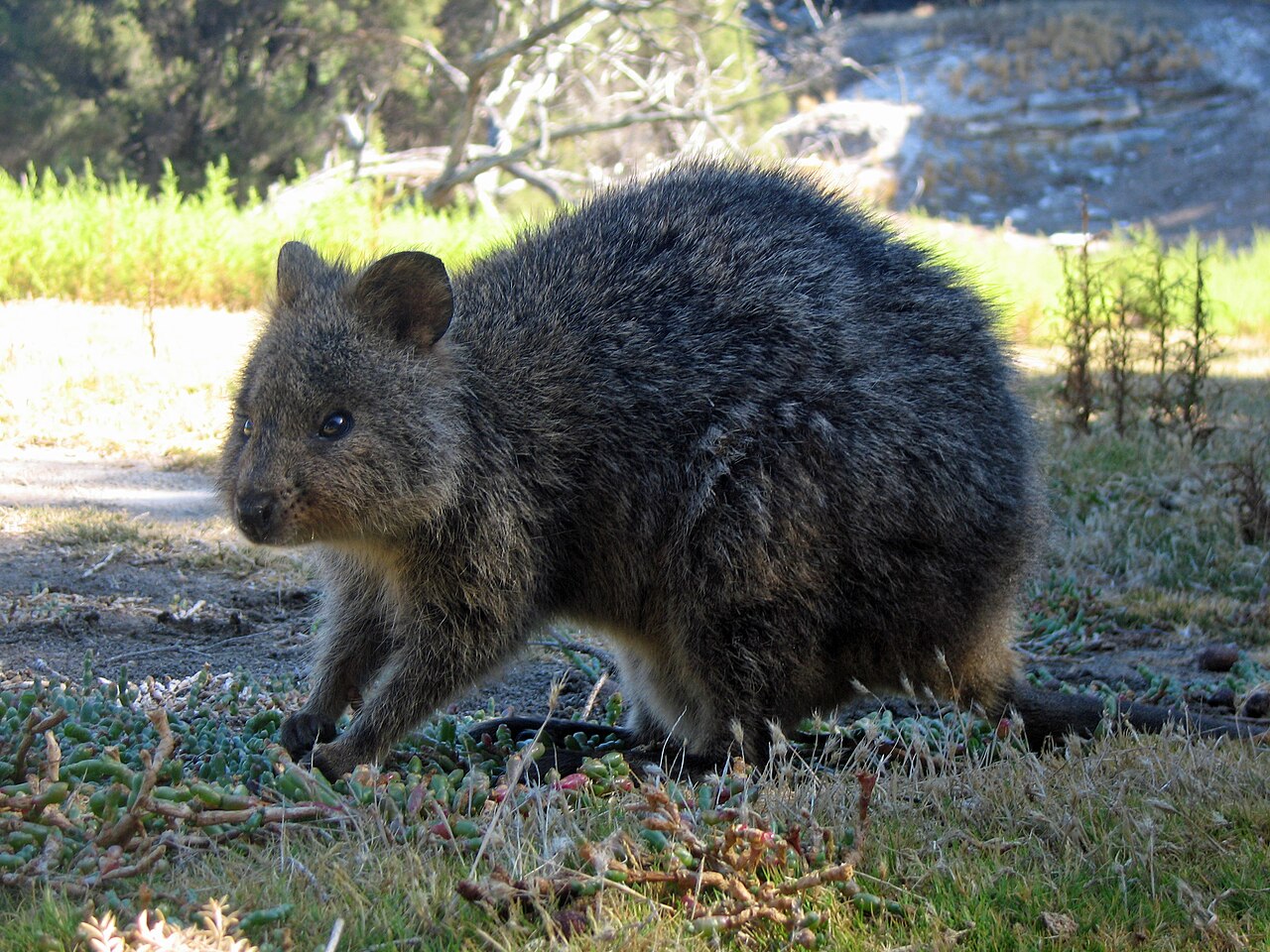
A compact wallaby with coarse grizzled gray-brown fur, lighter underside, short broad face, black nose, small rounded ears, sturdy hind legs and a relatively short tapering tail. Mainland animals can be darker than Rottnest Island animals. Males are generally longer and heavier than females, while both sexes share the same rounded ears, short tail and coarse coat.
Identification should combine body shape, markings, size, voice or movement, and location. One feature by itself can overlap with a related animal, a juvenile, or an individual in unusual light.
Photographs are most useful when they preserve scale and show several diagnostic features. Handling or repositioning a wild quokka for identification can cause stress and is unnecessary.
Size and physical adaptations
Quokka typically measures head and body 39–54 cm; tail 23–31 cm and weighs males about 2.7–4.5 kg; females about 1.6–3.5 kg. Among the smallest wallabies; body condition and island food availability cause seasonal changes.
Its useful adaptations include powerful hind legs enable bounding escape, coarse fur protects in dense scrub, low water needs suit seasonal island drought, foregut fermentation extracts fibrous plant nutrients, can climb shrubs and low trees, pouch protects a developing joey. These traits work together in the animal’s normal setting rather than serving as isolated curiosities.
Published measurements may use different methods, life stages or sample locations. Comparing figures responsibly means checking what was measured rather than selecting the largest number available.
Range and distribution
Endemic to southwestern Western Australia. Large island populations live on Rottnest and Bald islands, while fragmented mainland populations occur from the northern jarrah forest to the wet south coast and a few managed sanctuary sites. The native range includes Australia.
A country-level map indicates broad distribution, not continuous occupation. Climate, elevation, water, vegetation, prey, breeding sites, barriers and survey effort all affect where records occur.
Records near the edge of the range deserve careful documentation because they may reflect natural movement, improved survey coverage, accidental transport or a genuine distribution change.
Habitat
Dense streamside thicket, swamp vegetation, tea-tree cover, heath, low forest and island shrubland with shelter from heat and predators.
During the day quokkas rest beneath dense cover, often sharing limited cool shelters in hot weather. After dusk they move along well-worn runways to browse. Mainland populations depend strongly on thick vegetation near fresh water and a mosaic of fire ages. Protecting a population therefore requires the feeding, shelter and breeding features that make a site usable, along with connections that allow movement.
Microhabitat matters. Shade, soil, current, moisture, shelter or host plants can determine whether a small area is usable even when the surrounding landscape appears suitable.
Diet and feeding
Quokka is a herbivorous browser and grazer. Important foods include grasses, sedges, succulents, thomasia leaves, acacia leaves, young shoots, bark. Quokkas crop grass and browse leaves with incisors, then ferment fibrous food in a chambered foregut. Fresh post-fire growth can be attractive, but intense or frequent fire removes the dense shelter required for survival. Rottnest animals rely heavily on succulents during dry periods.
Diet changes with age, season, location and food supply. A dramatic prey record does not establish what most individuals eat most of the time; repeated field observations provide a stronger picture.
Feeding opportunities also create risk. An animal focused on prey may be less alert to predators, traffic or people, while contaminated prey can transfer pollutants through the food web.
Behavior and communication
Mostly nocturnal and crepuscular, with more daytime visibility around people on Rottnest Island. Individuals often feed alone but gather where food, shade or water is concentrated. They hop when moving rapidly, use small forefeet to handle vegetation and can climb leaning shrubs. Island quokkas have become habituated to visitors, while mainland animals remain elusive.
Scent marking, close sniffing and body posture mediate encounters. Mothers and young maintain contact with soft sounds and touch, while threatened animals stamp or move rapidly into cover. Behavior should be interpreted in context: alarm, courtship, feeding and temperature regulation can produce very different actions from the same animal.
Daily schedules are flexible responses, not rigid rules. Weather, breeding condition, disturbance, tides or food can move activity into a different part of the day.
Reproduction and development
After a short pregnancy the tiny newborn crawls into the pouch and attaches to a teat. Females can mate soon after birth and hold a new embryo in delayed development until the pouch becomes available or conditions improve. One joey at a time; twins are rare undefined
Young animals face different risks and may use different microhabitats or food than adults. Breeding success depends on adult condition, suitable sites and the survival of offspring through vulnerable early stages.
Counts of eggs or young describe reproductive output, not the number expected to reach adulthood. Mortality is normally greatest during eggs, larval or juvenile stages.
Predators and ecological role
Quokkas browse understory plants, move seeds and nutrients and create runways through thick vegetation. Their contrasting island and mainland populations reveal how introduced predators, water, fire and habitat structure interact. Documented or likely predators include Red Fox, Feral Cat, Dingo, Birds of Prey.
This animal is both a consumer and a food source. Its influence comes through many repeated interactions, so ecological claims should be based on measured populations rather than assumptions drawn from appearance.
Predator and prey relationships differ among places. A species can be ecologically influential without being abundant everywhere, and its role can change across its range.
Relationship with people
Close photographs on Rottnest made the quokka famous, but feeding changes its diet and behavior, while touching spreads disease and causes stress. Mainland recovery depends on fox and cat control, careful fire mosaics, wetland protection and connected dense habitat.
Keep at least two metres away, never touch or feed, secure bags and dispose of litter. Use camera zoom rather than crowding an animal and follow island rangers’ instructions. Responsible observation means keeping an appropriate distance, avoiding capture or feeding, protecting habitat and following local wildlife or invasive-species guidance.
Wildlife guidance should come from the responsible local agency because collection rules, reporting requests and appropriate responses differ between native and introduced ranges.
Conservation
Listed as Vulnerable. Island populations are relatively secure, but mainland populations remain fragmented and exposed to foxes, cats, fire, logging, disease and drying climate. The reported global trend is Decreasing overall, with local recoveries under predator control.
Important pressures include red fox predation, feral cat predation, frequent intense fire, habitat clearing and logging, climate drying, disease, vehicle strikes, feeding by visitors. Global status can hide local decline or recovery, so current regional monitoring and habitat management remain necessary.
The most useful conservation action follows the documented pressure. Protecting breeding sites, reducing road deaths or limiting pollutants can require different tools in different populations.