
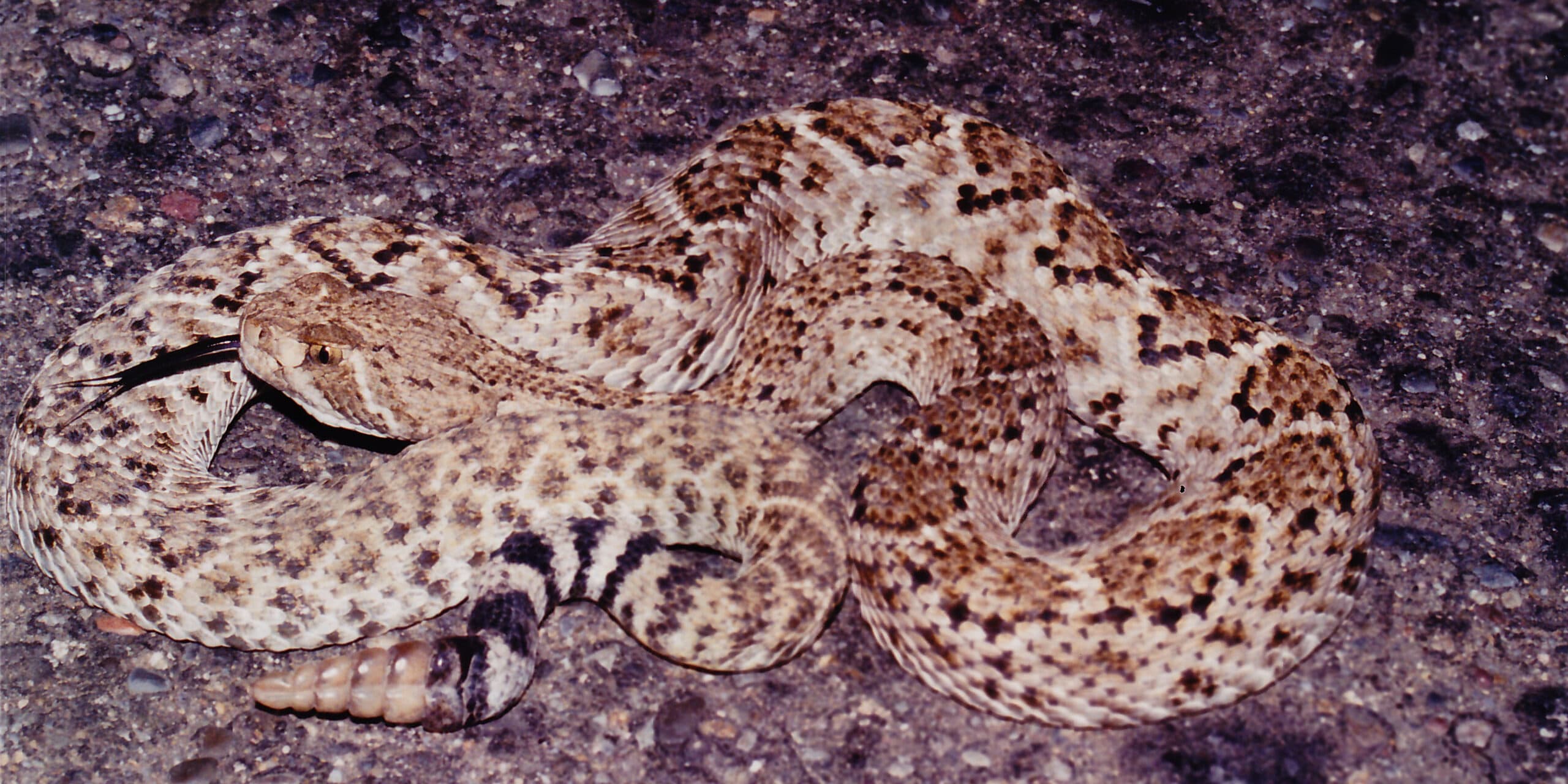
Rattlesnake (Crotalus and Sistrurus) is the common name for venomous pit vipers in the genera Crotalus and Sistrurus. The Reptile Database currently recognizes 58 species across the two genera. They share facial heat-sensing pits and a segmented tail rattle, but size, markings, habitat, venom composition and conservation status differ substantially among species. This guide separates well-supported biology from common assumptions and covers identification, range, habitat, diet, behavior, reproduction and conservation.
Identification
Rattlesnakes have a broad head, vertical pupils, hinged front fangs and a heat-sensing loreal pit between each eye and nostril. Most adults carry interlocking hollow keratin segments at the tail tip. Pattern and color vary widely, and young animals may have only a button, so a missing or silent rattle never proves that a snake is harmless. Females and males can differ in adult size and tail proportions, but the direction and degree vary among species. Sex cannot be identified safely from a distant encounter.
Identification should combine body shape, markings, size, voice or movement, and location. One feature by itself can overlap with a related animal, a juvenile, or an individual in unusual light.
Photographs are most useful when they preserve scale and show several diagnostic features. Handling or repositioning a wild rattlesnake for identification can cause stress and is unnecessary.
Size and physical adaptations
Rattlesnake typically measures roughly 30 cm to more than 2 m across species and weighs from well under 0.5 kg in small species to several kilograms in large diamondbacks. These endpoints combine small pygmy rattlesnakes with large diamondbacks and should not be applied to one species.
Its useful adaptations include paired facial pits detect infrared radiation from warm prey, long hinged fangs inject venom, a segmented keratin rattle provides an acoustic warning, cryptic scales conceal a waiting predator, a forked tongue samples airborne and surface chemicals, flexible jaws allow large prey to be swallowed whole. These traits work together in the animal’s normal setting rather than serving as isolated curiosities.
Published measurements may use different methods, life stages or sample locations. Comparing figures responsibly means checking what was measured rather than selecting the largest number available.
Range and distribution
Rattlesnakes are native only to the Americas. Their combined range extends from southern Canada through the United States and Mexico, across parts of Central America, and into South America as far as Argentina and Uruguay. No single species occupies this entire area. The native range includes Southern Canada, United States, Mexico, Central America, Northern and central South America, Argentina and Uruguay.
A country-level map indicates broad distribution, not continuous occupation. Climate, elevation, water, vegetation, prey, breeding sites, barriers and survey effort all affect where records occur.
Records near the edge of the range deserve careful documentation because they may reflect natural movement, improved survey coverage, accidental transport or a genuine distribution change.
Habitat
Deserts, grasslands, shrublands, forests, rocky slopes, wetlands, coastal plains and high mountain habitats, depending on species.
Many species select ambush sites near rodent travel routes and use rock crevices, burrows or root systems for refuge. Seasonal denning is important in cold climates, while tropical species follow different thermal and rainfall patterns. Habitat needs must therefore be assessed at species and population level. Protecting a population therefore requires the feeding, shelter and breeding features that make a site usable, along with connections that allow movement.
Microhabitat matters. Shade, soil, current, moisture, shelter or host plants can determine whether a small area is usable even when the surrounding landscape appears suitable.
Diet and feeding
Rattlesnake is a carnivorous ambush predator. Important foods include mice and other small mammals, lizards, birds, frogs, occasional other snakes. A rattlesnake waits beside a travel route, detects prey using vision, smell and infrared-sensitive pits, strikes and injects venom, then often releases mobile prey. Chemical tracking helps locate the envenomated animal before it is swallowed headfirst. Juveniles and small species generally take smaller prey than large adults.
Diet changes with age, season, location and food supply. A dramatic prey record does not establish what most individuals eat most of the time; repeated field observations provide a stronger picture.
Feeding opportunities also create risk. An animal focused on prey may be less alert to predators, traffic or people, while contaminated prey can transfer pollutants through the food web.
Behavior and communication
Often crepuscular or nocturnal in heat and more diurnal in cool weather; strongly seasonal at high latitudes. Rattlesnakes usually rely on camouflage and stillness. When escape seems difficult, a snake may coil, elevate its head and vibrate the rattle, but it may also remain silent. Some species return to traditional dens, and northern populations may overwinter communally.
The rattle is primarily a defensive warning to large animals. Tongue-flicking gathers chemical information, while body posture signals defensive readiness. Courtship involves close contact and chemical cues; males of some species perform ritualized combat. Behavior should be interpreted in context: alarm, courtship, feeding and temperature regulation can produce very different actions from the same animal.
Daily schedules are flexible responses, not rigid rules. Weather, breeding condition, disturbance, tides or food can move activity into a different part of the day.
Reproduction and development
Rattlesnakes reproduce sexually with internal fertilization and give birth to live young rather than laying exposed eggs. Females can store sperm, and reproductive timing depends on climate and species. Newborns are venomous and receive no prolonged parental care, although mothers of some species remain near young briefly. Often several live young; documented species span very small litters to more than 20 Young are born with a single prebutton rather than a functional multi-segment rattle. A new segment is retained after each skin shed, producing a working rattle after subsequent sheds. Growth, maturity and survival differ widely across species.
Young animals face different risks and may use different microhabitats or food than adults. Breeding success depends on adult condition, suitable sites and the survival of offspring through vulnerable early stages.
Counts of eggs or young describe reproductive output, not the number expected to reach adulthood. Mortality is normally greatest during eggs, larval or juvenile stages.
Predators and ecological role
Rattlesnakes suppress and redistribute populations of rodents and other small vertebrates, and they are prey for raptors, kingsnakes, roadrunners, mammals and other predators. Their venom is a feeding adaptation with composition shaped by prey and evolutionary history, not simply a weapon against people. Documented or likely predators include Kingsnakes, Red-tailed hawks, Greater roadrunners, Coyotes, Humans.
This animal is both a consumer and a food source. Its influence comes through many repeated interactions, so ecological claims should be based on measured populations rather than assumptions drawn from appearance.
Predator and prey relationships differ among places. A species can be ecologically influential without being abundant everywhere, and its role can change across its range.
Relationship with people
Rattlesnake bites are medical emergencies, but most encounters do not end in a bite. People can reduce risk by watching where hands and feet go, wearing sturdy footwear in habitat, keeping dogs leashed and giving every snake a wide escape route. Never attempt to capture, move or kill a rattlesnake.
Back away slowly and allow the snake to leave. If bitten, call emergency services, keep the person calm, remove rings or tight items and reach a hospital promptly. Do not cut the wound, apply ice, use a tourniquet, attempt suction or wait for symptoms. Responsible observation means keeping an appropriate distance, avoiding capture or feeding, protecting habitat and following local wildlife or invasive-species guidance.
Wildlife guidance should come from the responsible local agency because collection rules, reporting requests and appropriate responses differ between native and introduced ranges.
Conservation
Rattlesnakes do not have one IUCN category. The 58 recognized species have separate assessments, from relatively widespread species to island or mountain endemics at much greater risk. A group page must not apply Least Concern to all members. The reported global trend is No single group trend; individual populations may be stable, increasing, declining or unknown.
Important pressures include habitat loss and fragmentation, road mortality, intentional killing and organized roundups, illegal collection, disease and prey decline in some populations, climate change that alters seasonal refuges. Global status can hide local decline or recovery, so current regional monitoring and habitat management remain necessary.
The most useful conservation action follows the documented pressure. Protecting breeding sites, reducing road deaths or limiting pollutants can require different tools in different populations.
Sources and further reading
- The Reptile Database: Crotalus and Sistrurus search
- Smithsonian Libraries: The Biology of Rattlesnakes
- Smithsonian’s National Zoo: eastern diamondback rattlesnake
- National Wildlife Federation: rattlesnakes
- Government of Canada: western rattlesnake recovery strategy
- Wikimedia Commons image and license record
