
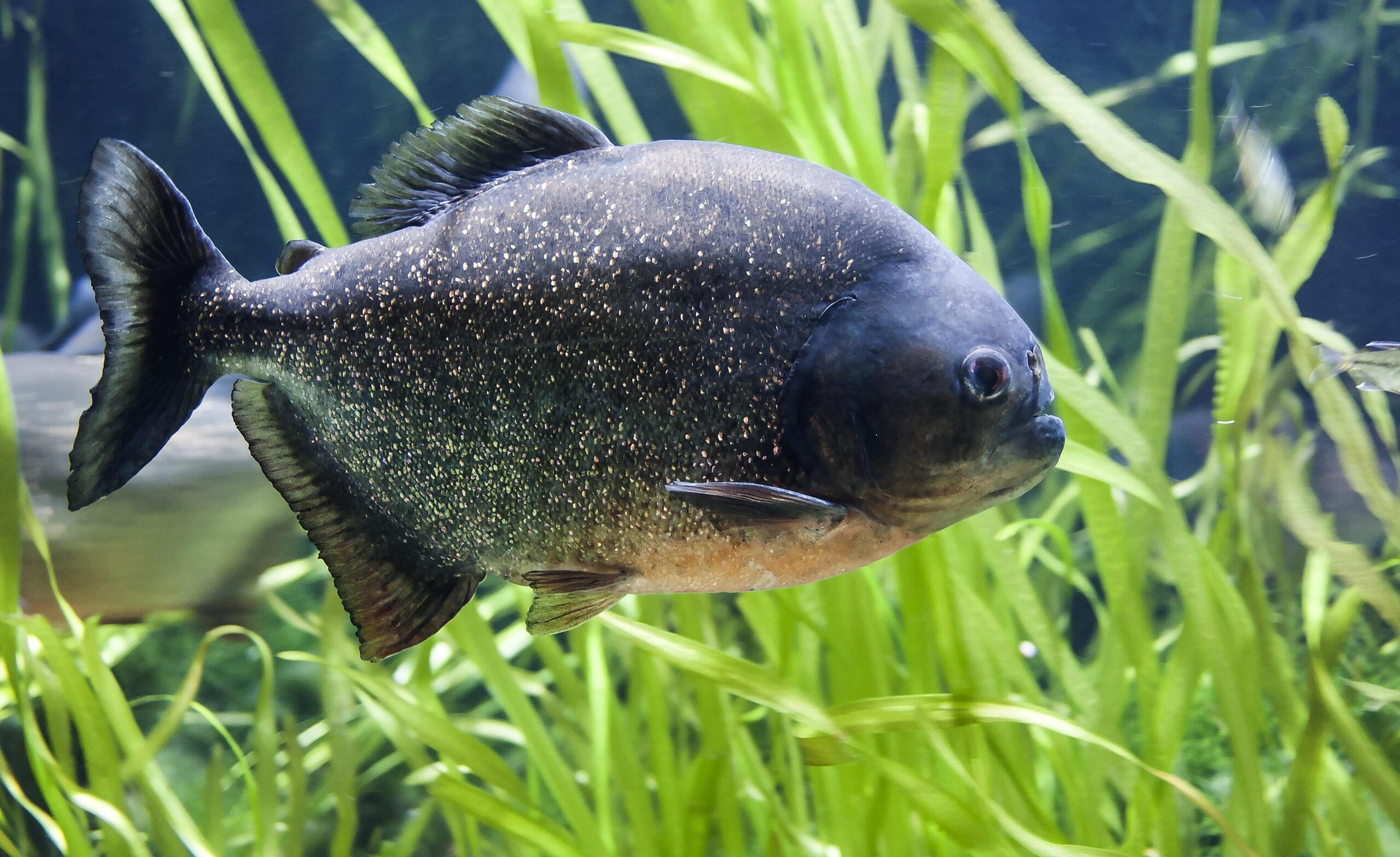
Red-bellied Piranha (Pygocentrus nattereri) is a medium-sized freshwater fish of tropical South America. Its orange-red belly and sharp triangular teeth are unmistakable, but the familiar image of constant feeding frenzy is misleading: it schools partly for protection, eats animal and plant foods, and usually avoids people. This guide separates well-supported biology from common assumptions and covers identification, range, habitat, diet, behavior, reproduction and conservation.
Identification
Adults have a deep, laterally compressed body, a blunt head and a powerful lower jaw. The sides are silver to gray, often with dark spotting, while the throat, chest and belly become orange to vivid red. A short adipose fin sits behind the dorsal fin. Each jaw carries a single row of triangular, razor-edged teeth that interlock when the mouth closes. Juveniles are slimmer and more heavily spotted, with less red on the underside. Sexes look broadly alike outside the breeding season. Females may become fuller-bodied with developing eggs, while spawning males can darken, but color and body shape alone are unreliable ways to determine sex.
Identification should combine body shape, markings, size, voice or movement, and location. One feature by itself can overlap with a related animal, a juvenile, or an individual in unusual light.
Photographs are most useful when they preserve scale and show several diagnostic features. Handling or repositioning a wild red-bellied piranha for identification can cause stress and is unnecessary.
Size and physical adaptations
Red-bellied Piranha typically measures commonly around 20–30 cm; maximum published standard length 50 cm and weighs maximum published weight about 3.9 kg. Most adults seen in the wild and aquariums are much smaller than the FishBase maximum. Standard length excludes the tail fin, so total length measurements are not directly comparable.
Its useful adaptations include interlocking triangular teeth shear flesh and fins, a deep body supports fast turning in crowded habitats, a sensitive lateral line detects water movement, schooling reduces individual predation risk, a flexible diet follows seasonal food availability, strong jaw muscles deliver quick slicing bites, coloration provides contrast and recognition in turbid water. These traits work together in the animal’s normal setting rather than serving as isolated curiosities.
Published measurements may use different methods, life stages or sample locations. Comparing figures responsibly means checking what was measured rather than selecting the largest number available.
Range and distribution
Native east of the Andes across much of the Amazon system, the Paraguay–Paraná drainage, northeastern Brazilian coastal rivers and the Essequibo region. Exact basin limits differ among references and local records require identification because several similar piranhas overlap. Aquarium releases have produced isolated non-native captures outside South America, including in the United States, but cold winters prevent establishment in many places. The native range includes Brazil, Bolivia, Paraguay, Argentina, Uruguay, Guyana, Suriname, French Guiana, Peru, Colombia, Ecuador.
A country-level map indicates broad distribution, not continuous occupation. Climate, elevation, water, vegetation, prey, breeding sites, barriers and survey effort all affect where records occur.
Records near the edge of the range deserve careful documentation because they may reflect natural movement, improved survey coverage, accidental transport or a genuine distribution change.
Habitat
Warm freshwater rivers, tributaries, creeks, floodplain lakes, lagoons and seasonally flooded forests, usually in lowland tropical and subtropical basins.
Schools use submerged roots, overhanging vegetation, woody cover and channel margins as shelter. Seasonal flooding opens vast feeding areas where fish, aquatic invertebrates, fallen fruit and seeds become available. As water falls, animals become concentrated in shrinking channels and pools, changing both diet and risk. The species tolerates turbid whitewater and slow backwaters, but water quality, temperature and oxygen still shape local abundance. Protecting a population therefore requires the feeding, shelter and breeding features that make a site usable, along with connections that allow movement.
Microhabitat matters. Shade, soil, current, moisture, shelter or host plants can determine whether a small area is usable even when the surrounding landscape appears suitable.
Diet and feeding
Red-bellied Piranha is a omnivore. Important foods include fish fins, scales and flesh, aquatic insects, crustaceans, mollusks, carrion, fruit and seeds, aquatic plants. Individuals nip fins or scales from larger fish, seize smaller prey, pick apart carrion and take insects, snails, crustaceans and plant material. Opportunism matters more than a single hunting method. Feeding intensity can rise where falling water crowds fish or food is scarce, but sensational demonstrations involving blood or restrained prey do not represent normal daily behavior. Young fish emphasize small invertebrates before taking larger items.
Diet changes with age, season, location and food supply. A dramatic prey record does not establish what most individuals eat most of the time; repeated field observations provide a stronger picture.
Feeding opportunities also create risk. An animal focused on prey may be less alert to predators, traffic or people, while contaminated prey can transfer pollutants through the food web.
Behavior and communication
Active by day and around dawn and dusk, with timing influenced by cover, temperature, predators and food. Red-bellied piranhas commonly move in loose schools that may contain dozens of fish. Experiments and field observations indicate that grouping reduces predation risk as well as helping individuals respond to food. Members maintain spacing through posture, movement, sound and occasional nips. When alarmed, a school may bunch tightly or dash into cover. Individuals can be cautious and may remain motionless near vegetation rather than attack an unfamiliar object.
The species combines visual displays, body orientation, water movement, chemical cues and sound. Piranhas can produce low-frequency sounds by rapidly contracting muscles attached to the swim bladder, especially during close conflict or handling. These signals help establish distance without every encounter escalating to a bite. The lateral-line system detects nearby movement in murky water. Behavior should be interpreted in context: alarm, courtship, feeding and temperature regulation can produce very different actions from the same animal.
Daily schedules are flexible responses, not rigid rules. Weather, breeding condition, disturbance, tides or food can move activity into a different part of the day.
Reproduction and development
Spawning is linked to rising water and the wet season in much of the range. A male clears a shallow bowl-shaped nest among roots or vegetation. A pair releases eggs and sperm over the site, and adhesive eggs attach to plant material. The male remains nearby and aggressively guards the nest from intruders. Timing and fecundity vary with locality, body size and water conditions. Hundreds to several thousand eggs may be released, varying by female and spawning event Newly hatched larvae remain close to the protected vegetation while using yolk reserves. After becoming free-swimming, fry feed on microscopic organisms and tiny invertebrates. Juveniles form groups, grow rapidly when food is plentiful and gradually add fish tissue and larger prey to the diet. Young animals are vulnerable to fish, birds and fluctuating water levels.
Young animals face different risks and may use different microhabitats or food than adults. Breeding success depends on adult condition, suitable sites and the survival of offspring through vulnerable early stages.
Counts of eggs or young describe reproductive output, not the number expected to reach adulthood. Mortality is normally greatest during eggs, larval or juvenile stages.
Predators and ecological role
The species connects several parts of the freshwater food web. It consumes fish tissue, invertebrates, carrion, fruit and seeds, while its eggs, juveniles and adults feed larger fishes, reptiles, birds and mammals. Fin nipping can affect the behavior and condition of other fishes without necessarily killing them. Scavenging recycles nutrients, and seasonal fruit feeding links flooded forests with river channels. Documented or likely predators include Black Caiman, Amazon River Dolphin, Large Catfish, Fish-eating Birds, Humans.
This animal is both a consumer and a food source. Its influence comes through many repeated interactions, so ecological claims should be based on measured populations rather than assumptions drawn from appearance.
Predator and prey relationships differ among places. A species can be ecologically influential without being abundant everywhere, and its role can change across its range.
Relationship with people
Red-bellied piranhas are eaten locally, caught by anglers and displayed in public aquariums. Their teeth and reputation support tourism and popular culture, but exaggerated stories obscure ordinary ecological roles. Bites to fishers and swimmers do occur, particularly when fish are handled, crowded, trapped in shallow warm water or defending nests. Deliberate release of aquarium fish is harmful and may be illegal.
Do not hand-feed, touch or corner a piranha. Fishers should use tools rather than fingers to remove hooks and keep hands away from the jaw even after capture. In native waters, follow local advice, avoid swimming near active fishing, fish-cleaning areas or isolated pools during extreme low water, and supervise children and pets. A deep bite needs prompt cleaning, bleeding control and medical assessment. Responsible observation means keeping an appropriate distance, avoiding capture or feeding, protecting habitat and following local wildlife or invasive-species guidance.
Wildlife guidance should come from the responsible local agency because collection rules, reporting requests and appropriate responses differ between native and introduced ranges.
Conservation
The species is widely distributed and currently assessed as Least Concern. That global category does not mean every population is secure; dams, pollution, wetland loss and overharvest can cause local declines. The reported global trend is Not established consistently across its broad range.
Important pressures include dam construction and altered flood pulses, wetland and riparian habitat loss, mining, agricultural and urban pollution, local overfishing, aquarium collection and illegal release, drought and warming that concentrate fish. Global status can hide local decline or recovery, so current regional monitoring and habitat management remain necessary.
The most useful conservation action follows the documented pressure. Protecting breeding sites, reducing road deaths or limiting pollutants can require different tools in different populations.