
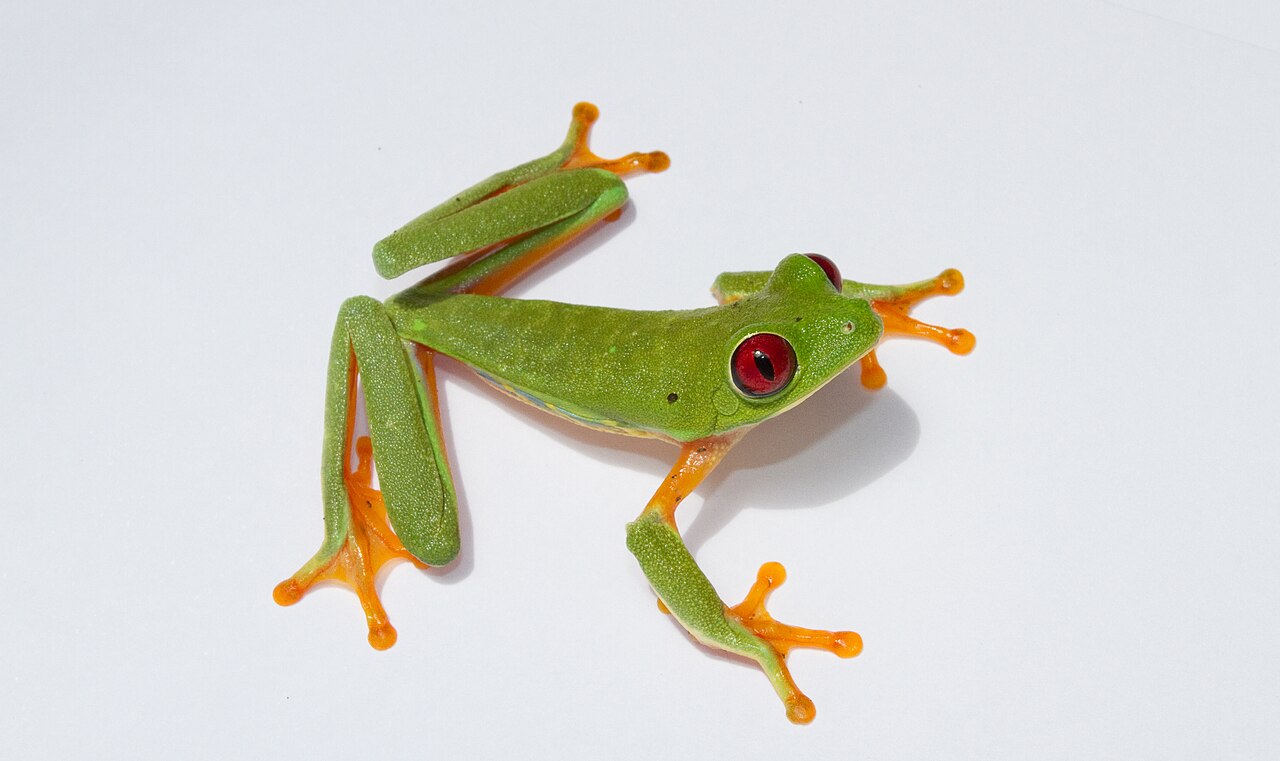
Red-Eyed Tree Frog (Agalychnis callidryas) is an arboreal amphibian of humid lowland and foothill forests from southern Mexico through Central America, with isolated records in northwestern Colombia. Its green back hides it among leaves by day, while red eyes, blue-and-yellow flanks and orange toes become conspicuous when it moves at night. It breeds on vegetation above water, allowing newly hatched tadpoles to drop directly into ponds. This guide separates well-supported biology from common assumptions and covers identification, range, habitat, diet, behavior, reproduction and conservation.
Identification
Adults have a smooth leaf-green back, large scarlet eyes with vertical pupils, orange toes and blue-and-yellow bars along the flanks and limbs. The belly is pale, the snout rounded and the long limbs end in broad adhesive discs. A resting frog folds its legs against the body, concealing the bright side colors. Color and flank pattern vary geographically, so the complete pattern and locality matter more than the red eye alone. Females are larger and heavier than males, commonly approaching 6–7 cm in body length while adult males are often about 4–5 cm. Calling males also develop temporary nuptial pads that help them hold a female during amplexus.
Identification should combine body shape, markings, size, voice or movement, and location. One feature by itself can overlap with a related animal, a juvenile, or an individual in unusual light.
Photographs are most useful when they preserve scale and show several diagnostic features. Handling or repositioning a wild red-eyed tree frog for identification can cause stress and is unnecessary.
Size and physical adaptations
Red-Eyed Tree Frog typically measures adult males about 4–5 cm and females about 5–7 cm snout to vent and weighs often about 6–15 g in adults, varying with sex and condition. Snout-to-vent length excludes the extended legs; females are usually substantially larger than males.
Its useful adaptations include adhesive toe discs grip smooth leaves, a transparent lower eyelid protects the eye, green resting color provides leaf camouflage, bright flank colors may startle predators, permeable skin absorbs water and oxygen, embryos detect dangerous vibrations, early hatching can help embryos escape predators. These traits work together in the animal’s normal setting rather than serving as isolated curiosities.
Published measurements may use different methods, life stages or sample locations. Comparing figures responsibly means checking what was measured rather than selecting the largest number available.
Range and distribution
Humid tropical lowlands and foothills from southern Mexico through much of Central America, with isolated populations in northwestern Colombia. Taxonomic revisions affect the exact northern boundary, and records should be checked against current species limits. The native range includes Mexico, Belize, Guatemala, Honduras, El Salvador, Nicaragua, Costa Rica, Panama, Colombia.
A country-level map indicates broad distribution, not continuous occupation. Climate, elevation, water, vegetation, prey, breeding sites, barriers and survey effort all affect where records occur.
Records near the edge of the range deserve careful documentation because they may reflect natural movement, improved survey coverage, accidental transport or a genuine distribution change.
Habitat
Lowland and premontane rainforest, wet secondary forest, shaded plantations and vegetated edges near temporary or permanent freshwater ponds, generally from sea level to about 1,250 m.
Adults shelter on broad leaves during daylight, often pressing the limbs tightly against the body to conserve moisture and hide bright colors. At night they climb through shrubs and trees to hunt. Breeding depends on calm water with overhanging vegetation, humid leaves for egg clutches and surrounding forest that protects adults from heat and dehydration. Protecting a population therefore requires the feeding, shelter and breeding features that make a site usable, along with connections that allow movement.
Microhabitat matters. Shade, soil, current, moisture, shelter or host plants can determine whether a small area is usable even when the surrounding landscape appears suitable.
Diet and feeding
Red-Eyed Tree Frog is a nocturnal insectivore. Important foods include moths, flies, crickets, grasshoppers, beetles, other small arthropods. An adult waits on vegetation and lunges at moving prey, using the tongue and jaws to capture small invertebrates. Tadpoles graze and filter organic material in ponds and may take animal matter opportunistically. Diet varies with body size, rainfall and local prey, and captive feeding records should not be assumed to describe wild intake.
Diet changes with age, season, location and food supply. A dramatic prey record does not establish what most individuals eat most of the time; repeated field observations provide a stronger picture.
Feeding opportunities also create risk. An animal focused on prey may be less alert to predators, traffic or people, while contaminated prey can transfer pollutants through the food web.
Behavior and communication
Nocturnal and arboreal, with breeding and calling concentrated during warm rainy periods. During the day the frog rests quietly beneath or upon leaves with its eyes partly covered by a patterned nictitating membrane. After dark it walks and leaps among branches. Males gather around breeding ponds, call from leaves and defend small calling positions. They can also shake branches during close contests, transmitting signals through the plant.
Males give short advertisement calls that help females locate them and warn rival males. Close rivals combine calls, postures and branch-shaking vibrations. The frogs also use touch during amplexus and chemical and visual cues at close range. Embryos begin sensing the outside world before hatching and respond selectively to vibration patterns associated with predators. Behavior should be interpreted in context: alarm, courtship, feeding and temperature regulation can produce very different actions from the same animal.
Daily schedules are flexible responses, not rigid rules. Weather, breeding condition, disturbance, tides or food can move activity into a different part of the day.
Reproduction and development
Rain stimulates males to call around forest ponds. A male clasps a female in amplexus while she deposits a gelatinous clutch on a leaf above water and he fertilizes the eggs externally. Moisture is essential because exposed clutches can dry. Normal hatching occurs after several days, but embryos attacked by a snake or wasp can hatch early and fall into the pond. Usually several dozen eggs per clutch; published counts vary among populations and females Aquatic tadpoles feed and grow in ponds before metamorphosing into small froglets that leave the water and enter vegetation. Eggs, tadpoles and froglets face different predators. Early escape from an egg predator moves an embryo into the pond sooner, where fish, aquatic insects and shrimp create a different set of risks.
Young animals face different risks and may use different microhabitats or food than adults. Breeding success depends on adult condition, suitable sites and the survival of offspring through vulnerable early stages.
Counts of eggs or young describe reproductive output, not the number expected to reach adulthood. Mortality is normally greatest during eggs, larval or juvenile stages.
Predators and ecological role
Red-Eyed Tree Frogs consume many nocturnal arthropods and in turn feed snakes, birds, bats and other predators. Their eggs support specialized predators such as wasps, while tadpoles transfer nutrients between leaf canopies and ponds. Because amphibian skin and eggs exchange water and chemicals readily, populations can respond to changes in rainfall, water quality and forest cover. Documented or likely predators include Cat-Eyed Snake, Social Wasp, Fishing Bat, Birds, Aquatic insects.
This animal is both a consumer and a food source. Its influence comes through many repeated interactions, so ecological claims should be based on measured populations rather than assumptions drawn from appearance.
Predator and prey relationships differ among places. A species can be ecologically influential without being abundant everywhere, and its role can change across its range.
Relationship with people
The species is a familiar symbol of tropical rainforest conservation and is displayed by zoos and kept in the pet trade. Observation should use dim light and avoid touching, because oils, salts, repellents and sunscreen on human skin can injure amphibians. Captive animals should come from documented legal, captive-bred sources rather than wild collection.
The frog poses little direct danger to people, but handling can harm the animal and may expose a person to microorganisms carried by amphibians. Observe without touching, wash hands after enclosure maintenance, supervise children and never release a captive frog or feeder insects outdoors. Responsible observation means keeping an appropriate distance, avoiding capture or feeding, protecting habitat and following local wildlife or invasive-species guidance.
Wildlife guidance should come from the responsible local agency because collection rules, reporting requests and appropriate responses differ between native and introduced ranges.
Conservation
The species is assessed as Least Concern because it remains widespread, but abundance is not uniform and some populations face continuing habitat loss, collection, disease and climate-related change. Current taxonomy can alter how particular northern populations are counted. The reported global trend is Decreasing in parts of its range, with regional uncertainty.
Important pressures include forest clearing and fragmentation, loss or pollution of breeding ponds, chytrid fungal disease and other pathogens, climate-driven changes in rainfall, illegal or poorly regulated collection, pesticide exposure, roads near breeding habitat. Global status can hide local decline or recovery, so current regional monitoring and habitat management remain necessary.
The most useful conservation action follows the documented pressure. Protecting breeding sites, reducing road deaths or limiting pollutants can require different tools in different populations.