
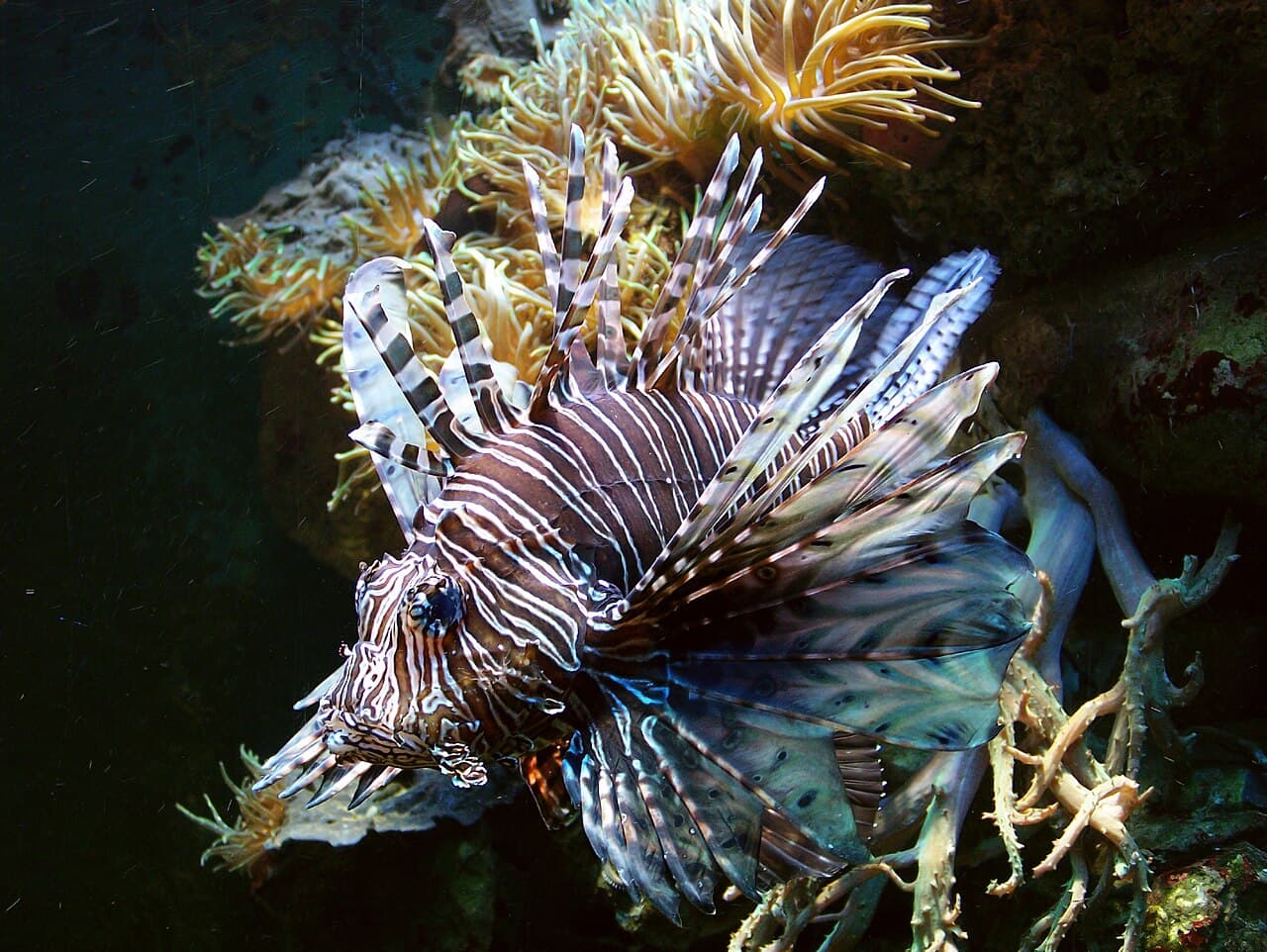
Red Lionfish (Pterois volitans) is a large, boldly striped scorpionfish native to the Indo-Pacific and introduced across the Atlantic, Gulf of Mexico and Caribbean. This guide separates well-supported biology from common assumptions and covers identification, range, habitat, diet, behavior, reproduction and conservation.
Identification
The body carries alternating maroon, reddish-brown and white vertical bands. Long separated dorsal spines rise above the back, fan-shaped pectoral rays spread on either side and fleshy tentacles occur above the eyes and around the mouth. Thirteen dorsal spines and three anal spines are venomous. Males and females look similar for most of the year. During courtship, mature males may become darker and display more strongly, while ripe females have a swollen pale abdomen.
Identification should combine body shape, markings, size, voice or movement, and location. One feature by itself can overlap with a related animal, a juvenile, or an individual in unusual light.
Photographs are most useful when they preserve scale and show several diagnostic features. Handling or repositioning a wild red lionfish for identification can cause stress and is unnecessary.
Size and physical adaptations
Red Lionfish typically measures commonly 25–38 cm; maximum about 45.7 cm and weighs large individuals can reach about 1.4 kg. Atlantic invaders can grow rapidly where prey is abundant; juveniles are much smaller but already carry venomous spines.
Its useful adaptations include venomous fin spines deter predators, broad pectoral fins herd prey toward the mouth, large gape swallows surprisingly large fishes, cryptic stripes break up the outline around reef structure, buccal jets can disorient small prey, high reproductive output supports rapid colonization. These traits work together in the animal’s normal setting rather than serving as isolated curiosities.
Published measurements may use different methods, life stages or sample locations. Comparing figures responsibly means checking what was measured rather than selecting the largest number available.
Range and distribution
Native from the eastern Indian Ocean and western Australia through Southeast Asia and the western Pacific to southern Japan, Korea and remote Pacific islands. Introduced populations now occupy the southeastern United States, Bermuda, Bahamas, Gulf of Mexico, Caribbean and portions of the South American Atlantic coast. The native range includes Australia, Indonesia, Malaysia, Philippines, Papua New Guinea, Japan, South Korea, Pacific islands, United States, The Bahamas, Caribbean nations, Mexico, Brazil.
A country-level map indicates broad distribution, not continuous occupation. Climate, elevation, water, vegetation, prey, breeding sites, barriers and survey effort all affect where records occur.
Records near the edge of the range deserve careful documentation because they may reflect natural movement, improved survey coverage, accidental transport or a genuine distribution change.
Habitat
Coral and rocky reefs, mangrove edges, seagrass, artificial structures and deep hard-bottom habitat, from shallow water to at least 200 m in the invaded Atlantic.
By day lionfish often hover under ledges, beside coral heads or around wrecks. They spread across reef edges to hunt at dawn, dusk and night. Juveniles use mangroves and sheltered structure as well as reefs. Protecting a population therefore requires the feeding, shelter and breeding features that make a site usable, along with connections that allow movement.
Microhabitat matters. Shade, soil, current, moisture, shelter or host plants can determine whether a small area is usable even when the surrounding landscape appears suitable.
Diet and feeding
Red Lionfish is a generalist carnivorous predator. Important foods include small reef fishes, gobies, wrasses, juvenile snappers, shrimp, crabs, other crustaceans. A lionfish approaches slowly, fans its pectoral rays to block escape and strikes by rapidly expanding the mouth and throat. In the invaded Atlantic it eats many native species that do not consistently recognize it as a predator, including young ecologically and commercially important fishes.
Diet changes with age, season, location and food supply. A dramatic prey record does not establish what most individuals eat most of the time; repeated field observations provide a stronger picture.
Feeding opportunities also create risk. An animal focused on prey may be less alert to predators, traffic or people, while contaminated prey can transfer pollutants through the food web.
Behavior and communication
Most active around dawn, dusk and night, although feeding also occurs by day. The fish hovers with precise fin movements, shelters near structure and may aggregate where prey is concentrated. It does not chase people, but it often holds position rather than fleeing, which increases accidental contact risk for divers and fishers.
Courtship uses circling, following and fin displays. Body orientation and raised spines signal defense at close range, while chemical and visual cues help fish locate prey and potential mates. Behavior should be interpreted in context: alarm, courtship, feeding and temperature regulation can produce very different actions from the same animal.
Daily schedules are flexible responses, not rigid rules. Weather, breeding condition, disturbance, tides or food can move activity into a different part of the day.
Reproduction and development
A courting pair rises into the water column, and the female releases two buoyant mucus packets containing thousands of eggs. Males release sperm over the packets, which drift and break apart as development begins. Two gelatinous egg masses totaling roughly 10,000–30,000 eggs per spawn Larvae drift in plankton for several weeks before settling into benthic habitat. Rapid growth, early maturity and frequent spawning allow an introduced population to expand quickly.
Young animals face different risks and may use different microhabitats or food than adults. Breeding success depends on adult condition, suitable sites and the survival of offspring through vulnerable early stages.
Counts of eggs or young describe reproductive output, not the number expected to reach adulthood. Mortality is normally greatest during eggs, larval or juvenile stages.
Predators and ecological role
In its native range the species is one reef predator among many. In the Atlantic, high densities remove small fishes and crustaceans, compete with native groupers and snappers and can reduce herbivorous recruits that help control algae. Local removal lowers density but cannot eradicate the broad invasion. Documented or likely predators include Moray Eels, Large Groupers, Humans.
This animal is both a consumer and a food source. Its influence comes through many repeated interactions, so ecological claims should be based on measured populations rather than assumptions drawn from appearance.
Predator and prey relationships differ among places. A species can be ecologically influential without being abundant everywhere, and its role can change across its range.
Relationship with people
The red lionfish is valued in marine aquariums but releases from that trade likely helped establish the Atlantic invasion. Divers and commercial fishers now remove lionfish for food and reef management. Properly cleaned flesh is edible, but venomous spines remain dangerous before removal.
Never touch or corner a lionfish. Fishers should use puncture-resistant tools and training to remove spines. A sting requires prompt medical evaluation; hot-water immersion may reduce pain while professional care is arranged, following local medical guidance. Responsible observation means keeping an appropriate distance, avoiding capture or feeding, protecting habitat and following local wildlife or invasive-species guidance.
Wildlife guidance should come from the responsible local agency because collection rules, reporting requests and appropriate responses differ between native and introduced ranges.
Conservation
Not considered globally threatened in its large native range. In the Atlantic it is managed as a harmful invasive species rather than protected wildlife. The reported global trend is Native global trend is not precisely known; introduced Atlantic populations are established and expanding locally.
Important pressures include local reef degradation in native range, aquarium collection in some areas, targeted removal in introduced range. Global status can hide local decline or recovery, so current regional monitoring and habitat management remain necessary.
The most useful conservation action follows the documented pressure. Protecting breeding sites, reducing road deaths or limiting pollutants can require different tools in different populations.