
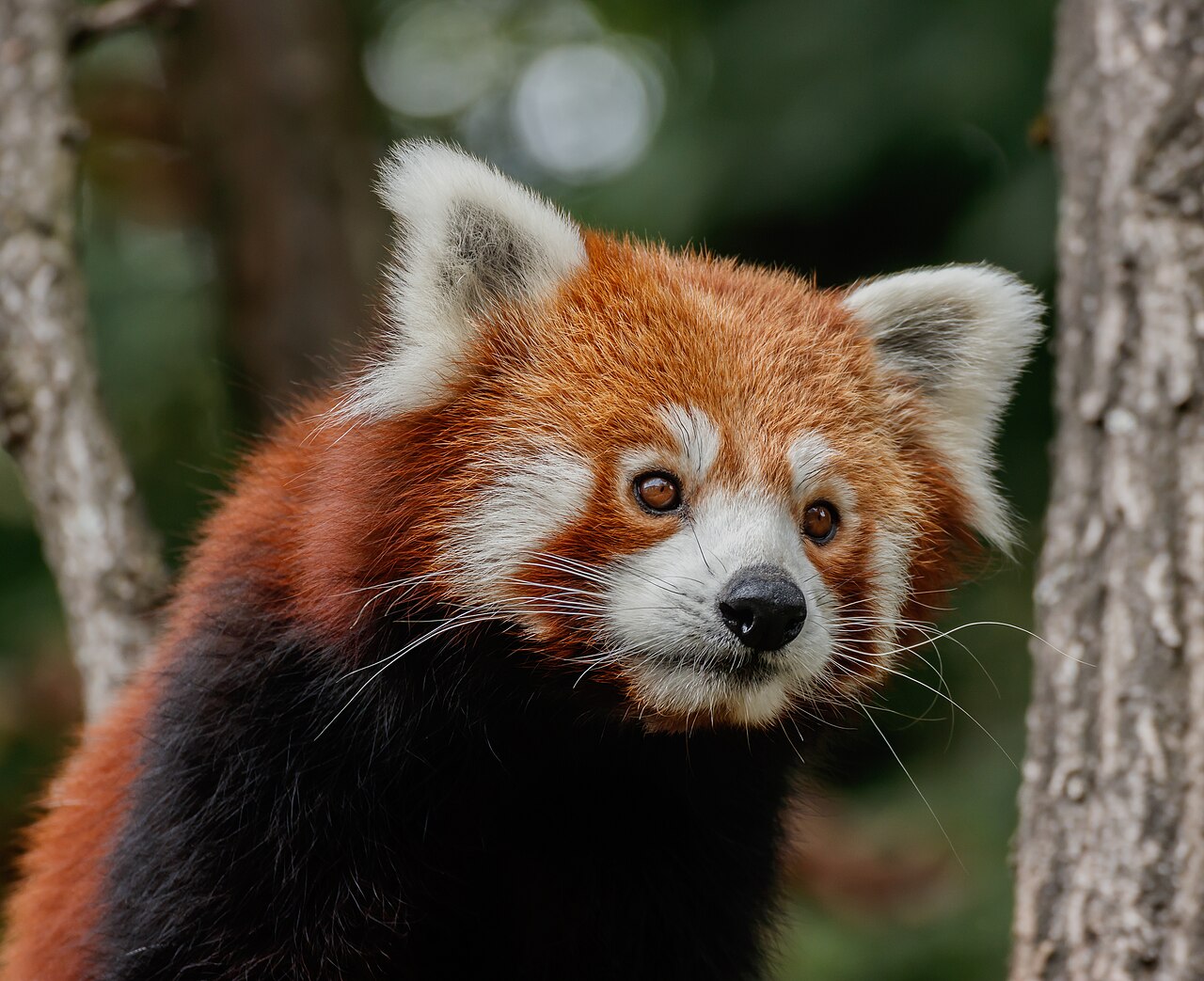
Red Panda (Ailurus fulgens) is a small arboreal mammal of temperate mountain forests in the eastern Himalayas and southwestern China. Its rust-red coat, masked face and ringed tail are distinctive, but its closest living relatives are musteloids rather than giant pandas. It depends on bamboo-rich forest, old trees and connected canopy cover. This guide separates well-supported biology from common assumptions and covers identification, range, habitat, diet, behavior, reproduction and conservation.
Identification
Red pandas have reddish upperparts, dark legs and belly, a pale face with reddish tear marks, pointed ears and a long bushy tail marked by alternating reddish and buff rings. Thick fur covers the soles of the feet. The broad, curved, semi-retractile claws and flexible ankles help them grip trunks and descend headfirst. Males and females look similar; males average slightly heavier, so sex is usually confirmed through anatomy, genetics or veterinary examination rather than coat pattern.
Identification should combine body shape, markings, size, voice or movement, and location. One feature by itself can overlap with a related animal, a juvenile, or an individual in unusual light.
Photographs are most useful when they preserve scale and show several diagnostic features. Handling or repositioning a wild red panda for identification can cause stress and is unnecessary.
Size and physical adaptations
Red Panda typically measures 56–62.5 cm head-and-body length and weighs 3.6–7.7 kg. Body size varies by sex, locality and taxonomic lineage; the Chinese lineage generally averages larger.
Its useful adaptations include false thumb grips bamboo stems, dense fur insulates the body and feet, long tail provides balance and warmth, flexible ankles aid headfirst descent, low metabolic rate conserves energy, sharp claws grip wet bark, broad molars crush fibrous leaves. These traits work together in the animal’s normal setting rather than serving as isolated curiosities.
Published measurements may use different methods, life stages or sample locations. Comparing figures responsibly means checking what was measured rather than selecting the largest number available.
Range and distribution
Red pandas occupy a narrow mountain arc from Nepal through northeastern India and Bhutan into northern Myanmar and southwestern China. Populations are fragmented, and the boundary between the proposed Himalayan and Chinese species or lineages is associated with major river systems. The native range includes Nepal, India, Bhutan, China, Myanmar.
A country-level map indicates broad distribution, not continuous occupation. Climate, elevation, water, vegetation, prey, breeding sites, barriers and survey effort all affect where records occur.
Records near the edge of the range deserve careful documentation because they may reflect natural movement, improved survey coverage, accidental transport or a genuine distribution change.
Habitat
Cool temperate broadleaf, mixed and conifer forest with dense bamboo understory, old hollow trees, fallen logs and reliable water.
They rest and escape predators in trees, feed in bamboo patches and use hollow trunks, rock crevices or dense vegetation as shelter. Suitable habitat combines canopy cover with productive bamboo at roughly 2,200–4,800 metres, though local elevation varies. Roads, grazing and logging can divide feeding areas from den trees. Protecting a population therefore requires the feeding, shelter and breeding features that make a site usable, along with connections that allow movement.
Microhabitat matters. Shade, soil, current, moisture, shelter or host plants can determine whether a small area is usable even when the surrounding landscape appears suitable.
Diet and feeding
Red Panda is a bamboo specialist with an opportunistic omnivorous diet. Important foods include bamboo leaves, tender bamboo shoots, berries, fruit, acorns, insects, bird eggs. Although classified in Carnivora, the red panda obtains most of its food from bamboo leaves and shoots. Because bamboo is fibrous and relatively low in usable energy, it selects nutritious parts, spends many hours feeding and conserves energy between bouts. Fruit, acorns, roots, insects, eggs and small animal matter supplement the diet seasonally.
Diet changes with age, season, location and food supply. A dramatic prey record does not establish what most individuals eat most of the time; repeated field observations provide a stronger picture.
Feeding opportunities also create risk. An animal focused on prey may be less alert to predators, traffic or people, while contaminated prey can transfer pollutants through the food web.
Behavior and communication
Most active at dawn, dusk and during the night, with daytime activity varying by temperature, season and disturbance. Red pandas are agile climbers and often rest stretched along a branch or curled with the tail over the face. They descend trees headfirst using rotating ankles and curved claws. On the ground they walk deliberately between feeding patches. Cold conditions suit them; in severe cold they reduce activity and curl tightly to conserve heat.
Individuals mark trees, rocks and paths with urine, glandular secretions and feces. Scent carries information about identity and reproductive condition. Quiet whistles, squeals, twitters and huffing calls are used at close range, while posture and raised fur signal alarm or defense. Behavior should be interpreted in context: alarm, courtship, feeding and temperature regulation can produce very different actions from the same animal.
Daily schedules are flexible responses, not rigid rules. Weather, breeding condition, disturbance, tides or food can move activity into a different part of the day.
Reproduction and development
Mating usually occurs in winter. Males and females follow scent trails and may mate with more than one partner. After delayed implantation and variable development, a pregnant female prepares a nest lined with leaves, grass and twigs in a hollow tree, rock crevice or protected den. Usually 1–4 cubs, commonly 2 Cubs are born furred but helpless, with closed eyes. The mother cleans and nurses them, moves them among nests if disturbed and spends increasing time away as they grow. Cubs first explore outside the nest at around three months, approach adult size near one year and may remain with their mother until the next breeding season.
Young animals face different risks and may use different microhabitats or food than adults. Breeding success depends on adult condition, suitable sites and the survival of offspring through vulnerable early stages.
Counts of eggs or young describe reproductive output, not the number expected to reach adulthood. Mortality is normally greatest during eggs, larval or juvenile stages.
Predators and ecological role
By consuming bamboo, fruit and small animal food, red pandas transfer nutrients through mountain forests and may disperse some seeds. Their reliance on structurally complex forest makes them an indicator of intact habitat shared with pheasants, small carnivores and many specialized plants. They can be prey for leopards, martens and large raptors, especially when young. Documented or likely predators include Snow Leopard, Yellow-Throated Marten, Leopard, Large Raptors, Domestic Dog.
This animal is both a consumer and a food source. Its influence comes through many repeated interactions, so ecological claims should be based on measured populations rather than assumptions drawn from appearance.
Predator and prey relationships differ among places. A species can be ecologically influential without being abundant everywhere, and its role can change across its range.
Relationship with people
Red pandas are protected throughout their range, but forest clearing, livestock grazing, roads, bamboo loss, snares and free-ranging dogs continue to reduce and fragment habitat. People should never buy live animals, skins or body parts. Responsible tourism keeps distance, follows park rules and supports community forestry without feeding wildlife.
Wild red pandas usually retreat, but their claws and teeth can injure a person who tries to touch, corner or capture one. Observe quietly from a distance and report an injured animal to wildlife authorities. Bites or deep scratches require prompt cleaning and medical assessment. Responsible observation means keeping an appropriate distance, avoiding capture or feeding, protecting habitat and following local wildlife or invasive-species guidance.
Wildlife guidance should come from the responsible local agency because collection rules, reporting requests and appropriate responses differ between native and introduced ranges.
Conservation
The IUCN Red List classifies the broadly treated Ailurus fulgens as Endangered because of a continuing decline driven by habitat loss, fragmentation and human pressures. The reported global trend is Decreasing.
Important pressures include forest loss, habitat fragmentation, bamboo decline, livestock grazing, free-ranging dogs, snares and poaching, road construction, climate change. Global status can hide local decline or recovery, so current regional monitoring and habitat management remain necessary.
The most useful conservation action follows the documented pressure. Protecting breeding sites, reducing road deaths or limiting pollutants can require different tools in different populations.