
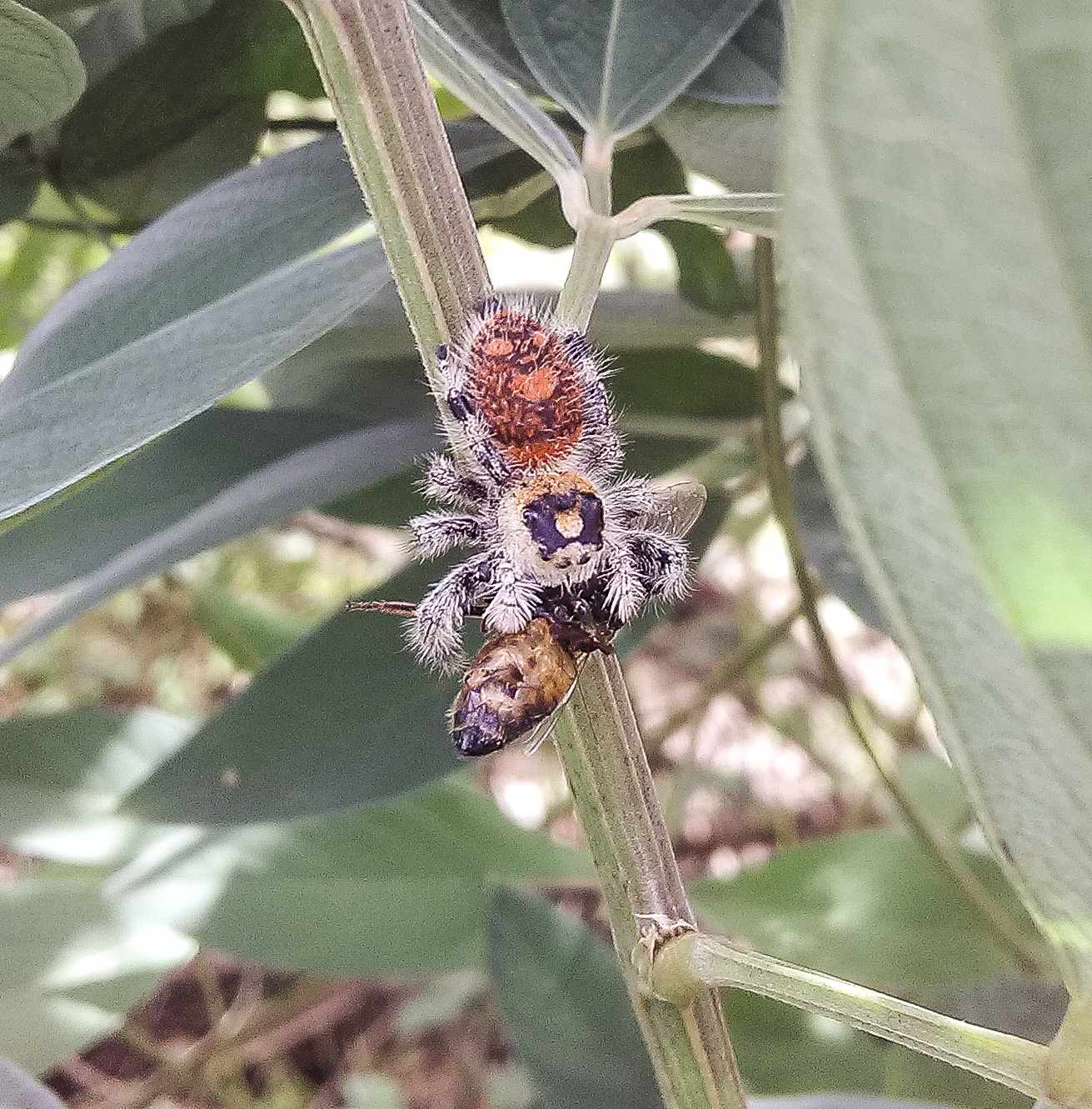
Regal Jumping Spider (Phidippus regius) is a large, sharp-eyed jumping spider that stalks insects across warm southeastern landscapes. This evidence-based guide covers identification, range, habitat, diet, behaviour, reproduction and conservation without repeating the FAQ block shown elsewhere on the page.
Identification and taxonomy
Regal Jumping Spider (Phidippus regius) is a large, sharp-eyed jumping spider that stalks insects across warm southeastern landscapes. The regal jumping spider is a salticid spider in genus Phidippus, a group known for excellent vision and active hunting. This distinction matters because names and appearances can hide important biological relationships. A reliable profile begins with the animal’s actual taxonomic scope rather than treating every familiar label as a separate species.
Key field marks include compact hairy body, high front cephalothorax and four forward-facing eyes. adult males are usually black with white markings; females range from gray to orange-brown. Females are larger and more variable in colour; mature males are usually black and white with enlarged front legs. Together, these traits are more useful for identification than colour alone, because age, season, light and geographic variation can all change how an individual looks.
Size and sexual dimorphism
Typical measurements are About 7–22 mm body length (About 0.3–0.9 in body length), with a weight of Less than 1 g (Less than 0.04 oz). Body size varies with sex, age, season, food and location, so these figures describe a practical range rather than a limit that every individual must fit.
Its physical design reflects the demands of its way of life. Important adaptations include large principal eyes resolve detail and colour, hydraulic legs power precise jumps, silk safety line anchors each leap, courtship displays reduce mistaken attacks. Each reduces the cost of moving, feeding or surviving in the conditions this animal regularly experiences.
Southeastern range
Native to the southeastern United States, the Bahamas and parts of the Caribbean, with Florida at the center of its well-documented range. Recorded native locations include United States, Bahamas, Cuba. Distribution maps show broad presence, but they should not be read as proof that the animal occupies every place inside a shaded country or region.
Local occurrence depends on usable habitat, prey or food, shelter, breeding sites and safe connections between them. Populations may therefore be common in one valley, island or watershed and absent from apparently similar areas nearby.
Habitat and silk retreats
Sunny woodland edges, scrub, gardens, walls and vegetation where surfaces provide hunting platforms and sheltered silk retreats. Habitat quality depends on structure as well as climate: animals need places to feed, hide, rest and reproduce, and those features may change over short distances.
Seasonal conditions alter how the habitat is used. Food peaks, snow or ice, drought, flooding and human disturbance can shift daily movements. Protecting a species consequently requires more than preserving a point on a map; the working ecological system around it must remain intact.
Prey and hunting
Regal Jumping Spider is a insectivore. Important foods include flies, moths, crickets, other spiders. Availability changes through the year, and individuals adjust where and how long they forage rather than following one fixed menu.
Feeding also connects this animal to the wider ecosystem. By consuming, moving or storing food and by becoming prey itself, it transfers energy through its community. Diet evidence should come from field observations and analysed remains, not from dramatic isolated records.
Vision and jumping
Activity is described as diurnal visual hunter. Typical behaviour includes stalks prey before pouncing, turns to inspect movement, builds a silk sleeping retreat. These actions help individuals find resources, warn others, maintain space or reduce exposure to predators.
Solitary outside courtship Communication may involve posture, scent, touch and calls. What appears simple from a distance often carries precise information about identity, alarm, breeding condition or ownership of a site.
Courtship and communication
Silk retreat in rolled leaves, bark crevices or sheltered corners provides shelter from weather and enemies. The location and structure of that refuge can be as important as food, especially when young are immobile or when adults must conserve energy.
Repeated use of paths, dens, nests or colony sites makes them vulnerable to disturbance. Observers should keep their distance, avoid blocking access and never handle young or alter a shelter to obtain a photograph.
Eggs and spiderlings
Breeding occurs warm months, with timing varying by climate. Multiple egg sacs, often containing dozens of eggs are produced after eggs hatch after roughly 2–4 weeks depending on temperature. Young depend on parental protection and food while their movement, insulation and foraging skills develop.
Sexual maturity is reached after several molts over a few months. Reproductive success depends on adult condition and local resources, so a population can contain visible adults yet decline when too few young survive to replace them.
Predators and defenses
Natural pressures include predation, severe weather, competition and variable food. Known predators or major sources of mortality include Wasps, Lizards, Birds. Avoidance, camouflage, shelter and vigilance reduce risk but cannot remove it.
Human activity can add faster pressures. Roads, pollution, disturbance, habitat conversion and altered food webs may act together, which is why local monitoring often reveals problems that a broad global category cannot show.
Conservation and coexistence
Not Evaluated by the IUCN; it is widespread in suitable habitat and has no global assessment. The reported population trend is Unknown. Major concerns include broad-spectrum pesticides, loss of structurally diverse vegetation, unnecessary killing through fear. Conservation decisions should use the species’ current assessment and local evidence.
Effective protection retains habitat connections, breeding and resting sites, and dependable food. It also reduces preventable mortality and measures results over time. Responsible wildlife viewing supports that work when people keep distance, follow local rules and avoid feeding wild animals.