
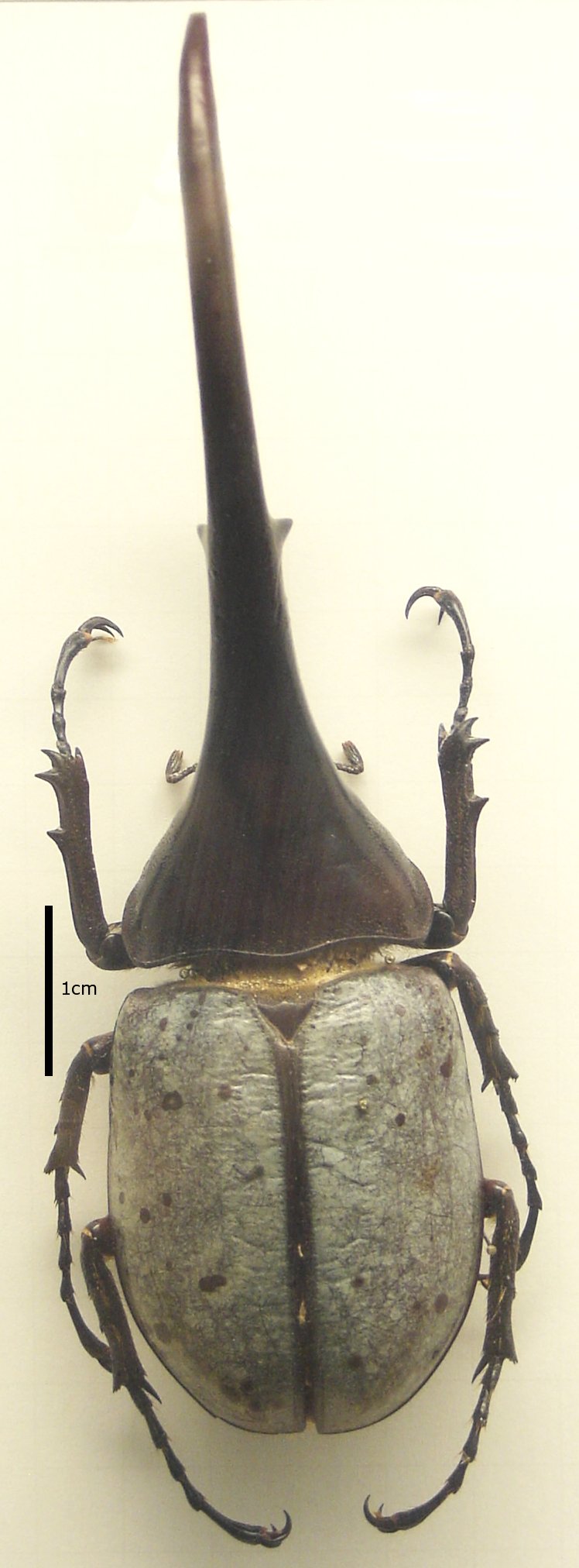
Rhinoceros Beetle (Dynastinae) are the roughly 1,400 described species in the scarab subfamily Dynastinae. Famous horned giants represent only part of the group; many species are small and lack dramatic horns. This guide separates well-supported biology from common assumptions and covers identification, range, habitat, diet, behavior, reproduction and conservation.
Identification
Adults are robust oval scarab beetles with clubbed, plate-like antennal tips, strong digging legs and hardened wing covers. Some males bear one or more enlarged horns on the head or thorax; females and many entire species have only small bumps or no obvious horns. Reliable identification uses locality and details of the antennae, mouthparts, legs and underside. In the best-known horned species, males carry larger horns used in contests while females are hornless or less ornamented. The amount of dimorphism differs greatly across the subfamily.
Identification should combine body shape, markings, size, voice or movement, and location. One feature by itself can overlap with a related animal, a juvenile, or an individual in unusual light.
Photographs are most useful when they preserve scale and show several diagnostic features. Handling or repositioning a wild rhinoceros beetle for identification can cause stress and is unnecessary.
Size and physical adaptations
Rhinoceros Beetle typically measures from a few millimetres to more than 15 cm across species when large horns are included and weighs Highly species- and sex-dependent; no valid single subfamily range. The smallest and largest values belong to different species, and horn length can greatly increase a male’s total measurement.
Its useful adaptations include hardened elytra protect the flight wings, spined forelegs dig through soil and plant debris, lamellate antennae detect odors, larval jaws process decaying wood or roots, male horns act as levers during contests. These traits work together in the animal’s normal setting rather than serving as isolated curiosities.
Published measurements may use different methods, life stages or sample locations. Comparing figures responsibly means checking what was measured rather than selecting the largest number available.
Range and distribution
Dynastinae occur on every inhabited continent, with the greatest diversity in tropical and subtropical regions. Each species has its own range; a worldwide subfamily map should not be read as the distribution of any one rhinoceros beetle. The native range includes North America, Central America, South America, Africa, Europe, South and Southeast Asia, East Asia, Australia, Pacific islands.
A country-level map indicates broad distribution, not continuous occupation. Climate, elevation, water, vegetation, prey, breeding sites, barriers and survey effort all affect where records occur.
Records near the edge of the range deserve careful documentation because they may reflect natural movement, improved survey coverage, accidental transport or a genuine distribution change.
Habitat
Forests, woodland, savanna, grassland, farms, gardens and other habitats containing soil, roots, decomposing wood or accumulations of dead plant matter.
Larvae live hidden in soil, rotten logs, stumps, compost or decaying plant debris. Adults often shelter by day and emerge at dusk or night to feed, mate and fly toward odor cues or lights. Protecting a population therefore requires the feeding, shelter and breeding features that make a site usable, along with connections that allow movement.
Microhabitat matters. Shade, soil, current, moisture, shelter or host plants can determine whether a small area is usable even when the surrounding landscape appears suitable.
Diet and feeding
Rhinoceros Beetle is a species-dependent herbivore, sap feeder or decomposer. Important foods include decaying wood, composting plant debris, plant roots, rotting fruit, tree sap, floral tissues. Most larvae consume decomposing organic matter or roots, while adults of different species take sap, ripe or rotting fruit, roots or flowers; some adults feed little. A food recorded for one pest or giant species cannot be assigned to the whole group.
Diet changes with age, season, location and food supply. A dramatic prey record does not establish what most individuals eat most of the time; repeated field observations provide a stronger picture.
Feeding opportunities also create risk. An animal focused on prey may be less alert to predators, traffic or people, while contaminated prey can transfer pollutants through the food web.
Behavior and communication
Most studied adults are nocturnal or crepuscular, although schedules differ among species. Adults dig, climb and fly with surprising power. Horned males may meet at feeding or breeding sites and use their horns to lift, push or dislodge rivals rather than to injure prey.
Chemical cues are central to locating mates and food, while touch and body position matter during close-range contests. Some larvae and adults can produce sounds by rubbing body parts. Behavior should be interpreted in context: alarm, courtship, feeding and temperature regulation can produce very different actions from the same animal.
Daily schedules are flexible responses, not rigid rules. Weather, breeding condition, disturbance, tides or food can move activity into a different part of the day.
Reproduction and development
After mating, females place eggs in soil, decaying wood or other organic substrate suited to the species. The grub passes through three larval stages, forms a protected pupal cell and emerges as a winged adult. Species-specific; eggs are laid singly or in small groups in suitable substrate Complete metamorphosis through egg, three grub stages, pupa and adult. Larval development can take months and, in some large species, several years; adults often live weeks to months.
Young animals face different risks and may use different microhabitats or food than adults. Breeding success depends on adult condition, suitable sites and the survival of offspring through vulnerable early stages.
Counts of eggs or young describe reproductive output, not the number expected to reach adulthood. Mortality is normally greatest during eggs, larval or juvenile stages.
Predators and ecological role
Larvae that consume rotten wood and plant debris accelerate decomposition and nutrient cycling, while flower-visiting adults can pollinate palms and aroids. Root-feeding species can damage crops, and invasive Oryctes species are serious palm pests. Documented or likely predators include Bird, Small Mammal, Reptile, Parasitoid Wasp.
This animal is both a consumer and a food source. Its influence comes through many repeated interactions, so ecological claims should be based on measured populations rather than assumptions drawn from appearance.
Predator and prey relationships differ among places. A species can be ecologically influential without being abundant everywhere, and its role can change across its range.
Relationship with people
People value rhinoceros beetles in art, collecting, festivals, education and the regulated pet trade. At the same time, coconut and oil-palm pests require quarantine and biological control, and moving live beetles or infested plant material can spread invasive populations.
Observe without handling or relocating them. Adults do not sting and cannot inject venom, but their claws can grip skin and large insects may pinch. Report suspected invasive coconut rhinoceros beetles to the responsible agricultural agency. Responsible observation means keeping an appropriate distance, avoiding capture or feeding, protecting habitat and following local wildlife or invasive-species guidance.
Wildlife guidance should come from the responsible local agency because collection rules, reporting requests and appropriate responses differ between native and introduced ranges.
Conservation
Dynastinae has no single IUCN category. Individual species face different conditions, and most have not received global assessments. The reported global trend is Unknown at the subfamily level.
Important pressures include deforestation, removal of dead wood, pesticide exposure, illegal collection, light pollution, climate change, invasive predators, control campaigns against pest species. Global status can hide local decline or recovery, so current regional monitoring and habitat management remain necessary.
The most useful conservation action follows the documented pressure. Protecting breeding sites, reducing road deaths or limiting pollutants can require different tools in different populations.
Sources and further reading
- University of Nebraska State Museum: Dynastine scarab beetles of Costa Rica and Panama
- University of Nebraska State Museum: Dynastinae of Ecuador
- University of Florida IFAS: Hercules Beetle
- Smithsonian research: functional classification of rhinoceros beetles
- Wikimedia Commons image and license record
