
Home/Animals/Mammalia/Ring-Tailed Lemur
Species profileIUCN: EN

Ring-Tailed Lemur

Lemur catta

A female-led, highly social primate of southern Madagascar with a conspicuous black-and-white tail.

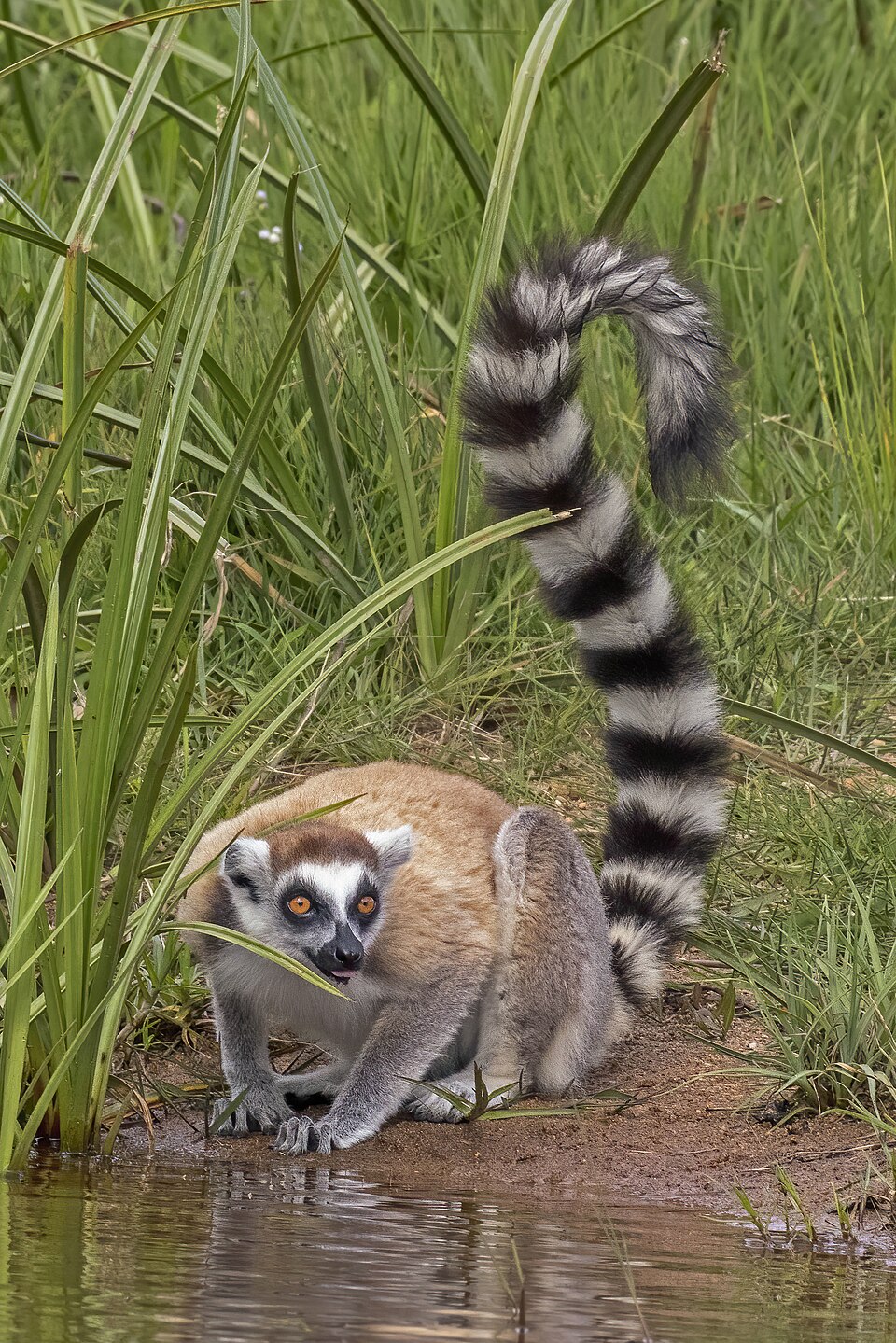
Wild ring-tailed lemur standing in Madagascar with its long black-and-white banded tail visible
Charles J. Sharp / Wikimedia Commons / CC BY-SA 4.0
๐ŸŒ Read in Language:

โšก At a Glance

Species profile
Also Known As
Ringtail, ring-tailed maki
Diet Category
Opportunistic omnivore dominated by plant foods
Activity Rhythm
Diurnal, with morning sunning, daytime travel and midday rest during heat.
Wild Lifespan
Wild median or typical survival is often around 15โ€“16 years, with substantial individual variation
Typical Weight
usually about 2.2โ€“3.5 kg
Conservation Status
EN
๐Ÿ’ก Key Biological Insight: Ring-tailed lemurs spend far more time on the ground than most lemurs, yet the famous striped tail cannot grasp a branch and is used mainly for balance and signaling.

๐ŸŒณ Scientific Taxonomy Hierarchy

The ring-tailed lemur is the only living species in genus Lemur and belongs to family Lemuridae. Like every wild lemur, it is native only to Madagascar and belongs to the strepsirrhine branch of primates.

KingdomAnimalia
PhylumChordata
ClassMammalia
OrderPrimates
FamilyLemuridae
GenusLemur
SpeciesLemur catta

Distinguishing Anatomical Features

  • โœ“The body is gray to rosy brown with a white belly, dark muzzle, black triangular eye patches and a foxlike face. Its long nonprehensile tail bears about thirteen alternating black and white bands and is often held upright like a flag while the troop travels.
  • โœ“Long tail balances movement and keeps troops visually connected
  • โœ“Toothcomb grooms fur and gathers food
  • โœ“Grooming claw cleans the coat
  • โœ“Scent glands mark routes and rivals
  • โœ“Strong hind limbs support leaps and ground travel
  • โœ“Flexible diet helps survive pronounced dry seasons

๐Ÿ“ Physical Measurements

Total Lengthhead and body about 15โ€“18 in; tail about 22โ€“25 in
Body Weightusually about 4.9โ€“7.7 lb
Tail LengthLong, bushy, nonprehensile and ringed black and white
WingspanNot applicable
Top SpeedNo dependable universal maximumMovement changes with context and conditions.

๐ŸŽจ Appearance & Distinctive Markings

GrayRosy brownWhiteBlack

Skin / Covering: Dense fur with bare palms, soles and muzzle

Sexual Dimorphism: Males and females look similar in size and coat. Mature males have conspicuous scent glands on the wrists and chest plus a horny wrist spur used during marking; females dominate group members.

๐Ÿ—บ๏ธ Geographic Distribution & Habitat

Endemic to southern and southwestern Madagascar, from spiny forest and dry scrub to gallery forest along rivers. The remaining range is fragmented, and troops may occur in isolated forest patches, protected reserves and rocky landscapes with limited tree cover.

Spiny thicket, dry deciduous forest, riverine gallery forest, scrub, rocky canyon and limited montane habitat with seasonal fruit, leaves and reliable shelter.

Country-level distribution map

Native range
FijiTanzaniaWestern SaharaCanadaUnited StatesKazakhstanUzbekistanPapua New GuineaIndonesiaArgentinaChileCongo - KinshasaSomaliaKenyaSudanChadHaitiDominican RepublicRussiaBahamasFalkland IslandsNorwayGreenlandFrench Southern TerritoriesTimor-LesteSouth AfricaLesothoMexicoUruguayBrazilBoliviaPeruColombiaPanamaCosta RicaNicaraguaHondurasEl SalvadorGuatemalaBelizeVenezuelaGuyanaSurinameFranceEcuadorPuerto RicoJamaicaCubaZimbabweBotswanaNamibiaSenegalMaliMauritaniaBeninNigerNigeriaCameroonTogoGhanaCรดte dโ€™IvoireGuineaGuinea-BissauLiberiaSierra LeoneBurkina FasoCentral African RepublicCongo - BrazzavilleGabonEquatorial GuineaZambiaMalawiMozambiqueEswatiniAngolaBurundiIsraelLebanonMadagascar โ€” Native rangePalestinian TerritoriesGambiaTunisiaAlgeriaJordanUnited Arab EmiratesQatarKuwaitIraqOmanVanuatuCambodiaThailandLaosMyanmar (Burma)VietnamNorth KoreaSouth KoreaMongoliaIndiaBangladeshBhutanNepalPakistanAfghanistanTajikistanKyrgyzstanTurkmenistanIranSyriaArmeniaSwedenBelarusUkrainePolandAustriaHungaryMoldovaRomaniaLithuaniaLatviaEstoniaGermanyBulgariaGreeceTรผrkiyeAlbaniaCroatiaSwitzerlandLuxembourgBelgiumNetherlandsPortugalSpainIrelandNew CaledoniaSolomon IslandsNew ZealandAustraliaSri LankaChinaTaiwanItalyDenmarkUnited KingdomIcelandAzerbaijanGeorgiaPhilippinesMalaysiaBruneiSloveniaFinlandSlovakiaCzechiaEritreaJapanParaguayYemenSaudi ArabiaCyprusMoroccoEgyptLibyaEthiopiaDjiboutiUgandaRwandaBosnia & HerzegovinaNorth MacedoniaSerbiaMontenegroKosovoTrinidad & TobagoSouth Sudan
Highlighted countries are recorded profile locations, not precise biological range boundaries.Map boundaries: Natural Earth

Recorded Native Countries & Territories:

๐Ÿ’ก Did You Know?

  • ๐Ÿ’กLong tail balances movement and keeps troops visually connected
  • ๐Ÿ’กToothcomb grooms fur and gathers food
  • ๐Ÿ’กGrooming claw cleans the coat
  • ๐Ÿ’กScent glands mark routes and rivals
  • ๐Ÿ’กStrong hind limbs support leaps and ground travel
  • ๐Ÿ’กFlexible diet helps survive pronounced dry seasons

๐ŸŒฟ Conservation Status & Threats

IUCN: EN โ€” Endangered

โ€œListed as Endangered. Habitat loss, charcoal production, fire, grazing, drought, hunting and capture for the pet trade have caused severe fragmentation and decline.โ€

Population Trend๐Ÿ“‰ Decreasing
Wild Population EstimateNo precise current global count exists; many populations are small and isolated, and suitable habitat continues to disappear.
CITESCITES Appendix I

โš ๏ธ Major Threats to Ring-Tailed Lemur

  • โ€ขForest clearing and charcoal production
  • โ€ขFrequent fire
  • โ€ขLivestock grazing
  • โ€ขDrought and climate change
  • โ€ขHunting
  • โ€ขIllegal pet trade
  • โ€ขTourism feeding and disturbance

๐Ÿ”„ Life Cycle & Reproduction

Wild vs. Captivity Lifespan Comparison

๐ŸŒฟ In the WildWild median or typical survival is often around 15โ€“16 years, with substantial individual variation
๐Ÿ  In Captivity (with veterinary care)Often 20โ€“25 years under managed care.
Clutch / Litter SizeUsually one infant; twins occur
Incubation / GestationGestation about 130โ€“144 days
Fledging / WeaningInfants receive nearly all direct care from the mother, ride on her body and are generally weaned by about five months.
Sexual MaturityFemales about 2.5 years; males often around 3 years
Mating SystemPolygynandrous with strong seasonal competition
Nesting / Den TypeNo nest; infants are born in the troop sleeping area and carried by the mother

๐Ÿฆ… Behavior & Field Ecology

Opportunistic omnivore dominated by plant foods

๐ŸŒ Ecological Food Web & Relationships: Ring-tailed lemurs disperse seeds, browse vegetation, consume insects and serve as prey for fossas and raptors. Their ground use links canopy and soil processes, while their seasonal dependence on fruit makes them sensitive to loss of mature drought-resistant trees.

Social Group SizeFemale-dominant multi-male, multi-female troops of about 3โ€“25
Activity RhythmDiurnal, with morning sunning, daytime travel and midday rest during heat.
Feeding StrategyOpportunistic omnivore dominated by plant foods

๐Ÿฅฉ Primary Prey & Preferred Diet

โœ“ Tamarind fruit and leavesโœ“ Other fruitsโœ“ Leavesโœ“ Flowersโœ“ Bark and sapโœ“ Herbsโœ“ Insectsโœ“ Occasional small vertebrates

๐Ÿ“ข Communication & Territorial Signals

  • Contact meows
  • Alarm calls
  • Wails
  • Facial expressions
  • Tail signals
  • Scent marking

๐Ÿพ Wild Temperament & Traits

โ€ข Socialโ€ข Territorial between troopsโ€ข Curious but defensive

๐Ÿค Human Interaction & Pet Advisory

โš ๏ธ Strictly Wild Species
๐Ÿšซ

Can You Keep a Ring-Tailed Lemur as a Pet?

An endangered social primate protected from international commercial trade; it is not a lawful or suitable pet.

Domestication StatusWild primate; not domesticated
Danger to HumansLow when respected; capable of painful bites and scratches
Economic & Ecotourism RoleSeed disperser, research model for primate social behavior, Madagascar tourism icon and flagship for dry-forest conservation.

โš ๏ธ Behavioral Risk Factors & Wildlife Safety

  • Sharp canine teeth
  • Strong defensive bite
  • Disease can move between humans and primates

๐ŸŒ Ecological Food Web & Relationships

๐Ÿฆ… Natural Predators (4)

FossaCryptoprocta ferox
Madagascar Harrier-HawkPolyboroides radiatus
Madagascar Ground BoaAcrantophis madagascariensis
Domestic DogCanis familiaris

๐Ÿงฌ Related Species (3)

Red-fronted LemurEulemur rufifronsOverlapping true lemur in parts of southern Madagascar
Brown LemurEulemur fulvusRelated Lemuridae species
Ruffed LemurVarecia variegataLarger forest relative

Ring-Tailed Lemur (Lemur catta) is an endangered lemur endemic to the dry forests, scrub and gallery woodland of southern and southwestern Madagascar. This guide separates well-supported biology from common assumptions and covers identification, range, habitat, diet, behavior, reproduction and conservation.

Identification

The body is gray to rosy brown with a white belly, dark muzzle, black triangular eye patches and a foxlike face. Its long nonprehensile tail bears about thirteen alternating black and white bands and is often held upright like a flag while the troop travels. Males and females look similar in size and coat. Mature males have conspicuous scent glands on the wrists and chest plus a horny wrist spur used during marking; females dominate group members.

Identification should combine body shape, markings, size, voice or movement, and location. One feature by itself can overlap with a related animal, a juvenile, or an individual in unusual light.

Photographs are most useful when they preserve scale and show several diagnostic features. Handling or repositioning a wild ring-tailed lemur for identification can cause stress and is unnecessary.

Size and physical adaptations

Ring-Tailed Lemur typically measures head and body about 39โ€“46 cm; tail about 56โ€“63 cm and weighs usually about 2.2โ€“3.5 kg. The tail is longer than the body but cannot grip branches; it serves balance, visibility and communication.

Its useful adaptations include long tail balances movement and keeps troops visually connected, toothcomb grooms fur and gathers food, grooming claw cleans the coat, scent glands mark routes and rivals, strong hind limbs support leaps and ground travel, flexible diet helps survive pronounced dry seasons. These traits work together in the animal’s normal setting rather than serving as isolated curiosities.

Published measurements may use different methods, life stages or sample locations. Comparing figures responsibly means checking what was measured rather than selecting the largest number available.

Range and distribution

Endemic to southern and southwestern Madagascar, from spiny forest and dry scrub to gallery forest along rivers. The remaining range is fragmented, and troops may occur in isolated forest patches, protected reserves and rocky landscapes with limited tree cover. The native range includes Madagascar.

A country-level map indicates broad distribution, not continuous occupation. Climate, elevation, water, vegetation, prey, breeding sites, barriers and survey effort all affect where records occur.

Records near the edge of the range deserve careful documentation because they may reflect natural movement, improved survey coverage, accidental transport or a genuine distribution change.

Habitat

Spiny thicket, dry deciduous forest, riverine gallery forest, scrub, rocky canyon and limited montane habitat with seasonal fruit, leaves and reliable shelter.

Troops travel on the ground and through trees, sleep together in selected trees or on cliffs and shift feeding routes as fruit and water change seasonally. Gallery forest provides especially important shade and high-quality food during severe dry periods. Protecting a population therefore requires the feeding, shelter and breeding features that make a site usable, along with connections that allow movement.

Microhabitat matters. Shade, soil, current, moisture, shelter or host plants can determine whether a small area is usable even when the surrounding landscape appears suitable.

Diet and feeding

Ring-Tailed Lemur is a opportunistic omnivore dominated by plant foods. Important foods include tamarind fruit and leaves, other fruits, leaves, flowers, bark and sap, herbs, insects, occasional small vertebrates. Food choice changes sharply with season and habitat. Tamarind can be especially important in western gallery forest, while flowers, leaves and succulent plants bridge lean periods. Individuals forage on the ground and in trees and use their hands to pull food toward the mouth.

Diet changes with age, season, location and food supply. A dramatic prey record does not establish what most individuals eat most of the time; repeated field observations provide a stronger picture.

Feeding opportunities also create risk. An animal focused on prey may be less alert to predators, traffic or people, while contaminated prey can transfer pollutants through the food web.

Behavior and communication

Diurnal, with morning sunning, daytime travel and midday rest during heat. A troop of several to more than twenty lemurs travels together under female leadership. Members sun with arms spread, groom using the toothcomb and engage in loud territorial encounters. Males change groups after maturity, while females usually remain in their birth troop.

The species uses contact calls, alarm calls, wails, facial expressions, tail posture and scent. Males rub wrist-gland secretions along the tail and waft the scent toward rivals in a ritualized display often called a stink fight. Behavior should be interpreted in context: alarm, courtship, feeding and temperature regulation can produce very different actions from the same animal.

Daily schedules are flexible responses, not rigid rules. Weather, breeding condition, disturbance, tides or food can move activity into a different part of the day.

Reproduction and development

The short annual mating season produces intense competition. Females mate with multiple males, then give birth near the start of the wet season when leaves and fruit become more available. Usually one infant; twins occur A newborn clings to the motherโ€™s belly, moves to her back after roughly two weeks and begins exploring nearby branches. Nursing decreases over several months as the infant samples solid food and learns troop routes.

Young animals face different risks and may use different microhabitats or food than adults. Breeding success depends on adult condition, suitable sites and the survival of offspring through vulnerable early stages.

Counts of eggs or young describe reproductive output, not the number expected to reach adulthood. Mortality is normally greatest during eggs, larval or juvenile stages.

Predators and ecological role

Ring-tailed lemurs disperse seeds, browse vegetation, consume insects and serve as prey for fossas and raptors. Their ground use links canopy and soil processes, while their seasonal dependence on fruit makes them sensitive to loss of mature drought-resistant trees. Documented or likely predators include Fossa, Madagascar Harrier-Hawk, Madagascar Ground Boa, Domestic Dog.

This animal is both a consumer and a food source. Its influence comes through many repeated interactions, so ecological claims should be based on measured populations rather than assumptions drawn from appearance.

Predator and prey relationships differ among places. A species can be ecologically influential without being abundant everywhere, and its role can change across its range.

Relationship with people

The species is central to Madagascar tourism and conservation education, but pet keeping, bushmeat hunting and photo tourism can harm wild troops. Feeding habituates lemurs, changes nutrition and increases biting and disease transmission. Legitimate sanctuaries do not offer wild capture as entertainment.

Keep the distance required by guides, never feed or touch a lemur and secure food and bags. Avoid roadside photo attractions and any facility that allows uncontrolled handling. Support community reserves and forest restoration. Responsible observation means keeping an appropriate distance, avoiding capture or feeding, protecting habitat and following local wildlife or invasive-species guidance.

Wildlife guidance should come from the responsible local agency because collection rules, reporting requests and appropriate responses differ between native and introduced ranges.

Conservation

Listed as Endangered. Habitat loss, charcoal production, fire, grazing, drought, hunting and capture for the pet trade have caused severe fragmentation and decline. The reported global trend is Decreasing.

Important pressures include forest clearing and charcoal production, frequent fire, livestock grazing, drought and climate change, hunting, illegal pet trade, tourism feeding and disturbance. Global status can hide local decline or recovery, so current regional monitoring and habitat management remain necessary.

The most useful conservation action follows the documented pressure. Protecting breeding sites, reducing road deaths or limiting pollutants can require different tools in different populations.

Sources and further reading

โ“ Frequently Asked Questions

Answers to frequently asked questions verified against peer-reviewed zoological research.

The raised striped tail acts as a visible signal that helps troop members stay together while traveling through grass, scrub or forest.