
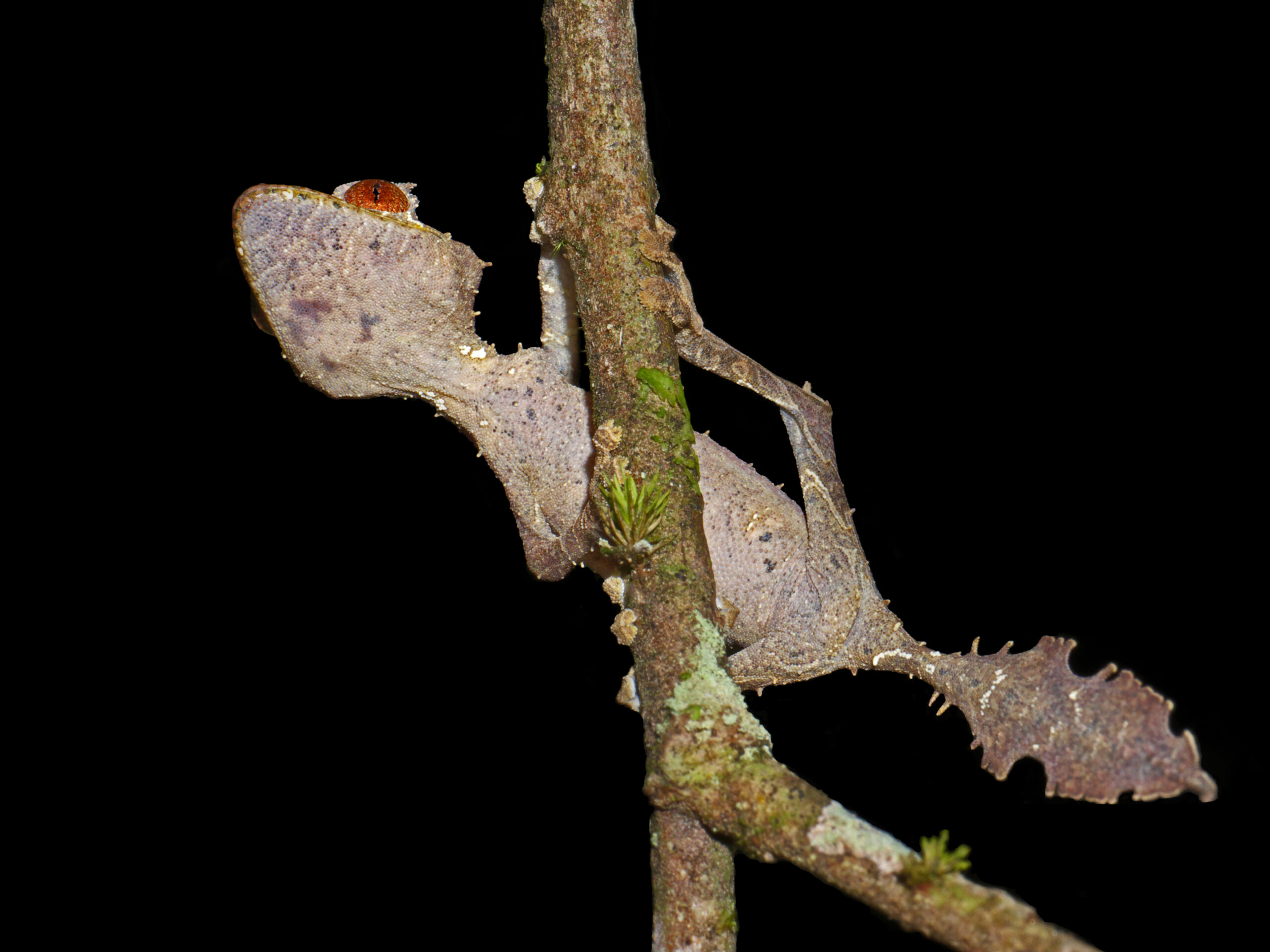
Satanic Leaf-Tailed Gecko (Uroplatus phantasticus) is an endemic lizard of Madagascar’s eastern humid forests. By day it hangs among twigs, leaves and low vegetation, relying on camouflage rather than speed. After dark its large eyes, adhesive toes and flexible body support active insect hunting. The dramatic common name refers to its appearance, not to dangerous behavior: the animal is harmless to people. This guide separates well-supported biology from common assumptions and covers identification, range, habitat, diet, behavior, reproduction and conservation.
Identification
The body is laterally compressed and mottled brown, gray, tan or rusty red. Raised ridges above the eyes resemble leaf points, while the short flattened tail carries vein-like lines and an irregular edge like a damaged dead leaf. The jawline and limbs break up the silhouette. Large lidless eyes have vertical pupils, and broad toes end in microscopic adhesive structures. Color and tail shape vary among individuals. Males usually have a more deeply notched, ragged-looking tail and visible hemipenal bulges at the tail base; females often have a broader, less indented leaf-shaped tail.
Identification should combine body shape, markings, size, voice or movement, and location. One feature by itself can overlap with a related animal, a juvenile, or an individual in unusual light.
Photographs are most useful when they preserve scale and show several diagnostic features. Handling or repositioning a wild satanic leaf-tailed gecko for identification can cause stress and is unnecessary.
Size and physical adaptations
Satanic Leaf-Tailed Gecko typically measures commonly about 7.5–10 cm total length; some individuals approach 15 cm and weighs usually only several grams; dependable wild mass ranges are limited. Published figures sometimes mix snout-to-vent and total length, so the measurement method must be checked.
Its useful adaptations include dead-leaf camouflage hides the resting body, flattened tail copies a decaying leaf, adhesive toe pads grip smooth vegetation, large eyes gather light at night, vertical pupils control incoming light, tail can be shed when seized, flattened body reduces the visible outline. These traits work together in the animal’s normal setting rather than serving as isolated curiosities.
Published measurements may use different methods, life stages or sample locations. Comparing figures responsibly means checking what was measured rather than selecting the largest number available.
Range and distribution
Endemic to eastern and southeastern Madagascar, with records from humid-forest localities including Andasibe, Ranomafana and several protected areas. Molecular work has refined locality records because the small leaf-tailed geckos include closely related and cryptic species. It occurs naturally nowhere outside Madagascar. The native range includes Madagascar.
A country-level map indicates broad distribution, not continuous occupation. Climate, elevation, water, vegetation, prey, breeding sites, barriers and survey effort all affect where records occur.
Records near the edge of the range deserve careful documentation because they may reflect natural movement, improved survey coverage, accidental transport or a genuine distribution change.
Habitat
Primary and tall secondary humid rainforest, generally in cool shaded forest from low elevations into the eastern highlands.
The gecko rests during daylight on low branches, vines, trunks and dead leaves, often hanging head-down or holding the tail beside the body to complete the disguise. It becomes active after dark and moves through shrubs and small trees in search of prey. Forest structure, humidity and cool nighttime temperatures matter; simplified plantations and exposed edges do not reproduce the full shelter of intact rainforest. Protecting a population therefore requires the feeding, shelter and breeding features that make a site usable, along with connections that allow movement.
Microhabitat matters. Shade, soil, current, moisture, shelter or host plants can determine whether a small area is usable even when the surrounding landscape appears suitable.
Diet and feeding
Satanic Leaf-Tailed Gecko is a nocturnal insectivore. Important foods include crickets, moths, beetles, cockroaches, spiders, other small forest arthropods. After dusk the gecko leaves its resting posture and searches vegetation. Large eyes detect small movements, while adhesive toes permit careful approaches along angled leaves and smooth stems. It waits or advances slowly, then lunges and seizes prey with the jaws. Wild diet studies remain limited, so records of suitable arthropods describe a flexible insectivore rather than a fixed menu.
Diet changes with age, season, location and food supply. A dramatic prey record does not establish what most individuals eat most of the time; repeated field observations provide a stronger picture.
Feeding opportunities also create risk. An animal focused on prey may be less alert to predators, traffic or people, while contaminated prey can transfer pollutants through the food web.
Behavior and communication
Nocturnal; remains motionless and camouflaged through much of the day. When concealment fails, an individual can flatten its body, twist to keep a branch between itself and an observer, open the mouth in a threat display or leap away. Tail shedding may allow escape from a predator, but regrowth costs energy and the replacement is less perfectly shaped. Adults are mainly solitary, meeting to court or when good shelter and prey overlap.
Detailed field studies of communication are scarce. Close-range visual posture, scent and touch probably organize courtship and spacing, as in other geckos. A defensive gape exposes the bright mouth and makes the small animal appear larger. Soft vocal sounds are reported in Uroplatus, but specific call functions in this species should not be overstated without direct study. Behavior should be interpreted in context: alarm, courtship, feeding and temperature regulation can produce very different actions from the same animal.
Daily schedules are flexible responses, not rigid rules. Weather, breeding condition, disturbance, tides or food can move activity into a different part of the day.
Reproduction and development
Courtship and egg-laying follow seasonal changes in temperature, rain and food. Fertilization is internal. A female deposits two nearly spherical eggs in leaf litter or another concealed place rather than attaching them to a branch. Captive observations provide much of the detailed reproductive information, so exact timing in different wild populations remains uncertain. Usually two eggs Embryos develop in parchment-shelled eggs protected from direct sun and flooding. Hatchlings emerge fully formed, climb and hunt tiny prey without parental care. Their small size increases water loss and limits prey choice. Females may produce several clutches in a favorable season, but reproduction is energetically demanding.
Young animals face different risks and may use different microhabitats or food than adults. Breeding success depends on adult condition, suitable sites and the survival of offspring through vulnerable early stages.
Counts of eggs or young describe reproductive output, not the number expected to reach adulthood. Mortality is normally greatest during eggs, larval or juvenile stages.
Predators and ecological role
This gecko is a small arthropod predator and prey for rainforest snakes, birds and mammals. Its specialization links survival to the layered structure and microclimate of eastern rainforest. Camouflage reduces detection, but it does not protect the animal when forest is cleared. Because visually similar populations can represent distinct evolutionary lineages, conserving sites across the range protects genetic diversity that a single reserve cannot contain. Documented or likely predators include Madagascar Tree Boa, Madagascar Ground Boa, Owls, Tenrecs, Human.
This animal is both a consumer and a food source. Its influence comes through many repeated interactions, so ecological claims should be based on measured populations rather than assumptions drawn from appearance.
Predator and prey relationships differ among places. A species can be ecologically influential without being abundant everywhere, and its role can change across its range.
Relationship with people
The common name has made this gecko internationally famous, bringing tourism and conservation attention but also demand from reptile collectors. All Uroplatus species are regulated under CITES Appendix II, so international trade requires documentation. Captive breeding can reduce pressure only when legal origins are traceable and welfare standards are high. Forest protection remains the central conservation need.
The gecko is nonvenomous and harmless. Do not handle or remove wild animals. A frightened gecko can leap, drop its tail or be injured by pressure. Night walks should use established trails and low disturbance, and photographs should avoid prolonged bright light. Buyers must verify legal captive-bred origin and applicable permits. Responsible observation means keeping an appropriate distance, avoiding capture or feeding, protecting habitat and following local wildlife or invasive-species guidance.
Wildlife guidance should come from the responsible local agency because collection rules, reporting requests and appropriate responses differ between native and introduced ranges.
Conservation
The IUCN lists Uroplatus phantasticus as Least Concern because it has a relatively broad eastern Madagascar range and occurs in protected areas. Forest loss and collection remain concerns, and a global category does not guarantee security at every locality. The reported global trend is Decreasing as humid forest is lost and fragmented.
Important pressures include rainforest clearing for agriculture, forest fragmentation and fire, illegal or unsustainable collection, climate-driven heat and drying, loss of cool humid microhabitat. Global status can hide local decline or recovery, so current regional monitoring and habitat management remain necessary.
The most useful conservation action follows the documented pressure. Protecting breeding sites, reducing road deaths or limiting pollutants can require different tools in different populations.