
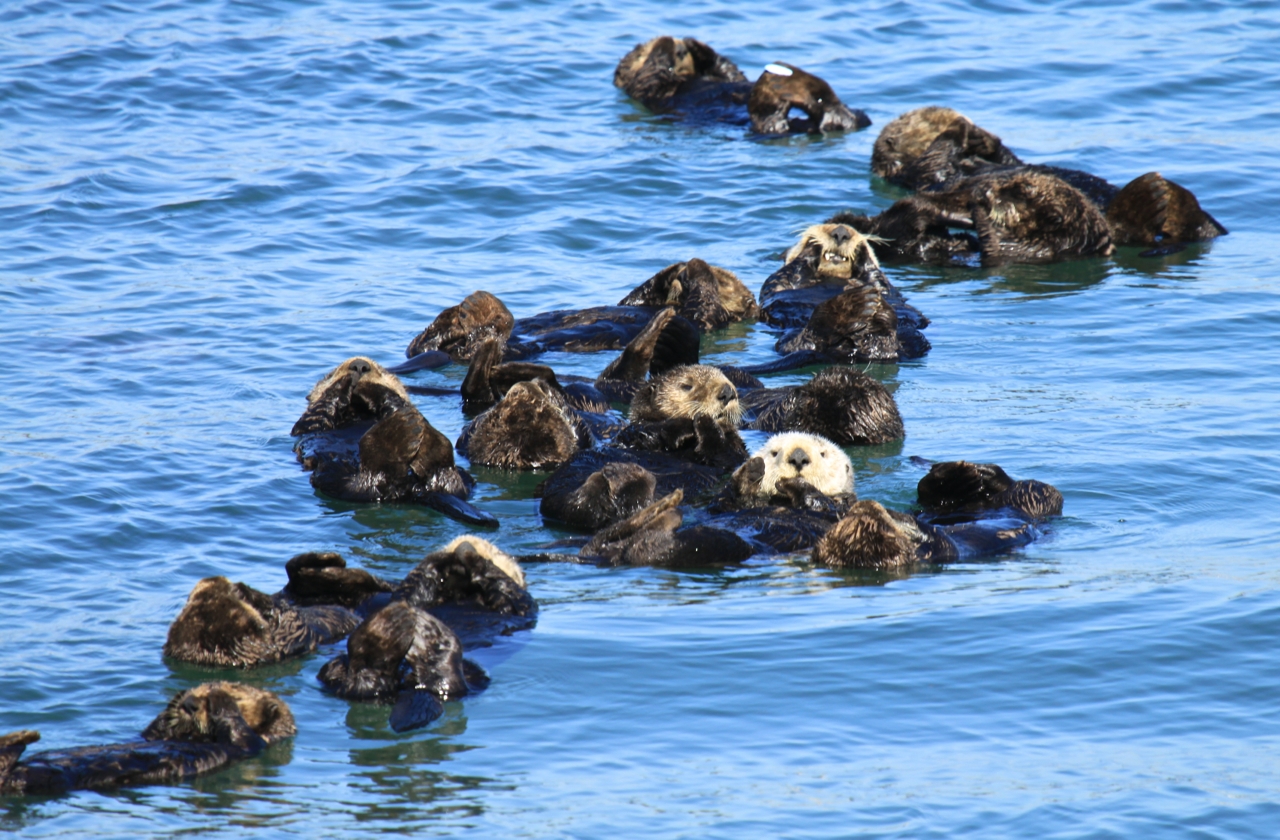
Sea Otter (Enhydra lutris) is the heaviest living otter and one of the smallest marine mammals. It spends almost its entire life in coastal North Pacific water, floating on its back to rest, groom and eat. Unlike seals and whales, it lacks a thick blubber layer and stays warm with exceptionally dense fur and a high metabolism. By eating sea urchins, Sea Otters can prevent overgrazing and help kelp forests flourish. This guide separates well-supported biology from common assumptions and covers identification, range, habitat, diet, behavior, reproduction and conservation.
Identification
Sea Otters have long streamlined bodies, broad hind feet shaped like flippers, small forepaws, a flattened muscular tail and rounded faces with sensitive whiskers. Fur is dark brown to black, often with a pale silver or cream head in adults. The hind feet propel swimming while forepaws locate and handle prey. Loose skin beneath each forearm forms a pocket used to carry food or a favored rock. Adult males are larger and heavier, with broader heads. Females are smaller and solely care for pups.
Identification should combine body shape, markings, size, voice or movement, and location. One feature by itself can overlap with a related animal, a juvenile, or an individual in unusual light.
Photographs are most useful when they preserve scale and show several diagnostic features. Handling or repositioning a wild sea otter for identification can cause stress and is unnecessary.
Size and physical adaptations
Sea Otter typically measures About 1–1.5 m including tail and weighs Females often 14–33 kg; males commonly 22–45 kg. Northern males are generally larger than southern Sea Otters.
Its useful adaptations include densest fur of any mammal traps insulating air, high metabolism produces heat, webbed flipper-like hind feet power swimming, closable nostrils and ears exclude water, sensitive whiskers and paws detect bottom prey, forearm skin pockets hold food and tools, strong molars crush shells, kidneys permit drinking seawater. These traits work together in the animal’s normal setting rather than serving as isolated curiosities.
Published measurements may use different methods, life stages or sample locations. Comparing figures responsibly means checking what was measured rather than selecting the largest number available.
Range and distribution
Coastal North Pacific from northern Japan and the Russian Far East through the Aleutian Islands and Alaska to British Columbia, Washington and central California. Historical range continued to Baja California. Fur-trade hunting left isolated remnants; reintroductions restored several regions, but major gaps remain. The native range includes Japan, Russia, United States, Canada, Mexico.
A country-level map indicates broad distribution, not continuous occupation. Climate, elevation, water, vegetation, prey, breeding sites, barriers and survey effort all affect where records occur.
Records near the edge of the range deserve careful documentation because they may reflect natural movement, improved survey coverage, accidental transport or a genuine distribution change.
Habitat
Shallow coastal waters, rocky reefs, kelp forests, seagrass beds, estuaries, bays and soft-bottom nearshore habitat.
Sea Otters usually forage over seafloor within diving distance of the surface, often shallower than 40 meters. Kelp canopies provide anchorage, shelter and nursery habitat, but otters also thrive in eelgrass beds and unvegetated bays. They haul out occasionally, especially in Alaska. Distribution depends on prey, water depth, storms, ice, shark risk and undisturbed resting areas. Protecting a population therefore requires the feeding, shelter and breeding features that make a site usable, along with connections that allow movement.
Microhabitat matters. Shade, soil, current, moisture, shelter or host plants can determine whether a small area is usable even when the surrounding landscape appears suitable.
Diet and feeding
Sea Otter is a carnivore. Important foods include sea urchins, crabs, clams, mussels, abalone, snails, octopus, sea stars, fish. A Sea Otter dives to the bottom, searches with paws and whiskers, stores several prey items in an underarm pocket, then surfaces to eat on its back. Hard prey may be struck against a chest-held rock or pounded on a stationary stone. Individuals develop dietary specialties learned from their mothers. Because insulation is metabolically expensive, adults may eat 20–30 percent of body mass daily.
Diet changes with age, season, location and food supply. A dramatic prey record does not establish what most individuals eat most of the time; repeated field observations provide a stronger picture.
Feeding opportunities also create risk. An animal focused on prey may be less alert to predators, traffic or people, while contaminated prey can transfer pollutants through the food web.
Behavior and communication
Forages in repeated dive bouts by day and night, alternating with intensive grooming and rest. Sea Otters float, groom, forage and sleep at the surface. Grooming restores the insulating air layer by cleaning and blowing air into fur. Resting groups are called rafts and may contain dozens or hundreds, often separated by sex. Otters wrap in kelp or hold paws to reduce drifting. Tool habits, prey choices and foraging sites vary among individuals and communities.
Sea Otters use chirps, whistles, coos, growls, hisses and screams. Mothers and pups call frequently to reunite after dives. Scent and touch are important at close range, while splashing and posture signal aggression. Pups produce piercing cries when separated. In resting rafts, quiet contact and spacing maintain social cohesion without continuous vocalization. Behavior should be interpreted in context: alarm, courtship, feeding and temperature regulation can produce very different actions from the same animal.
Daily schedules are flexible responses, not rigid rules. Weather, breeding condition, disturbance, tides or food can move activity into a different part of the day.
Reproduction and development
Mating can occur year-round. Territorial males associate with females in their area and may hold a female by the nose during mating, leaving scars. Implantation can be delayed, so the interval between mating and birth varies. A female normally gives birth to one pup and provides all care. Usually one pup; twins are rare and seldom both survive The pup is born with buoyant natal fur and cannot dive effectively. Its mother carries, grooms and nurses it, parking it at the surface while she forages. She brings prey and teaches handling and tool use. Young gradually molt into adult fur, practice diving and become independent at roughly six months, though timing varies.
Young animals face different risks and may use different microhabitats or food than adults. Breeding success depends on adult condition, suitable sites and the survival of offspring through vulnerable early stages.
Counts of eggs or young describe reproductive output, not the number expected to reach adulthood. Mortality is normally greatest during eggs, larval or juvenile stages.
Predators and ecological role
Sea Otters are classic keystone predators. By consuming sea urchins, they reduce grazing pressure on kelp, supporting complex forests that shelter fish, damp waves and store carbon. In estuaries they eat crabs, indirectly allowing small grazers to clean algae from eelgrass. Effects vary with habitat and prey. Otters also become prey for Killer Whales, sharks and Eagles. Documented or likely predators include Killer Whale, Great White Shark, Bald Eagle, Human.
This animal is both a consumer and a food source. Its influence comes through many repeated interactions, so ecological claims should be based on measured populations rather than assumptions drawn from appearance.
Predator and prey relationships differ among places. A species can be ecologically influential without being abundant everywhere, and its role can change across its range.
Relationship with people
Sea Otters were hunted nearly to extinction for fur during the eighteenth and nineteenth centuries. Protection and reintroduction restored parts of the range, though recovery remains uneven. Otters support kelp and eelgrass but may reduce harvestable shellfish locally, creating management conflicts that require tribal, community, fishery and ecological knowledge. Wildlife viewers should avoid disrupting costly rest and grooming.
Sea Otters are powerful wild carnivores with strong teeth. Stay at least the locally required distance away; in California, federal guidance recommends kayaks remain about 60 feet away. Never feed, touch or surround an otter, keep dogs leashed and back away if an animal watches, dives or changes behavior. Habituated otters may become aggressive. Responsible observation means keeping an appropriate distance, avoiding capture or feeding, protecting habitat and following local wildlife or invasive-species guidance.
Wildlife guidance should come from the responsible local agency because collection rules, reporting requests and appropriate responses differ between native and introduced ranges.
Conservation
The IUCN lists the Sea Otter as Endangered globally. Abundance has recovered from fur-trade lows but remains far below the historical range, and trends differ among subspecies and stocks. Southern Sea Otters remain federally threatened in the United States, while Southwest Alaska stocks have separate protections. The reported global trend is Variable: increasing in some regions, stable or declining in others.
Important pressures include oil spills and fur contamination, shark-bite mortality, killer whale predation, disease and parasites, fishing-gear entanglement, disturbance and illegal feeding, climate-driven ecosystem change. Global status can hide local decline or recovery, so current regional monitoring and habitat management remain necessary.
The most useful conservation action follows the documented pressure. Protecting breeding sites, reducing road deaths or limiting pollutants can require different tools in different populations.