
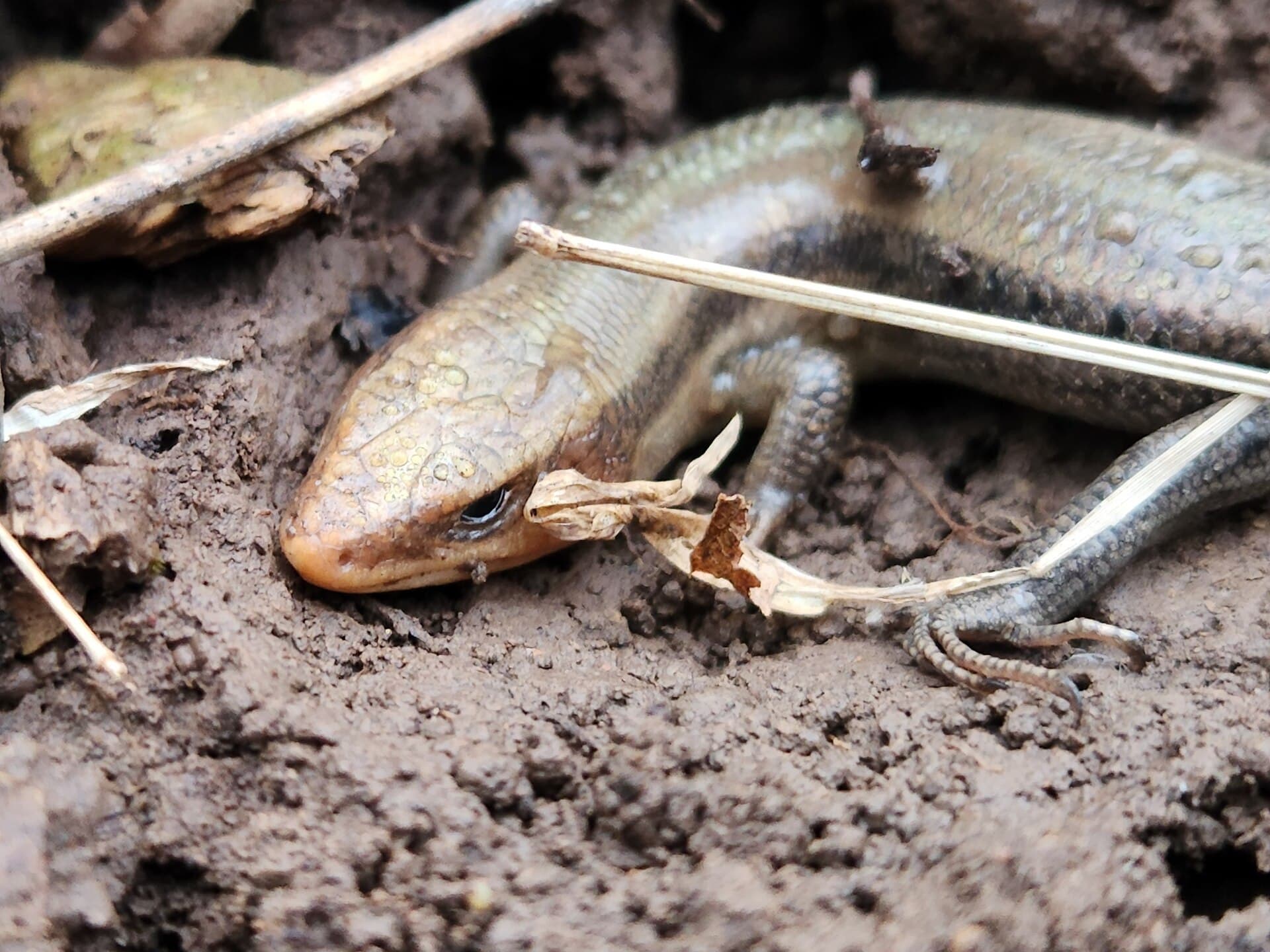
Skinks are a large and varied family of lizards called Scincidae. The name does not identify one species: it covers more than 1,600 described species, and the total changes as researchers describe new animals and revise older classifications. Skinks live across much of the world, from temperate woodland and tropical rainforest to desert sand, rocky slopes, farms, gardens and oceanic islands.
Many skinks have smooth, overlapping scales, a long body, short legs and a tapering tail. That familiar outline is only a starting point. Some species are robust blue-tongued lizards, some climb trees, some “swim” through loose sand, and others have reduced limbs or no visible limbs at all. Because the family is so diverse, size, diet, reproduction and conservation must be described as ranges and examples rather than one universal fact.
Skink classification and diversity
Skinks belong to order Squamata, the reptile group that also contains other lizards and snakes. Their family name is Scincidae. Modern skink classification has changed as anatomical and genetic studies have tested relationships among major lineages. Some scientific treatments divide skinks into several families, while widely used databases continue to recognize Scincidae as a broad family. This page follows the broad family treatment used by the Reptile Database and NCBI Taxonomy.
The Reptile Database reported more than 8,000 living lizard species in its June 2026 release, and skinks form one of the largest parts of that diversity. A fixed species total quickly becomes outdated, so “more than 1,600” is more useful than pretending that one permanent number exists.
Well-known members include the common five-lined skink (Plestiodon fasciatus) of eastern North America, the sandfish skink (Scincus scincus) of North African and southwestern Asian deserts, the eastern blue-tongued lizard (Tiliqua scincoides) of Australia and New Guinea, and the Solomon Islands skink (Corucia zebrata). These examples are separate species with different bodies and ways of life.
What does a skink look like?
Many skinks have shiny scales supported by small bony plates called osteoderms. The head is often wedge-shaped, the neck may be difficult to distinguish from the body, and the limbs are commonly shorter than those of similarly sized lacertid lizards. None of these traits describes every member of the family.
Body form reflects habitat. Sandfish skinks have streamlined bodies and fringed toes that help them move beneath loose sand. Arboreal species have proportions and claws suited to climbing. Burrowing lineages may have tiny limbs, fewer toes or a snake-like body. Blue-tongued skinks are comparatively heavy-bodied and expose a conspicuous blue tongue during defensive displays.
Color also varies. Skinks may be brown, bronze, gray, black, green, striped, spotted or banded. Juvenile five-lined skinks have bright blue tails, while adult males can develop orange coloration around the head during the breeding season. A representative photograph therefore shows one species, not the appearance of every skink.
Where skinks live
Skinks have a near-global distribution outside Antarctica. They occur through Africa, Asia, Australia, the Pacific, much of the Americas and warmer parts of Europe. Diversity is especially high in tropical and subtropical regions, with Australia supporting an exceptional variety of species.
The family occupies forests, savannas, shrublands, grasslands, deserts, rocky outcrops, dunes, wetlands, stream margins, farms and urban gardens. Ground-dwelling species use leaf litter, soil cracks, fallen timber and stones for shelter. Other species live in trees, among rocks or beneath sand. Local moisture, temperature, vegetation and access to refuges often determine exactly where a species can survive.
Skinks are ectotherms, so they use their surroundings to regulate body temperature. A woodland skink may move between sunlit patches and cool cover, while a desert species may remain below the surface during the hottest part of the day. Daily activity can be daytime, twilight or nighttime depending on the species and climate.
Skink diet
Most small skinks eat insects and other invertebrates. Common prey includes beetles, crickets, termites, caterpillars, spiders, snails and worms. Larger species may take small vertebrates when the opportunity arises. Skinks locate food with vision and chemical information collected by the tongue and processed by the vomeronasal system.
Several large skinks are omnivores. Blue-tongued lizards eat animal prey as well as flowers, fruit and other plant material. The Solomon Islands skink is strongly herbivorous compared with most of the family. Diet labels must therefore be attached to a species; “all skinks are insectivores” is inaccurate.
Behavior, senses and tail loss
Many skinks escape predators by sprinting into a crevice, diving into leaf litter or burrowing. Some species can release part of the tail when seized. The detached tail continues moving and may distract a predator while the lizard escapes. A replacement can grow, but it usually differs from the original in internal structure and appearance. Regrowth also costs energy, so tail loss is an emergency defense rather than a harmless trick.
Skinks use scent cues to recognize mates, rivals and familiar areas. Social behavior ranges from mainly solitary lives to stable pairs and family groups. Several Australian social skinks in the Egernia group form long-lasting associations and recognize relatives, an important reminder that lizard social systems can be complex.
Different skinks use different defenses. A skink may freeze, flee, bite, inflate its body, hiss, expose a colored tongue or wedge itself into a shelter. Most small species are harmless to people and prefer escape. Even a larger skink should be observed without grabbing or blocking its retreat.
Eggs, live birth and parental care
Skink reproduction is unusually diverse. Many species lay eggs, while many others give birth to live young. Live-bearing has evolved repeatedly within skinks, and some lineages provide developing embryos with more maternal nourishment than a simple yolk supply. No single clutch size or incubation period represents the family.
Parental behavior also differs. Female common five-lined skinks guard their nests, adjust contact with the eggs as moisture changes and remain until hatching. Other egg-laying species leave soon after laying. In some social skinks, young remain near adults and family relationships persist beyond birth.
Breeding seasons respond to local rainfall and temperature. Tropical species may follow wet and dry cycles, while temperate species typically breed after winter dormancy. Age at maturity and lifespan vary from small, fast-growing species to much larger, slower-lived skinks.
Predators and ecological role
Skinks are both predators and prey. By eating large numbers of insects and other small animals, they influence soil and leaf-litter food webs. Omnivorous and herbivorous species may also move seeds or consume vegetation. Their digging and movement through litter can disturb soil and organic material on a small scale.
Snakes, birds, mammals, larger lizards, frogs and predatory invertebrates eat skinks. Eggs and juveniles face especially broad predator communities. On islands, introduced rats, cats, mongooses and snakes can create severe pressure because native skinks may not have defenses against them.
Are skinks endangered?
There is no single conservation category for Scincidae. Some skink species are common and widespread; others survive only on one island, mountain, forest fragment or dune system. Each species needs its own assessment. Applying “Least Concern” or “Endangered” to the whole family would hide these differences.
Major threats include habitat clearing, invasive predators, fire-regime changes, pollution, road mortality, collection, disease and climate change. Restricted island species can be especially vulnerable because one invasive predator or extreme event may affect most of their range. Conservation work includes habitat protection, invasive-species control, legal protection, captive breeding and carefully managed reintroductions.
Skinks around homes and as pets
Wild skinks often enter gardens because stones, logs, ground cover and sunny edges provide shelter and feeding sites. They can help consume small invertebrates. People can support local lizards by retaining safe cover, limiting pesticides, keeping cats controlled and avoiding glue traps. A skink found outdoors should usually be left where it is unless it faces an immediate danger.
Some species are kept in captivity, particularly blue-tongued skinks, but “skink care” is not one set of instructions. Temperature gradients, humidity, enclosure size, ultraviolet lighting, diet and legal requirements differ substantially. Prospective keepers should identify the exact species, confirm that it was obtained legally and use guidance written for that species.