
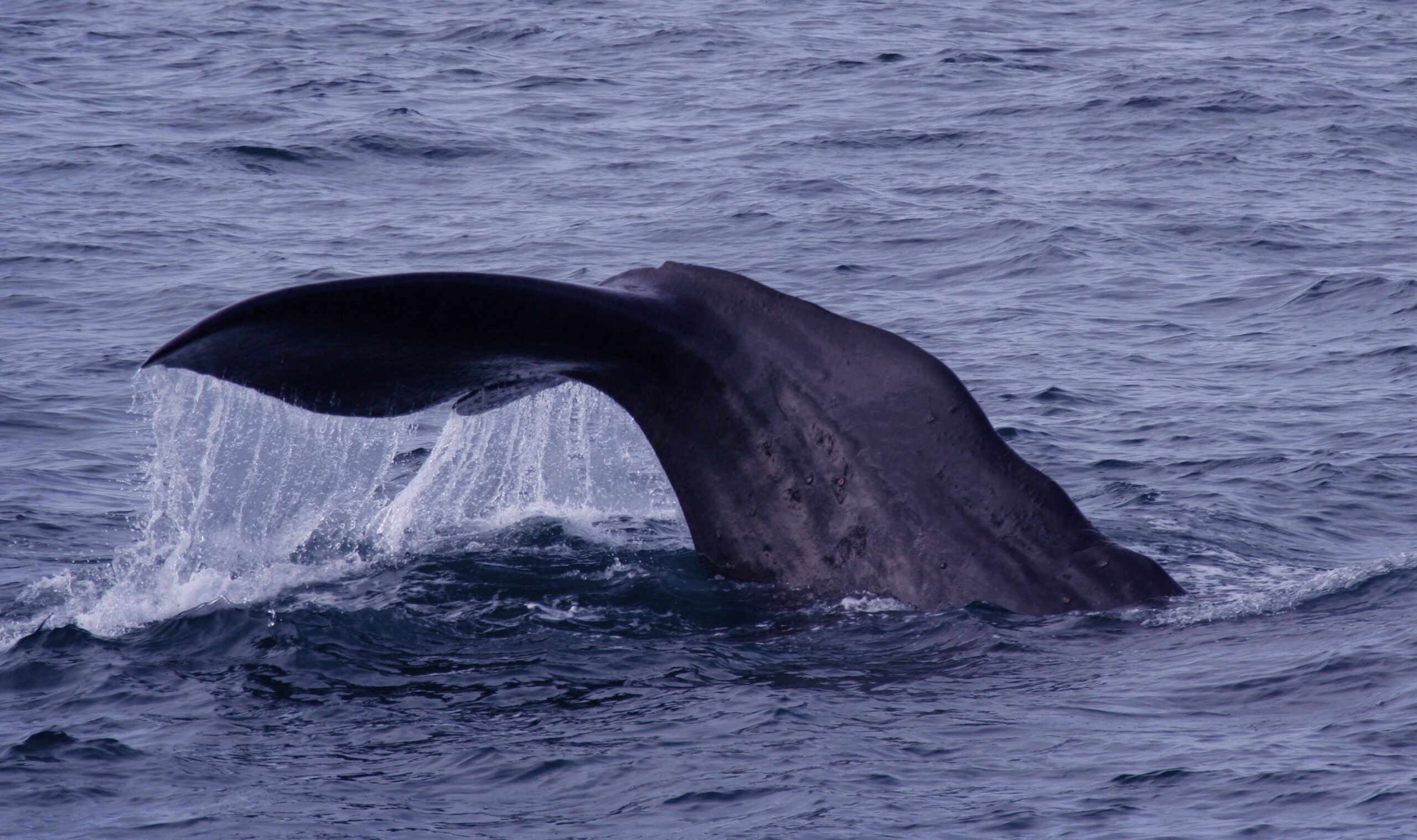
Sperm Whale (Physeter macrocephalus) is an extreme deep-diving predator with the largest brain of any animal and a head that can occupy roughly one-third of its body. It searches dark ocean depths with intense echolocation clicks, socializes through patterned codas and surfaces with a distinctive angled blow from a single left-side blowhole. This guide separates well-supported biology from common assumptions and covers identification, range, habitat, diet, behavior, reproduction and conservation.
Identification
The enormous squared head, narrow underslung lower jaw and wrinkled dark-gray skin are distinctive. A single S-shaped blowhole sits near the front-left corner of the head, producing a low bushy blow angled forward and left. The back lacks a true dorsal fin and instead bears a low hump followed by knuckles. Broad triangular tail flukes rise clearly before a deep dive. Adult males are dramatically larger than females, reaching around 16 meters and 45 tonnes, while females commonly reach about 12 meters and 15 tonnes.
Identification should combine body shape, markings, size, voice or movement, and location. One feature by itself can overlap with a related animal, a juvenile, or an individual in unusual light.
Photographs are most useful when they preserve scale and show several diagnostic features. Handling or repositioning a wild sperm whale for identification can cause stress and is unnecessary.
Size and physical adaptations
Sperm Whale typically measures Females to about 12 m; males commonly to 16 m or more and weighs Females about 15 tonnes; large males about 45 tonnes. Exceptional historical males were larger, but estimates vary.
Its useful adaptations include spermaceti organ helps produce and focus sound, extremely loud clicks locate prey in darkness, collapsible lungs reduce pressure problems, high blood and muscle oxygen stores extend dives, flexible rib cage tolerates depth pressure, lower-jaw fat channels returning echoes to the ear, large flukes power steep descents, physiology tolerates long breath holds. These traits work together in the animal’s normal setting rather than serving as isolated curiosities.
Published measurements may use different methods, life stages or sample locations. Comparing figures responsibly means checking what was measured rather than selecting the largest number available.
Range and distribution
Found in deep ice-free waters of every major ocean, from near the equator into high latitudes. Females, calves and young males concentrate in tropical and subtropical waters, while mature males make long seasonal movements into colder productive seas and return to breed. The native range includes United States, Canada, Mexico, Brazil, Argentina, South Africa, Australia, New Zealand, Japan, Russia, Norway, Iceland, United Kingdom, Ireland, Portugal, Spain, Morocco, India, Sri Lanka, Indonesia, Philippines, Chile, Peru.
A country-level map indicates broad distribution, not continuous occupation. Climate, elevation, water, vegetation, prey, breeding sites, barriers and survey effort all affect where records occur.
Records near the edge of the range deserve careful documentation because they may reflect natural movement, improved survey coverage, accidental transport or a genuine distribution change.
Habitat
Deep ocean, continental slopes, submarine canyons, seamounts and offshore basins, occasionally near coasts where deep water approaches land.
Sperm Whales favor waters where depth and oceanography concentrate squid and fish. They descend through the water column to mesopelagic and bathypelagic zones, often hunting near slopes or bottom features. Social groups rest and travel near the surface between repeated dive cycles. Protecting a population therefore requires the feeding, shelter and breeding features that make a site usable, along with connections that allow movement.
Microhabitat matters. Shade, soil, current, moisture, shelter or host plants can determine whether a small area is usable even when the surrounding landscape appears suitable.
Diet and feeding
Sperm Whale is a carnivore. Important foods include medium and large squid, deep-sea fish, sharks, skates, octopus. A whale lifts its flukes, descends steeply and begins a regular series of echolocation clicks. As it approaches prey, clicks accelerate into a rapid buzz that guides the final capture. Most prey are swallowed whole and feeding occurs far below sunlight. Dives commonly last tens of minutes, while exceptional dives exceed an hour and reach well beyond 1,000 meters.
Diet changes with age, season, location and food supply. A dramatic prey record does not establish what most individuals eat most of the time; repeated field observations provide a stronger picture.
Feeding opportunities also create risk. An animal focused on prey may be less alert to predators, traffic or people, while contaminated prey can transfer pollutants through the food web.
Behavior and communication
Cycles between long deep foraging dives, surface recovery, travel, socializing and brief drifting rest. Females and young live in long-lasting social units that travel, forage and protect calves together. Mature males leave natal groups and range toward higher latitudes, often alone or in loose bachelor associations. Groups may form a defensive rosette around a threatened calf. Whales identify and coordinate with patterned click sequences called codas.
Regular echolocation clicks search the environment, fast buzzes track prey and codas carry social information. Coda rhythms differ among cultural clans, whose members share vocal traditions and social identity across wide regions. Calves learn patterns within their group. Sound also enables contact over distances that vision cannot bridge underwater. Behavior should be interpreted in context: alarm, courtship, feeding and temperature regulation can produce very different actions from the same animal.
Daily schedules are flexible responses, not rigid rules. Weather, breeding condition, disturbance, tides or food can move activity into a different part of the day.
Reproduction and development
Large mature males visit lower-latitude female groups to mate. Females reproduce slowly, bearing one calf after a pregnancy of roughly 14–16 months and then nursing for several years. Long intervals between births make population recovery from whaling unusually slow. One calf A calf is born tail-first near the surface and immediately depends on its mother and other unit members. It nurses on energy-rich milk and may begin eating prey before complete weaning, which can take two years or longer. Females generally remain in natal social units; young males gradually leave and expand their range.
Young animals face different risks and may use different microhabitats or food than adults. Breeding success depends on adult condition, suitable sites and the survival of offspring through vulnerable early stages.
Counts of eggs or young describe reproductive output, not the number expected to reach adulthood. Mortality is normally greatest during eggs, larval or juvenile stages.
Predators and ecological role
Sperm Whales are major predators in deep-ocean food webs and transport nutrients toward the surface through waste and carcasses. Their dives sample a realm humans rarely observe. Killer Whales sometimes attack groups, especially calves. Scars from squid suckers record encounters with large deep-sea prey. Documented or likely predators include Killer Whale, Large Shark, Human.
This animal is both a consumer and a food source. Its influence comes through many repeated interactions, so ecological claims should be based on measured populations rather than assumptions drawn from appearance.
Predator and prey relationships differ among places. A species can be ecologically influential without being abundant everywhere, and its role can change across its range.
Relationship with people
Industrial whaling killed immense numbers for spermaceti oil and ambergris, leaving populations depleted. Modern protections ended most commercial hunting, but whales still face entanglement, vessel strikes, ocean noise, contaminants, debris and changing prey. Whale watching and acoustic research now create nonlethal economic and scientific value.
Sperm Whales are enormous protected wildlife. Boaters should follow regional approach distances, avoid intercepting travel or separating animals, reduce speed and never swim toward a whale. Entangled whales require trained response teams because lines, flukes and sudden dives are lethal hazards. Responsible observation means keeping an appropriate distance, avoiding capture or feeding, protecting habitat and following local wildlife or invasive-species guidance.
Wildlife guidance should come from the responsible local agency because collection rules, reporting requests and appropriate responses differ between native and introduced ranges.
Conservation
The IUCN lists the Sperm Whale as Vulnerable because industrial whaling caused severe global depletion and recovery is slow. NOAA lists the species as Endangered under the U.S. Endangered Species Act and depleted under the Marine Mammal Protection Act. The reported global trend is Increasing in some assessments but uncertain across much of the global range.
Important pressures include fishing-gear entanglement, vessel strikes, ocean noise, marine debris, oil spills and contaminants, climate-driven prey change. Global status can hide local decline or recovery, so current regional monitoring and habitat management remain necessary.
The most useful conservation action follows the documented pressure. Protecting breeding sites, reducing road deaths or limiting pollutants can require different tools in different populations.