
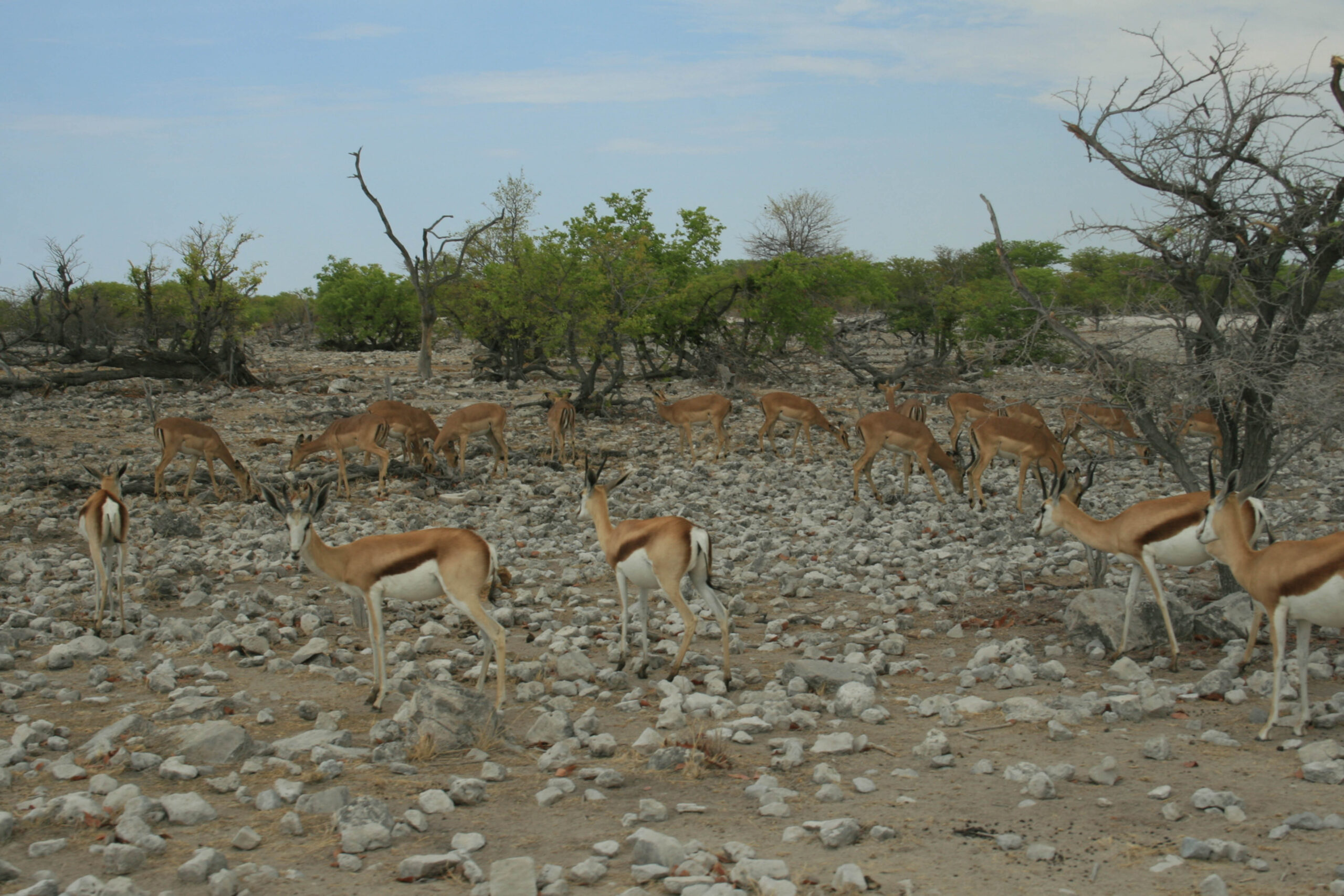
Springbok (Antidorcas marsupialis) is a medium-sized antelope of the dry grasslands and shrublands of southern Africa. Both sexes carry curved horns, and a dark flank stripe separates the reddish upper coat from white underparts. When excited, it can open a hidden fold along its back, raise a white crest and perform repeated high leaps called pronking. This guide separates well-supported biology from common assumptions and covers identification, range, habitat, diet, behavior, reproduction and conservation.
Identification
Springbok have a white face crossed by dark lines from eye to mouth, reddish-fawn upperparts, a broad chocolate-brown stripe along each flank and clean white underparts and rump. A skin fold from mid-back to the rump conceals long white hairs that rise into a fan during display. Both sexes have black, ringed, lyre-shaped horns, though male horns are generally thicker. Males are usually heavier with thicker horns and necks; females are slightly smaller but also horned.
Identification should combine body shape, markings, size, voice or movement, and location. One feature by itself can overlap with a related animal, a juvenile, or an individual in unusual light.
Photographs are most useful when they preserve scale and show several diagnostic features. Handling or repositioning a wild springbok for identification can cause stress and is unnecessary.
Size and physical adaptations
Springbok typically measures About 1.2–1.5 m head and body and weighs About 27–48 kg. Northern forms tend to be larger than southern Cape Springbok.
Its useful adaptations include switches seasonally between grazing and browsing, obtains moisture from succulent leaves and flowers, efficient kidneys conserve water, reflective pale coat reduces solar heat gain, pronking signals alertness and physical condition, dorsal crest creates a conspicuous group signal, fast running helps escape open-country predators, flexible herding tracks patchy rain and forage. These traits work together in the animal’s normal setting rather than serving as isolated curiosities.
Published measurements may use different methods, life stages or sample locations. Comparing figures responsibly means checking what was measured rather than selecting the largest number available.
Range and distribution
Native to arid and semi-arid southern Africa, especially Namibia, Botswana, western and central South Africa and southwestern Angola. Modern distribution is fragmented by fencing, farms and reserves, although large free-ranging populations remain in parts of the Kalahari and Namib regions. The native range includes Angola, Namibia, Botswana, South Africa.
A country-level map indicates broad distribution, not continuous occupation. Climate, elevation, water, vegetation, prey, breeding sites, barriers and survey effort all affect where records occur.
Records near the edge of the range deserve careful documentation because they may reflect natural movement, improved survey coverage, accidental transport or a genuine distribution change.
Habitat
Open dry grassland, shrub steppe, Karoo, Kalahari savanna, dry lake margins and sparse desert-edge plains.
Springbok favor open country where they can detect predators and move quickly between scattered forage patches. They track rain-driven green growth and may congregate in very large herds. Shade is used during extreme heat, and animals can live away from permanent water when moisture-rich browse is available. Protecting a population therefore requires the feeding, shelter and breeding features that make a site usable, along with connections that allow movement.
Microhabitat matters. Shade, soil, current, moisture, shelter or host plants can determine whether a small area is usable even when the surrounding landscape appears suitable.
Diet and feeding
Springbok is a herbivore. Important foods include grasses, herbs, flowers, leaves, shrub shoots, succulents, seeds, wild melons. Springbok are mixed feeders. They graze fresh grass after rain and browse shrubs, flowers and succulents during dry periods. This seasonal switch provides both nutrients and water. Feeding is concentrated in cooler hours when conditions are harsh, and animals may paw or reach for low plants while moving steadily across open ground.
Diet changes with age, season, location and food supply. A dramatic prey record does not establish what most individuals eat most of the time; repeated field observations provide a stronger picture.
Feeding opportunities also create risk. An animal focused on prey may be less alert to predators, traffic or people, while contaminated prey can transfer pollutants through the food web.
Behavior and communication
Active mainly in daylight and cooler twilight hours, with rest and rumination during midday heat. Herd structure changes with season and resources. Females and young form nursery groups, bachelor males gather separately, and territorial males defend areas when females are receptive. During drought or fresh growth, many groups can merge into traveling herds. Historic treks reportedly contained enormous numbers, but fences now restrict most mass movements.
Body display is especially important. The white dorsal crest opens during alarm or excitement, making a pronking animal conspicuous. Snorts and foot stamps can alert nearby herd members. Territorial males mark with dung, urine and preorbital glands, then use horn displays and parallel walking in contests. Mothers and calves maintain contact by voice and scent. Behavior should be interpreted in context: alarm, courtship, feeding and temperature regulation can produce very different actions from the same animal.
Daily schedules are flexible responses, not rigid rules. Weather, breeding condition, disturbance, tides or food can move activity into a different part of the day.
Reproduction and development
Springbok can breed in different months according to rainfall and region, though rutting often intensifies in the dry season. Territorial males herd and court females while excluding rivals. A female normally bears one calf after roughly five and a half months. Usually one calf; twins are rare A newborn calf is precocial but spends its earliest period lying concealed while the mother returns to nurse. It soon follows her and joins nursery groups. Calves begin sampling plants within weeks and are weaned after several months, while maternal association may continue longer.
Young animals face different risks and may use different microhabitats or food than adults. Breeding success depends on adult condition, suitable sites and the survival of offspring through vulnerable early stages.
Counts of eggs or young describe reproductive output, not the number expected to reach adulthood. Mortality is normally greatest during eggs, larval or juvenile stages.
Predators and ecological role
Springbok convert sparse grasses and shrubs into prey for large carnivores and redistribute nutrients through dung and movement. Their mixed feeding reduces dependence on either grass or browse alone. Large herds influence vegetation locally, while carcasses sustain scavengers. They share dry rangelands with oryx, wildebeest, ostriches and livestock. Documented or likely predators include Cheetah, African Lion, Leopard, Black-backed Jackal.
This animal is both a consumer and a food source. Its influence comes through many repeated interactions, so ecological claims should be based on measured populations rather than assumptions drawn from appearance.
Predator and prey relationships differ among places. A species can be ecologically influential without being abundant everywhere, and its role can change across its range.
Relationship with people
Springbok have provided meat and hides for people for millennia and remain important in wildlife ranching, hunting and tourism. The animal is a national symbol of South Africa and lends its name to national sports teams. Commercial ranches and reserves now hold many animals, but fencing has largely ended the immense historical treks.
Springbok normally flee people, but any cornered antelope can strike with sharp horns or hooves. Observe from vehicles or at the distance required by reserves, never feed wildlife, avoid separating calves from mothers and do not attempt capture without trained professionals. Responsible observation means keeping an appropriate distance, avoiding capture or feeding, protecting habitat and following local wildlife or invasive-species guidance.
Wildlife guidance should come from the responsible local agency because collection rules, reporting requests and appropriate responses differ between native and introduced ranges.
Conservation
The IUCN lists Springbok as Least Concern. The species is numerous and widespread in suitable southern African habitat, including protected areas and private ranches. Local genetic integrity, movement corridors and native rangeland still require management, and fenced populations should not be mistaken for unrestricted historic abundance. The reported global trend is Generally stable to increasing in many managed areas, with local variation.
Important pressures include fencing and movement restriction, habitat conversion, drought, overharvest locally, disease exchange with livestock, genetic mixing among translocated subspecies. Global status can hide local decline or recovery, so current regional monitoring and habitat management remain necessary.
The most useful conservation action follows the documented pressure. Protecting breeding sites, reducing road deaths or limiting pollutants can require different tools in different populations.