
Home/Animals/Mammalia/Sugar Glider
Species profileIUCN: NE

Sugar Glider

Petaurus breviceps

A nocturnal marsupial that glides between trees on a wrist-to-ankle membrane.

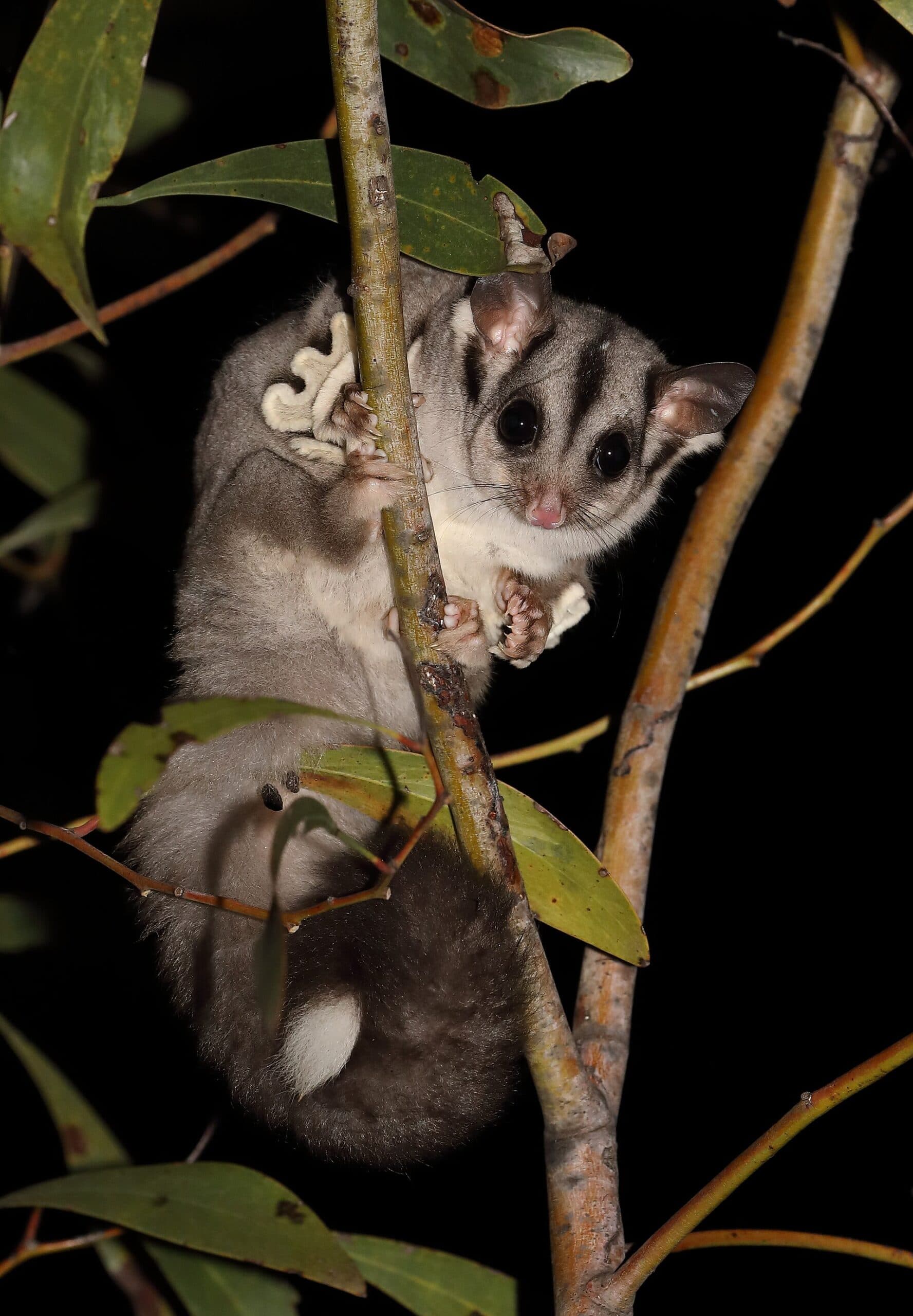
Wild sugar glider Petaurus breviceps clinging to a tree trunk in Victoria Australia
patrickkavanagh / Wikimedia Commons / CC BY 2.0
🌐 Read in Language:

⚡ At a Glance

Species profile
Also Known As
Short-headed glider
Diet Category
Omnivorous: plant exudates, nectar, pollen, insects, and other small animal food
Activity Rhythm
Nocturnal, with torpor possible during cold or food shortage
Wild Lifespan
Population-specific; published captive figures should not be substituted for wild survival
Typical Weight
Historical broad accounts report roughly 79–160 g and may combine cryptic species
Conservation Status
NE
💡 Key Biological Insight: The gliding membrane forms an airfoil when all four limbs spread, allowing controlled travel between trees.

🌳 Scientific Taxonomy Hierarchy

Petaurus breviceps is a petaurid marsupial. A 2020 integrative revision separated Krefft's glider P. notatus and savanna glider P. ariel from the former broad sugar-glider concept. This profile uses P. breviceps sensu stricto and treats New Guinean and captive ancestry cautiously because taxonomy remains in flux.

KingdomAnimalia
PhylumChordata
ClassMammalia
OrderDiprotodontia
FamilyPetauridae
GenusPetaurus
SpeciesPetaurus breviceps

Distinguishing Anatomical Features

  • ✓Gliding membrane from wrist to ankle
  • ✓Dark stripe from nose along the back
  • ✓Large forward-facing eyes
  • ✓Long furred tail
  • ✓Rounded mobile ears
  • ✓Marsupial pouch in females

📏 Physical Measurements

Total LengthHistorical accounts: about 4.7–12.6 in
Body WeightHistorical accounts: about 2.8–5.6 oz
Tail LengthHistorical accounts: about 5.9–18.9 in
WingspanNot wings; patagium spans wrist to ankle
Top SpeedNo dependable universal maximumGlide performance depends on height, wind, gap, and vegetation.

🎨 Appearance & Distinctive Markings

GrayCreamBlackBrownWhite

Skin / Covering: Fur

Sexual Dimorphism: Males may show visible forehead and chest scent glands; body-size differences depend on population.

🗺️ Geographic Distribution & Habitat

Australia contains a narrowed P. breviceps range after the 2020 split. New Guinean and nearby-island populations are included provisionally because their relationship to Australian lineages remains unresolved.

Woodland and forest with connected canopy, tree hollows, flowering and sap-producing trees, and seasonal insect prey.

Country-level distribution map

Native range
FijiTanzaniaWestern SaharaCanadaUnited StatesKazakhstanUzbekistanPapua New Guinea — Native rangeIndonesia — Native rangeArgentinaChileCongo - KinshasaSomaliaKenyaSudanChadHaitiDominican RepublicRussiaBahamasFalkland IslandsNorwayGreenlandFrench Southern TerritoriesTimor-LesteSouth AfricaLesothoMexicoUruguayBrazilBoliviaPeruColombiaPanamaCosta RicaNicaraguaHondurasEl SalvadorGuatemalaBelizeVenezuelaGuyanaSurinameFranceEcuadorPuerto RicoJamaicaCubaZimbabweBotswanaNamibiaSenegalMaliMauritaniaBeninNigerNigeriaCameroonTogoGhanaCôte d’IvoireGuineaGuinea-BissauLiberiaSierra LeoneBurkina FasoCentral African RepublicCongo - BrazzavilleGabonEquatorial GuineaZambiaMalawiMozambiqueEswatiniAngolaBurundiIsraelLebanonMadagascarPalestinian TerritoriesGambiaTunisiaAlgeriaJordanUnited Arab EmiratesQatarKuwaitIraqOmanVanuatuCambodiaThailandLaosMyanmar (Burma)VietnamNorth KoreaSouth KoreaMongoliaIndiaBangladeshBhutanNepalPakistanAfghanistanTajikistanKyrgyzstanTurkmenistanIranSyriaArmeniaSwedenBelarusUkrainePolandAustriaHungaryMoldovaRomaniaLithuaniaLatviaEstoniaGermanyBulgariaGreeceTürkiyeAlbaniaCroatiaSwitzerlandLuxembourgBelgiumNetherlandsPortugalSpainIrelandNew CaledoniaSolomon IslandsNew ZealandAustralia — Native rangeSri LankaChinaTaiwanItalyDenmarkUnited KingdomIcelandAzerbaijanGeorgiaPhilippinesMalaysiaBruneiSloveniaFinlandSlovakiaCzechiaEritreaJapanParaguayYemenSaudi ArabiaCyprusMoroccoEgyptLibyaEthiopiaDjiboutiUgandaRwandaBosnia & HerzegovinaNorth MacedoniaSerbiaMontenegroKosovoTrinidad & TobagoSouth Sudan
Highlighted countries are recorded profile locations, not precise biological range boundaries.Map boundaries: Natural Earth

Recorded Native Countries & Territories:

💡 Did You Know?

  • 💡Patagium supports controlled gliding
  • 💡Large eyes aid nocturnal vision
  • 💡Prehensile feet grip bark
  • 💡Torpor saves energy
  • 💡Sharp incisors open bark for exudates
  • 💡Long tail stabilizes movement

🌿 Conservation Status & Threats

IUCN: NE — NE

“Petaurus breviceps sensu stricto requires assessment using its narrower post-2020 range. Older status summaries may combine P. notatus, P. ariel, and unresolved New Guinean lineages.”

Population TrendNot established across the narrowed species concept
Wild Population EstimateNo dependable species-wide estimate under the revised taxonomy
CITESNo CITES listing stated here

⚠️ Major Threats to Sugar Glider

  • •Loss of hollow-bearing trees
  • •Canopy fragmentation
  • •Severe wildfire
  • •Drought and food disruption
  • •Roads and fences
  • •Introduced cats
  • •Taxonomic uncertainty

🔄 Life Cycle & Reproduction

Wild vs. Captivity Lifespan Comparison

🌿 In the WildPopulation-specific; no dependable revised-species figure
🏠 In Captivity (with veterinary care)Can be many years with expert care, but husbandry and health strongly affect survival
Clutch / Litter SizeUsually one or two pouch young in historical accounts; confirm lineage and population
Incubation / GestationMarsupial gestation is followed by extended pouch development
Fledging / WeaningYoung leave the pouch, remain in the den, then become mobile
Sexual MaturityPopulation-specific
Mating SystemSocial groups with mating patterns documented differently among populations
Nesting / Den TypeTree hollow lined with leaves

🦅 Behavior & Field Ecology

Omnivorous exudate feeder and insect predator

🌐 Ecological Food Web & Relationships: Consumes exudates, nectar, pollen, and invertebrates; may move pollen and serves as prey for owls, pythons, goannas, quolls, and introduced cats.

Social Group SizeSmall social groups; composition differs by population
Activity RhythmNocturnal, with torpor possible during cold or food shortage
Feeding StrategyOmnivorous exudate feeder and insect predator

🥩 Primary Prey & Preferred Diet

✓ Eucalypt and acacia exudates✓ Nectar and pollen✓ Insects✓ Other small animal prey

📢 Communication & Territorial Signals

  • Scent marks
  • Alarm calls
  • Contact calls
  • Threat sounds
  • Touch and grooming

🐾 Wild Temperament & Traits

• Social• Nocturnal• Agile• Scent-oriented• Territorial toward outsiders

🤝 Human Interaction & Pet Advisory

🐾 Domestic / Pet Companion
🐶

Sugar Glider as a Pet Companion

Only where legal and with compatible companionship, large climbing and gliding space, balanced specialist nutrition, enrichment, and an experienced exotic-animal veterinarian.

Domestication StatusCaptive-bred but not domesticated
Danger to HumansLow physical danger, high husbandry commitment
Economic & Ecotourism RoleEcotourism, education, research, and ecological function; captive trade requires responsible breeding and legal compliance.

⚠️ Behavioral Risk Factors & Wildlife Safety

  • Can bite when frightened
  • Nocturnal noise and scent marking
  • Nutritional disease from poor diets
  • Stress and behavioral harm from isolation or small housing

🌐 Ecological Food Web & Relationships

🦅 Natural Predators (4)

OwlsStrigiformes
PythonsPythonidae
Monitor LizardsVaranus
Feral CatFelis catus

🧬 Related Species (3)

Krefft's GliderPetaurus notatusSeparated from the former broad sugar-glider concept in 2020
Savanna GliderPetaurus arielNorthern Australian lineage elevated in the 2020 revision
Squirrel GliderPetaurus norfolcensisLarger related Australian glider

Sugar glider (Petaurus breviceps) is a small nocturnal marsupial that moves between trees on a membrane stretched from wrist to ankle. Modern taxonomy has narrowed the Australian meaning of this name: a 2020 integrative study separated Krefft’s glider (P. notatus) and the savanna glider (P. ariel) from the older broad concept. New Guinean populations and captive animals remain harder to place. This profile focuses on P. breviceps sensu stricto and flags evidence inherited from older accounts that may combine several species.

Identification and taxonomy

A sugar glider has soft gray fur, a dark stripe along the crown and back, pale underparts, large forward-facing eyes, rounded mobile ears, and a long furry tail. The gliding membrane, or patagium, runs along each side of the body between forelimb and hindlimb. When the animal leaps and spreads its limbs, the membrane forms an airfoil; changes in limb position and tail angle help control direction and landing.

Appearance overlaps with close relatives. The 2020 revision used morphology, genetics, and geography to distinguish true sugar gliders from P. notatus and P. ariel in Australia. Older photographs, museum records, pet descriptions, and range maps may use P. breviceps for all three. New Guinea contains additional diversity that is still being studied. Reliable identification should combine locality with current taxonomic evidence rather than color alone.

Range and habitat

Under the narrowed Australian treatment, P. breviceps occupies parts of the eastern coastal region, including southern Queensland and New South Wales. Populations called sugar gliders also occur in New Guinea and nearby islands, but their relationship to Australian lineages is unsettled. Captive-trade animals may not have documented geographic ancestry, so their scientific identity should be described cautiously.

Sugar gliders depend on wooded habitat with connected canopies, tree hollows, and seasonally available food. Eucalypt forest and woodland provide sap, gum, nectar, pollen, insects, and den sites. A small patch can look green yet remain unsuitable if old hollow-bearing trees are absent or roads and clearings break movement routes. Fire history, logging, drought, and flowering patterns all change habitat quality.

Gliding and movement

Gliding lets a sugar glider cross gaps while reducing the need to descend to the ground. The animal launches from a trunk or branch, spreads all four limbs, and steers by changing membrane tension and body position. The tail contributes stability, but it does not work like a bird’s powered flight surface. Landing begins with a steepening approach and contact by the forefeet, followed quickly by the hindfeet.

Distance depends on launch height, gap width, wind, vegetation, and the individual. A single record should not be treated as a universal maximum. On the ground, a glider is more exposed to predators and moves less efficiently than in trees. Canopy connections and well-spaced trunks are therefore part of its functional habitat, not merely scenery around a nest.

Diet and feeding

Sugar gliders are opportunistic omnivores. They obtain plant exudates by biting bark and licking sap or gum, visit flowers for nectar and pollen, and hunt insects and other small animal prey. The balance changes with season. When insects are abundant, protein-rich prey can become important; during other periods, flowering trees and exudates support the group.

This flexible natural diet is difficult to reproduce in captivity. Fruit alone is not adequate, and excessive sweet food can create nutritional imbalance despite the common name. Calcium, phosphorus, protein, micronutrients, and energy must be balanced under veterinary guidance. Wild animals should never be fed because artificial food can alter movement, disease exposure, and dependence on people.

Social life and communication

Sugar gliders shelter in tree hollows, often with other individuals. Social groups use scent to mark members and areas, and vocalizations include alarm sounds, contact calls, and threat noises. Grooming and close sleeping contact help maintain social bonds and conserve heat. Group composition and territory size differ among habitat types and among studies that may have included cryptic species.

Night activity begins after emergence from the den. Individuals travel through familiar routes to feed, inspect scent marks, and interact. Bright artificial light, loss of canopy, and repeated disturbance near hollows can change these patterns. Torpor—a controlled lowering of body temperature and metabolism—can conserve energy during cold or food shortage, but its frequency depends on conditions.

Reproduction and development

Like other marsupials, sugar gliders give birth to very undeveloped young that continue growing attached to teats inside the mother’s pouch. After leaving the pouch, young remain in the nest and depend on adults before becoming mobile. Timing, litter size, weaning, and age at maturity should be tied to a documented population because older summaries may pool more than one species.

Hollow availability affects breeding as well as shelter. Natural cavities often form in older trees, so removing mature trees can create a shortage that persists for decades. Nest boxes may help monitoring or supplement sites in some managed landscapes, but they do not replace complex forest structure, food trees, or connected canopy.

Predators and ecological role

Owls, pythons, goannas, quolls, and introduced cats can prey on small gliding marsupials. Risk rises when animals cross open ground or use fragmented edges. Camouflage, nocturnal activity, communal denning, alarm calls, and rapid gliding reduce danger but cannot remove it. Wildfire can temporarily eliminate both cover and food while exposing survivors.

As consumers of nectar, pollen, gum, and insects, sugar gliders participate in woodland food webs and may move pollen between flowers. They are also prey for native predators. Their presence can indicate that a landscape retains hollows and connected vegetation, though surveys must identify the species correctly where related gliders meet.

Conservation and life with people

The taxonomic split changed conservation interpretation. A formerly broad, apparently widespread “sugar glider” may actually contain species with smaller ranges and different trends. True P. breviceps should therefore be assessed with its narrowed distribution, while New Guinean lineages need further resolution. Threats include hollow loss, fragmentation, severe fire, drought, roads, fencing, and predation by introduced cats.

Sugar gliders are also kept as exotic pets in some countries. They are nocturnal, social, long-lived commitments that require space for climbing and gliding, compatible companionship, enrichment, specialized nutrition, and an experienced exotic-animal veterinarian. Laws differ, and captive ancestry may be uncertain. Purchasing should never support wild capture. A person considering one should first verify legality, veterinary access, and whether they can meet complex social and nighttime needs for the animal’s full life.

Sources and further reading

❓ Frequently Asked Questions

Answers to frequently asked questions verified against peer-reviewed zoological research.

They glide rather than fly, spreading a membrane from wrist to ankle and steering with their limbs, body, and tail.