
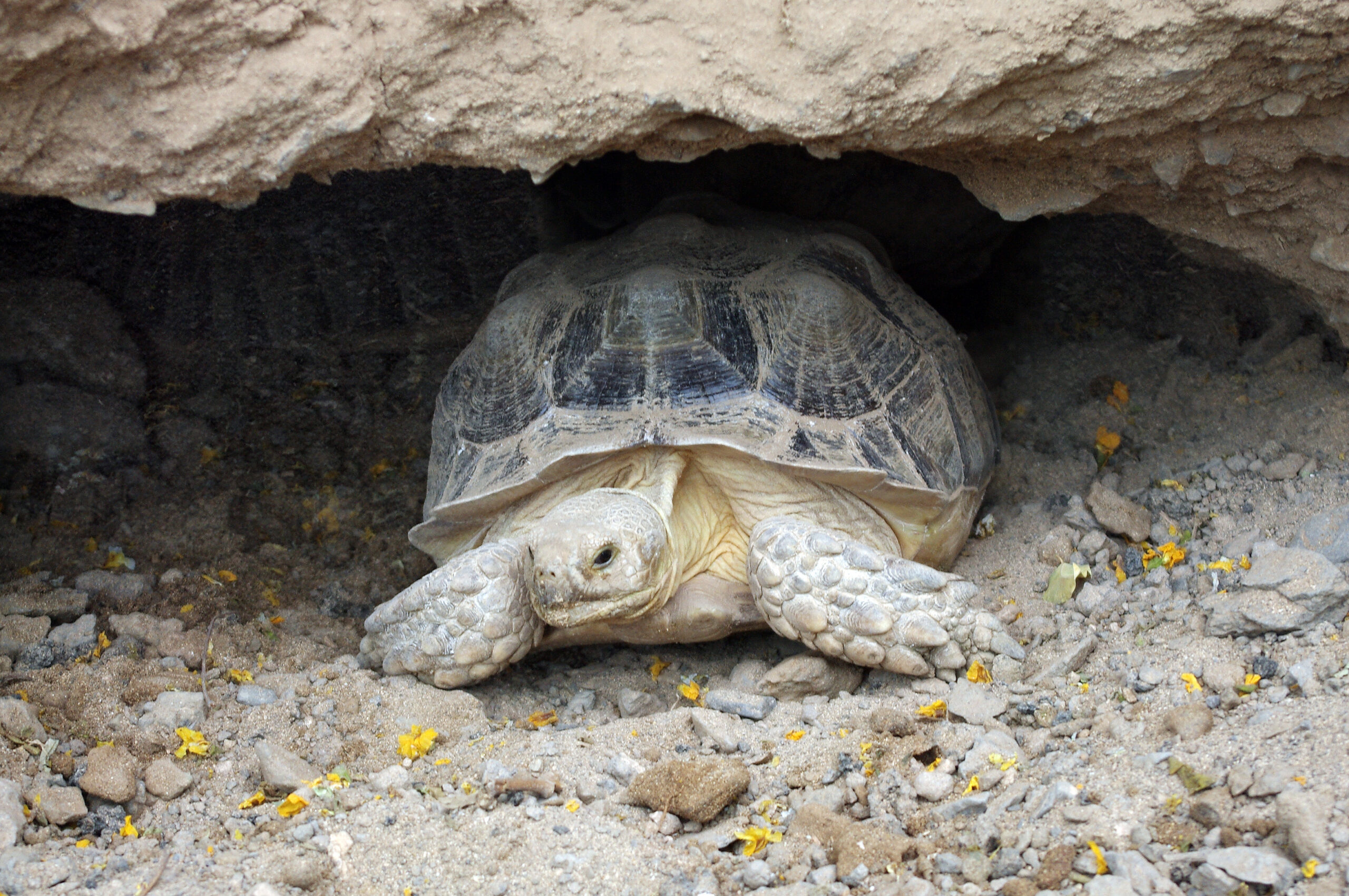
Sulcata Tortoise (Centrochelys sulcata) is a giant land tortoise native to the dry Sahel belt south of the Sahara. It survives seasonal heat and scarce surface water by feeding on tough vegetation, conserving moisture and digging long burrows with heavily armored forelegs. Despite being widely bred in captivity, wild populations are fragmented and declining through habitat loss, collection and exploitation. This guide separates well-supported biology from common assumptions and covers identification, range, habitat, diet, behavior, reproduction and conservation.
Identification
Adults have a broad sandy-yellow to brown domed shell with strongly grooved growth rings, a thick head and massive column-like limbs. The forelegs carry overlapping pointed scales that act as armor during digging. Two or three large conical spurs project from each thigh, giving the species its English name. Unlike many tortoises, it lacks a cervical scute directly above the neck. Adult males grow much larger, develop longer forked gular projections at the front of the plastron, a concave plastron and a long thick tail; females have shorter gulars and a flatter underside.
Identification should combine body shape, markings, size, voice or movement, and location. One feature by itself can overlap with a related animal, a juvenile, or an individual in unusual light.
Photographs are most useful when they preserve scale and show several diagnostic features. Handling or repositioning a wild sulcata tortoise for identification can cause stress and is unnecessary.
Size and physical adaptations
Sulcata Tortoise typically measures males can reach 86 cm straight carapace length; females about 58 cm and weighs large males can exceed 100 kg; females are much lighter. Growth varies with sex, food, rainfall and captive conditions. Very rapid captive growth can deform the shell and should not be treated as a goal.
Its useful adaptations include powerful forelegs excavate deep burrows, thick scales protect limbs during digging, efficient kidneys conserve water, large body buffers temperature change, high-fiber gut processes dry grasses, pale shell reflects some solar heat, burrows provide refuge for other animals. These traits work together in the animal’s normal setting rather than serving as isolated curiosities.
Published measurements may use different methods, life stages or sample locations. Comparing figures responsibly means checking what was measured rather than selecting the largest number available.
Range and distribution
A fragmented band across the Sahel and southern Sahara from Senegal and Mauritania east through Mali, Burkina Faso, Niger, Chad and Sudan to the Horn of Africa, with records at the southern Arabian Peninsula. It is absent or severely depleted from parts of its former range, and some country records are uncertain or may involve trade animals. The native range includes Benin, Burkina Faso, Central African Republic, Chad, Eritrea, Ethiopia, Mali, Mauritania, Niger, Nigeria, Saudi Arabia, Senegal, Sudan, Yemen.
A country-level map indicates broad distribution, not continuous occupation. Climate, elevation, water, vegetation, prey, breeding sites, barriers and survey effort all affect where records occur.
Records near the edge of the range deserve careful documentation because they may reflect natural movement, improved survey coverage, accidental transport or a genuine distribution change.
Habitat
Arid savanna, thorn scrub, dry grassland, sandy plains and seasonal drainage areas in the Sahel.
The tortoise forages when temperatures are tolerable, especially mornings, late afternoons and the rainy season. During midday heat, cold nights or drought it retreats into a burrow where temperature and humidity fluctuate less than at the surface. It favors sites with diggable soil, perennial grasses and scattered shade. Fences, cultivation and deep plowing can remove feeding habitat and block movements between remaining populations. Protecting a population therefore requires the feeding, shelter and breeding features that make a site usable, along with connections that allow movement.
Microhabitat matters. Shade, soil, current, moisture, shelter or host plants can determine whether a small area is usable even when the surrounding landscape appears suitable.
Diet and feeding
Sulcata Tortoise is a high-fiber herbivore. Important foods include native grasses, dry grass stems, succulent plants, herbs, leaves, flowers, occasional fallen fruit. Wild Sulcatas crop coarse grasses and seasonal herbs, obtaining much of their water from plants and drinking heavily when rain creates pools. The long digestive tract and microbial fermentation extract energy from fibrous food. Fruit is only an occasional wild item. Captive diets rich in fruit, animal protein or concentrated pellets can cause unhealthy growth and should not be used to imitate a natural grazer.
Diet changes with age, season, location and food supply. A dramatic prey record does not establish what most individuals eat most of the time; repeated field observations provide a stronger picture.
Feeding opportunities also create risk. An animal focused on prey may be less alert to predators, traffic or people, while contaminated prey can transfer pollutants through the food web.
Behavior and communication
Diurnal when conditions are mild; shifts activity to cooler hours and shelters underground during extremes. Adults are strong, persistent walkers and exceptional diggers. They follow feeding routes, investigate scent and may push through weak barriers. Males become combative during courtship, ramming rivals and using their forked front shell projections to overturn them. Outside breeding encounters, individuals are mostly solitary. A burrow may be reused for years and changes the local microhabitat.
Tortoises use scent to find food and reproductive partners, and close-range posture and touch during courtship. Males circle females, ram shells and may vocalize while mating. Shell impacts, scraping and movement transmit vibration through the ground. There is no evidence for complex group communication because adults do not maintain stable social herds. Behavior should be interpreted in context: alarm, courtship, feeding and temperature regulation can produce very different actions from the same animal.
Daily schedules are flexible responses, not rigid rules. Weather, breeding condition, disturbance, tides or food can move activity into a different part of the day.
Reproduction and development
Mating occurs mainly from the end of the rains into the dry season, though timing varies across the broad range. Males compete vigorously and court females on land. After internal fertilization a female tests several places, digs a flask-shaped nest with her hind feet and deposits a large clutch before covering and compacting the soil. Commonly 14–40 eggs, with two or three clutches possible in a season Round hard-shelled eggs develop underground through the dry season. Hatchlings use an egg tooth to break the shell and may wait for favorable moisture before emerging. They receive no parental care and face predation, dehydration and fire. Young tortoises grow slowly in the wild, where food pulses follow rain rather than remaining abundant year-round.
Young animals face different risks and may use different microhabitats or food than adults. Breeding success depends on adult condition, suitable sites and the survival of offspring through vulnerable early stages.
Counts of eggs or young describe reproductive output, not the number expected to reach adulthood. Mortality is normally greatest during eggs, larval or juvenile stages.
Predators and ecological role
Sulcata Tortoises are large grazers, seed dispersers and ecosystem engineers. They clip vegetation, move seeds in dung and excavate refuges used by other animals. Their burrows alter soil, moisture and shelter availability in an environment with few cool protected spaces. Eggs and hatchlings feed monitor lizards, mammals and birds, while healthy adults have few natural predators other than people. Documented or likely predators include Nile Monitor, Golden Jackal, Raptors, Spotted Hyena, Human.
This animal is both a consumer and a food source. Its influence comes through many repeated interactions, so ecological claims should be based on measured populations rather than assumptions drawn from appearance.
Predator and prey relationships differ among places. A species can be ecologically influential without being abundant everywhere, and its role can change across its range.
Relationship with people
People have long used Sulcatas for food, traditional practices and trade. Large numbers are now bred for the international pet market, yet captive abundance does not replace disappearing wild populations. Reintroduction projects in Senegal combine protected habitat, local participation and carefully managed breeding. Escaped pets can dig under foundations, damage pipes and become invasive outside Africa.
Adults are not venomous or predatory, but their mass and strength can injure feet, knock over children or break weak gates. Never sit on a tortoise, lift it by the limbs or place fingers near fighting males. Wash hands after contact because reptiles may carry Salmonella. Report escapes quickly and never release a pet into the wild. Responsible observation means keeping an appropriate distance, avoiding capture or feeding, protecting habitat and following local wildlife or invasive-species guidance.
Wildlife guidance should come from the responsible local agency because collection rules, reporting requests and appropriate responses differ between native and introduced ranges.
Conservation
The official IUCN Red List assessment classifies Centrochelys sulcata as Vulnerable, though it is old and specialist reviews consider the species at even higher risk. Wild populations are declining and fragmented despite the species being common in captivity. The reported global trend is Decreasing.
Important pressures include habitat conversion and overgrazing, collection for meat and pet trade, egg harvesting, fire and drought, roads and fencing, climate change, loss of wild genetic diversity. Global status can hide local decline or recovery, so current regional monitoring and habitat management remain necessary.
The most useful conservation action follows the documented pressure. Protecting breeding sites, reducing road deaths or limiting pollutants can require different tools in different populations.