
Home/Animals/Actinopterygii/Summer Flounder
Species profileIUCN: NE

Summer Flounder

Paralichthys dentatus

A left-eyed Atlantic flatfish that changes color, hides in sand and migrates between estuaries and offshore spawning grounds.

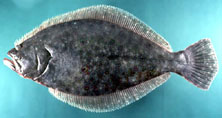
Summer Flounder resting on the seafloor with mottled brown camouflage
NOAA Fisheries / Public domain
๐ŸŒ Read in Language:

โšก At a Glance

Species profile
Also Known As
Fluke; Northern Fluke
Diet Category
Ambush predator of fish and mobile invertebrates
Activity Rhythm
Primarily diurnal, with feeding and swimming influenced by tides, light and water temperature.
Wild Lifespan
Often 8โ€“12 years, with some individuals older
Typical Weight
commonly 0.5โ€“2 kg; exceptional females near 7 kg
Conservation Status
NE
๐Ÿ’ก Key Biological Insight: During development, the right eye migrates across the head so that both eyes face upward while the fish rests on its right side.

๐ŸŒณ Scientific Taxonomy Hierarchy

Paralichthys dentatus is a full species in the large-tooth flounder family Paralichthyidae. It is a left-eyed flatfish, although rare individuals may be reversed. It differs from the right-eyed winter flounder and should not be confused with the closely related southern flounder.

KingdomAnimalia
PhylumChordata
ClassActinopterygii
OrderPleuronectiformes
FamilyParalichthyidae
GenusParalichthys
SpeciesParalichthys dentatus

Distinguishing Anatomical Features

  • โœ“The body is broad, thin and oval, with both eyes normally on the left, pigmented side. That upper surface is brown, gray or tan with many pale and dark spots, including distinct ocellated spots. The blind side is white. A large mouth carries sharp teeth, and long dorsal and anal fins fringe most of the body.
  • โœ“Both eyes shift to the left side
  • โœ“Chromatophores change body color
  • โœ“Flat body hides under sediment
  • โœ“Upward-facing eyes scan for prey
  • โœ“Large toothed mouth seizes fish
  • โœ“Fin undulation enables bottom swimming
  • โœ“Seasonal migration tracks temperature

๐Ÿ“ Physical Measurements

Total Lengthcommonly 12โ€“24 in; exceptional females near 39 in
Body Weightcommonly 1โ€“4.4 lb; exceptional females near 15 lb
Tail LengthShort caudal peduncle with a rounded tail fin
WingspanNot applicable
Top SpeedNo dependable universal maximumMovement changes with context and conditions.

๐ŸŽจ Appearance & Distinctive Markings

BrownGrayTanOliveWhiteBlack spotsGrayTanWhite

Skin / Covering: Small scales covered by mucus

Sexual Dimorphism: Females grow faster, mature at larger sizes and reach much greater maximum length and weight. External color and body shape do not reliably distinguish sex.

๐Ÿ—บ๏ธ Geographic Distribution & Habitat

Summer flounder occur along the northwest Atlantic coast from Nova Scotia to eastern Florida, with greatest abundance from Massachusetts through North Carolina. They enter bays and estuaries during warmer months and move to deeper continental-shelf water in autumn and winter.

Sandy and muddy seafloor, estuaries, coastal bays, tidal creeks, seagrass edges and continental-shelf waters from the shallows to about 150 m.

Country-level distribution map

Native range
FijiTanzaniaWestern SaharaCanada โ€” Native rangeUnited States โ€” Native rangeKazakhstanUzbekistanPapua New GuineaIndonesiaArgentinaChileCongo - KinshasaSomaliaKenyaSudanChadHaitiDominican RepublicRussiaBahamasFalkland IslandsNorwayGreenlandFrench Southern TerritoriesTimor-LesteSouth AfricaLesothoMexicoUruguayBrazilBoliviaPeruColombiaPanamaCosta RicaNicaraguaHondurasEl SalvadorGuatemalaBelizeVenezuelaGuyanaSurinameFranceEcuadorPuerto RicoJamaicaCubaZimbabweBotswanaNamibiaSenegalMaliMauritaniaBeninNigerNigeriaCameroonTogoGhanaCรดte dโ€™IvoireGuineaGuinea-BissauLiberiaSierra LeoneBurkina FasoCentral African RepublicCongo - BrazzavilleGabonEquatorial GuineaZambiaMalawiMozambiqueEswatiniAngolaBurundiIsraelLebanonMadagascarPalestinian TerritoriesGambiaTunisiaAlgeriaJordanUnited Arab EmiratesQatarKuwaitIraqOmanVanuatuCambodiaThailandLaosMyanmar (Burma)VietnamNorth KoreaSouth KoreaMongoliaIndiaBangladeshBhutanNepalPakistanAfghanistanTajikistanKyrgyzstanTurkmenistanIranSyriaArmeniaSwedenBelarusUkrainePolandAustriaHungaryMoldovaRomaniaLithuaniaLatviaEstoniaGermanyBulgariaGreeceTรผrkiyeAlbaniaCroatiaSwitzerlandLuxembourgBelgiumNetherlandsPortugalSpainIrelandNew CaledoniaSolomon IslandsNew ZealandAustraliaSri LankaChinaTaiwanItalyDenmarkUnited KingdomIcelandAzerbaijanGeorgiaPhilippinesMalaysiaBruneiSloveniaFinlandSlovakiaCzechiaEritreaJapanParaguayYemenSaudi ArabiaCyprusMoroccoEgyptLibyaEthiopiaDjiboutiUgandaRwandaBosnia & HerzegovinaNorth MacedoniaSerbiaMontenegroKosovoTrinidad & TobagoSouth Sudan
Highlighted countries are recorded profile locations, not precise biological range boundaries.Map boundaries: Natural Earth

Recorded Native Countries & Territories:

๐Ÿ’ก Did You Know?

  • ๐Ÿ’กBoth eyes shift to the left side
  • ๐Ÿ’กChromatophores change body color
  • ๐Ÿ’กFlat body hides under sediment
  • ๐Ÿ’กUpward-facing eyes scan for prey
  • ๐Ÿ’กLarge toothed mouth seizes fish
  • ๐Ÿ’กFin undulation enables bottom swimming
  • ๐Ÿ’กSeasonal migration tracks temperature

๐ŸŒฟ Conservation Status & Threats

IUCN: NE โ€” NE

โ€œThe species is managed through stock assessment rather than an IUCN global category. NOAAโ€™s 2025 assessment found the U.S. stock was not overfished and overfishing was not occurring, although abundance and recruitment still fluctuate.โ€

Population TrendManaged stock varies over time; current U.S. assessment indicates sustainable fishing status
Wild Population EstimateNo single global count; abundance is monitored through surveys and fishery data
CITESNot listed

โš ๏ธ Major Threats to Summer Flounder

  • โ€ขExcess fishing pressure
  • โ€ขNursery habitat degradation
  • โ€ขWarming waters
  • โ€ขLow recruitment years
  • โ€ขBottom habitat disturbance
  • โ€ขBycatch
  • โ€ขCoastal pollution

๐Ÿ”„ Life Cycle & Reproduction

Wild vs. Captivity Lifespan Comparison

๐ŸŒฟ In the WildOften 8โ€“12 years, with some individuals older
๐Ÿ  In Captivity (with veterinary care)Large public systems can display the species, but long-term care requires professional marine life support and substantial bottom space.
Clutch / Litter SizeHundreds of thousands to several million pelagic eggs per female per season
Incubation / GestationSeveral days, strongly dependent on water temperature
Fledging / WeaningPelagic larva that later settles as a tiny asymmetrical juvenile
Sexual MaturityMales commonly 1โ€“2 years; females about 2โ€“3 years
Mating SystemExternal fertilization through broadcast spawning
Nesting / Den TypeNo nest; floating eggs develop offshore in the water column

๐Ÿฆ… Behavior & Field Ecology

Ambush predator of fish and mobile invertebrates

๐ŸŒ Ecological Food Web & Relationships: Summer flounder link estuarine nurseries with continental-shelf food webs. They consume forage fish, shrimp and crabs and in turn feed sharks, cod, hakes, monkfish, sea ravens and other predators. Their seasonal movements transport energy between shallow bays and offshore waters, while juveniles serve as prey for crabs and coastal fish.

Social Group SizeMostly solitary outside seasonal spawning concentrations
Activity RhythmPrimarily diurnal, with feeding and swimming influenced by tides, light and water temperature.
Feeding StrategyAmbush predator of fish and mobile invertebrates

๐Ÿฅฉ Primary Prey & Preferred Diet

โœ“ Small fishโœ“ Squidโœ“ Shrimpโœ“ Crabsโœ“ Mantis shrimpโœ“ Marine worms

๐Ÿ“ข Communication & Territorial Signals

  • Visual detection
  • Lateral-line vibration sensing
  • Olfaction
  • Taste
  • Seasonal temperature cues
  • Chemical spawning cues

๐Ÿพ Wild Temperament & Traits

โ€ข Camouflagedโ€ข Predatoryโ€ข Migratoryโ€ข Mostly solitaryโ€ข Bottom-orientedโ€ข Fast-striking

๐Ÿค Human Interaction & Pet Advisory

โš ๏ธ Strictly Wild Species
๐Ÿšซ

Can You Keep a Summer Flounder as a Pet?

Summer flounder are large migratory marine predators and are unsuitable for home aquariums. Public aquariums require broad bottom area, high water quality, appropriate salinity and temperature, compatible prey or balanced marine diets and veterinary oversight. Wild capture must follow fishery and collection rules.

Domestication StatusWild fishery species; not domesticated
Danger to HumansLow direct risk, with handling and fishing-gear injuries possible
Economic & Ecotourism RoleA major Atlantic fishery species, an estuary-to-shelf predator and a model for studying flatfish development, camouflage and migration.

โš ๏ธ Behavioral Risk Factors & Wildlife Safety

  • Sharp teeth can cut fingers
  • Hooks cause punctures
  • Slippery fish can cause falls
  • Improper storage risks foodborne illness
  • Fishing gear can entangle wildlife

๐ŸŒ Ecological Food Web & Relationships

๐Ÿฆ… Natural Predators (5)

Spiny DogfishSqualus acanthias
MonkfishLophius americanus
Atlantic CodGadus morhua
Silver HakeMerluccius bilinearis
HumanHomo sapiens

๐Ÿงฌ Related Species (4)

Southern FlounderParalichthys lethostigmaClose western Atlantic relative
Gulf FlounderParalichthys albiguttaClose relative
Winter FlounderPseudopleuronectes americanusRight-eyed regional flatfish
Fourspot FlounderHippoglossina oblongaRegional flatfish predator

Summer Flounder (Paralichthys dentatus) is a bottom-dwelling predator native to the northwest Atlantic. It begins life as a symmetrical swimming larva, then one eye migrates to the left side as the body flattens. Adults camouflage themselves on sand and mud, ambushing fish and crustaceans and moving offshore each autumn to spawn. This guide separates well-supported biology from common assumptions and covers identification, range, habitat, diet, behavior, reproduction and conservation.

Identification

The body is broad, thin and oval, with both eyes normally on the left, pigmented side. That upper surface is brown, gray or tan with many pale and dark spots, including distinct ocellated spots. The blind side is white. A large mouth carries sharp teeth, and long dorsal and anal fins fringe most of the body. Females grow faster, mature at larger sizes and reach much greater maximum length and weight. External color and body shape do not reliably distinguish sex.

Identification should combine body shape, markings, size, voice or movement, and location. One feature by itself can overlap with a related animal, a juvenile, or an individual in unusual light.

Photographs are most useful when they preserve scale and show several diagnostic features. Handling or repositioning a wild summer flounder for identification can cause stress and is unnecessary.

Size and physical adaptations

Summer Flounder typically measures commonly 30โ€“60 cm; exceptional females near 1 m and weighs commonly 0.5โ€“2 kg; exceptional females near 7 kg. Most very large summer flounder are female because females live longer and grow faster.

Its useful adaptations include both eyes shift to the left side, chromatophores change body color, flat body hides under sediment, upward-facing eyes scan for prey, large toothed mouth seizes fish, fin undulation enables bottom swimming, seasonal migration tracks temperature. These traits work together in the animal’s normal setting rather than serving as isolated curiosities.

Published measurements may use different methods, life stages or sample locations. Comparing figures responsibly means checking what was measured rather than selecting the largest number available.

Range and distribution

Summer flounder occur along the northwest Atlantic coast from Nova Scotia to eastern Florida, with greatest abundance from Massachusetts through North Carolina. They enter bays and estuaries during warmer months and move to deeper continental-shelf water in autumn and winter. The native range includes Canada, United States.

A country-level map indicates broad distribution, not continuous occupation. Climate, elevation, water, vegetation, prey, breeding sites, barriers and survey effort all affect where records occur.

Records near the edge of the range deserve careful documentation because they may reflect natural movement, improved survey coverage, accidental transport or a genuine distribution change.

Habitat

Sandy and muddy seafloor, estuaries, coastal bays, tidal creeks, seagrass edges and continental-shelf waters from the shallows to about 150 m.

Young fish use estuaries and sheltered shallows as nursery grounds. Adults settle where sand meets silt, clay, shell or vegetation and can bury until only the eyes show. In late spring they move inshore to productive feeding areas; cooling water in autumn triggers an offshore migration toward spawning grounds. Protecting a population therefore requires the feeding, shelter and breeding features that make a site usable, along with connections that allow movement.

Microhabitat matters. Shade, soil, current, moisture, shelter or host plants can determine whether a small area is usable even when the surrounding landscape appears suitable.

Diet and feeding

Summer Flounder is a ambush predator of fish and mobile invertebrates. Important foods include small fish, squid, shrimp, crabs, mantis shrimp, marine worms. A flounder lies partly buried and visually tracks prey above the bottom. It can creep forward with fin movements or explode upward in a rapid strike. Small fish, squid and crustaceans dominate the diet, with prey size increasing as the fish grows. Seasonal availability matters: shrimp can become especially important in winter.

Diet changes with age, season, location and food supply. A dramatic prey record does not establish what most individuals eat most of the time; repeated field observations provide a stronger picture.

Feeding opportunities also create risk. An animal focused on prey may be less alert to predators, traffic or people, while contaminated prey can transfer pollutants through the food web.

Behavior and communication

Primarily diurnal, with feeding and swimming influenced by tides, light and water temperature. For much of the year an individual occupies a limited feeding area, resting flat or buried between short movements. It adjusts pigment cells to resemble the surrounding bottom, earning the nickname chameleon of the sea. Seasonal migrations are much longer, and tagged adults may return to the same estuaries in later years.

Vision is central to detecting prey, predators and habitat. The lateral-line system senses nearby water movement, while smell and taste locate food and suitable water. Seasonal temperature and day length help coordinate migration and spawning. Adults release eggs and sperm into open water without courtship care. Behavior should be interpreted in context: alarm, courtship, feeding and temperature regulation can produce very different actions from the same animal.

Daily schedules are flexible responses, not rigid rules. Weather, breeding condition, disturbance, tides or food can move activity into a different part of the day.

Reproduction and development

Adults migrate offshore in autumn and winter and gather over the continental shelf. Females release batches of buoyant eggs while males release sperm. Large females produce far more eggs than small ones and may spawn repeatedly during a season. Neither parent guards the eggs. Hundreds of thousands to several million pelagic eggs per female per season Transparent larvae hatch in open water with one eye on each side. During metamorphosis the body flattens and the right eye migrates to the left side. Juveniles settle to the bottom and move toward estuarine nursery habitat, where abundant prey supports rapid growth before seasonal offshore movements begin.

Young animals face different risks and may use different microhabitats or food than adults. Breeding success depends on adult condition, suitable sites and the survival of offspring through vulnerable early stages.

Counts of eggs or young describe reproductive output, not the number expected to reach adulthood. Mortality is normally greatest during eggs, larval or juvenile stages.

Predators and ecological role

Summer flounder link estuarine nurseries with continental-shelf food webs. They consume forage fish, shrimp and crabs and in turn feed sharks, cod, hakes, monkfish, sea ravens and other predators. Their seasonal movements transport energy between shallow bays and offshore waters, while juveniles serve as prey for crabs and coastal fish. Documented or likely predators include Spiny Dogfish, Monkfish, Atlantic Cod, Silver Hake, Human.

This animal is both a consumer and a food source. Its influence comes through many repeated interactions, so ecological claims should be based on measured populations rather than assumptions drawn from appearance.

Predator and prey relationships differ among places. A species can be ecologically influential without being abundant everywhere, and its role can change across its range.

Relationship with people

Summer flounder support valuable commercial and recreational fisheries. U.S. management uses catch limits, size rules, seasons, permits, monitoring and gear requirements. Regulations change by year and jurisdiction, so anglers must check current state and federal rules before fishing. Circle hooks, careful handling and rapid release improve survival of fish that must be returned.

The fish is not venomous, but sharp teeth, hooks, fin rays and slippery decks can injure handlers. Use a landing net and appropriate tool, keep fingers away from the mouth and follow seafood temperature and cooking guidance. Boat crews should also manage trawl and line gear carefully to reduce entanglement. Responsible observation means keeping an appropriate distance, avoiding capture or feeding, protecting habitat and following local wildlife or invasive-species guidance.

Wildlife guidance should come from the responsible local agency because collection rules, reporting requests and appropriate responses differ between native and introduced ranges.

Conservation

The species is managed through stock assessment rather than an IUCN global category. NOAAโ€™s 2025 assessment found the U.S. stock was not overfished and overfishing was not occurring, although abundance and recruitment still fluctuate. The reported global trend is Managed stock varies over time; current U.S. assessment indicates sustainable fishing status.

Important pressures include excess fishing pressure, nursery habitat degradation, warming waters, low recruitment years, bottom habitat disturbance, bycatch, coastal pollution. Global status can hide local decline or recovery, so current regional monitoring and habitat management remain necessary.

The most useful conservation action follows the documented pressure. Protecting breeding sites, reducing road deaths or limiting pollutants can require different tools in different populations.

Sources and further reading

โ“ Frequently Asked Questions

Answers to frequently asked questions verified against peer-reviewed zoological research.

Its scientific name is Paralichthys dentatus, a large-tooth flounder of the northwest Atlantic.