
Home/Animals/Mammalia/Tasmanian Devil
Species profileIUCN: EN

Tasmanian Devil

Sarcophilus harrisii

The largest living carnivorous marsupial, an essential scavenger threatened by transmissible facial cancer.

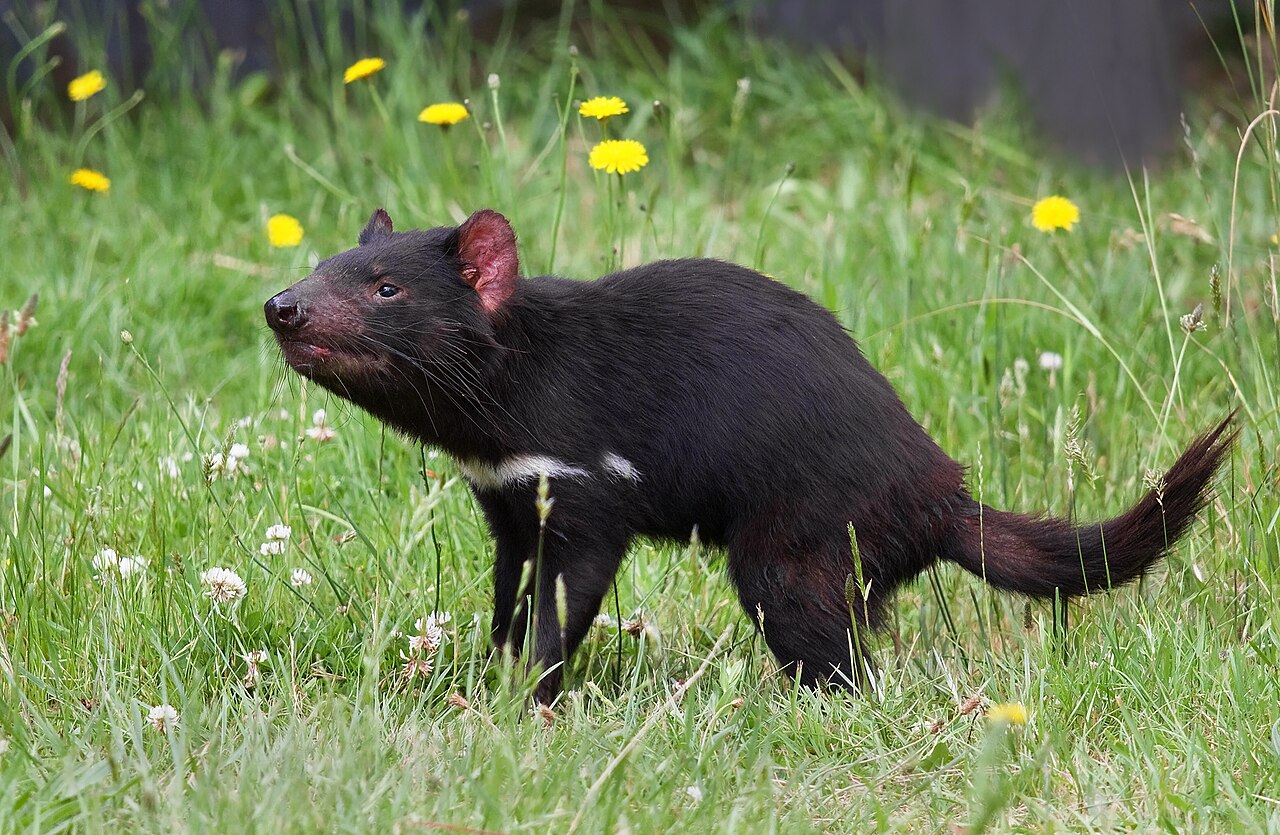
Tasmanian devil standing on grass, showing black fur, white chest marking and broad head
JJ Harrison / Wikimedia Commons / CC BY-SA 3.0
🌐 Read in Language:

⚡ At a Glance

Species profile
Also Known As
Devil, purinina
Diet Category
Carnivorous scavenger and opportunistic predator
Activity Rhythm
Mostly nocturnal and crepuscular, with juveniles sometimes active by day.
Wild Lifespan
Usually about 5–6 years in the wild, with some older individuals
Typical Weight
females commonly 4–8 kg; males commonly 6–12 kg
Conservation Status
EN
💡 Key Biological Insight: Devil facial tumour disease spreads when living cancer cells pass between animals, usually through bites during social encounters or feeding, making it one of the rare naturally transmissible cancers.

🌳 Scientific Taxonomy Hierarchy

The Tasmanian devil is the only living species in genus Sarcophilus and belongs to the carnivorous marsupial family Dasyuridae. Fossils show that devils survived on mainland Australia until roughly three thousand years ago.

KingdomAnimalia
PhylumChordata
ClassMammalia
OrderDasyuromorphia
FamilyDasyuridae
GenusSarcophilus
SpeciesSarcophilus harrisii

Distinguishing Anatomical Features

  • ✓A devil has a large head, muscular neck, short black coat, rounded ears and a thick tail that stores fat. Many individuals have a white chest band or rump patch, though markings vary. The muzzle is broad and the jaws carry heavy teeth suited to crushing bone.
  • ✓Powerful jaws crush bone and cartilage
  • ✓Large head and neck anchor chewing muscles
  • ✓Acute smell locates carcasses at night
  • ✓Fat-storing tail reflects body condition
  • ✓Rear-opening pouch protects young while digging
  • ✓Loud calls and scent organize communal feeding

📏 Physical Measurements

Total Lengthhead and body about 20–31 in; tail about 9–12 in
Body Weightfemales commonly 9–18 lb; males commonly 13–26 lb
Tail LengthThick at the base and used for fat storage
WingspanNot applicable
Top SpeedNo dependable universal maximumMovement changes with context and conditions.

🎨 Appearance & Distinctive Markings

BlackWhiteDark brownPink ears

Skin / Covering: Short coarse fur

Sexual Dimorphism: Adult males are generally longer and substantially heavier, with broader heads and necks. Females have a rear-opening pouch containing four teats.

🗺️ Geographic Distribution & Habitat

Wild populations occur across mainland Tasmania from coast to highlands, with abundance greatest in productive dry forest, woodland and farmland mosaics. Disease-free insurance populations have been established on islands and in managed facilities.

Coastal heath, open eucalypt forest, woodland, pasture edge, scrub and mixed forest where dens, carcasses and connected travel cover are available.

Country-level distribution map

Native range
FijiTanzaniaWestern SaharaCanadaUnited StatesKazakhstanUzbekistanPapua New GuineaIndonesiaArgentinaChileCongo - KinshasaSomaliaKenyaSudanChadHaitiDominican RepublicRussiaBahamasFalkland IslandsNorwayGreenlandFrench Southern TerritoriesTimor-LesteSouth AfricaLesothoMexicoUruguayBrazilBoliviaPeruColombiaPanamaCosta RicaNicaraguaHondurasEl SalvadorGuatemalaBelizeVenezuelaGuyanaSurinameFranceEcuadorPuerto RicoJamaicaCubaZimbabweBotswanaNamibiaSenegalMaliMauritaniaBeninNigerNigeriaCameroonTogoGhanaCôte d’IvoireGuineaGuinea-BissauLiberiaSierra LeoneBurkina FasoCentral African RepublicCongo - BrazzavilleGabonEquatorial GuineaZambiaMalawiMozambiqueEswatiniAngolaBurundiIsraelLebanonMadagascarPalestinian TerritoriesGambiaTunisiaAlgeriaJordanUnited Arab EmiratesQatarKuwaitIraqOmanVanuatuCambodiaThailandLaosMyanmar (Burma)VietnamNorth KoreaSouth KoreaMongoliaIndiaBangladeshBhutanNepalPakistanAfghanistanTajikistanKyrgyzstanTurkmenistanIranSyriaArmeniaSwedenBelarusUkrainePolandAustriaHungaryMoldovaRomaniaLithuaniaLatviaEstoniaGermanyBulgariaGreeceTürkiyeAlbaniaCroatiaSwitzerlandLuxembourgBelgiumNetherlandsPortugalSpainIrelandNew CaledoniaSolomon IslandsNew ZealandAustralia — Native rangeSri LankaChinaTaiwanItalyDenmarkUnited KingdomIcelandAzerbaijanGeorgiaPhilippinesMalaysiaBruneiSloveniaFinlandSlovakiaCzechiaEritreaJapanParaguayYemenSaudi ArabiaCyprusMoroccoEgyptLibyaEthiopiaDjiboutiUgandaRwandaBosnia & HerzegovinaNorth MacedoniaSerbiaMontenegroKosovoTrinidad & TobagoSouth Sudan
Highlighted countries are recorded profile locations, not precise biological range boundaries.Map boundaries: Natural Earth

Recorded Native Countries & Territories:

💡 Did You Know?

  • 💡Powerful jaws crush bone and cartilage
  • 💡Large head and neck anchor chewing muscles
  • 💡Acute smell locates carcasses at night
  • 💡Fat-storing tail reflects body condition
  • 💡Rear-opening pouch protects young while digging
  • 💡Loud calls and scent organize communal feeding

🌿 Conservation Status & Threats

IUCN: EN — Endangered

“Listed as Endangered. Devil facial tumour disease caused severe population declines, compounded by vehicle strikes, habitat change, low genetic diversity and persecution.”

Population Trend📉 Decreasing
Wild Population EstimateNo single precise current total exists; monitoring shows major regional reductions since disease emerged in the 1990s.

⚠️ Major Threats to Tasmanian Devil

  • •Devil facial tumour disease
  • •Vehicle collisions
  • •Low genetic diversity
  • •Habitat loss and fragmentation
  • •Persecution and illegal killing
  • •Climate and prey changes

🔄 Life Cycle & Reproduction

Wild vs. Captivity Lifespan Comparison

🌿 In the WildUsually about 5–6 years in the wild, with some older individuals
🏠 In Captivity (with veterinary care)Often 5–8 years under managed care.
Clutch / Litter SizeUp to 20–30 newborns may be delivered, but no more than four attach to teats
Incubation / GestationGestation about three weeks, followed by roughly four months in the pouch
Fledging / WeaningPouch young attach permanently to a teat at first; older juveniles stay in a den and become independent by about nine to ten months.
Sexual MaturityUsually near the end of the second year, sometimes earlier
Mating SystemPolygynandrous with vigorous competition and temporary mate guarding
Nesting / Den TypeDen in hollow log, burrow, cave or dense shelter

🦅 Behavior & Field Ecology

Carnivorous scavenger and opportunistic predator

🌐 Ecological Food Web & Relationships: As Tasmania’s largest surviving marsupial carnivore, the devil removes carrion, recycles nutrients and may suppress introduced mesopredators around food. Rapid carcass consumption also reduces blowfly breeding and limits food available to feral cats.

Social Group SizeSolitary foraging with temporary feeding aggregations
Activity RhythmMostly nocturnal and crepuscular, with juveniles sometimes active by day.
Feeding StrategyCarnivorous scavenger and opportunistic predator

🥩 Primary Prey & Preferred Diet

✓ Wallaby and possum carrion✓ Wombats✓ Small mammals✓ Birds✓ Reptiles✓ Frogs✓ Insects✓ Domestic livestock carrion

📢 Communication & Territorial Signals

  • Screeches
  • Growls and snarls
  • Scent marking
  • Open-mouth display
  • Body posture

🐾 Wild Temperament & Traits

• Secretive• Bold at carcasses• Defensive when trapped

🤝 Human Interaction & Pet Advisory

⚠️ Strictly Wild Species
🚫

Can You Keep a Tasmanian Devil as a Pet?

A protected endangered marsupial with powerful jaws, large ranging needs and complex biology; it is not a pet.

Domestication StatusWild marsupial; not domesticated
Danger to HumansLow to people when left alone; a trapped animal can deliver a severe bite
Economic & Ecotourism RoleTop native scavenger, nutrient recycler, Tasmanian cultural icon and flagship for cancer, genetics and wildlife-disease research.

⚠️ Behavioral Risk Factors & Wildlife Safety

  • Exceptionally strong jaws
  • Sharp teeth
  • Wildlife handling risks disease and injury

🌐 Ecological Food Web & Relationships

🦅 Natural Predators (4)

Tasmanian DevilSarcophilus harrisii
Wedge-tailed EagleAquila audax
Domestic DogCanis familiaris
Humans and VehiclesHomo sapiens

🧬 Related Species (3)

Spotted-tailed QuollDasyurus maculatusLarge living dasyurid relative
Eastern QuollDasyurus viverrinusSmaller Tasmanian relative
ThylacineThylacinus cynocephalusExtinct Tasmanian carnivorous marsupial

Tasmanian Devil (Sarcophilus harrisii) is a stocky nocturnal predator and scavenger now found naturally only on the Australian island of Tasmania. This guide separates well-supported biology from common assumptions and covers identification, range, habitat, diet, behavior, reproduction and conservation.

Identification

A devil has a large head, muscular neck, short black coat, rounded ears and a thick tail that stores fat. Many individuals have a white chest band or rump patch, though markings vary. The muzzle is broad and the jaws carry heavy teeth suited to crushing bone. Adult males are generally longer and substantially heavier, with broader heads and necks. Females have a rear-opening pouch containing four teats.

Identification should combine body shape, markings, size, voice or movement, and location. One feature by itself can overlap with a related animal, a juvenile, or an individual in unusual light.

Photographs are most useful when they preserve scale and show several diagnostic features. Handling or repositioning a wild tasmanian devil for identification can cause stress and is unnecessary.

Size and physical adaptations

Tasmanian Devil typically measures head and body about 52–80 cm; tail about 23–30 cm and weighs females commonly 4–8 kg; males commonly 6–12 kg. Size varies across Tasmania with sex, age, habitat and food; large males from productive areas may exceed typical figures.

Its useful adaptations include powerful jaws crush bone and cartilage, large head and neck anchor chewing muscles, acute smell locates carcasses at night, fat-storing tail reflects body condition, rear-opening pouch protects young while digging, loud calls and scent organize communal feeding. These traits work together in the animal’s normal setting rather than serving as isolated curiosities.

Published measurements may use different methods, life stages or sample locations. Comparing figures responsibly means checking what was measured rather than selecting the largest number available.

Range and distribution

Wild populations occur across mainland Tasmania from coast to highlands, with abundance greatest in productive dry forest, woodland and farmland mosaics. Disease-free insurance populations have been established on islands and in managed facilities. The native range includes Australia.

A country-level map indicates broad distribution, not continuous occupation. Climate, elevation, water, vegetation, prey, breeding sites, barriers and survey effort all affect where records occur.

Records near the edge of the range deserve careful documentation because they may reflect natural movement, improved survey coverage, accidental transport or a genuine distribution change.

Habitat

Coastal heath, open eucalypt forest, woodland, pasture edge, scrub and mixed forest where dens, carcasses and connected travel cover are available.

A devil shelters by day in a hollow log, cave, wombat burrow, dense vegetation or space beneath a building. At night it may travel many kilometres along tracks and scent routes, using open ground to search and thick cover for security. Protecting a population therefore requires the feeding, shelter and breeding features that make a site usable, along with connections that allow movement.

Microhabitat matters. Shade, soil, current, moisture, shelter or host plants can determine whether a small area is usable even when the surrounding landscape appears suitable.

Diet and feeding

Tasmanian Devil is a carnivorous scavenger and opportunistic predator. Important foods include wallaby and possum carrion, wombats, small mammals, birds, reptiles, frogs, insects, domestic livestock carrion. Devils rely heavily on carrion but also catch vulnerable prey. Strong jaws and teeth consume skin, muscle, organs, fur and much of the skeleton, leaving little waste. Several animals may gather noisily at a large carcass and establish access through posture, calls and biting.

Diet changes with age, season, location and food supply. A dramatic prey record does not establish what most individuals eat most of the time; repeated field observations provide a stronger picture.

Feeding opportunities also create risk. An animal focused on prey may be less alert to predators, traffic or people, while contaminated prey can transfer pollutants through the food web.

Behavior and communication

Mostly nocturnal and crepuscular, with juveniles sometimes active by day. Adults usually forage alone but become highly social around food. Screeches, growls, yawning displays and open-mouthed lunges reduce some physical conflict, although bites are common. Devils swim, climb when young and cover large nightly distances.

Scent marks, growls, snarls, screeches and body posture communicate ownership, submission and readiness to fight. The famous wide gape often signals fear or uncertainty rather than an unprovoked attack. Behavior should be interpreted in context: alarm, courtship, feeding and temperature regulation can produce very different actions from the same animal.

Daily schedules are flexible responses, not rigid rules. Weather, breeding condition, disturbance, tides or food can move activity into a different part of the day.

Reproduction and development

Mating occurs mainly in late summer and autumn. A female can produce many tiny newborns, but only four can attach to the four teats in her pouch, so at most four pouch young survive the first competition. Up to 20–30 newborns may be delivered, but no more than four attach to teats After leaving the pouch, young remain in a den while the mother forages. They begin following her and are progressively weaned before dispersing to establish their own ranges.

Young animals face different risks and may use different microhabitats or food than adults. Breeding success depends on adult condition, suitable sites and the survival of offspring through vulnerable early stages.

Counts of eggs or young describe reproductive output, not the number expected to reach adulthood. Mortality is normally greatest during eggs, larval or juvenile stages.

Predators and ecological role

As Tasmania’s largest surviving marsupial carnivore, the devil removes carrion, recycles nutrients and may suppress introduced mesopredators around food. Rapid carcass consumption also reduces blowfly breeding and limits food available to feral cats. Documented or likely predators include Tasmanian Devil, Wedge-tailed Eagle, Domestic Dog, Humans and Vehicles.

This animal is both a consumer and a food source. Its influence comes through many repeated interactions, so ecological claims should be based on measured populations rather than assumptions drawn from appearance.

Predator and prey relationships differ among places. A species can be ecologically influential without being abundant everywhere, and its role can change across its range.

Relationship with people

Early settlers persecuted devils as livestock threats, although scavenging was often mistaken for predation. Today the species is a Tasmanian emblem. Roadkill, illegal shooting and poorly secured poultry still cause conflict, while road-killed carcasses attract devils into traffic.

Never feed or approach a wild devil. Slow down from dusk to dawn, remove wildlife carcasses from roads only when legally and safely possible, secure poultry and report sick animals to Tasmania’s wildlife authorities without attempting capture. Responsible observation means keeping an appropriate distance, avoiding capture or feeding, protecting habitat and following local wildlife or invasive-species guidance.

Wildlife guidance should come from the responsible local agency because collection rules, reporting requests and appropriate responses differ between native and introduced ranges.

Conservation

Listed as Endangered. Devil facial tumour disease caused severe population declines, compounded by vehicle strikes, habitat change, low genetic diversity and persecution. The reported global trend is Decreasing overall, with some disease-affected populations showing evolutionary and demographic responses.

Important pressures include devil facial tumour disease, vehicle collisions, low genetic diversity, habitat loss and fragmentation, persecution and illegal killing, climate and prey changes. Global status can hide local decline or recovery, so current regional monitoring and habitat management remain necessary.

The most useful conservation action follows the documented pressure. Protecting breeding sites, reducing road deaths or limiting pollutants can require different tools in different populations.

Sources and further reading

❓ Frequently Asked Questions

Answers to frequently asked questions verified against peer-reviewed zoological research.

Screeches, growls and snarls communicate fear, dominance and access to food during close social encounters, especially at carcasses.