
Home/Animals/Aves/Tawny Frogmouth
Species profileIUCN: LC

Tawny Frogmouth

Podargus strigoides

A bark-patterned Australian night bird that freezes into the shape of a broken branch by day.

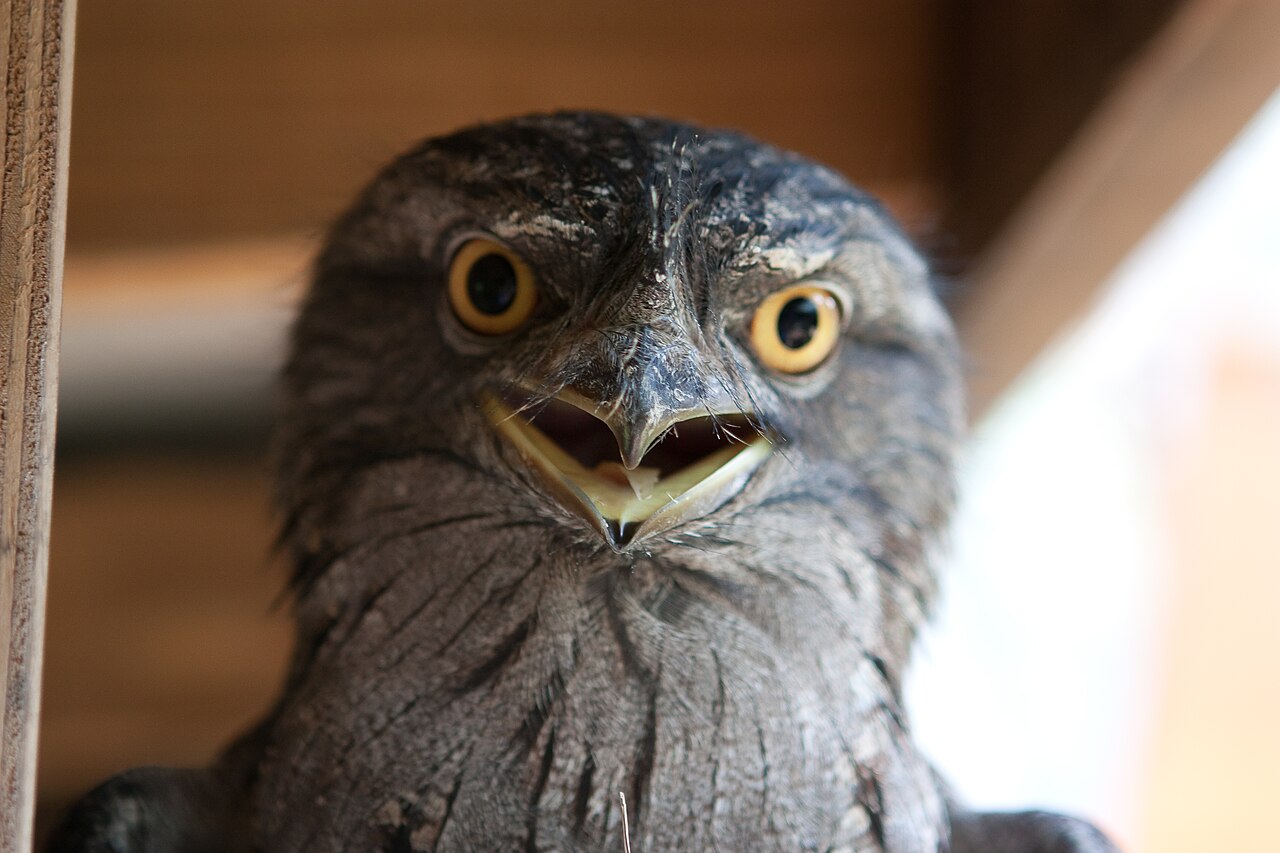
Tawny frogmouth facing forward on a branch, showing mottled gray-brown plumage, broad bill and yellow eyes
Chocolateoak / Wikimedia Commons / CC BY-SA 3.0
🌐 Read in Language:

⚡ At a Glance

Species profile
Also Known As
Frogmouth, mopoke (regional and sometimes confused with boobook)
Diet Category
Carnivore, primarily insectivore
Activity Rhythm
Nocturnal, resting motionless by day.
Wild Lifespan
Wild individuals can live for many years; precise typical survival is uncertain
Typical Weight
about 290–680 g
Conservation Status
LC
💡 Key Biological Insight: Its famous upright freeze is an active camouflage response: the bird elongates its body and partly closes its eyes to resemble a jagged branch.

🌳 Scientific Taxonomy Hierarchy

The tawny frogmouth is a species in family Podargidae. Although its forward-facing eyes and nocturnal habits resemble an owl, it is not an owl and is more closely allied with other caprimulgiform night birds.

KingdomAnimalia
PhylumChordata
ClassAves
OrderCaprimulgiformes
FamilyPodargidae
GenusPodargus
SpeciesPodargus strigoides

Distinguishing Anatomical Features

  • ✓A broad, flattened bill, yellow eyes, a large rounded head and heavily mottled gray-brown plumage distinguish this species. When resting, it points the bill upward, narrows its eyes and compresses its feathers so its streaks align with bark.
  • ✓Mottled plumage matches bark
  • ✓Rigid cryptic posture mimics a broken branch
  • ✓Wide gape captures large prey
  • ✓Rictal bristles help protect the face
  • ✓Large eyes support low-light hunting
  • ✓Low-energy torpor can reduce cold-weather demands

📏 Physical Measurements

Total Lengthabout 13–21 in
Body Weightabout 10–24 oz
Tail Lengthabout 6.6–9.0 in in measured Victorian adults
WingspanNo single authoritative range used here
Top SpeedNo dependable universal maximumMovement changes with context and conditions.

🎨 Appearance & Distinctive Markings

Silver grayBrownBlackWhiteRufousRufous

Skin / Covering: Dense mottled feathers with bristles around a broad bill

Sexual Dimorphism: The sexes overlap strongly in appearance and size. Gray is the common plumage form, while a richer rufous form occurs more often in females; plumage alone does not reliably identify sex.

🗺️ Geographic Distribution & Habitat

Widespread across mainland Australia and Tasmania, although absent or scarce in the wettest closed rainforest and the most treeless arid interior.

Open forest, woodland, heath, wooded farmland, parks and well-treed suburbs with hunting perches and horizontal nesting forks.

Country-level distribution map

Native range
FijiTanzaniaWestern SaharaCanadaUnited StatesKazakhstanUzbekistanPapua New GuineaIndonesiaArgentinaChileCongo - KinshasaSomaliaKenyaSudanChadHaitiDominican RepublicRussiaBahamasFalkland IslandsNorwayGreenlandFrench Southern TerritoriesTimor-LesteSouth AfricaLesothoMexicoUruguayBrazilBoliviaPeruColombiaPanamaCosta RicaNicaraguaHondurasEl SalvadorGuatemalaBelizeVenezuelaGuyanaSurinameFranceEcuadorPuerto RicoJamaicaCubaZimbabweBotswanaNamibiaSenegalMaliMauritaniaBeninNigerNigeriaCameroonTogoGhanaCôte d’IvoireGuineaGuinea-BissauLiberiaSierra LeoneBurkina FasoCentral African RepublicCongo - BrazzavilleGabonEquatorial GuineaZambiaMalawiMozambiqueEswatiniAngolaBurundiIsraelLebanonMadagascarPalestinian TerritoriesGambiaTunisiaAlgeriaJordanUnited Arab EmiratesQatarKuwaitIraqOmanVanuatuCambodiaThailandLaosMyanmar (Burma)VietnamNorth KoreaSouth KoreaMongoliaIndiaBangladeshBhutanNepalPakistanAfghanistanTajikistanKyrgyzstanTurkmenistanIranSyriaArmeniaSwedenBelarusUkrainePolandAustriaHungaryMoldovaRomaniaLithuaniaLatviaEstoniaGermanyBulgariaGreeceTürkiyeAlbaniaCroatiaSwitzerlandLuxembourgBelgiumNetherlandsPortugalSpainIrelandNew CaledoniaSolomon IslandsNew ZealandAustralia — Native rangeSri LankaChinaTaiwanItalyDenmarkUnited KingdomIcelandAzerbaijanGeorgiaPhilippinesMalaysiaBruneiSloveniaFinlandSlovakiaCzechiaEritreaJapanParaguayYemenSaudi ArabiaCyprusMoroccoEgyptLibyaEthiopiaDjiboutiUgandaRwandaBosnia & HerzegovinaNorth MacedoniaSerbiaMontenegroKosovoTrinidad & TobagoSouth Sudan
Highlighted countries are recorded profile locations, not precise biological range boundaries.Map boundaries: Natural Earth

Recorded Native Countries & Territories:

💡 Did You Know?

  • 💡Mottled plumage matches bark
  • 💡Rigid cryptic posture mimics a broken branch
  • 💡Wide gape captures large prey
  • 💡Rictal bristles help protect the face
  • 💡Large eyes support low-light hunting
  • 💡Low-energy torpor can reduce cold-weather demands

🌿 Conservation Status & Threats

IUCN: LC — Least Concern

“Globally listed as Least Concern because it remains widespread. Local threats include vehicle strikes, habitat-tree loss, secondary poisoning and predation by introduced animals.”

Population TrendGenerally regarded as stable, though local monitoring can reveal losses
Wild Population EstimateNo precise global population total is available.

⚠️ Major Threats to Tawny Frogmouth

  • •Vehicle collisions while chasing insects
  • •Removal of mature trees
  • •Rodenticide and insecticide poisoning
  • •Domestic cats and introduced foxes
  • •Extreme heat and severe weather
  • •Nest disturbance

🔄 Life Cycle & Reproduction

Wild vs. Captivity Lifespan Comparison

🌿 In the WildWild individuals can live for many years; precise typical survival is uncertain
🏠 In Captivity (with veterinary care)Captive lifespan can reach the teens under professional care.
Clutch / Litter SizeUsually 2–3 white eggs
Incubation / GestationAbout 28–32 days
Fledging / WeaningAltricial chicks depend on both parents in the nest and remain with adults after fledging.
Sexual MaturityNot consistently reported across authoritative public sources
Mating SystemSocially monogamous pair bond
Nesting / Den TypeLoose stick platform on a horizontal tree fork

🦅 Behavior & Field Ecology

Carnivore, primarily insectivore

🌐 Ecological Food Web & Relationships: Tawny frogmouths remove large numbers of nocturnal insects and also take other small animals, linking canopy perches with ground-level prey communities. Their eggs and young support native predators, while large trees provide both nesting structure and daytime concealment.

Social Group SizeUsually a pair or small family group
Activity RhythmNocturnal, resting motionless by day.
Feeding StrategyCarnivore, primarily insectivore

🥩 Primary Prey & Preferred Diet

✓ Moths and beetles✓ Other nocturnal insects✓ Worms✓ Slugs and snails✓ Small lizards✓ Frogs✓ Small mammals✓ Occasional small birds

📢 Communication & Territorial Signals

  • Low repeated oom
  • Hiss
  • Bill clapping
  • Soft contact calls

🐾 Wild Temperament & Traits

• Still by day• Alert• Territorial• Gentle-looking but defensive at a nest

🤝 Human Interaction & Pet Advisory

⚠️ Strictly Wild Species
🚫

Can You Keep a Tawny Frogmouth as a Pet?

A protected native bird with specialized diet, nocturnal behavior and flight needs; it is not suitable or generally legal as a private pet.

Domestication StatusWild Australian bird; not domesticated
Danger to HumansVery low to people; a distressed bird may gape, hiss or snap
Economic & Ecotourism RoleNatural control of nocturnal invertebrates, urban wildlife education and a widely loved symbol of Australian camouflage.

⚠️ Behavioral Risk Factors & Wildlife Safety

  • Broad bill can pinch
  • Defensive bill clapping
  • Handling stresses injured wildlife

🌐 Ecological Food Web & Relationships

🦅 Natural Predators (5)

Powerful OwlNinox strenua
Carpet PythonMorelia spilota
GoannaVaranus spp.
Domestic CatFelis catus
Red FoxVulpes vulpes

🧬 Related Species (3)

Papuan FrogmouthPodargus papuensisLarger close relative in Australia and New Guinea
Marbled FrogmouthPodargus ocellatusForest-dwelling close relative
Australian Owlet-nightjarAegotheles cristatusRelated nocturnal caprimulgiform bird

Tawny Frogmouth (Podargus strigoides) is a nocturnal Australian bird famous for cryptic plumage, a broad bill and a rigid daytime camouflage posture. This guide separates well-supported biology from common assumptions and covers identification, range, habitat, diet, behavior, reproduction and conservation.

Identification

A broad, flattened bill, yellow eyes, a large rounded head and heavily mottled gray-brown plumage distinguish this species. When resting, it points the bill upward, narrows its eyes and compresses its feathers so its streaks align with bark. The sexes overlap strongly in appearance and size. Gray is the common plumage form, while a richer rufous form occurs more often in females; plumage alone does not reliably identify sex.

Identification should combine body shape, markings, size, voice or movement, and location. One feature by itself can overlap with a related animal, a juvenile, or an individual in unusual light.

Photographs are most useful when they preserve scale and show several diagnostic features. Handling or repositioning a wild tawny frogmouth for identification can cause stress and is unnecessary.

Size and physical adaptations

Tawny Frogmouth typically measures about 34–53 cm and weighs about 290–680 g. Southern birds tend to be larger than northern birds, and published mass ranges vary by sex, subspecies and region.

Its useful adaptations include mottled plumage matches bark, rigid cryptic posture mimics a broken branch, wide gape captures large prey, rictal bristles help protect the face, large eyes support low-light hunting, low-energy torpor can reduce cold-weather demands. These traits work together in the animal’s normal setting rather than serving as isolated curiosities.

Published measurements may use different methods, life stages or sample locations. Comparing figures responsibly means checking what was measured rather than selecting the largest number available.

Range and distribution

Widespread across mainland Australia and Tasmania, although absent or scarce in the wettest closed rainforest and the most treeless arid interior. The native range includes Australia.

A country-level map indicates broad distribution, not continuous occupation. Climate, elevation, water, vegetation, prey, breeding sites, barriers and survey effort all affect where records occur.

Records near the edge of the range deserve careful documentation because they may reflect natural movement, improved survey coverage, accidental transport or a genuine distribution change.

Habitat

Open forest, woodland, heath, wooded farmland, parks and well-treed suburbs with hunting perches and horizontal nesting forks.

Pairs often use the same territory for years. They rest lengthwise on branches during daylight, hunt from exposed perches at night and need mature trees for roosting and the simple stick platforms used for nesting. Protecting a population therefore requires the feeding, shelter and breeding features that make a site usable, along with connections that allow movement.

Microhabitat matters. Shade, soil, current, moisture, shelter or host plants can determine whether a small area is usable even when the surrounding landscape appears suitable.

Diet and feeding

Tawny Frogmouth is a carnivore, primarily insectivore. Important foods include moths and beetles, other nocturnal insects, worms, slugs and snails, small lizards, frogs, small mammals, occasional small birds. A frogmouth usually waits on a branch, fence or post and pounces onto prey on the ground. It can also snatch flying moths. Its feet are relatively weak, so the broad bill rather than powerful talons handles prey.

Diet changes with age, season, location and food supply. A dramatic prey record does not establish what most individuals eat most of the time; repeated field observations provide a stronger picture.

Feeding opportunities also create risk. An animal focused on prey may be less alert to predators, traffic or people, while contaminated prey can transfer pollutants through the food web.

Behavior and communication

Nocturnal, resting motionless by day. Pairs maintain territories and often roost together or near their young. By day they rely on stillness and camouflage; after dark they use repeated perches to watch for prey. In cold conditions they can lower body temperature and enter brief torpor to save energy.

The best-known call is a low, rhythmic oom repeated many times. Hisses, bill claps and softer contact sounds occur during threat, courtship and family interactions. Behavior should be interpreted in context: alarm, courtship, feeding and temperature regulation can produce very different actions from the same animal.

Daily schedules are flexible responses, not rigid rules. Weather, breeding condition, disturbance, tides or food can move activity into a different part of the day.

Reproduction and development

Pairs construct a loose, shallow platform of sticks on a horizontal fork. Both parents incubate: the male commonly covers the day shift and both share night duties. Arid-zone timing can follow rain rather than a fixed calendar. Usually 2–3 white eggs Chicks hatch covered in white down and are brooded and fed by both parents. They grow rapidly on animal prey, develop cryptic juvenile plumage and leave the small platform before becoming fully independent.

Young animals face different risks and may use different microhabitats or food than adults. Breeding success depends on adult condition, suitable sites and the survival of offspring through vulnerable early stages.

Counts of eggs or young describe reproductive output, not the number expected to reach adulthood. Mortality is normally greatest during eggs, larval or juvenile stages.

Predators and ecological role

Tawny frogmouths remove large numbers of nocturnal insects and also take other small animals, linking canopy perches with ground-level prey communities. Their eggs and young support native predators, while large trees provide both nesting structure and daytime concealment. Documented or likely predators include Powerful Owl, Carpet Python, Goanna, Domestic Cat, Red Fox.

This animal is both a consumer and a food source. Its influence comes through many repeated interactions, so ecological claims should be based on measured populations rather than assumptions drawn from appearance.

Predator and prey relationships differ among places. A species can be ecologically influential without being abundant everywhere, and its role can change across its range.

Relationship with people

The species tolerates well-treed suburbs, making it one of Australia’s most frequently encountered nocturnal birds. Roads create a serious hazard because insects gather around headlights and streetlights. Rodenticides and insecticides can poison the prey on which frogmouths depend, while removal of old trees eliminates roost and nest sites.

Drive slowly at night in wooded areas, retain mature native trees, avoid broad insecticide and rodenticide use, keep cats contained and contact a licensed wildlife rescuer if a bird is injured. Do not approach a nest or force a resting bird to break camouflage. Responsible observation means keeping an appropriate distance, avoiding capture or feeding, protecting habitat and following local wildlife or invasive-species guidance.

Wildlife guidance should come from the responsible local agency because collection rules, reporting requests and appropriate responses differ between native and introduced ranges.

Conservation

Globally listed as Least Concern because it remains widespread. Local threats include vehicle strikes, habitat-tree loss, secondary poisoning and predation by introduced animals. The reported global trend is Generally regarded as stable, though local monitoring can reveal losses.

Important pressures include vehicle collisions while chasing insects, removal of mature trees, rodenticide and insecticide poisoning, domestic cats and introduced foxes, extreme heat and severe weather, nest disturbance. Global status can hide local decline or recovery, so current regional monitoring and habitat management remain necessary.

The most useful conservation action follows the documented pressure. Protecting breeding sites, reducing road deaths or limiting pollutants can require different tools in different populations.

Sources and further reading

❓ Frequently Asked Questions

Answers to frequently asked questions verified against peer-reviewed zoological research.

No. It is a frogmouth in family Podargidae. Unlike owls, it has relatively weak feet and captures most prey with its broad bill.