
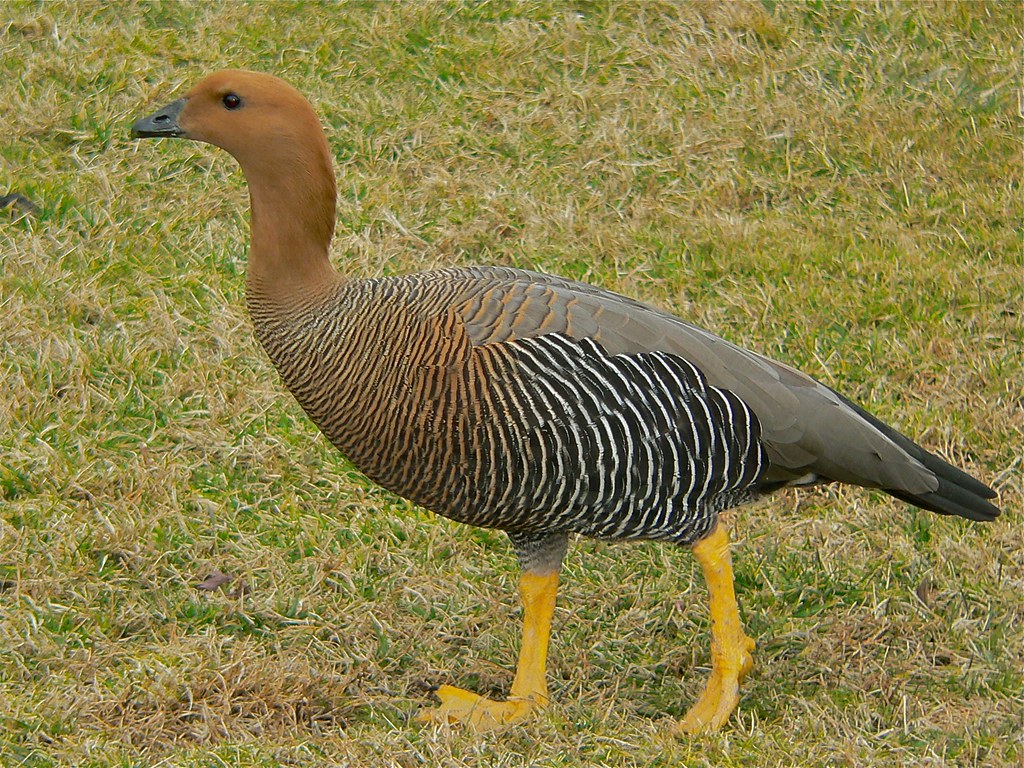
Upland Goose (Chloephaga picta) is a grazing South American sheldgoose of Patagonia, Tierra del Fuego and the Falkland Islands. This guide separates well-supported biology from common assumptions and covers identification, range, habitat, diet, behavior, reproduction and conservation.
Identification
Males are strikingly white on the head, neck and underparts with bold black barring across the back and flanks and dark legs. Females are warm russet brown with black barring and yellowish legs. Both sexes show broad white wing panels contrasting with dark flight feathers. Sexual dimorphism is extreme: an adult male is predominantly white and black, while the female is rich brown and barred. Falkland birds average larger than mainland birds.
Identification should combine body shape, markings, size, voice or movement, and location. One feature by itself can overlap with a related animal, a juvenile, or an individual in unusual light.
Photographs are most useful when they preserve scale and show several diagnostic features. Handling or repositioning a wild upland goose for identification can cause stress and is unnecessary.
Size and physical adaptations
Upland Goose typically measures roughly 60–75 cm depending on subspecies and sex and weighs approximately 2.7–4.0 kg. Falkland Islands birds are larger than mainland birds, and males average heavier than females.
Its useful adaptations include strong bill clips short grass, robust legs support long periods grazing, dense down insulates in cold windy climates, contrasting plumage signals sex at a distance, precocial goslings walk and feed after hatching, powerful wings support seasonal migration. These traits work together in the animal’s normal setting rather than serving as isolated curiosities.
Published measurements may use different methods, life stages or sample locations. Comparing figures responsibly means checking what was measured rather than selecting the largest number available.
Range and distribution
Native to southern South America from Patagonia and Tierra del Fuego through southern Chile and Argentina, plus the Falkland Islands. Continental populations include seasonal migrants, whereas many island birds are resident. The native range includes Argentina, Chile, Falkland Islands.
A country-level map indicates broad distribution, not continuous occupation. Climate, elevation, water, vegetation, prey, breeding sites, barriers and survey effort all affect where records occur.
Records near the edge of the range deserve careful documentation because they may reflect natural movement, improved survey coverage, accidental transport or a genuine distribution change.
Habitat
Open steppe, short coastal grassland, wet meadow, pasture, lake and river margins, and grassy uplands from sea level into the Andes.
Pairs graze short turf but seek denser vegetation for a concealed ground nest. Families remain near freshwater, marshy ground or sheltered coasts while goslings are small, then join larger post-breeding flocks. Protecting a population therefore requires the feeding, shelter and breeding features that make a site usable, along with connections that allow movement.
Microhabitat matters. Shade, soil, current, moisture, shelter or host plants can determine whether a small area is usable even when the surrounding landscape appears suitable.
Diet and feeding
Upland Goose is a herbivore. Important foods include short grasses, sedges, herb leaves, shoots, seeds, aquatic plants, insects eaten mainly by goslings. Adults walk and crop low vegetation with the bill, often feeding in pairs or flocks for long periods. Young graze almost immediately and supplement plants with small invertebrates during rapid growth.
Diet changes with age, season, location and food supply. A dramatic prey record does not establish what most individuals eat most of the time; repeated field observations provide a stronger picture.
Feeding opportunities also create risk. An animal focused on prey may be less alert to predators, traffic or people, while contaminated prey can transfer pollutants through the food web.
Behavior and communication
Diurnal, with feeding concentrated through daylight. Breeding pairs are monogamous and strongly territorial, confronting neighboring geese with calls, postures and chases. Outside breeding, birds gather in large grazing and molting flocks. They spend more time walking than swimming except when escorting goslings.
Pairs use loud honks, whistles and cackling calls to maintain contact and challenge rivals. Head position, lowered neck, open bill and wing movement signal aggression before a chase. Behavior should be interpreted in context: alarm, courtship, feeding and temperature regulation can produce very different actions from the same animal.
Daily schedules are flexible responses, not rigid rules. Weather, breeding condition, disturbance, tides or food can move activity into a different part of the day.
Reproduction and development
A pair selects a concealed site in grass or low vegetation, usually within reach of wet ground or water. The female lines the nest with vegetation and down and incubates while the male guards nearby. Usually 5–8 eggs Goslings hatch covered in down, leave the nest promptly and feed themselves under parental protection. Families move through grass near water; young acquire flight feathers and become capable of flight at roughly nine to ten weeks.
Young animals face different risks and may use different microhabitats or food than adults. Breeding success depends on adult condition, suitable sites and the survival of offspring through vulnerable early stages.
Counts of eggs or young describe reproductive output, not the number expected to reach adulthood. Mortality is normally greatest during eggs, larval or juvenile stages.
Predators and ecological role
Upland geese convert grass and herbs into prey biomass for raptors and terrestrial predators, disperse nutrients between feeding and roost sites and influence the height and composition of heavily grazed turf. Their nesting success reflects predator pressure and grassland condition. Documented or likely predators include Culpeo, Peregrine Falcon, Caracara, Skua, Humans.
This animal is both a consumer and a food source. Its influence comes through many repeated interactions, so ecological claims should be based on measured populations rather than assumptions drawn from appearance.
Predator and prey relationships differ among places. A species can be ecologically influential without being abundant everywhere, and its role can change across its range.
Relationship with people
Because flocks graze pasture, farmers historically treated upland geese as competitors with sheep and subjected them to persecution. Research shows that conflict and policy differ sharply between abundant Falkland populations and declining mainland sheldgoose communities. Current management must identify species and population rather than applying one rule to every goose.
Observe territorial pairs and broods without approaching. Do not feed birds, flush molting flocks or allow dogs to chase families. Follow local hunting and protected-area regulations because status differs between countries and subspecies. Responsible observation means keeping an appropriate distance, avoiding capture or feeding, protecting habitat and following local wildlife or invasive-species guidance.
Wildlife guidance should come from the responsible local agency because collection rules, reporting requests and appropriate responses differ between native and introduced ranges.
Conservation
Globally assessed as Least Concern and abundant in the Falkland Islands. Continental populations face stronger pressures and the species has received threatened status in Argentina, showing why regional assessment matters. The reported global trend is Overall numbers remain large, but mainland trends and legal status differ by region.
Important pressures include persecution over pasture conflict, hunting, loss and modification of patagonian grassland, introduced mammalian predators, disturbance of nests and broods, climate-driven change to southern wetlands. Global status can hide local decline or recovery, so current regional monitoring and habitat management remain necessary.
The most useful conservation action follows the documented pressure. Protecting breeding sites, reducing road deaths or limiting pollutants can require different tools in different populations.