
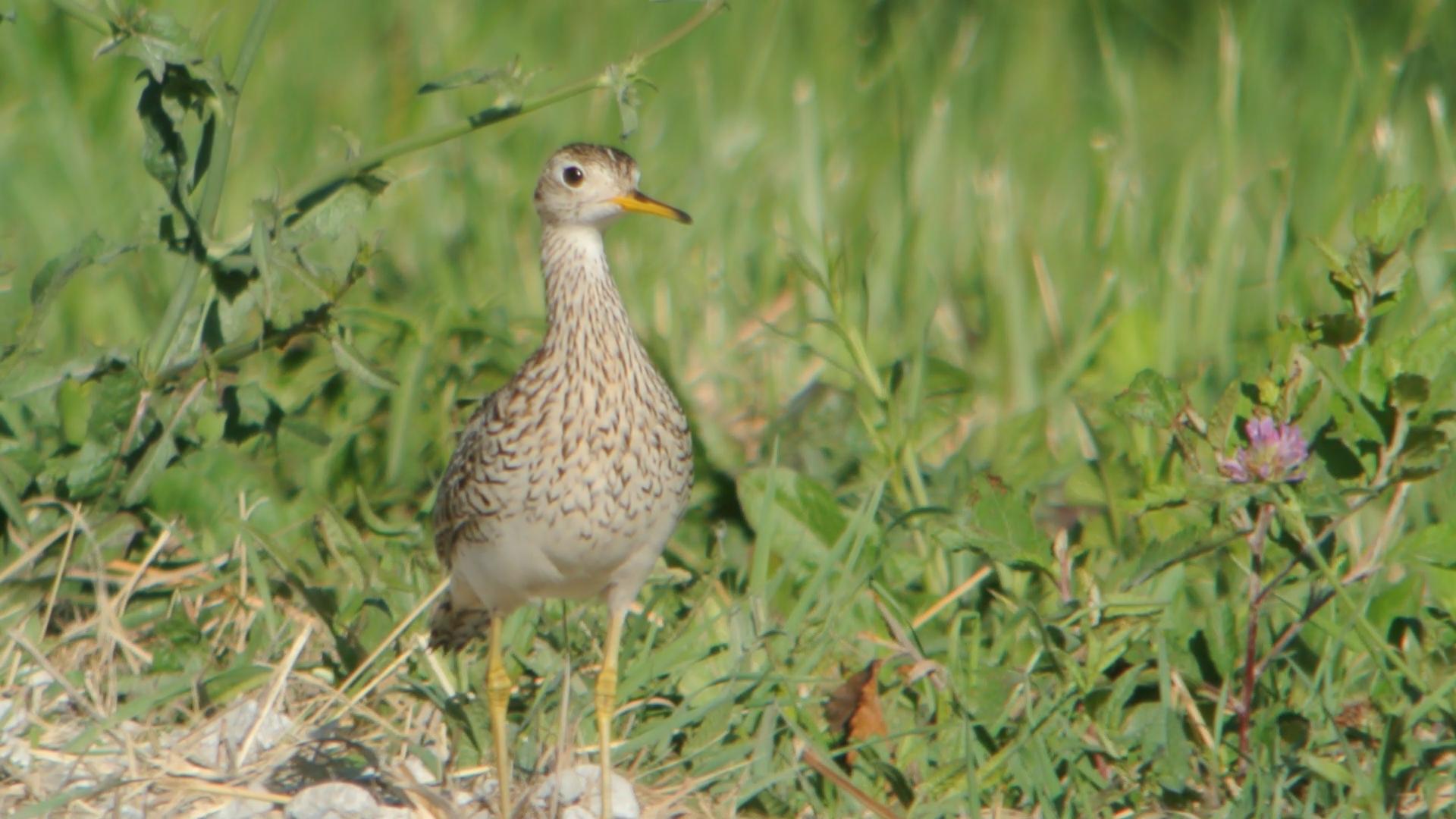
Upland Sandpiper (Bartramia longicauda) is a terrestrial shorebird that walks through open grassland, nests far from water and migrates between North and South America. This guide separates well-supported biology from common assumptions and covers identification, range, habitat, diet, behavior, reproduction and conservation.
Identification
A small dove-like head, large dark eye, thin neck, long yellowish legs and unusually long tail create an upright silhouette. The back is mottled brown, the breast strongly streaked and the belly pale. A short straight bill is yellowish at the base with a dark tip. Males and females look alike and overlap in size. Juveniles resemble adults but show fresher, more evenly edged upperpart feathers and a paler head.
Identification should combine body shape, markings, size, voice or movement, and location. One feature by itself can overlap with a related animal, a juvenile, or an individual in unusual light.
Photographs are most useful when they preserve scale and show several diagnostic features. Handling or repositioning a wild upland sandpiper for identification can cause stress and is unnecessary.
Size and physical adaptations
Upland Sandpiper typically measures about 28–32 cm and weighs roughly 97–226 g. Body mass changes with migration fuel, sex and season; published samples span breeding and passage birds.
Its useful adaptations include long legs move efficiently through grass, large eyes detect insects and predators, cryptic plumage conceals a ground nest, long pointed wings support migration, wolf-whistle calls carry over open prairie, precocial chicks feed soon after hatching. These traits work together in the animal’s normal setting rather than serving as isolated curiosities.
Published measurements may use different methods, life stages or sample locations. Comparing figures responsibly means checking what was measured rather than selecting the largest number available.
Range and distribution
Breeds mainly in the northern Great Plains and prairie provinces, with smaller populations in Alaska, northwestern Canada and scattered eastern grasslands. It migrates through the Americas to winter chiefly in the grasslands of southern South America. The native range includes United States, Canada, Argentina, Uruguay, Paraguay, Brazil, Bolivia.
A country-level map indicates broad distribution, not continuous occupation. Climate, elevation, water, vegetation, prey, breeding sites, barriers and survey effort all affect where records occur.
Records near the edge of the range deserve careful documentation because they may reflect natural movement, improved survey coverage, accidental transport or a genuine distribution change.
Habitat
Native prairie, pasture, hayfield, fallow cropland, airfield, upland tundra and mountain meadow with little woody vegetation.
Breeding pairs need enough residual grass to hide a nest plus more open patches for walking and feeding. Migrants and wintering birds often select shorter grazed or agricultural vegetation. Mowing dates, grazing intensity and pesticide use therefore change habitat value quickly. Protecting a population therefore requires the feeding, shelter and breeding features that make a site usable, along with connections that allow movement.
Microhabitat matters. Shade, soil, current, moisture, shelter or host plants can determine whether a small area is usable even when the surrounding landscape appears suitable.
Diet and feeding
Upland Sandpiper is a primarily insectivore. Important foods include grasshoppers and crickets, beetles and weevils, fly and moth larvae, ants, spiders, earthworms, snails, grass and weed seeds. Birds walk deliberately through grass and pick prey from soil or low vegetation. They gather where fire, grazing or cultivation exposes insects, and may concentrate in fields rich in grasshoppers or grubs.
Diet changes with age, season, location and food supply. A dramatic prey record does not establish what most individuals eat most of the time; repeated field observations provide a stronger picture.
Feeding opportunities also create risk. An animal focused on prey may be less alert to predators, traffic or people, while contaminated prey can transfer pollutants through the food web.
Behavior and communication
Diurnal and crepuscular, with substantial nocturnal migration. Upland sandpipers often perch on fence posts, raise the head to scan and then resume walking. A displaying male circles high on fluttering wings while giving a sputtering whistle, and paired birds may perform synchronized aerial descents.
The far-carrying flight call sounds like a rising and falling wolf whistle. Males also give rattles and whistles during ground and aerial display, while adults use alarm calls around eggs and chicks. Behavior should be interpreted in context: alarm, courtship, feeding and temperature regulation can produce very different actions from the same animal.
Daily schedules are flexible responses, not rigid rules. Weather, breeding condition, disturbance, tides or food can move activity into a different part of the day.
Reproduction and development
A pair forms after aerial and ground display. The male starts several shallow scrapes and the female completes a chosen nest beneath grass, lining it with nearby vegetation. Both adults incubate. Usually 4 eggs; documented range 2–7 Downy chicks leave the ground nest soon after hatching and feed themselves while adults guard and guide them. Families move through grassland, and young gain flight after several weeks before gathering in loose flocks.
Young animals face different risks and may use different microhabitats or food than adults. Breeding success depends on adult condition, suitable sites and the survival of offspring through vulnerable early stages.
Counts of eggs or young describe reproductive output, not the number expected to reach adulthood. Mortality is normally greatest during eggs, larval or juvenile stages.
Predators and ecological role
This bird consumes large numbers of prairie insects and acts as an indicator of extensive grassland with appropriate structure. Its nest and chicks feed native predators, while its annual movements connect food webs across two continents. Documented or likely predators include Red Fox, Coyote, Striped Skunk, Northern Harrier, American Badger.
This animal is both a consumer and a food source. Its influence comes through many repeated interactions, so ecological claims should be based on measured populations rather than assumptions drawn from appearance.
Predator and prey relationships differ among places. A species can be ecologically influential without being abundant everywhere, and its role can change across its range.
Relationship with people
Market hunting severely reduced the species in the nineteenth century, and migratory-bird laws ended commercial take in North America. Modern pressures center on prairie conversion, early hay cutting, pesticides, invasive woody plants and changes to South American winter grasslands. Airports sometimes preserve suitable short grass but also create aircraft-safety conflict.
Watch from roads or trails with optics, avoid entering nesting grass and delay mowing known breeding fields until young can fly. Keep dogs leashed and report marked birds or important breeding sites to conservation programs. Responsible observation means keeping an appropriate distance, avoiding capture or feeding, protecting habitat and following local wildlife or invasive-species guidance.
Wildlife guidance should come from the responsible local agency because collection rules, reporting requests and appropriate responses differ between native and introduced ranges.
Conservation
Globally assessed as Least Concern, with an estimated breeding population in the hundreds of thousands. Serious regional declines have made it a conservation-priority species in many states and provinces. The reported global trend is Broad continental trend has been relatively stable, but eastern and local populations have declined.
Important pressures include conversion of native prairie, early mowing and agricultural machinery, pesticide reduction of insect prey, woody encroachment, loss of south american grassland, illegal hunting in parts of the migration route. Global status can hide local decline or recovery, so current regional monitoring and habitat management remain necessary.
The most useful conservation action follows the documented pressure. Protecting breeding sites, reducing road deaths or limiting pollutants can require different tools in different populations.