
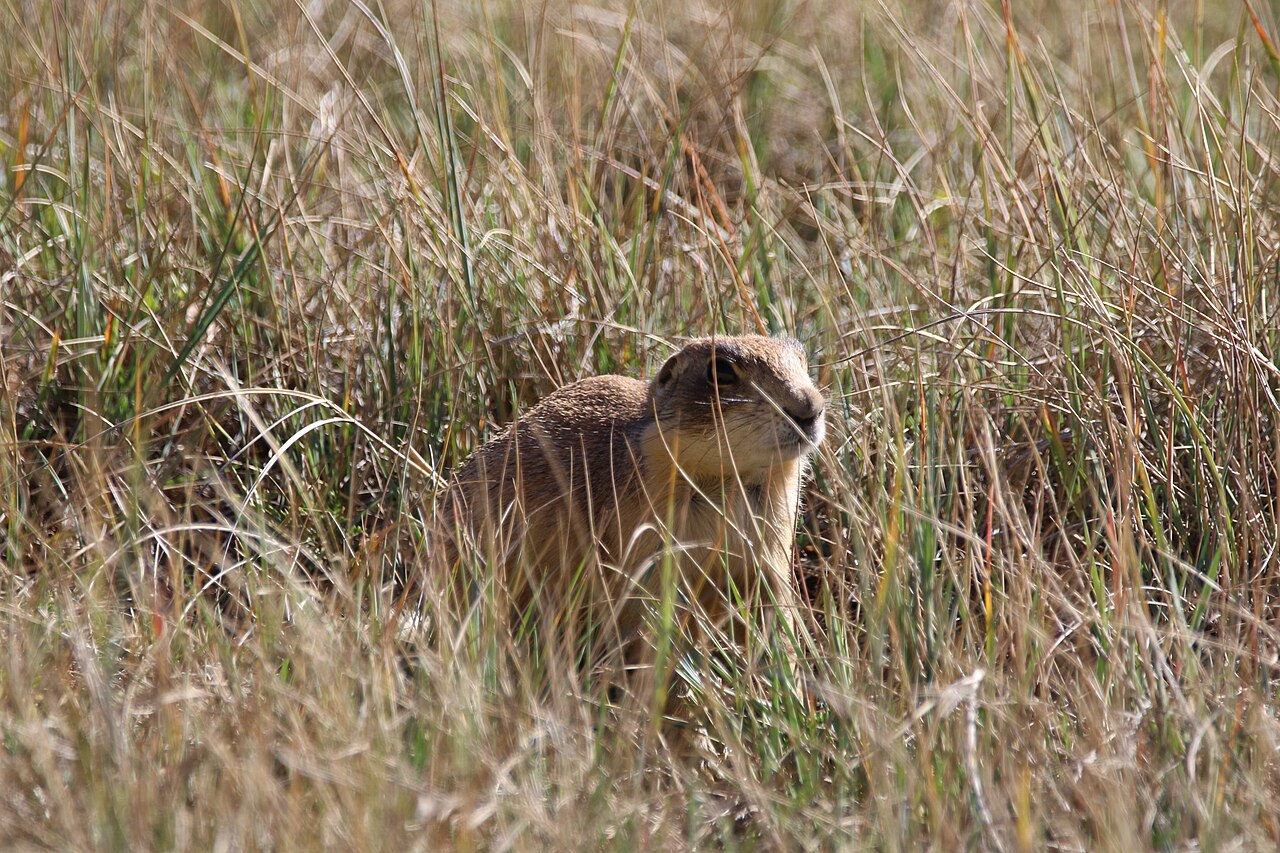
Utah Prairie Dog (Cynomys parvidens) is a colonial ground squirrel found naturally only in southwestern and south-central Utah. This guide separates well-supported biology from common assumptions and covers identification, range, habitat, diet, behavior, reproduction and conservation.
Identification
Adults are compact, cinnamon to clay-colored ground squirrels with a short tail whose terminal half is white. A dark eyebrow above each eye, brown cheek patch and pale chin help distinguish the species, although locality and several features should be used together. Adult males average heavier than females, especially before winter. Both sexes gain and lose substantial mass with season, and their coat changes during twice-yearly molts.
Identification should combine body shape, markings, size, voice or movement, and location. One feature by itself can overlap with a related animal, a juvenile, or an individual in unusual light.
Photographs are most useful when they preserve scale and show several diagnostic features. Handling or repositioning a wild utah prairie dog for identification can cause stress and is unnecessary.
Size and physical adaptations
Utah Prairie Dog typically measures about 25–40 cm including the tail and weighs males about 750–1,410 g; females about 640–1,140 g at adult seasonal peaks. Body mass changes sharply between spring emergence and late summer, so date and sex matter when comparing measurements.
Its useful adaptations include long claws excavate deep burrows, low vegetation preserves long sightlines, alarm calls warn nearby colony members, burrows buffer heat, cold and predators, seasonal fat reserves support winter retreat, eyes set high on the head scan while feeding. These traits work together in the animal’s normal setting rather than serving as isolated curiosities.
Published measurements may use different methods, life stages or sample locations. Comparing figures responsibly means checking what was measured rather than selecting the largest number available.
Range and distribution
Endemic to southwestern and south-central Utah, principally in the Awapa Plateau, Paunsaugunt and Sevier River regions. Its modern range is a small fraction of the area occupied historically. The native range includes United States.
A country-level map indicates broad distribution, not continuous occupation. Climate, elevation, water, vegetation, prey, breeding sites, barriers and survey effort all affect where records occur.
Records near the edge of the range deserve careful documentation because they may reflect natural movement, improved survey coverage, accidental transport or a genuine distribution change.
Habitat
Short-grass prairie, mountain meadow, sagebrush openings and agricultural grassland with deep, well-drained soil suitable for burrows.
Colonies require vegetation low enough to detect predators and soil deep enough for tunnels that remain dry. Animals graze near burrow entrances, maintain lookout mounds and use underground chambers for sleep, rearing young and protection from winter weather. Protecting a population therefore requires the feeding, shelter and breeding features that make a site usable, along with connections that allow movement.
Microhabitat matters. Shade, soil, current, moisture, shelter or host plants can determine whether a small area is usable even when the surrounding landscape appears suitable.
Diet and feeding
Utah Prairie Dog is a primarily herbivore. Important foods include grasses, forbs, flowers, seeds, young leaves, occasional insects. Prairie dogs clip and graze vegetation around the colony, often selecting flowers, seeds and young growth when available. Feeding activity alters plant height and composition, which improves visibility and creates habitat used by other open-country animals.
Diet changes with age, season, location and food supply. A dramatic prey record does not establish what most individuals eat most of the time; repeated field observations provide a stronger picture.
Feeding opportunities also create risk. An animal focused on prey may be less alert to predators, traffic or people, while contaminated prey can transfer pollutants through the food web.
Behavior and communication
Diurnal in the active season; spends most winter time underground. Families occupy connected territories within a larger colony or town. Individuals forage, dig, groom, play and stand upright to scan. Utah prairie dogs retreat below ground in late summer or autumn and remain mostly subterranean through winter, though they are not continuously dormant.
Sharp vocal calls announce danger and help coordinate colony response. Scent, touch, grooming, play and upright visual displays maintain family relationships and territorial boundaries. Behavior should be interpreted in context: alarm, courtship, feeding and temperature regulation can produce very different actions from the same animal.
Daily schedules are flexible responses, not rigid rules. Weather, breeding condition, disturbance, tides or food can move activity into a different part of the day.
Reproduction and development
Mating occurs soon after adults emerge from winter refuge. Females rear one litter a year in an underground nest chamber, so annual population growth depends heavily on adult survival and the success of that single breeding attempt. Usually 3–4 pups in a litter Pups are born underground and stay in the burrow while growing fur and opening their eyes. They begin appearing above ground at roughly five to seven weeks, learn colony signals and foraging skills, and reach adult size by autumn.
Young animals face different risks and may use different microhabitats or food than adults. Breeding success depends on adult condition, suitable sites and the survival of offspring through vulnerable early stages.
Counts of eggs or young describe reproductive output, not the number expected to reach adulthood. Mortality is normally greatest during eggs, larval or juvenile stages.
Predators and ecological role
Burrowing aerates and mixes soil, mounds create microhabitats and close grazing maintains patches of short vegetation. Utah prairie dogs are important prey for coyotes, badgers, raptors and snakes, while their abandoned tunnels shelter insects, reptiles and small mammals. Documented or likely predators include American Badger, Coyote, Golden Eagle, Red-tailed Hawk, Prairie Rattlesnake.
This animal is both a consumer and a food source. Its influence comes through many repeated interactions, so ecological claims should be based on measured populations rather than assumptions drawn from appearance.
Predator and prey relationships differ among places. A species can be ecologically influential without being abundant everywhere, and its role can change across its range.
Relationship with people
Conversion of meadow to crops, deliberate poisoning, unregulated shooting and conflict over forage drove large historical declines. Sylvatic plague can then erase whole colonies rapidly. Recovery programs protect habitat, treat fleas, translocate animals from conflict sites and build cooperation among federal agencies, Utah, counties and landowners.
Watch from a distance and never feed or attempt to touch prairie dogs. Fleas associated with wild rodents can carry plague, while habituation increases conflict and vehicle risk. Obey closures and report sick or dead animals to park or wildlife staff. Responsible observation means keeping an appropriate distance, avoiding capture or feeding, protecting habitat and following local wildlife or invasive-species guidance.
Wildlife guidance should come from the responsible local agency because collection rules, reporting requests and appropriate responses differ between native and introduced ranges.
Conservation
The IUCN lists the Utah prairie dog as Endangered, while the United States lists it as Threatened under the Endangered Species Act. Recovery is limited by its tiny range, plague, habitat change and continuing conflict. The reported global trend is Recovering in some managed areas but vulnerable to rapid local loss.
Important pressures include sylvatic plague, habitat conversion and fragmentation, poisoning and shooting, drought and climate change, agricultural and urban conflict, small isolated colonies and low genetic diversity. Global status can hide local decline or recovery, so current regional monitoring and habitat management remain necessary.
The most useful conservation action follows the documented pressure. Protecting breeding sites, reducing road deaths or limiting pollutants can require different tools in different populations.