
Home/Animals/Mammalia/Vervet Monkey
Species profileIUCN: LC

Vervet Monkey

Chlorocebus pygerythrus

An agile African monkey with a black face, pale brow and a sophisticated social life built around grooming and alarm calls.

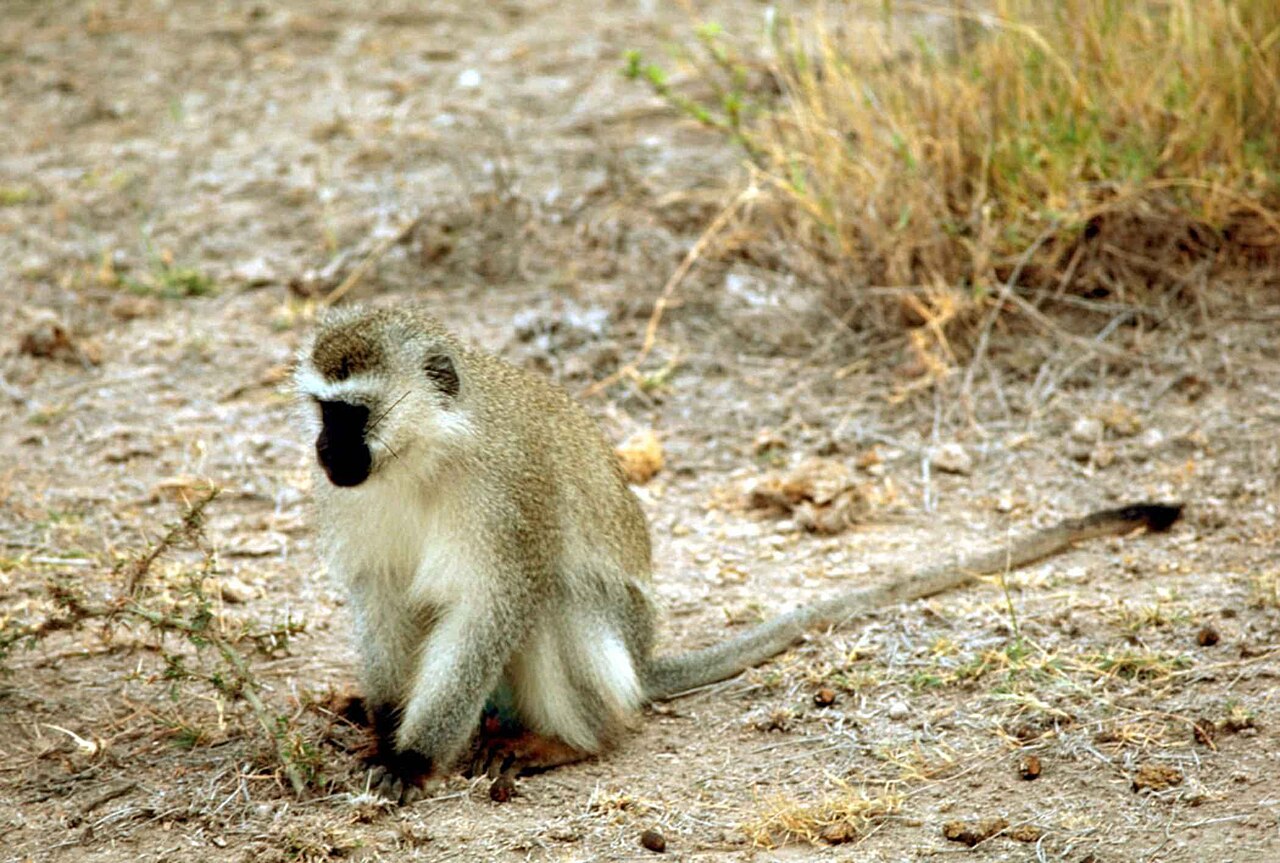
Adult vervet monkey with olive-gray fur, a black face and white facial fringe
Stolz Gary M / U.S. Fish and Wildlife Service / Public domain
🌐 Read in Language:

⚡ At a Glance

Species profile
Also Known As
Vervet, southern vervet monkey
Diet Category
Omnivore with a strong emphasis on fruit, seeds, flowers and leaves
Activity Rhythm
Diurnal, feeding and traveling from morning to late afternoon before sleeping communally in trees.
Wild Lifespan
About 11–13 years recorded in the wild; some captive individuals live much longer
Typical Weight
females average about 4.1 kg; males about 5.5 kg, with broad regional variation
Conservation Status
LC
💡 Key Biological Insight: Different alarm calls can prompt troop members to scan the sky, climb a tree or look toward the ground, depending on the type of predator.

🌳 Scientific Taxonomy Hierarchy

The vervet monkey is the species Chlorocebus pygerythrus in the guenon family Cercopithecidae. Older publications often treated several green monkeys together as Cercopithecus or Chlorocebus aethiops, so historical records require careful taxonomic interpretation.

KingdomAnimalia
PhylumChordata
ClassMammalia
OrderPrimates
FamilyCercopithecidae
GenusChlorocebus
SpeciesChlorocebus pygerythrus

Distinguishing Anatomical Features

  • ✓Adults have a grizzled olive-gray to greenish coat, pale underside, black face, dark hands and feet, and a white fringe around the face. The long tail is not prehensile. Males are conspicuously larger and have bright blue skin around the scrotum with a contrasting red penis.
  • ✓Cheek pouches store food for later chewing
  • ✓Long limbs and tail support fast quadrupedal travel
  • ✓Color vision helps select ripe fruit and young leaves
  • ✓Predator-specific alarm calls trigger different escape responses
  • ✓Flexible diet supports life in seasonal habitats
  • ✓Complex grooming alliances maintain troop bonds

📏 Physical Measurements

Total Lengthfemales average about 1.4 ft head–body; males about 1.6 ft
Body Weightfemales average about 9 lb; males about 12 lb, with broad regional variation
Tail LengthLong balancing tail, generally longer than the body and not prehensile
WingspanNot applicable
Top SpeedNo dependable universal maximumMovement changes with context and conditions.

🎨 Appearance & Distinctive Markings

Olive-grayGreenish brownWhiteBlackBlueWhiteBlackGreen-gray

Skin / Covering: Short grizzled fur with bare dark face, hands and feet

Sexual Dimorphism: Adult males average larger and heavier than females and have conspicuous blue-and-red genital coloration.

🗺️ Geographic Distribution & Habitat

Native from the Ethiopian Highlands and southern Somalia through Kenya, eastern Uganda, Rwanda, Burundi and Tanzania, then south through Zambia, Malawi, Mozambique, Zimbabwe, eastern Botswana, Eswatini and South Africa. Taxonomic boundaries with neighboring Chlorocebus species remain uncertain in some contact zones.

Savanna woodland, riverine forest, bushland, coastal thicket, swamp edge, montane grassland, farmland, gardens and towns where water and tall sleeping trees are available.

Country-level distribution map

Native range
FijiTanzania — Native rangeWestern SaharaCanadaUnited StatesKazakhstanUzbekistanPapua New GuineaIndonesiaArgentinaChileCongo - Kinshasa — Native rangeSomalia — Native rangeKenya — Native rangeSudanChadHaitiDominican RepublicRussiaBahamasFalkland IslandsNorwayGreenlandFrench Southern TerritoriesTimor-LesteSouth Africa — Native rangeLesothoMexicoUruguayBrazilBoliviaPeruColombiaPanamaCosta RicaNicaraguaHondurasEl SalvadorGuatemalaBelizeVenezuelaGuyanaSurinameFranceEcuadorPuerto RicoJamaicaCubaZimbabwe — Native rangeBotswana — Native rangeNamibiaSenegalMaliMauritaniaBeninNigerNigeriaCameroonTogoGhanaCôte d’IvoireGuineaGuinea-BissauLiberiaSierra LeoneBurkina FasoCentral African RepublicCongo - BrazzavilleGabonEquatorial GuineaZambia — Native rangeMalawi — Native rangeMozambique — Native rangeEswatini — Native rangeAngolaBurundi — Native rangeIsraelLebanonMadagascarPalestinian TerritoriesGambiaTunisiaAlgeriaJordanUnited Arab EmiratesQatarKuwaitIraqOmanVanuatuCambodiaThailandLaosMyanmar (Burma)VietnamNorth KoreaSouth KoreaMongoliaIndiaBangladeshBhutanNepalPakistanAfghanistanTajikistanKyrgyzstanTurkmenistanIranSyriaArmeniaSwedenBelarusUkrainePolandAustriaHungaryMoldovaRomaniaLithuaniaLatviaEstoniaGermanyBulgariaGreeceTürkiyeAlbaniaCroatiaSwitzerlandLuxembourgBelgiumNetherlandsPortugalSpainIrelandNew CaledoniaSolomon IslandsNew ZealandAustraliaSri LankaChinaTaiwanItalyDenmarkUnited KingdomIcelandAzerbaijanGeorgiaPhilippinesMalaysiaBruneiSloveniaFinlandSlovakiaCzechiaEritreaJapanParaguayYemenSaudi ArabiaCyprusMoroccoEgyptLibyaEthiopia — Native rangeDjiboutiUganda — Native rangeRwanda — Native rangeBosnia & HerzegovinaNorth MacedoniaSerbiaMontenegroKosovoTrinidad & TobagoSouth Sudan — Native range
Highlighted countries are recorded profile locations, not precise biological range boundaries.Map boundaries: Natural Earth

💡 Did You Know?

  • 💡Cheek pouches store food for later chewing
  • 💡Long limbs and tail support fast quadrupedal travel
  • 💡Color vision helps select ripe fruit and young leaves
  • 💡Predator-specific alarm calls trigger different escape responses
  • 💡Flexible diet supports life in seasonal habitats
  • 💡Complex grooming alliances maintain troop bonds

🌿 Conservation Status & Threats

IUCN: LC — Least Concern

“IUCN assessed the species as Least Concern in 2022 because of its broad range and adaptability, but reported a decreasing population trend. Local threats include hunting, persecution as a crop raider, capture, road mortality, dog attacks and habitat degradation.”

Population Trend📉 Decreasing
Wild Population EstimateNo reliable global mature-population estimate is available.
CITESCITES Appendix II

⚠️ Major Threats to Vervet Monkey

  • •Hunting and persecution
  • •Capture for trade or research
  • •Vehicle collisions
  • •Dog attacks
  • •Habitat degradation and tree loss
  • •Conflict around crops and tourist sites

🔄 Life Cycle & Reproduction

Wild vs. Captivity Lifespan Comparison

🌿 In the WildAbout 11–13 years recorded in the wild; some captive individuals live much longer
🏠 In Captivity (with veterinary care)Kept by accredited zoos and research institutions in complex social groups with professional veterinary care.
Clutch / Litter SizeUsually one infant; twins are rare
Incubation / GestationGestation about 165 days, or 5.5 months
Fledging / WeaningSingle clinging infant weighing roughly 300–350 g in many records
Sexual MaturityFemales commonly 2.5–4 years; males about 5 years
Mating SystemPromiscuous or polygynandrous within a multi-male troop
Nesting / Den TypeNo nest; troop members sleep on branches in selected tall trees

🦅 Behavior & Field Ecology

Omnivore with a strong emphasis on fruit, seeds, flowers and leaves

🌐 Ecological Food Web & Relationships: Vervets disperse seeds from the many fruits they eat and also prey on insects and small vertebrates. They are important prey for leopards, eagles, pythons, baboons and other carnivores. By using river corridors, savannas, farms and towns, they also connect wild food webs with human-modified landscapes.

Social Group SizeMulti-male, multi-female troops often numbering roughly 10–30, with larger groups also recorded
Activity RhythmDiurnal, feeding and traveling from morning to late afternoon before sleeping communally in trees.
Feeding StrategyOmnivore with a strong emphasis on fruit, seeds, flowers and leaves

🥩 Primary Prey & Preferred Diet

✓ Fruit✓ Seeds✓ Flowers✓ Young leaves✓ Gum✓ Insects✓ Bird eggs✓ Small vertebrates✓ Crops

📢 Communication & Territorial Signals

  • Predator alarm calls
  • Grunts and contact calls
  • Facial expressions
  • Grooming and touch
  • Body posture and gaze

🐾 Wild Temperament & Traits

• Social• Alert• Curious• Territorial around key resources• Defensive when cornered

🤝 Human Interaction & Pet Advisory

⚠️ Strictly Wild Species
🚫

Can You Keep a Vervet Monkey as a Pet?

A vervet needs lifelong membership in a complex troop, extensive space and specialist care. Private possession is illegal in many places and causes severe welfare and safety problems.

Domestication StatusWild primate; not domesticated
Danger to HumansModerate — habituated adults can bite or scratch during conflict over food
Economic & Ecotourism RoleSeed dispersal, insect predation, prey for native carnivores, ecotourism and long-running research into primate behavior, communication and health.

⚠️ Behavioral Risk Factors & Wildlife Safety

  • Strong jaws and canine teeth
  • Fast coordinated troop defense
  • Disease transmission through bites and scratches

🌐 Ecological Food Web & Relationships

🦅 Natural Predators (6)

LeopardPanthera pardus
Martial EaglePolemaetus bellicosus
African Rock PythonPython sebae
Spotted HyenaCrocuta crocuta
Chacma BaboonPapio ursinus
Domestic DogCanis lupus familiaris

🧬 Related Species (4)

GrivetChlorocebus aethiopsNorthern relative meeting the vervet near Ethiopia and Kenya
Tantalus MonkeyChlorocebus tantalusWest and central African relative
Green MonkeyChlorocebus sabaeusWest African and Caribbean relative
Malbrouck MonkeyChlorocebus cynosurosSouth-central African relative

Vervet Monkey (Chlorocebus pygerythrus) is an Old World monkey of eastern and southern Africa that moves confidently both on the ground and through trees. This guide separates well-supported biology from common assumptions and covers identification, range, habitat, diet, behavior, reproduction and conservation.

Identification

Adults have a grizzled olive-gray to greenish coat, pale underside, black face, dark hands and feet, and a white fringe around the face. The long tail is not prehensile. Males are conspicuously larger and have bright blue skin around the scrotum with a contrasting red penis. Adult males average larger and heavier than females and have conspicuous blue-and-red genital coloration.

Identification should combine body shape, markings, size, voice or movement, and location. One feature by itself can overlap with a related animal, a juvenile, or an individual in unusual light.

Photographs are most useful when they preserve scale and show several diagnostic features. Handling or repositioning a wild vervet monkey for identification can cause stress and is unnecessary.

Size and physical adaptations

Vervet Monkey typically measures females average about 42.6 cm head–body; males about 49 cm and weighs females average about 4.1 kg; males about 5.5 kg, with broad regional variation. Published measurements cover several populations and sometimes older taxonomic concepts; males are consistently larger than females.

Its useful adaptations include cheek pouches store food for later chewing, long limbs and tail support fast quadrupedal travel, color vision helps select ripe fruit and young leaves, predator-specific alarm calls trigger different escape responses, flexible diet supports life in seasonal habitats, complex grooming alliances maintain troop bonds. These traits work together in the animal’s normal setting rather than serving as isolated curiosities.

Published measurements may use different methods, life stages or sample locations. Comparing figures responsibly means checking what was measured rather than selecting the largest number available.

Range and distribution

Native from the Ethiopian Highlands and southern Somalia through Kenya, eastern Uganda, Rwanda, Burundi and Tanzania, then south through Zambia, Malawi, Mozambique, Zimbabwe, eastern Botswana, Eswatini and South Africa. Taxonomic boundaries with neighboring Chlorocebus species remain uncertain in some contact zones. The native range includes Botswana, Burundi, Democratic Republic of the Congo, Eswatini, Ethiopia, Kenya, Malawi, Mozambique, Rwanda, Somalia, South Africa, South Sudan, Tanzania, Uganda, Zambia, Zimbabwe.

A country-level map indicates broad distribution, not continuous occupation. Climate, elevation, water, vegetation, prey, breeding sites, barriers and survey effort all affect where records occur.

Records near the edge of the range deserve careful documentation because they may reflect natural movement, improved survey coverage, accidental transport or a genuine distribution change.

Habitat

Savanna woodland, riverine forest, bushland, coastal thicket, swamp edge, montane grassland, farmland, gardens and towns where water and tall sleeping trees are available.

Troops feed on the ground and in trees by day, then gather in tall trees at night. Permanent water, reliable food and safe sleeping sites shape home-range use. Groups may defend concentrated resources while tolerating neighboring troops where food is dispersed. Protecting a population therefore requires the feeding, shelter and breeding features that make a site usable, along with connections that allow movement.

Microhabitat matters. Shade, soil, current, moisture, shelter or host plants can determine whether a small area is usable even when the surrounding landscape appears suitable.

Diet and feeding

Vervet Monkey is a omnivore with a strong emphasis on fruit, seeds, flowers and leaves. Important foods include fruit, seeds, flowers, young leaves, gum, insects, bird eggs, small vertebrates, crops. Vervets forage through several vegetation layers and on the ground. They rapidly pack food into expandable cheek pouches, move to a safer place and chew it later. Seasonal fruit and seeds dominate many diets, while insects, flowers, leaves, gums and occasional vertebrate prey add nutrients.

Diet changes with age, season, location and food supply. A dramatic prey record does not establish what most individuals eat most of the time; repeated field observations provide a stronger picture.

Feeding opportunities also create risk. An animal focused on prey may be less alert to predators, traffic or people, while contaminated prey can transfer pollutants through the food web.

Behavior and communication

Diurnal, feeding and traveling from morning to late afternoon before sleeping communally in trees. A vervet troop contains multiple adult males and females plus young. Females usually remain in their natal group and inherit a rank related to their mother, while maturing males transfer between troops. Grooming creates alliances, repairs tension and gives relatives privileged access to infants.

Vervets combine calls, facial expressions, gaze, posture, touch and scent. Their famous alarm calls vary with threats such as eagles, snakes and large terrestrial predators, and listeners respond in ways appropriate to each danger. Meaning depends on context and learning as well as call structure. Behavior should be interpreted in context: alarm, courtship, feeding and temperature regulation can produce very different actions from the same animal.

Daily schedules are flexible responses, not rigid rules. Weather, breeding condition, disturbance, tides or food can move activity into a different part of the day.

Reproduction and development

Breeding timing follows local rainfall and food supply, with a birth peak that gives lactating females access to abundant seasonal foods. Females usually produce one infant after a gestation of about five and a half months. Usually one infant; twins are rare Infants cling to the mother and are born with a dark natal coat and pink face that change toward adult coloration during the first months. Maternal relatives inspect and groom infants, and juveniles learn foods, routes, ranks and alarm responses through prolonged social contact.

Young animals face different risks and may use different microhabitats or food than adults. Breeding success depends on adult condition, suitable sites and the survival of offspring through vulnerable early stages.

Counts of eggs or young describe reproductive output, not the number expected to reach adulthood. Mortality is normally greatest during eggs, larval or juvenile stages.

Predators and ecological role

Vervets disperse seeds from the many fruits they eat and also prey on insects and small vertebrates. They are important prey for leopards, eagles, pythons, baboons and other carnivores. By using river corridors, savannas, farms and towns, they also connect wild food webs with human-modified landscapes. Documented or likely predators include Leopard, Martial Eagle, African Rock Python, Spotted Hyena, Chacma Baboon, Domestic Dog.

This animal is both a consumer and a food source. Its influence comes through many repeated interactions, so ecological claims should be based on measured populations rather than assumptions drawn from appearance.

Predator and prey relationships differ among places. A species can be ecologically influential without being abundant everywhere, and its role can change across its range.

Relationship with people

Vervets readily learn where crops, refuse and handouts are available. Raiding can impose real costs on farmers, while feeding by tourists makes animals bolder and more likely to bite or steal. Durable bins, guarded crops, tree management and firm no-feeding rules reduce conflict without injuring troops.

Never feed or touch a vervet. Keep food concealed, secure doors and windows, supervise children and give the troop space to leave. Do not stare, threaten or corner an animal. A bite or scratch needs immediate washing and medical assessment because primates can transmit serious infections. Responsible observation means keeping an appropriate distance, avoiding capture or feeding, protecting habitat and following local wildlife or invasive-species guidance.

Wildlife guidance should come from the responsible local agency because collection rules, reporting requests and appropriate responses differ between native and introduced ranges.

Conservation

IUCN assessed the species as Least Concern in 2022 because of its broad range and adaptability, but reported a decreasing population trend. Local threats include hunting, persecution as a crop raider, capture, road mortality, dog attacks and habitat degradation. The reported global trend is Decreasing.

Important pressures include hunting and persecution, capture for trade or research, vehicle collisions, dog attacks, habitat degradation and tree loss, conflict around crops and tourist sites. Global status can hide local decline or recovery, so current regional monitoring and habitat management remain necessary.

The most useful conservation action follows the documented pressure. Protecting breeding sites, reducing road deaths or limiting pollutants can require different tools in different populations.

Sources and further reading

❓ Frequently Asked Questions

Answers to frequently asked questions verified against peer-reviewed zoological research.

Chlorocebus pygerythrus lives across eastern and southern Africa in savanna woodland, riverine forest, bushland, farmland and some towns, usually near water and safe sleeping trees.