
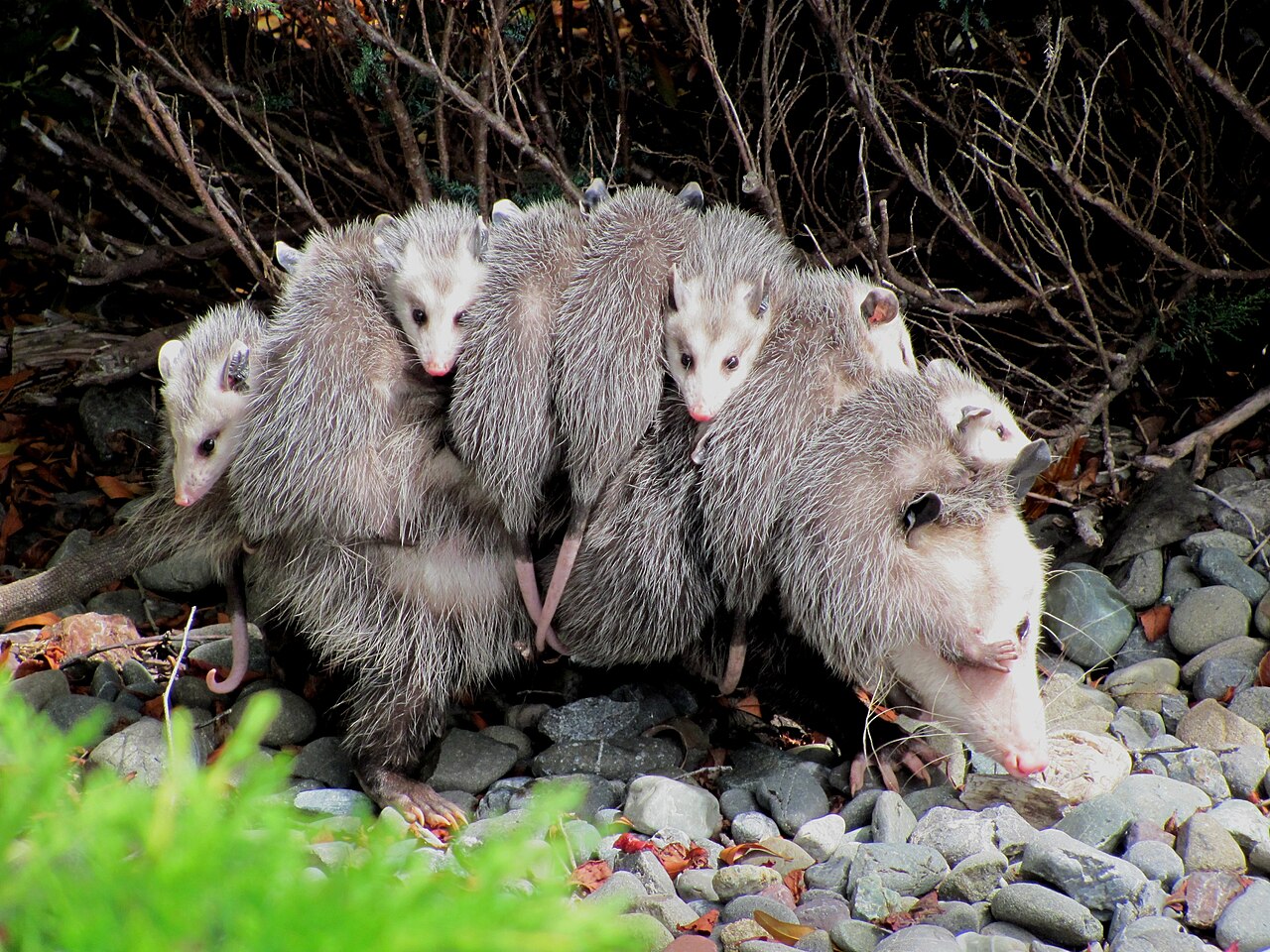
Virginia Opossum (Didelphis virginiana) is a nocturnal, cat-sized marsupial that ranges from Central America through much of the United States into southern Canada. This guide separates well-supported biology from common assumptions and covers identification, range, habitat, diet, behavior, reproduction and conservation.
Identification
A long pointed muzzle, naked dark ears, coarse gray-and-white fur and a nearly hairless scaly tail make this species distinctive. The feet have sharp claws except for a clawless, opposable inner toe on each hind foot. Adults may open the mouth to display an unusually large set of 50 teeth. Adult males are usually heavier than females and may develop a broader head, but the sexes have the same general coloration.
Identification should combine body shape, markings, size, voice or movement, and location. One feature by itself can overlap with a related animal, a juvenile, or an individual in unusual light.
Photographs are most useful when they preserve scale and show several diagnostic features. Handling or repositioning a wild virginia opossum for identification can cause stress and is unnecessary.
Size and physical adaptations
Virginia Opossum typically measures body about 40–41 cm plus a 28–29 cm tail on average and weighs females about 1.9–2.1 kg; males about 2.1–2.8 kg in Smithsonian figures. Body size varies geographically and seasonally; males average heavier than females.
Its useful adaptations include pouch shelters extremely undeveloped newborns, opposable hind toes grip branches, prehensile tail steadies climbing and carries nest material, fifty teeth handle a varied omnivorous diet, nocturnal habits reduce daytime heat and disturbance, involuntary death-feigning may discourage some predators. These traits work together in the animal’s normal setting rather than serving as isolated curiosities.
Published measurements may use different methods, life stages or sample locations. Comparing figures responsibly means checking what was measured rather than selecting the largest number available.
Range and distribution
Native from Costa Rica north through Mexico and the eastern and central United States. Its range has expanded north into southern Canada, while people introduced populations along parts of the Pacific coast of the United States and British Columbia. The native range includes Costa Rica, Nicaragua, Honduras, El Salvador, Guatemala, Belize, Mexico, United States, Canada.
A country-level map indicates broad distribution, not continuous occupation. Climate, elevation, water, vegetation, prey, breeding sites, barriers and survey effort all affect where records occur.
Records near the edge of the range deserve careful documentation because they may reflect natural movement, improved survey coverage, accidental transport or a genuine distribution change.
Habitat
Woodland, thicket, stream edge, swamp, wet meadow, farmland, suburban neighborhood and city green space, usually with secure den sites and nearby water.
Virginia opossums shelter by day in hollow trees, brush piles, burrows made by other animals, rock crevices, culverts or protected spaces beneath buildings. They usually change dens frequently rather than defending one permanent home and forage across several habitat edges after dark. Protecting a population therefore requires the feeding, shelter and breeding features that make a site usable, along with connections that allow movement.
Microhabitat matters. Shade, soil, current, moisture, shelter or host plants can determine whether a small area is usable even when the surrounding landscape appears suitable.
Diet and feeding
Virginia Opossum is a opportunistic omnivore and scavenger. Important foods include insects, earthworms, snails, fruit, seeds, carrion, eggs, small vertebrates, pet food and refuse. An opossum walks slowly while sniffing and investigating leaf litter, logs and human-made edges. It eats seasonally available animal and plant matter, including insects, worms, fruit, seeds, carrion and small vertebrates. In towns it may also exploit unsecured refuse or outdoor pet food.
Diet changes with age, season, location and food supply. A dramatic prey record does not establish what most individuals eat most of the time; repeated field observations provide a stronger picture.
Feeding opportunities also create risk. An animal focused on prey may be less alert to predators, traffic or people, while contaminated prey can transfer pollutants through the food web.
Behavior and communication
Nocturnal, with most foraging between dusk and dawn; activity declines during severe winter weather but the species does not truly hibernate. Virginia opossums are usually solitary and avoid confrontation. A cornered animal may hiss, drool, gape and show its teeth. Under extreme stress, especially in younger animals, it can enter an involuntary rigid, unresponsive state known as playing possum; this is not a consciously chosen performance.
Scent and chemical cues help adults locate mates and identify occupied areas. Hisses, growls, screeches, lip-smacking sounds and body posture communicate alarm or contact, while mothers and young also use soft clicking sounds. Behavior should be interpreted in context: alarm, courtship, feeding and temperature regulation can produce very different actions from the same animal.
Daily schedules are flexible responses, not rigid rules. Weather, breeding condition, disturbance, tides or food can move activity into a different part of the day.
Reproduction and development
Males may mate with several females during a breeding season that commonly begins in winter and can extend into summer. After one of the shortest mammalian gestations, tiny newborns crawl from the birth canal into the pouch and attach to teats. 4–25 young may be born, but the pouch can support only the young that successfully attach to available teats Pouch young grow from embryonic-looking newborns into furred juveniles. After leaving the pouch they may ride on the mother’s back, begin sampling solid food before weaning and become independent soon afterward.
Young animals face different risks and may use different microhabitats or food than adults. Breeding success depends on adult condition, suitable sites and the survival of offspring through vulnerable early stages.
Counts of eggs or young describe reproductive output, not the number expected to reach adulthood. Mortality is normally greatest during eggs, larval or juvenile stages.
Predators and ecological role
As both predator and scavenger, the Virginia opossum links many parts of a food web. It consumes invertebrates, small vertebrates, fruit and carrion, disperses some seeds and recycles nutrients. Opossums also feed owls, coyotes, foxes, bobcats and other predators. Their success near people reflects flexible behavior rather than dependence on one food. Documented or likely predators include Great Horned Owl, Coyote, Bobcat, Red Fox, Domestic Dog, Humans.
This animal is both a consumer and a food source. Its influence comes through many repeated interactions, so ecological claims should be based on measured populations rather than assumptions drawn from appearance.
Predator and prey relationships differ among places. A species can be ecologically influential without being abundant everywhere, and its role can change across its range.
Relationship with people
Opossums often visit yards for fallen fruit, compost, refuse or pet food and may den beneath decks. They are usually transient and beneficial scavengers. Conflicts can be reduced by feeding pets indoors, securing bins and closing entry points only after confirming that no animal or dependent young remain.
Give a wild opossum an open escape route and keep pets indoors or leashed. Never grab a sick, injured or apparently dead animal; defensive immobility can be mistaken for death. Contact a licensed wildlife rehabilitator or local animal service when help is needed. Rabies is possible even though reports are relatively uncommon, so any bite requires prompt medical advice. Responsible observation means keeping an appropriate distance, avoiding capture or feeding, protecting habitat and following local wildlife or invasive-species guidance.
Wildlife guidance should come from the responsible local agency because collection rules, reporting requests and appropriate responses differ between native and introduced ranges.
Conservation
The species is widespread and assessed as Least Concern. Road mortality is conspicuous, and local animals also face persecution, trapping, dog attacks, poisoning and loss of secure den sites. The reported global trend is Range has expanded northward in recent history, although local survival falls during severe cold and heavy snow.
Important pressures include vehicle collisions, deliberate killing, dog attacks, rodenticides and other poisons, loss of den sites and cover, severe cold and frost injury near the northern range edge. Global status can hide local decline or recovery, so current regional monitoring and habitat management remain necessary.
The most useful conservation action follows the documented pressure. Protecting breeding sites, reducing road deaths or limiting pollutants can require different tools in different populations.