
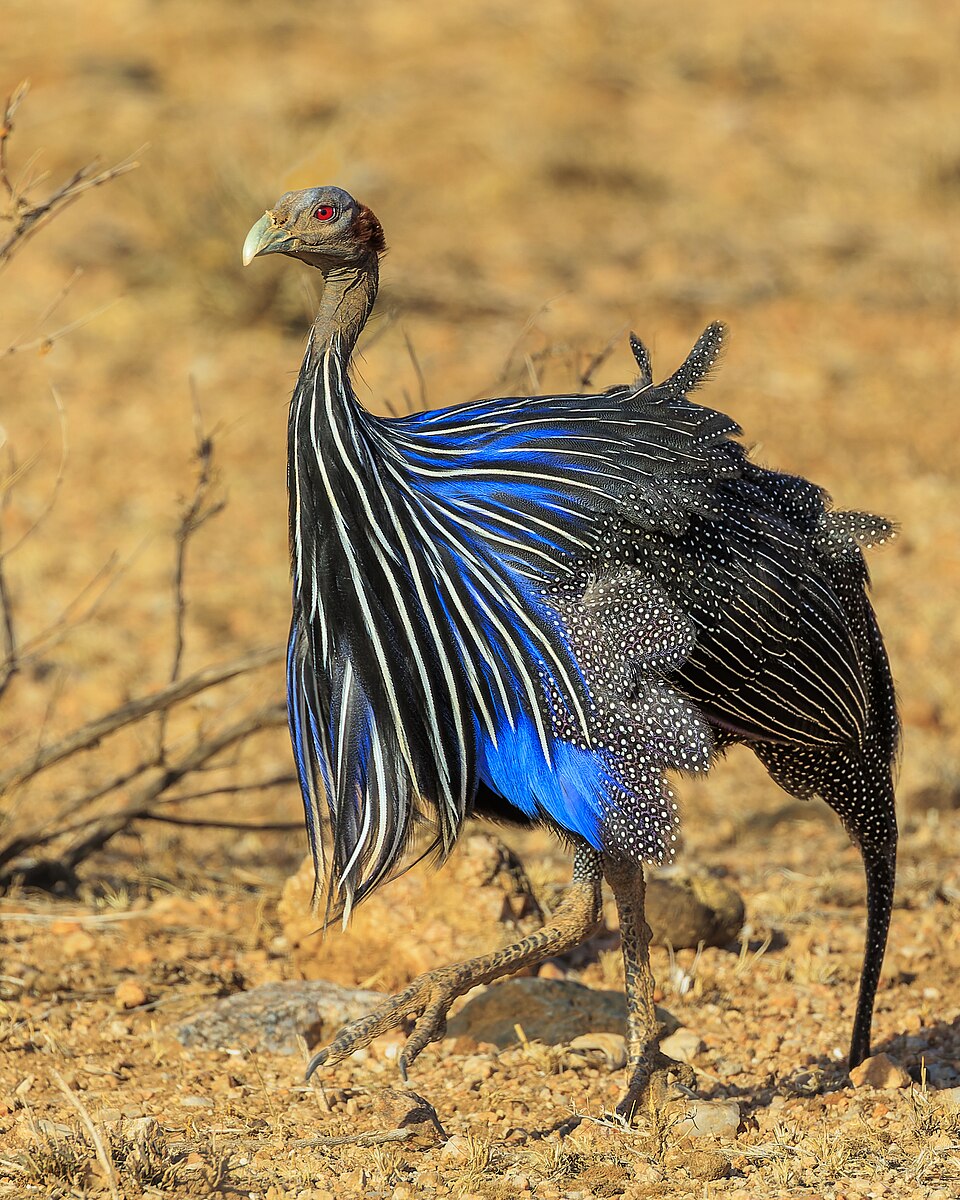
Vulturine Guineafowl (Acryllium vulturinum) is a long-legged terrestrial bird of the dry scrublands and savannas of northeastern Africa and the only living species in the genus Acryllium. This guide separates well-supported biology from common assumptions and covers identification, range, habitat, diet, behavior, reproduction and conservation.
Identification
A small bare blue head sits on a long dark neck above lance-shaped blue, black and white hackles. The breast is intense cobalt blue, the back and wings are black with dense white spots and lines, and the long tail and legs give a taller outline than other guineafowl. A chestnut patch covers the nape. The sexes look very similar; males average slightly larger and may have more prominent leg spurs and a more upright display posture.
Identification should combine body shape, markings, size, voice or movement, and location. One feature by itself can overlap with a related animal, a juvenile, or an individual in unusual light.
Photographs are most useful when they preserve scale and show several diagnostic features. Handling or repositioning a wild vulturine guineafowl for identification can cause stress and is unnecessary.
Size and physical adaptations
Vulturine Guineafowl typically measures about 61–71 cm and weighs about 1.0–1.6 kg. It is the largest living guineafowl, with long legs, neck and tail contributing to total length.
Its useful adaptations include long legs support rapid ground running, cryptic spotted back breaks up the outline in scrub shade, cheek and head skin releases heat, strong feet scratch dry soil for seeds and invertebrates, water-efficient physiology suits semi-arid habitat, short rounded wings provide fast escape and access to tree roosts. These traits work together in the animal’s normal setting rather than serving as isolated curiosities.
Published measurements may use different methods, life stages or sample locations. Comparing figures responsibly means checking what was measured rather than selecting the largest number available.
Range and distribution
Native to northeastern Africa from southern Ethiopia and Somalia through much of arid and semi-arid Kenya into northeastern Tanzania. Distribution follows suitable dry scrub and savanna rather than political borders. The native range includes Ethiopia, Somalia, Kenya, Tanzania.
A country-level map indicates broad distribution, not continuous occupation. Climate, elevation, water, vegetation, prey, breeding sites, barriers and survey effort all affect where records occur.
Records near the edge of the range deserve careful documentation because they may reflect natural movement, improved survey coverage, accidental transport or a genuine distribution change.
Habitat
Dry thorn scrub, acacia and commiphora bushland, semi-desert grassland, open savanna and riverine woodland edges, with trees or tall bushes for night roosting.
Flocks walk long distances between feeding patches, shade and safe roosts. They forage mainly on open ground but keep thorn cover within running distance. At dusk they fly into trees, often near seasonal water or productive feeding areas, and descend again after sunrise. Protecting a population therefore requires the feeding, shelter and breeding features that make a site usable, along with connections that allow movement.
Microhabitat matters. Shade, soil, current, moisture, shelter or host plants can determine whether a small area is usable even when the surrounding landscape appears suitable.
Diet and feeding
Vulturine Guineafowl is a ground-foraging omnivore. Important foods include grass and herb seeds, roots and tubers, green shoots, fruit and berries, termites, beetles and other insects, snails, small reptiles. Birds spread across the ground, pecking exposed items and scratching litter or soil with strong feet. Seeds and underground plant parts sustain them through dry periods, while rain triggers flushes of insects and vegetation that support breeding. Food can supply much of their water in arid areas.
Diet changes with age, season, location and food supply. A dramatic prey record does not establish what most individuals eat most of the time; repeated field observations provide a stronger picture.
Feeding opportunities also create risk. An animal focused on prey may be less alert to predators, traffic or people, while contaminated prey can transfer pollutants through the food web.
Behavior and communication
Diurnal, with intense morning and late-afternoon foraging and midday shade during hot weather. Outside breeding, vulturine guineafowl form cohesive groups that coordinate movement, roosting and predator vigilance. They usually run when alarmed and reserve flight for hard pursuit or reaching a roost. Social networks are stable, and recent field research shows that nonbreeders can help families after chicks hatch.
Loud repeated calls keep moving flock members together and carry over long distances. Alarm notes alert the group, while head position, body height, wing spreading, chasing and food offering signal rank or courtship at close range. Behavior should be interpreted in context: alarm, courtship, feeding and temperature regulation can produce very different actions from the same animal.
Daily schedules are flexible responses, not rigid rules. Weather, breeding condition, disturbance, tides or food can move activity into a different part of the day.
Reproduction and development
Seasonal rains stimulate pairs to separate temporarily from the larger group. A male guards and courtship-feeds the female while she lays a large clutch in a concealed ground scrape. Field studies show that the female carries out incubation, then other group members may join the family and help protect and guide the chicks. Often 8–10 eggs in field studies, with clutches up to about 15 Chicks hatch covered in striped down with eyes open and can walk and feed soon after leaving the scrape. Adults lead them to food and cover. Wing feathers develop rapidly, allowing young birds to reach safer elevated roosts within their first weeks.
Young animals face different risks and may use different microhabitats or food than adults. Breeding success depends on adult condition, suitable sites and the survival of offspring through vulnerable early stages.
Counts of eggs or young describe reproductive output, not the number expected to reach adulthood. Mortality is normally greatest during eggs, larval or juvenile stages.
Predators and ecological role
The flock consumes and disperses seeds, digs for underground plant parts and removes large numbers of insects after rain. Eggs and chicks feed snakes, monitor lizards, mongooses and raptors, while adults are prey for eagles, jackals and wild cats. Ground scratching also mixes litter into dry savanna soil. Documented or likely predators include Martial Eagle, Tawny Eagle, Black-backed Jackal, African Wildcat, Monitor Lizards, Pythons.
This animal is both a consumer and a food source. Its influence comes through many repeated interactions, so ecological claims should be based on measured populations rather than assumptions drawn from appearance.
Predator and prey relationships differ among places. A species can be ecologically influential without being abundant everywhere, and its role can change across its range.
Relationship with people
The species attracts birdwatchers and safari visitors and is displayed in zoos worldwide. Local hunting, egg collection and capture occur, but the bird remains widespread across extensive drylands. Protecting thorn scrub, retaining safe tree roosts and limiting disturbance during wet-season nesting support local flocks.
Wild birds should be watched from a respectful distance. Never chase a flock toward roads or separate adults from chicks. Captive males can strike or spur during territorial conflict, so only trained keepers should enter breeding enclosures. Responsible observation means keeping an appropriate distance, avoiding capture or feeding, protecting habitat and following local wildlife or invasive-species guidance.
Wildlife guidance should come from the responsible local agency because collection rules, reporting requests and appropriate responses differ between native and introduced ranges.
Conservation
BirdLife and IUCN classify the vulturine guineafowl as Least Concern because it has a large range and substantial population. Local losses can still follow hunting, capture, overgrazing, shrub removal and loss of safe roost trees. The reported global trend is Generally considered stable at the global scale.
Important pressures include local hunting and egg collection, capture for trade, overgrazing and loss of ground cover, removal of thorn scrub and roost trees, road mortality, increasing drought and altered rainfall. Global status can hide local decline or recovery, so current regional monitoring and habitat management remain necessary.
The most useful conservation action follows the documented pressure. Protecting breeding sites, reducing road deaths or limiting pollutants can require different tools in different populations.