
Species profileIUCN: VU

Walrus

Odobenus rosmarus

A giant Arctic pinniped whose tusks, whiskers and thick blubber support life between shallow seafloors and drifting sea ice.

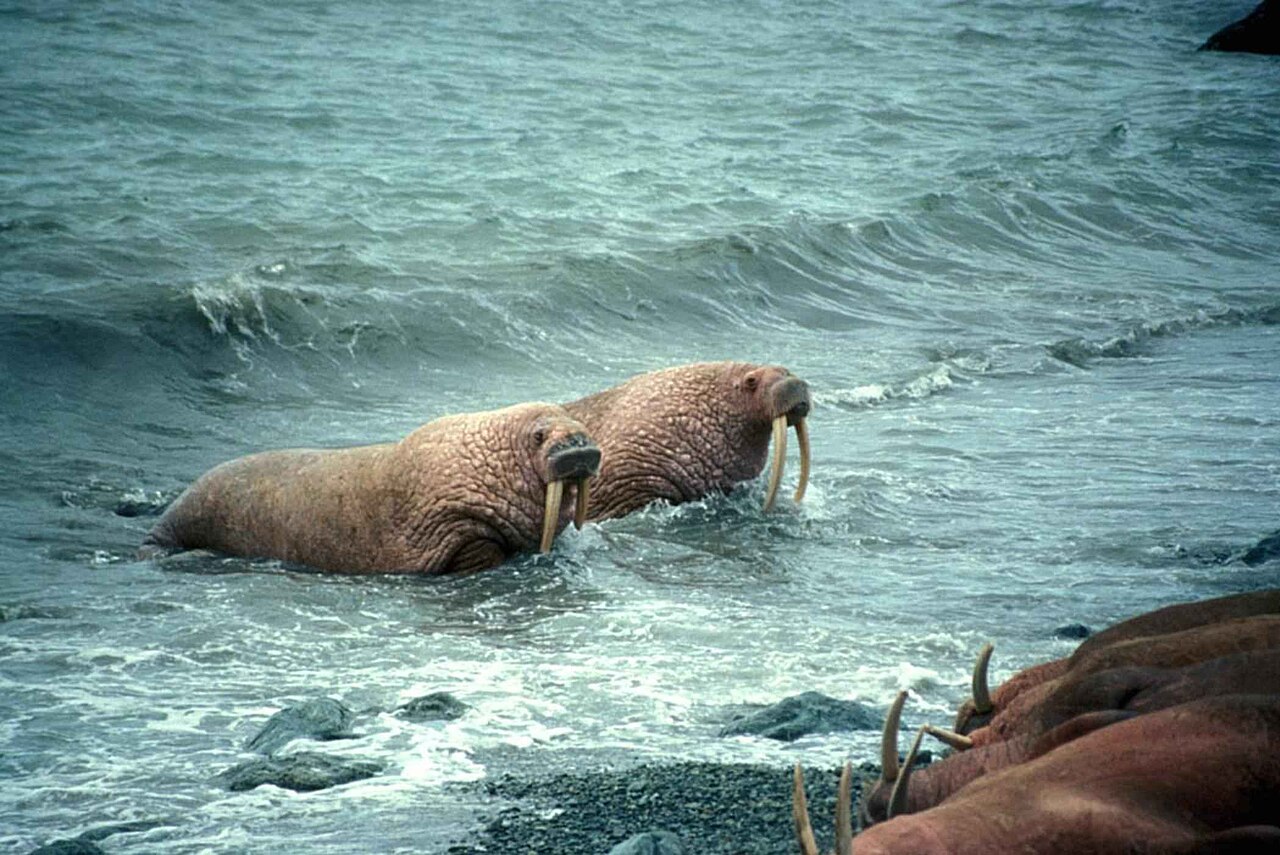
Pair of walruses resting together, showing whiskered muzzles and long ivory tusks
U.S. Fish and Wildlife Service / Public domain
๐ŸŒ Read in Language:

โšก At a Glance

Species profile
Also Known As
Atlantic walrus, Pacific walrus
Diet Category
Benthic carnivore specializing on clams and other seafloor invertebrates
Activity Rhythm
Feeds in repeated dive bouts and rests socially on ice or land; daily timing changes with ice, tides, weather and prey.
Wild Lifespan
Commonly 30โ€“40 years
Typical Weight
females often 400โ€“900 kg; males 800โ€“1,700 kg, with exceptional Pacific bulls heavier
Conservation Status
VU
๐Ÿ’ก Key Biological Insight: A walrus can use more than 400 highly sensitive whiskers to detect small clams in dark, silty seafloor habitat.

๐ŸŒณ Scientific Taxonomy Hierarchy

The walrus is the species Odobenus rosmarus, the sole living species in both the genus Odobenus and family Odobenidae. Two widely recognized subspecies are the Atlantic walrus O. r. rosmarus and the larger Pacific walrus O. r. divergens.

KingdomAnimalia
PhylumChordata
ClassMammalia
OrderCarnivora
FamilyOdobenidae
GenusOdobenus
SpeciesOdobenus rosmarus

Distinguishing Anatomical Features

  • โœ“A walrus has a massive barrel-shaped body, small head, broad muzzle packed with hundreds of stiff vibrissae and a pair of enlarged upper canine tusks. Adults have sparse hair over deeply folded skin. Blood flow makes resting animals appear pink, while cold-water vasoconstriction can make them look pale gray.
  • โœ“Thick blubber insulates and stores energy
  • โœ“Vibrissae detect buried bottom prey
  • โœ“Tusks establish rank and help haul onto ice
  • โœ“Hind flippers rotate forward for four-limbed movement on land
  • โœ“Large blood volume supports extended dives
  • โœ“Expandable throat pouches may aid buoyancy and sound production

๐Ÿ“ Physical Measurements

Total Lengthfemales commonly about 7.5โ€“10.2 ft; males about 8.9โ€“11.8 ft
Body Weightfemales often 880โ€“1,980 lb; males 1,760โ€“3,750 lb, with exceptional Pacific bulls heavier
Tail LengthVery short tail between hind flippers
WingspanNot applicable
Top SpeedNo dependable universal maximumMovement changes with context and conditions.

๐ŸŽจ Appearance & Distinctive Markings

BrownCinnamonPinkGrayPinkBrown

Skin / Covering: Thick deeply folded skin with sparse hair and a heavy blubber layer

Sexual Dimorphism: Adult males are much larger and heavier than females, with broader necks, thicker skin and longer, heavier tusks.

๐Ÿ—บ๏ธ Geographic Distribution & Habitat

Circumpolar but discontinuous in Arctic and subarctic seas. Pacific walruses occupy the Bering, Chukchi and adjacent Arctic waters of Alaska and Russia; Atlantic walruses range from the Canadian Arctic and Greenland east through Svalbard to the Russian Arctic.

Shallow continental-shelf seas with productive muddy or sandy bottoms, seasonal sea ice, polynyas and coastal beaches or rocky haul-outs.

Country-level distribution map

Native range
FijiTanzaniaWestern SaharaCanada โ€” Native rangeUnited States โ€” Native rangeKazakhstanUzbekistanPapua New GuineaIndonesiaArgentinaChileCongo - KinshasaSomaliaKenyaSudanChadHaitiDominican RepublicRussia โ€” Native rangeBahamasFalkland IslandsNorway โ€” Native rangeGreenland โ€” Native rangeFrench Southern TerritoriesTimor-LesteSouth AfricaLesothoMexicoUruguayBrazilBoliviaPeruColombiaPanamaCosta RicaNicaraguaHondurasEl SalvadorGuatemalaBelizeVenezuelaGuyanaSurinameFranceEcuadorPuerto RicoJamaicaCubaZimbabweBotswanaNamibiaSenegalMaliMauritaniaBeninNigerNigeriaCameroonTogoGhanaCรดte dโ€™IvoireGuineaGuinea-BissauLiberiaSierra LeoneBurkina FasoCentral African RepublicCongo - BrazzavilleGabonEquatorial GuineaZambiaMalawiMozambiqueEswatiniAngolaBurundiIsraelLebanonMadagascarPalestinian TerritoriesGambiaTunisiaAlgeriaJordanUnited Arab EmiratesQatarKuwaitIraqOmanVanuatuCambodiaThailandLaosMyanmar (Burma)VietnamNorth KoreaSouth KoreaMongoliaIndiaBangladeshBhutanNepalPakistanAfghanistanTajikistanKyrgyzstanTurkmenistanIranSyriaArmeniaSwedenBelarusUkrainePolandAustriaHungaryMoldovaRomaniaLithuaniaLatviaEstoniaGermanyBulgariaGreeceTรผrkiyeAlbaniaCroatiaSwitzerlandLuxembourgBelgiumNetherlandsPortugalSpainIrelandNew CaledoniaSolomon IslandsNew ZealandAustraliaSri LankaChinaTaiwanItalyDenmarkUnited KingdomIcelandAzerbaijanGeorgiaPhilippinesMalaysiaBruneiSloveniaFinlandSlovakiaCzechiaEritreaJapanParaguayYemenSaudi ArabiaCyprusMoroccoEgyptLibyaEthiopiaDjiboutiUgandaRwandaBosnia & HerzegovinaNorth MacedoniaSerbiaMontenegroKosovoTrinidad & TobagoSouth Sudan
Highlighted countries are recorded profile locations, not precise biological range boundaries.Map boundaries: Natural Earth

๐Ÿ’ก Did You Know?

  • ๐Ÿ’กThick blubber insulates and stores energy
  • ๐Ÿ’กVibrissae detect buried bottom prey
  • ๐Ÿ’กTusks establish rank and help haul onto ice
  • ๐Ÿ’กHind flippers rotate forward for four-limbed movement on land
  • ๐Ÿ’กLarge blood volume supports extended dives
  • ๐Ÿ’กExpandable throat pouches may aid buoyancy and sound production

๐ŸŒฟ Conservation Status & Threats

IUCN: VU โ€” Vulnerable

โ€œThe current IUCN global assessment lists the walrus as Vulnerable because continued climate warming is expected to reduce sea-ice habitat and alter access to shallow feeding grounds. Population knowledge remains uneven among regions.โ€

Population TrendUncertain globally; regional populations differ and future habitat quality is projected to decline
Wild Population EstimateIUCN previously estimated about 112,500 mature individuals, but broad uncertainty and uneven survey coverage remain.
CITESCITES Appendix III

โš ๏ธ Major Threats to Walrus

  • โ€ขLoss of seasonal sea ice
  • โ€ขCrowding and trampling at coastal haul-outs
  • โ€ขDisturbance from ships, aircraft and tourism
  • โ€ขOil spills and industrial development
  • โ€ขNoise and increased Arctic shipping
  • โ€ขContaminants
  • โ€ขUnsustainable local harvest where controls fail

๐Ÿ”„ Life Cycle & Reproduction

Wild vs. Captivity Lifespan Comparison

๐ŸŒฟ In the WildCommonly 30โ€“40 years
๐Ÿ  In Captivity (with veterinary care)Only a small number of accredited marine-mammal facilities can meet the enormous space, social, diet and veterinary needs.
Clutch / Litter SizeUsually one calf; twins are extremely rare
Incubation / GestationAbout 15โ€“16 months including delayed implantation; active fetal development is shorter
Fledging / WeaningSingle precocial calf weighing roughly 45โ€“75 kg, depending on population and source
Sexual MaturityFemales roughly 6โ€“8 years; males physiologically mature later and often do not breed successfully until larger and older
Mating SystemPolygynous competition among displaying adult males
Nesting / Den TypeNo nest; calf is born on stable sea ice

๐Ÿฆ… Behavior & Field Ecology

Benthic carnivore specializing on clams and other seafloor invertebrates

๐ŸŒ Ecological Food Web & Relationships: Walruses disturb and oxygenate seafloor sediment while feeding, recycle nutrients and connect benthic production with surface predators and scavengers. Polar bears and killer whales prey on them, especially calves. Carcasses feed foxes, gulls and many invertebrates, while haul-outs concentrate marine nutrients along Arctic coasts.

Social Group SizeLarge herds, often separated partly by sex and life stage outside breeding
Activity RhythmFeeds in repeated dive bouts and rests socially on ice or land; daily timing changes with ice, tides, weather and prey.
Feeding StrategyBenthic carnivore specializing on clams and other seafloor invertebrates

๐Ÿฅฉ Primary Prey & Preferred Diet

โœ“ Clamsโœ“ Musselsโœ“ Snailsโœ“ Marine wormsโœ“ Sea cucumbersโœ“ Tunicatesโœ“ Crabsโœ“ Occasional fish or seal tissue

๐Ÿ“ข Communication & Territorial Signals

  • Underwater knocks and bells
  • Roars and grunts
  • Tusks and body posture
  • Touch
  • Scent

๐Ÿพ Wild Temperament & Traits

โ€ข Socialโ€ข Vigilantโ€ข Powerfulโ€ข Defensive around calves or crowded haul-outs

๐Ÿค Human Interaction & Pet Advisory

โš ๏ธ Strictly Wild Species
๐Ÿšซ

Can You Keep a Walrus as a Pet?

Completely unsuitable and generally illegal for private keeping. A walrus requires Arctic-scale aquatic space, a social group, hundreds of kilograms of specialized food and expert marine-mammal care.

Domestication StatusWild marine mammal; not domesticated
Danger to HumansHigh at close range โ€” exceptionally large, strong and tusked
Economic & Ecotourism RoleArctic food-web engineering, Indigenous subsistence and culture, nutrient cycling, scientific monitoring of sea-ice change and responsible wildlife tourism.

โš ๏ธ Behavioral Risk Factors & Wildlife Safety

  • Long ivory tusks
  • Mass up to well over a tonne
  • Can charge on land and maneuver rapidly in water
  • Defensive mothers and crowded herds are unpredictable

๐ŸŒ Ecological Food Web & Relationships

๐Ÿฆ… Natural Predators (5)

Polar BearUrsus maritimus
Killer WhaleOrcinus orca
HumansHomo sapiens
Arctic FoxVulpes lagopus
Glaucous GullLarus hyperboreus

๐Ÿงฌ Related Species (4)

Harbor SealPhoca vitulinaTrue seal relative in another pinniped family
Steller Sea LionEumetopias jubatusLarge eared-seal relative of the North Pacific
Bearded SealErignathus barbatusArctic benthic-feeding true seal
Polar BearUrsus maritimusCarnivoran relative and major predator

Walrus (Odobenus rosmarus) is the only living member of the family Odobenidae and occurs in discontinuous populations across Arctic and subarctic seas. This guide separates well-supported biology from common assumptions and covers identification, range, habitat, diet, behavior, reproduction and conservation.

Identification

A walrus has a massive barrel-shaped body, small head, broad muzzle packed with hundreds of stiff vibrissae and a pair of enlarged upper canine tusks. Adults have sparse hair over deeply folded skin. Blood flow makes resting animals appear pink, while cold-water vasoconstriction can make them look pale gray. Adult males are much larger and heavier than females, with broader necks, thicker skin and longer, heavier tusks.

Identification should combine body shape, markings, size, voice or movement, and location. One feature by itself can overlap with a related animal, a juvenile, or an individual in unusual light.

Photographs are most useful when they preserve scale and show several diagnostic features. Handling or repositioning a wild walrus for identification can cause stress and is unnecessary.

Size and physical adaptations

Walrus typically measures females commonly about 2.3โ€“3.1 m; males about 2.7โ€“3.6 m, varying by subspecies and weighs females often 400โ€“900 kg; males 800โ€“1,700 kg, with exceptional Pacific bulls heavier. Pacific walruses average larger than Atlantic walruses, and body mass changes with age, sex and seasonal fat reserves.

Its useful adaptations include thick blubber insulates and stores energy, vibrissae detect buried bottom prey, tusks establish rank and help haul onto ice, hind flippers rotate forward for four-limbed movement on land, large blood volume supports extended dives, expandable throat pouches may aid buoyancy and sound production. These traits work together in the animal’s normal setting rather than serving as isolated curiosities.

Published measurements may use different methods, life stages or sample locations. Comparing figures responsibly means checking what was measured rather than selecting the largest number available.

Range and distribution

Circumpolar but discontinuous in Arctic and subarctic seas. Pacific walruses occupy the Bering, Chukchi and adjacent Arctic waters of Alaska and Russia; Atlantic walruses range from the Canadian Arctic and Greenland east through Svalbard to the Russian Arctic. The native range includes United States (Alaska), Canada, Greenland, Norway, Svalbard and Jan Mayen, Russia.

A country-level map indicates broad distribution, not continuous occupation. Climate, elevation, water, vegetation, prey, breeding sites, barriers and survey effort all affect where records occur.

Records near the edge of the range deserve careful documentation because they may reflect natural movement, improved survey coverage, accidental transport or a genuine distribution change.

Habitat

Shallow continental-shelf seas with productive muddy or sandy bottoms, seasonal sea ice, polynyas and coastal beaches or rocky haul-outs.

Walruses alternate between feeding dives and rest on ice or shore. Mobile sea ice lets females and calves rest near shallow feeding grounds. When summer ice retreats beyond the continental shelf, Pacific animals may gather by the tens of thousands on coastal haul-outs and travel farther to forage. Protecting a population therefore requires the feeding, shelter and breeding features that make a site usable, along with connections that allow movement.

Microhabitat matters. Shade, soil, current, moisture, shelter or host plants can determine whether a small area is usable even when the surrounding landscape appears suitable.

Diet and feeding

Walrus is a benthic carnivore specializing on clams and other seafloor invertebrates. Important foods include clams, mussels, snails, marine worms, sea cucumbers, tunicates, crabs, occasional fish or seal tissue. A walrus descends to the seabed, sweeps sediment with the muzzle and uses sensitive vibrissae to find prey. Water jets and flipper movements expose buried animals. Powerful suction draws soft clam tissue from the shell, leaving many shells behind. Tusks are not the main digging tool.

Diet changes with age, season, location and food supply. A dramatic prey record does not establish what most individuals eat most of the time; repeated field observations provide a stronger picture.

Feeding opportunities also create risk. An animal focused on prey may be less alert to predators, traffic or people, while contaminated prey can transfer pollutants through the food web.

Behavior and communication

Feeds in repeated dive bouts and rests socially on ice or land; daily timing changes with ice, tides, weather and prey. Walruses are highly social, often resting in dense contact and communicating with roars, knocks, bell-like underwater sounds and touch. Females and young form strong associations. Breeding bulls display acoustically underwater and use tusks and body size to compete, while crowded haul-outs can become dangerous during disturbance.

Sound travels efficiently underwater, and males produce patterned knocks, pulses and bell-like notes during winter breeding. Roars, grunts and barks coordinate surface groups. Tusks, posture, scent and physical contact communicate rank and reassurance at close range. Behavior should be interpreted in context: alarm, courtship, feeding and temperature regulation can produce very different actions from the same animal.

Daily schedules are flexible responses, not rigid rules. Weather, breeding condition, disturbance, tides or food can move activity into a different part of the day.

Reproduction and development

Mating occurs in winter near pack-ice edges. Implantation of the embryo is delayed, extending total pregnancy to roughly 15โ€“16 months. A female usually gives birth to one large calf on sea ice in spring and invests in it for two years or longer, so births are separated by several years. Usually one calf; twins are extremely rare A calf can swim soon after birth but depends on rich milk and close protection. It rides on the motherโ€™s back or rests against her in water and gradually learns haul-out routes and bottom feeding. Nursing commonly continues for two years or more.

Young animals face different risks and may use different microhabitats or food than adults. Breeding success depends on adult condition, suitable sites and the survival of offspring through vulnerable early stages.

Counts of eggs or young describe reproductive output, not the number expected to reach adulthood. Mortality is normally greatest during eggs, larval or juvenile stages.

Predators and ecological role

Walruses disturb and oxygenate seafloor sediment while feeding, recycle nutrients and connect benthic production with surface predators and scavengers. Polar bears and killer whales prey on them, especially calves. Carcasses feed foxes, gulls and many invertebrates, while haul-outs concentrate marine nutrients along Arctic coasts. Documented or likely predators include Polar Bear, Killer Whale, Humans, Arctic Fox, Glaucous Gull.

This animal is both a consumer and a food source. Its influence comes through many repeated interactions, so ecological claims should be based on measured populations rather than assumptions drawn from appearance.

Predator and prey relationships differ among places. A species can be ecologically influential without being abundant everywhere, and its role can change across its range.

Relationship with people

Arctic Indigenous peoples have sustained relationships with walruses for food, hides, ivory and community knowledge. Modern co-management seeks to preserve both populations and subsistence traditions. Visitors, aircraft and ships can trigger stampedes at crowded haul-outs, crushing calves; regulated distance and quiet approach are essential.

Walruses are huge, fast in water and armed with long tusks. Never approach one on ice, shore or from a small boat. Follow legal viewing distances, avoid blocking its route to water and leave immediately if animals raise their heads, bunch together or enter the sea. Responsible observation means keeping an appropriate distance, avoiding capture or feeding, protecting habitat and following local wildlife or invasive-species guidance.

Wildlife guidance should come from the responsible local agency because collection rules, reporting requests and appropriate responses differ between native and introduced ranges.

Conservation

The current IUCN global assessment lists the walrus as Vulnerable because continued climate warming is expected to reduce sea-ice habitat and alter access to shallow feeding grounds. Population knowledge remains uneven among regions. The reported global trend is Uncertain globally; regional populations differ and future habitat quality is projected to decline.

Important pressures include loss of seasonal sea ice, crowding and trampling at coastal haul-outs, disturbance from ships, aircraft and tourism, oil spills and industrial development, noise and increased arctic shipping, contaminants, unsustainable local harvest where controls fail. Global status can hide local decline or recovery, so current regional monitoring and habitat management remain necessary.

The most useful conservation action follows the documented pressure. Protecting breeding sites, reducing road deaths or limiting pollutants can require different tools in different populations.

Sources and further reading

โ“ Frequently Asked Questions

Answers to frequently asked questions verified against peer-reviewed zoological research.

Tusks help establish social rank, defend against threats and pull the body onto ice. They are not the main tool for digging clams from the seafloor.