
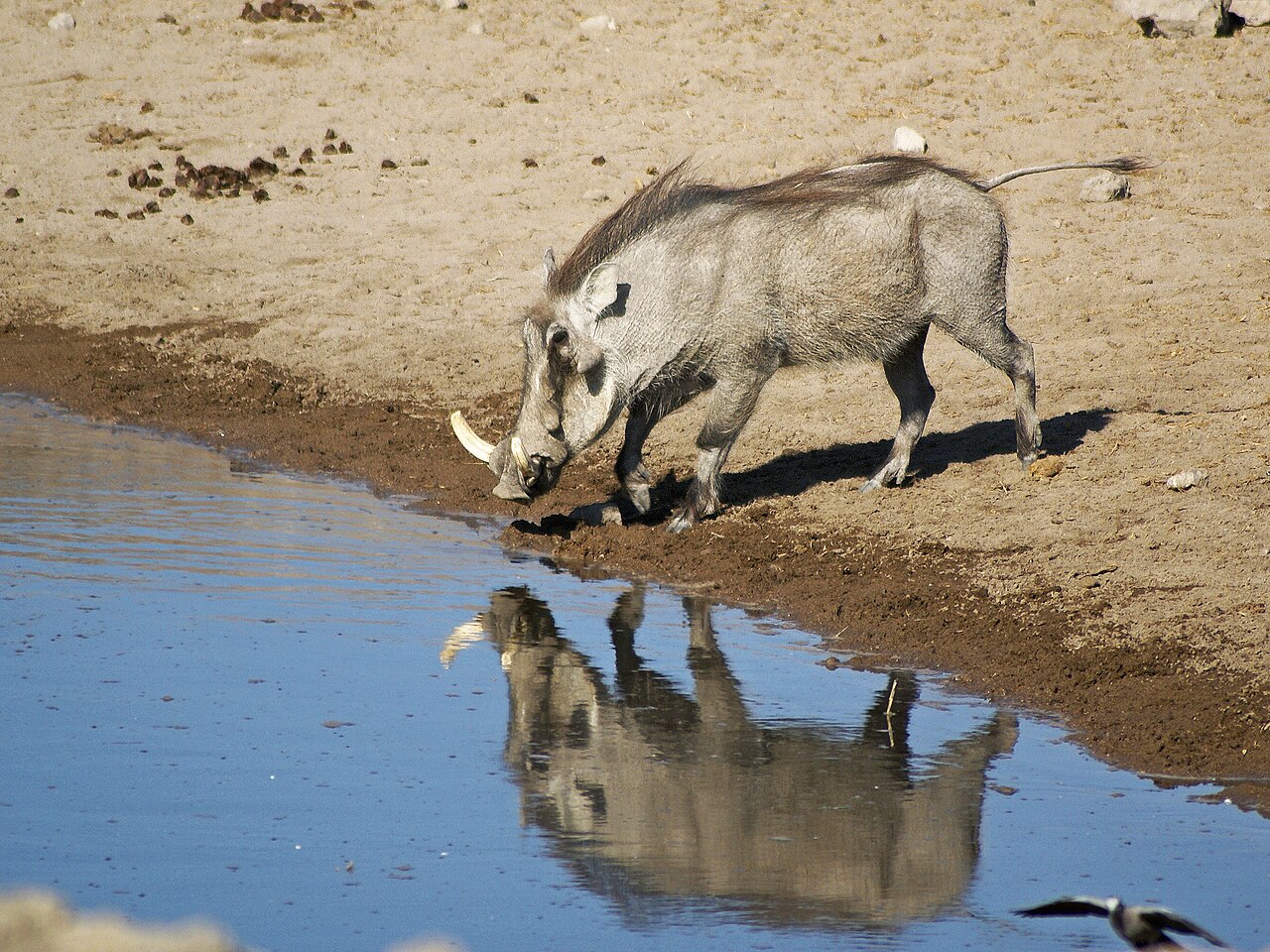
Warthog (Phacochoerus africanus) is a widespread wild pig of sub-Saharan grasslands and savannas, distinct from the desert warthog of the Horn of Africa. This guide separates well-supported biology from common assumptions and covers identification, range, habitat, diet, behavior, reproduction and conservation.
Identification
A disproportionately large flat head carries upward-curving upper tusks and sharp lower tusks. Paired facial pads are especially large in males. The body has sparse gray-brown hair, a dark mane along the neck and back, and a long thin tail ending in a tuft that is often held upright while running. Males are 15–20 percent heavier, with larger facial pads and much longer, thicker tusks than females.
Identification should combine body shape, markings, size, voice or movement, and location. One feature by itself can overlap with a related animal, a juvenile, or an individual in unusual light.
Photographs are most useful when they preserve scale and show several diagnostic features. Handling or repositioning a wild warthog for identification can cause stress and is unnecessary.
Size and physical adaptations
Warthog typically measures about 0.9–1.5 m head–body and weighs about 50–150 kg. Adult males occupy the upper part of the weight range; habitat quality and subspecies also influence size.
Its useful adaptations include calloused wrist pads support low grazing posture, broad snout and tusks excavate roots and bulbs, facial pads protect eyes and jaws during combat, burrows buffer daytime heat and cold nights, sparse coat sheds heat in open savanna, fast running and upright tail coordinate escape. These traits work together in the animal’s normal setting rather than serving as isolated curiosities.
Published measurements may use different methods, life stages or sample locations. Comparing figures responsibly means checking what was measured rather than selecting the largest number available.
Range and distribution
Widely but patchily distributed through sub-Saharan Africa from the western Sahel and Ethiopia south to Namibia and eastern South Africa. It is absent from rainforest, the driest deserts and intensively settled landscapes without refuge. The native range includes Mauritania, Senegal, Mali, Burkina Faso, Niger, Chad, Sudan, South Sudan, Ethiopia, Uganda, Kenya, Tanzania, Angola, Zambia, Malawi, Mozambique, Zimbabwe, Botswana, Namibia, South Africa, Eswatini.
A country-level map indicates broad distribution, not continuous occupation. Climate, elevation, water, vegetation, prey, breeding sites, barriers and survey effort all affect where records occur.
Records near the edge of the range deserve careful documentation because they may reflect natural movement, improved survey coverage, accidental transport or a genuine distribution change.
Habitat
Open and wooded savanna, grass steppe, floodplain, semi-desert, pasture and lightly farmed land with short grass, water or wallows and abandoned burrows.
Warthogs feed in open grassland by day and use shade, mud and water to control heat. At night they shelter in aardvark burrows, rock cavities or excavated dens, often backing inside. Home ranges overlap because sounders do not defend exclusive territories. Protecting a population therefore requires the feeding, shelter and breeding features that make a site usable, along with connections that allow movement.
Microhabitat matters. Shade, soil, current, moisture, shelter or host plants can determine whether a small area is usable even when the surrounding landscape appears suitable.
Diet and feeding
Warthog is a primarily grazing herbivore with flexible omnivorous habits. Important foods include short grasses, rhizomes, bulbs, roots, berries, bark, fruit, occasional carrion, dung. The animal kneels on thick wrist calluses to crop short grass with mobile lips. During drought it digs with the snout and front feet for bulbs and rhizomes that supply food and moisture. Opportunistic carrion or dung forms only a small part of an otherwise plant-heavy diet.
Diet changes with age, season, location and food supply. A dramatic prey record does not establish what most individuals eat most of the time; repeated field observations provide a stronger picture.
Feeding opportunities also create risk. An animal focused on prey may be less alert to predators, traffic or people, while contaminated prey can transfer pollutants through the food web.
Behavior and communication
Mostly diurnal where undisturbed, shifting toward twilight or night around heavy human activity. Females and young live in sounders that share feeding grounds, wallows and sleeping burrows. Adult males are solitary or form loose bachelor associations, joining females to mate. Warthogs rely first on alertness and rapid flight, but a cornered animal can defend itself effectively with lower tusks.
Smell and gland rubbing carry individual and reproductive information. Grunts maintain contact, squeals express submission or distress and tooth grinding accompanies conflict or courtship. The upright tail is a conspicuous visual signal to following group members. Behavior should be interpreted in context: alarm, courtship, feeding and temperature regulation can produce very different actions from the same animal.
Daily schedules are flexible responses, not rigid rules. Weather, breeding condition, disturbance, tides or food can move activity into a different part of the day.
Reproduction and development
Seasonal rainfall controls mating and birth timing. Several males may follow an estrous female, using ritualized head pushing and blunt upper tusks rather than the sharper lower weapons. The sow leaves her sounder to give birth safely inside a burrow. 1–7 piglets, averaging about 3 Newborn piglets remain in the den during their first vulnerable days and begin accompanying their mother after about six or seven weeks. Related females may nurse one another’s young. Juveniles learn grazing sites, wallows, escape routes and burrows within the sounder.
Young animals face different risks and may use different microhabitats or food than adults. Breeding success depends on adult condition, suitable sites and the survival of offspring through vulnerable early stages.
Counts of eggs or young describe reproductive output, not the number expected to reach adulthood. Mortality is normally greatest during eggs, larval or juvenile stages.
Predators and ecological role
Grazing helps maintain short-grass patches, while digging aerates soil and exposes food for birds and smaller animals. Warthogs are major prey for lions and leopards. Oxpeckers remove some ticks and sound alarms, and abandoned or shared burrows connect warthogs to aardvarks and many shelter-using species. Documented or likely predators include Lion, Leopard, Cheetah, Spotted Hyena, African Wild Dog, Nile Crocodile.
This animal is both a consumer and a food source. Its influence comes through many repeated interactions, so ecological claims should be based on measured populations rather than assumptions drawn from appearance.
Predator and prey relationships differ among places. A species can be ecologically influential without being abundant everywhere, and its role can change across its range.
Relationship with people
Warthogs support tourism and regulated hunting but may damage rice, groundnuts and other crops. They can carry pathogens relevant to livestock, including ticks involved in African swine fever cycles, so farm biosecurity and separation from domestic pigs matter. Conflict is best addressed with secure fencing and waste management.
Stay inside vehicles where required and never block a warthog’s route to cover. On foot, keep a wide distance, avoid burrow entrances and never approach piglets. If surprised, move away calmly and leave an escape path; do not run toward dense cover that may conceal another animal. Responsible observation means keeping an appropriate distance, avoiding capture or feeding, protecting habitat and following local wildlife or invasive-species guidance.
Wildlife guidance should come from the responsible local agency because collection rules, reporting requests and appropriate responses differ between native and introduced ranges.
Conservation
The common warthog is globally Least Concern because it remains widespread and often common in protected areas. Local populations decline under heavy hunting, settlement, disease-control killing and habitat loss. The reported global trend is Broadly stable in secure habitat but decreasing in some unprotected regions.
Important pressures include unregulated hunting and bushmeat trade, agricultural expansion and settlement, persecution as a crop pest, disease-control campaigns, drought and loss of water, road mortality, competition with livestock. Global status can hide local decline or recovery, so current regional monitoring and habitat management remain necessary.
The most useful conservation action follows the documented pressure. Protecting breeding sites, reducing road deaths or limiting pollutants can require different tools in different populations.