
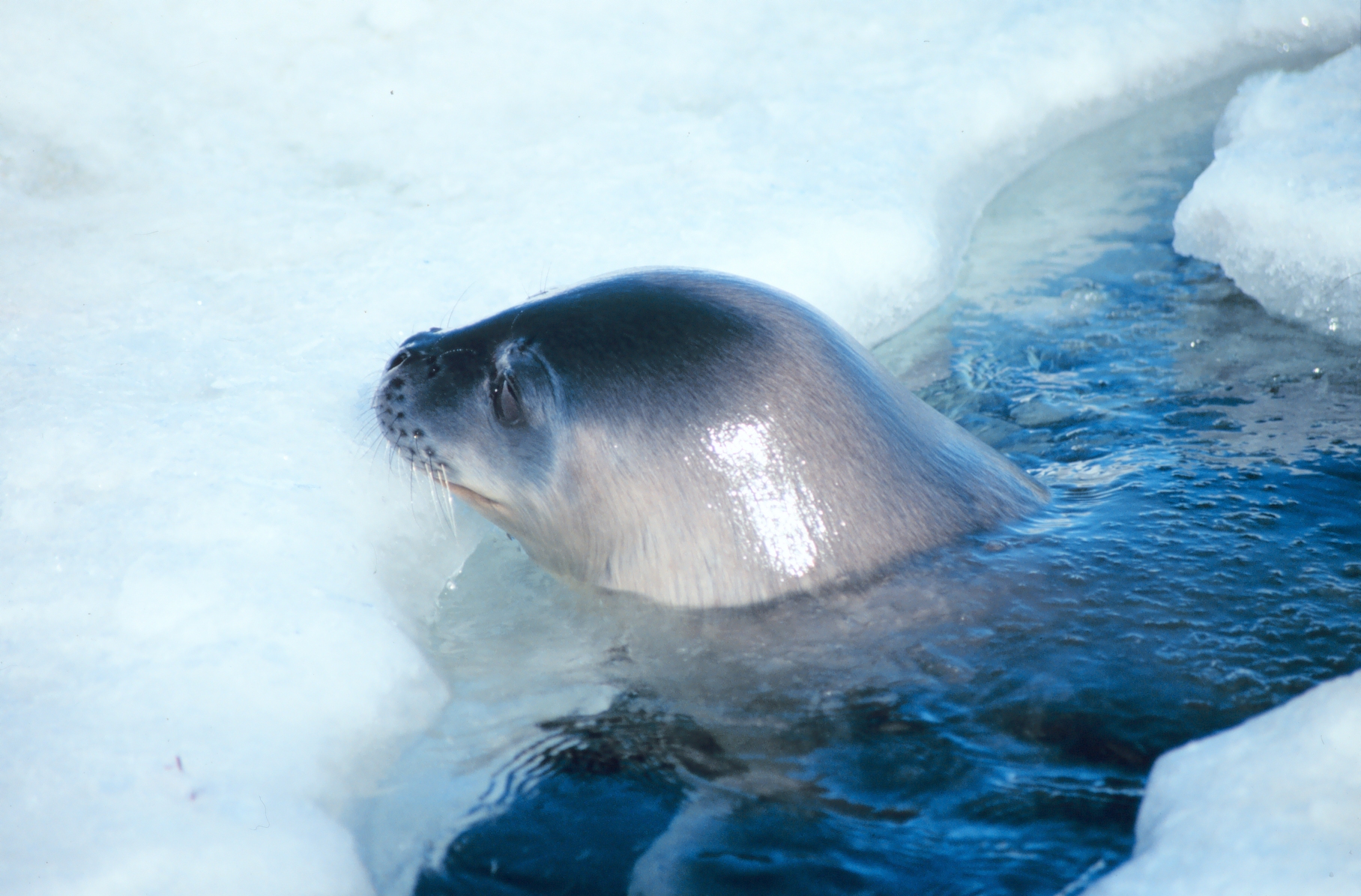
Weddell Seal (Leptonychotes weddellii) is a large true seal closely tied to fast ice around Antarctica. It rests, gives birth and nurses on ice while hunting fish and invertebrates below. Exceptional breath-hold physiology, low-light vision and a remarkable underwater voice allow it to navigate a dark world where a breathing hole may be the only safe path back to air. This guide separates well-supported biology from common assumptions and covers identification, range, habitat, diet, behavior, reproduction and conservation.
Identification
Adults are thick-bodied with a small rounded head, short muzzle and large forward-facing eyes. The coat is mottled gray to brown-black with irregular pale silver patches, often lighter below. Foreflippers are short and clawed; hind flippers point backward and cannot rotate beneath the body. The mouth contains strong canines and incisors used to rasp ice around breathing holes. Females average slightly longer and heavier than males, especially during pregnancy; external sex differences are otherwise subtle.
Identification should combine body shape, markings, size, voice or movement, and location. One feature by itself can overlap with a related animal, a juvenile, or an individual in unusual light.
Photographs are most useful when they preserve scale and show several diagnostic features. Handling or repositioning a wild weddell seal for identification can cause stress and is unnecessary.
Size and physical adaptations
Weddell Seal typically measures About 2.5–3.5 m and weighs Roughly 350–600 kg, changing seasonally. Pregnant females and well-fed adults are heaviest before breeding and fasting.
Its useful adaptations include large blood volume stores oxygen, high muscle myoglobin supports long dives, heart rate slows during submergence, peripheral blood flow can be reduced, sensitive whiskers track water movement from prey, large eyes function in dim under-ice light, teeth maintain breathing holes in thin ice, thick blubber insulates and stores energy. These traits work together in the animal’s normal setting rather than serving as isolated curiosities.
Published measurements may use different methods, life stages or sample locations. Comparing figures responsibly means checking what was measured rather than selecting the largest number available.
Range and distribution
Circumpolar around Antarctica, especially coastal fast ice, embayments and islands from the continent north to seasonally icy subantarctic waters. Highest densities occur where stable ice contains cracks or thin areas that seals can maintain as breathing access. The native range includes Antarctica.
A country-level map indicates broad distribution, not continuous occupation. Climate, elevation, water, vegetation, prey, breeding sites, barriers and survey effort all affect where records occur.
Records near the edge of the range deserve careful documentation because they may reflect natural movement, improved survey coverage, accidental transport or a genuine distribution change.
Habitat
Antarctic coastal ocean, fast ice, pack ice, breathing holes, cracks and continental-shelf waters.
Stable fast ice provides platforms for pupping, nursing, resting and molting. Beneath it, seals travel between known holes and natural cracks. They forage in the water column and near the seabed, often along banks, slopes and troughs shallower than about 600 meters, though individual dives can be deeper. Protecting a population therefore requires the feeding, shelter and breeding features that make a site usable, along with connections that allow movement.
Microhabitat matters. Shade, soil, current, moisture, shelter or host plants can determine whether a small area is usable even when the surrounding landscape appears suitable.
Diet and feeding
Weddell Seal is a carnivore. Important foods include antarctic silverfish, antarctic toothfish, notothenioid fish, squid, octopus, crustaceans. Weddell Seals hunt underwater by sight and whisker sensation. Fish dominate many diets, but crustaceans and cephalopods become important by region and season. Animals may approach prey from below, where their pale underside is less obvious against ice. Documented females differ strongly in prey choice, and some individuals specialize.
Diet changes with age, season, location and food supply. A dramatic prey record does not establish what most individuals eat most of the time; repeated field observations provide a stronger picture.
Feeding opportunities also create risk. An animal focused on prey may be less alert to predators, traffic or people, while contaminated prey can transfer pollutants through the food web.
Behavior and communication
Alternates submerged foraging with long rest periods on ice; dive timing changes with light, season and prey. On ice Weddell Seals appear slow because they move by flexing the body and pulling with foreflippers, but underwater they are agile. Adults defend access around breeding holes and remember routes beneath ice. They bask during calm weather, groom with foreflipper claws and may lie in orientations that maximize solar warmth.
Weddell Seals possess one of the richest known pinniped vocal repertoires. Underwater whistles, trills, chirps, knocks and descending calls travel far beneath ice, where sound is more reliable than sight. Males advertise and contest underwater territories acoustically. Mothers and pups use calls and close-range scent to reunite on crowded ice. Behavior should be interpreted in context: alarm, courtship, feeding and temperature regulation can produce very different actions from the same animal.
Daily schedules are flexible responses, not rigid rules. Weather, breeding condition, disturbance, tides or food can move activity into a different part of the day.
Reproduction and development
Females give birth on stable sea ice during the austral spring, with timing later at higher latitudes. Mating occurs underwater near the end of lactation. Delayed implantation helps align the next birth with favorable spring ice, producing a total interval of roughly nine to eleven months. Usually one pup; twins are rare A pup is born with gray lanugo and weighs around 25–30 kilograms. Its mother produces extremely rich milk, allowing rapid mass gain over a nursing period of about six to seven weeks. Pups enter water early, practice swimming beside their mothers and replace lanugo with a juvenile coat before independence.
Young animals face different risks and may use different microhabitats or food than adults. Breeding success depends on adult condition, suitable sites and the survival of offspring through vulnerable early stages.
Counts of eggs or young describe reproductive output, not the number expected to reach adulthood. Mortality is normally greatest during eggs, larval or juvenile stages.
Predators and ecological role
Weddell Seals are major predators of Antarctic shelf fish and invertebrates and prey for Killer Whales and Leopard Seals. Their foraging connects food webs below ice with nutrients deposited on its surface. Because breeding success depends on ice access and mothers lose substantial mass while nursing, the species is a valuable indicator of changes in sea ice and prey. Documented or likely predators include Killer Whale, Leopard Seal, South Polar Skua, Human.
This animal is both a consumer and a food source. Its influence comes through many repeated interactions, so ecological claims should be based on measured populations rather than assumptions drawn from appearance.
Predator and prey relationships differ among places. A species can be ecologically influential without being abundant everywhere, and its role can change across its range.
Relationship with people
Weddell Seals were once killed locally to feed sled dogs and now support long-term ecological research. Scientists use tags, cameras and demographic records to study diving, prey, reproduction and climate. Antarctic Treaty protections restrict harm and disturbance. Visitors must follow expedition and national-program distance rules.
A resting Weddell Seal may seem approachable but has strong jaws and sharp teeth. Never block its route to water or a breathing hole, touch or feed it, or place yourself between a mother and pup. Follow Antarctic wildlife-distance rules and move away if the seal lifts its head repeatedly, vocalizes or changes posture. Responsible observation means keeping an appropriate distance, avoiding capture or feeding, protecting habitat and following local wildlife or invasive-species guidance.
Wildlife guidance should come from the responsible local agency because collection rules, reporting requests and appropriate responses differ between native and introduced ranges.
Conservation
The IUCN lists the Weddell Seal as Least Concern because it remains widespread and numerous around Antarctica. Direct exploitation is limited, but climate-driven changes to fast ice and prey, fisheries interactions, pollution and local research or tourism disturbance require continued monitoring. The reported global trend is Uncertain globally; regional colonies vary.
Important pressures include climate-driven sea-ice change, prey shifts, potential fishery competition, pollution and contaminants, local disturbance, disease emergence. Global status can hide local decline or recovery, so current regional monitoring and habitat management remain necessary.
The most useful conservation action follows the documented pressure. Protecting breeding sites, reducing road deaths or limiting pollutants can require different tools in different populations.