
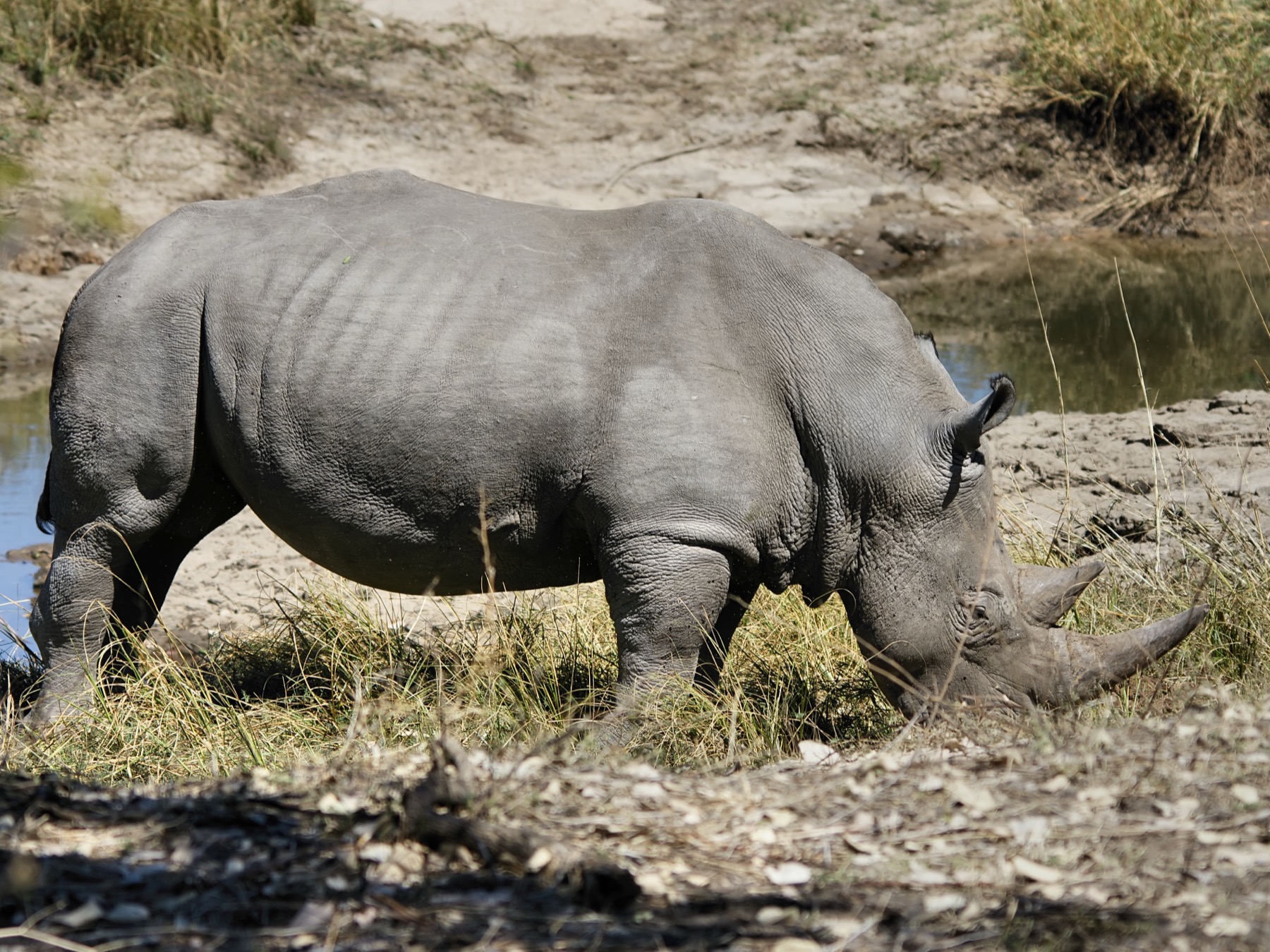
White Rhinoceros (Ceratotherium simum) is a massive African grazer with two keratin horns, a broad muzzle and a low-slung head. The name does not describe a white coat; the hide is gray and often takes the color of local dust or mud. The species includes the southern white rhinoceros and the northern white rhinoceros, whose present conservation situations differ drastically. This guide separates well-supported biology from common assumptions and covers identification, range, habitat, diet, behavior, reproduction and conservation.
Identification
A White Rhinoceros has an enormous barrel-shaped body, pronounced shoulder hump, long head held close to the ground and a wide, straight-edged upper lip used to crop grass. Two horns rise from the snout, the front usually much longer. The ears are long and tubular, the skin gray and only sparsely haired. A Black Rhinoceros is generally smaller and has a pointed prehensile upper lip for browsing. Adult males are larger and heavier, with thicker necks and often more massive horn bases. Females may have a longer, more slender front horn, but horn shape varies widely and is altered by wear or deliberate dehorning.
Identification should combine body shape, markings, size, voice or movement, and location. One feature by itself can overlap with a related animal, a juvenile, or an individual in unusual light.
Photographs are most useful when they preserve scale and show several diagnostic features. Handling or repositioning a wild white rhinoceros for identification can cause stress and is unnecessary.
Size and physical adaptations
White Rhinoceros typically measures Head and body about 3.4–4.2 m and weighs Females often 1,600–1,700 kg; males commonly 2,000–2,300 kg. Large males can exceed typical figures; shoulder height is roughly 1.6–1.9 m.
Its useful adaptations include broad square lip crops short grass, massive shoulder muscles support the heavy head, three-toed feet spread weight on firm ground, acute hearing and smell compensate for limited vision, horns defend calves and settle disputes, thick skin resists thorn and abrasion, mud wallowing cools skin and discourages parasites, hindgut fermentation processes large volumes of grass. These traits work together in the animal’s normal setting rather than serving as isolated curiosities.
Published measurements may use different methods, life stages or sample locations. Comparing figures responsibly means checking what was measured rather than selecting the largest number available.
Range and distribution
Southern white rhinos now occur mainly in protected and privately managed populations in southern Africa, especially South Africa, Namibia, Botswana, Zimbabwe and Eswatini, with reintroduced groups elsewhere. The northern subspecies formerly ranged across parts of central and eastern Africa but no viable wild population remains. The native range includes South Africa, Namibia, Botswana, Zimbabwe, Eswatini, Mozambique, Zambia, Kenya, Uganda.
A country-level map indicates broad distribution, not continuous occupation. Climate, elevation, water, vegetation, prey, breeding sites, barriers and survey effort all affect where records occur.
Records near the edge of the range deserve careful documentation because they may reflect natural movement, improved survey coverage, accidental transport or a genuine distribution change.
Habitat
Open savanna, grassland, grassy woodland and floodplain with reliable grazing, water, shade and wallows.
White rhinos spend long periods on short-grass lawns, drink regularly when water is available, rest in shade during heat and visit mud wallows. Bulls hold territories marked by dung middens and urine. Landscape use expands in dry seasons as animals search for water and remaining forage. Protecting a population therefore requires the feeding, shelter and breeding features that make a site usable, along with connections that allow movement.
Microhabitat matters. Shade, soil, current, moisture, shelter or host plants can determine whether a small area is usable even when the surrounding landscape appears suitable.
Diet and feeding
White Rhinoceros is a obligate grazer and hindgut fermenter. Important foods include short grasses, perennial grasses, fresh grass shoots, dry-season grass stems. The broad lips sweep close to the soil and clip large mouthfuls of grass. A White Rhinoceros may graze for many hours in cool parts of the day and process fibrous forage in an enlarged hindgut. It does not routinely browse woody plants like the smaller Black Rhinoceros.
Diet changes with age, season, location and food supply. A dramatic prey record does not establish what most individuals eat most of the time; repeated field observations provide a stronger picture.
Feeding opportunities also create risk. An animal focused on prey may be less alert to predators, traffic or people, while contaminated prey can transfer pollutants through the food web.
Behavior and communication
Active by day and night, with grazing concentrated in cooler morning, evening and nighttime hours. Females and calves may form loose groups called crashes, while territorial bulls are often solitary. Subadult males can associate in bachelor groups. Rhinos follow habitual routes between feeding grounds, water and wallows, and deposit dung at communal middens that carry scent information about identity and reproductive state.
White rhinos use snorts, squeals, bellows, growls and panting calls. Scent in dung and urine is especially important, allowing animals to assess sex, status and reproductive condition at middens. Ear position, head angle, approach and retreat communicate intent at close range. Behavior should be interpreted in context: alarm, courtship, feeding and temperature regulation can produce very different actions from the same animal.
Daily schedules are flexible responses, not rigid rules. Weather, breeding condition, disturbance, tides or food can move activity into a different part of the day.
Reproduction and development
Breeding can occur year-round. A territorial bull tests females and may accompany a receptive female for days. After a pregnancy lasting about sixteen months, the mother gives birth to one calf and provides all direct care. One calf A newborn weighing roughly 40–65 kg stands and follows its mother within hours. Calves begin tasting grass early but nurse for about a year and remain with the mother for two to three years. The long pregnancy and long interval between calves make population recovery slow after heavy poaching.
Young animals face different risks and may use different microhabitats or food than adults. Breeding success depends on adult condition, suitable sites and the survival of offspring through vulnerable early stages.
Counts of eggs or young describe reproductive output, not the number expected to reach adulthood. Mortality is normally greatest during eggs, larval or juvenile stages.
Predators and ecological role
As a megagrazer, the White Rhinoceros maintains short-grass patches, redistributes nutrients in dung and creates wallows used by other animals. Its grazing can shift vegetation structure at local scales. Oxpeckers and other birds forage on external parasites or disturbed insects, while lions and spotted hyenas occasionally threaten calves. Documented or likely predators include Human, Lion, Spotted Hyena, Nile Crocodile.
This animal is both a consumer and a food source. Its influence comes through many repeated interactions, so ecological claims should be based on measured populations rather than assumptions drawn from appearance.
Predator and prey relationships differ among places. A species can be ecologically influential without being abundant everywhere, and its role can change across its range.
Relationship with people
White rhinos support tourism, protected-area employment and conservation economies, yet demand for horn drives organized poaching. Horn has no proven cancer-curing value. Intensive protection can include armed patrols, intelligence work, DNA forensics, translocation, dehorning and closely monitored breeding. These measures are costly and work best alongside demand reduction and community benefits.
A White Rhinoceros can accelerate rapidly and may charge if surprised, crowded or separated from a calf. Stay inside authorized vehicles, obey guides, never approach on foot and never block an escape route. Give mothers and bulls exceptional space. Responsible observation means keeping an appropriate distance, avoiding capture or feeding, protecting habitat and following local wildlife or invasive-species guidance.
Wildlife guidance should come from the responsible local agency because collection rules, reporting requests and appropriate responses differ between native and introduced ranges.
Conservation
The species has long been assessed as Near Threatened, but poaching has driven major recent declines and future assessments may change. Southern white rhinos recovered dramatically during the twentieth century but are again falling in several strongholds. The northern subspecies is functionally extinct, with only two nonbreeding females alive under care. The reported global trend is Decreasing.
Important pressures include poaching for horn, organized wildlife trafficking, habitat loss and fragmentation, small isolated populations, drought, civil insecurity, slow reproduction. Global status can hide local decline or recovery, so current regional monitoring and habitat management remain necessary.
The most useful conservation action follows the documented pressure. Protecting breeding sites, reducing road deaths or limiting pollutants can require different tools in different populations.