
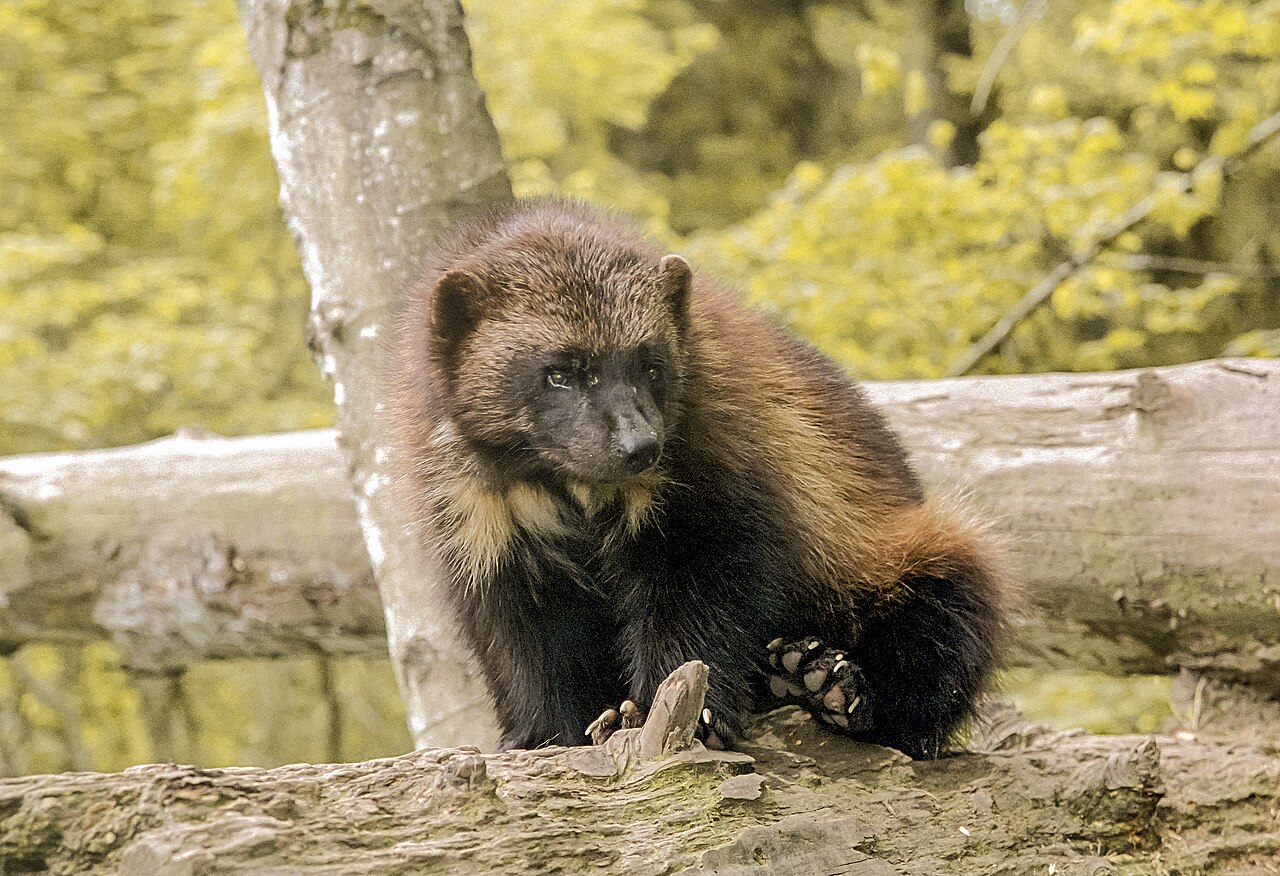
Wolverine (Gulo gulo) is the largest primarily land-dwelling member of the weasel family, ranging through Arctic, subarctic and high-mountain landscapes across North America and Eurasia. This guide separates well-supported biology from common assumptions and covers identification, range, habitat, diet, behavior, reproduction and conservation.
Identification
A wolverine has a low, muscular body, broad head, short rounded ears and strong limbs ending in large five-toed paws. Dense dark-brown fur is usually marked by a paler stripe running from each shoulder along the flanks to the rump. Its bushy tail, bear-like gait and pale facial mask help distinguish it from martens and fishers. Males average about 30 percent heavier than females and usually occupy much larger home ranges, although coat pattern is similar in both sexes.
Identification should combine body shape, markings, size, voice or movement, and location. One feature by itself can overlap with a related animal, a juvenile, or an individual in unusual light.
Photographs are most useful when they preserve scale and show several diagnostic features. Handling or repositioning a wild wolverine for identification can cause stress and is unnecessary.
Size and physical adaptations
Wolverine typically measures about 65–105 cm head–body, plus a 17–26 cm tail and weighs females commonly about 7–12 kg; males about 11–18 kg, with exceptional individuals heavier. Body size varies geographically and seasonally; males are consistently larger than females.
Its useful adaptations include broad paws spread weight over soft snow, curved claws grip ice, crust and steep slopes, dense oily fur resists frost and sheds moisture, powerful jaws open frozen hide and crush bone, a specialized upper molar shears meat, keen smell detects carrion beneath deep snow, compact ears and body reduce heat loss. These traits work together in the animal’s normal setting rather than serving as isolated curiosities.
Published measurements may use different methods, life stages or sample locations. Comparing figures responsibly means checking what was measured rather than selecting the largest number available.
Range and distribution
Circumpolar across northern North America and Eurasia, with the largest continuous populations in Alaska, Canada and Russia. Farther south it persists mainly in remote mountain ranges, including parts of the northwestern contiguous United States, Scandinavia, Mongolia and northern China. The native range includes United States, Canada, Norway, Sweden, Finland, Russia, Mongolia, China.
A country-level map indicates broad distribution, not continuous occupation. Climate, elevation, water, vegetation, prey, breeding sites, barriers and survey effort all affect where records occur.
Records near the edge of the range deserve careful documentation because they may reflect natural movement, improved survey coverage, accidental transport or a genuine distribution change.
Habitat
Arctic tundra, boreal forest, taiga, alpine meadows, rocky mountains and persistent spring-snow landscapes with low road density and little disturbance.
Individuals range across enormous areas to find unpredictable food. They use forests for cover, open tundra and alpine slopes for travel and foraging, and snow-covered boulder fields, fallen timber or avalanche debris for maternal dens. Females need secure denning areas that retain deep snow into spring. Protecting a population therefore requires the feeding, shelter and breeding features that make a site usable, along with connections that allow movement.
Microhabitat matters. Shade, soil, current, moisture, shelter or host plants can determine whether a small area is usable even when the surrounding landscape appears suitable.
Diet and feeding
Wolverine is a opportunistic carnivore and scavenger. Important foods include caribou and reindeer carrion, deer and moose carrion, hares, rodents, grouse and other birds, eggs, insects, berries, occasionally weakened ungulates. Carrion from winter-killed animals and kills made by wolves or people can sustain wolverines when small prey is scarce. Their jaws and shearing molars open frozen skin, tendons and bone. They also hunt rodents, hares and birds, and may kill a weakened deer or reindeer. Surplus meat is cached in snow, rock crevices or cold wetlands, where low temperatures slow decay.
Diet changes with age, season, location and food supply. A dramatic prey record does not establish what most individuals eat most of the time; repeated field observations provide a stronger picture.
Feeding opportunities also create risk. An animal focused on prey may be less alert to predators, traffic or people, while contaminated prey can transfer pollutants through the food web.
Behavior and communication
Active year-round by day or night, with timing shaped by prey, season, weather and human disturbance. Wolverines are mostly solitary and continually patrol broad, overlapping ranges rather than defending a small fixed territory. Their rolling gait conserves energy over snow, and they readily climb steep slopes and trees. Strong scent marking advertises identity and reproductive condition. Despite a fierce reputation, they usually avoid people and larger predators when escape is possible.
Anal glands, urine and scent marks placed along travel routes convey identity and reproductive condition. Wolverines also use growls, hisses, whines and body posture at close range, especially between mothers and young or during disputes over food. Behavior should be interpreted in context: alarm, courtship, feeding and temperature regulation can produce very different actions from the same animal.
Daily schedules are flexible responses, not rigid rules. Weather, breeding condition, disturbance, tides or food can move activity into a different part of the day.
Reproduction and development
Mating usually occurs from late spring through summer, but delayed implantation postpones embryo development until winter. The female gives birth in a secure chamber beneath deep snow, often among boulders or fallen trees. Because reproduction is energetically expensive and food varies, adult females may not raise a litter every year. Usually 2–3 kits; reported range about 1–5 Kits are born pale, blind and dependent in late winter. Their mother nurses and moves them among den sites as snow melts. They begin eating cached meat and following her on foraging trips, usually becoming independent by their first autumn, though some remain associated longer.
Young animals face different risks and may use different microhabitats or food than adults. Breeding success depends on adult condition, suitable sites and the survival of offspring through vulnerable early stages.
Counts of eggs or young describe reproductive output, not the number expected to reach adulthood. Mortality is normally greatest during eggs, larval or juvenile stages.
Predators and ecological role
Wolverines recycle nutrients by consuming carcasses that might remain frozen for months, and their caches feed ravens, foxes and smaller scavengers. They compete with wolves, bears, lynx and other carnivores yet often depend indirectly on large predators that leave ungulate remains. Their demand for connected, cold landscapes makes them an indicator of intact northern ecosystems. Documented or likely predators include Gray Wolf, Cougar, Brown Bear, Golden Eagle, Humans.
This animal is both a consumer and a food source. Its influence comes through many repeated interactions, so ecological claims should be based on measured populations rather than assumptions drawn from appearance.
Predator and prey relationships differ among places. A species can be ecologically influential without being abundant everywhere, and its role can change across its range.
Relationship with people
Wolverines are rarely seen but attract scientific interest, wildlife tourism and strong cultural attention. They sometimes raid cabins, traps or food caches and may take reindeer or livestock, creating conflict with herders. Secure storage, rapid carcass removal and compensation or husbandry programs reduce conflict better than indiscriminate killing. Roads, recreation and development can fragment the large quiet landscapes females need.
A wild wolverine normally avoids people. Never approach, feed or corner one, and keep dogs leashed in occupied habitat. Store food and refuse securely, leave carcasses and dens undisturbed, and back away calmly if an animal holds its ground. Attacks on people are extraordinarily rare, but its teeth, claws and strength demand respect. Responsible observation means keeping an appropriate distance, avoiding capture or feeding, protecting habitat and following local wildlife or invasive-species guidance.
Wildlife guidance should come from the responsible local agency because collection rules, reporting requests and appropriate responses differ between native and introduced ranges.
Conservation
The IUCN lists the wolverine as Least Concern globally because its circumpolar range remains broad. Regional populations can be small and isolated, especially at the southern edge, where loss of persistent spring snow, trapping, roads and disturbance can have outsized effects. The reported global trend is Globally uncertain to decreasing; regional trends differ and southern populations remain vulnerable.
Important pressures include loss of persistent spring snow, climate warming, habitat fragmentation and roads, disturbance near maternal dens, unsustainable trapping or incidental take, reduced carrion availability, small isolated southern populations. Global status can hide local decline or recovery, so current regional monitoring and habitat management remain necessary.
The most useful conservation action follows the documented pressure. Protecting breeding sites, reducing road deaths or limiting pollutants can require different tools in different populations.