
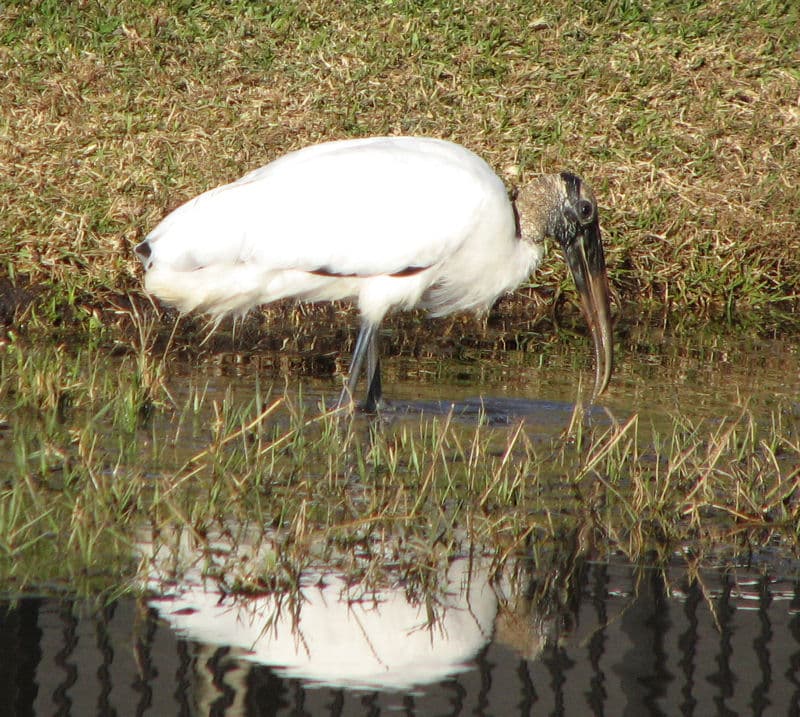
Wood Stork (Mycteria americana) are large American wading birds that forage with an open bill in shallow wetlands, nest colonially above standing water and soar on broad wings from the southeastern United States through tropical South America. This guide separates well-supported biology from common assumptions and covers identification, range, habitat, diet, behavior, reproduction and conservation.
Identification
Adults are huge white wading birds with black flight feathers and tail, very long dark legs, a heavy down-curved bill and a bare gray-black scaly head and neck. Juveniles have grayish feathering on the neck and a paler bill that darkens with age. In flight the long neck and legs remain extended. Adult males and females look alike, although males average somewhat larger. Plumage is not a reliable way to sex individuals in the field.
Identification should combine body shape, markings, size, voice or movement, and location. One feature by itself can overlap with a related animal, a juvenile, or an individual in unusual light.
Photographs are most useful when they preserve scale and show several diagnostic features. Handling or repositioning a wild wood stork for identification can cause stress and is unnecessary.
Size and physical adaptations
Wood Stork typically measures 85–115 cm and weighs 2.05–2.64 kg. Cornell reports these measurements for both sexes; regional and individual variation occurs.
Its useful adaptations include sensitive bill detects prey by touch, rapid bill reflex snaps shut on contact, long legs wade through shallow wetlands, broad wings support energy-efficient soaring, bare head remains cleaner during feeding. These traits work together in the animal’s normal setting rather than serving as isolated curiosities.
Published measurements may use different methods, life stages or sample locations. Comparing figures responsibly means checking what was measured rather than selecting the largest number available.
Range and distribution
Wood storks occur from the southeastern United States and Mexico through Central America and much of tropical and subtropical South America. They disperse widely after breeding, and seasonal movements follow changing wetland conditions rather than one uniform migration pattern. The native range includes United States, Mexico, Belize, Guatemala, Honduras, El Salvador, Nicaragua, Costa Rica, Panama, Cuba, Dominican Republic, Haiti, Trinidad and Tobago, Colombia, Venezuela, Guyana, Suriname, French Guiana, Ecuador, Peru, Bolivia, Brazil, Paraguay, Uruguay, Argentina.
A country-level map indicates broad distribution, not continuous occupation. Climate, elevation, water, vegetation, prey, breeding sites, barriers and survey effort all affect where records occur.
Records near the edge of the range deserve careful documentation because they may reflect natural movement, improved survey coverage, accidental transport or a genuine distribution change.
Habitat
Fresh and brackish forested wetlands for nesting, plus open marshes, swamps, ponds, lagoons, flooded fields, ditches and shallow pools for feeding.
Birds usually forage in water about 10–30 cm deep, especially where falling water concentrates fish. Colonies occupy trees or shrubs above standing water, which helps deter land predators and keeps nests near wetland feeding areas. Protecting a population therefore requires the feeding, shelter and breeding features that make a site usable, along with connections that allow movement.
Microhabitat matters. Shade, soil, current, moisture, shelter or host plants can determine whether a small area is usable even when the surrounding landscape appears suitable.
Diet and feeding
Wood Stork is a primarily fish-eating wetland predator. Important foods include small fish, crayfish, crabs, aquatic insects, frogs, small reptiles, occasional seeds. A wood stork walks slowly with its partly open bill submerged, sweeping or holding it in the water. Contact with prey triggers an extremely fast snap. Foot stirring and wing flicking can flush hidden animals, and birds often feed together as water levels concentrate fish.
Diet changes with age, season, location and food supply. A dramatic prey record does not establish what most individuals eat most of the time; repeated field observations provide a stronger picture.
Feeding opportunities also create risk. An animal focused on prey may be less alert to predators, traffic or people, while contaminated prey can transfer pollutants through the food web.
Behavior and communication
Diurnal, with feeding in cooler periods and thermal soaring as daytime air warms. Wood storks are strongly social at colonies, roosts and feeding sites. They often advance in loose lines through shallow water. In flight they alternate slow wingbeats with long glides and use warm rising air to gain altitude with little effort.
Adults are usually quiet away from colonies. At nests, birds hiss, croak and clap or rattle their bills, while chicks use loud begging calls to solicit food. Behavior should be interpreted in context: alarm, courtship, feeding and temperature regulation can produce very different actions from the same animal.
Daily schedules are flexible responses, not rigid rules. Weather, breeding condition, disturbance, tides or food can move activity into a different part of the day.
Reproduction and development
Pairs form for a breeding season and build a large stick platform together in a tree or shrub above water. Both adults incubate and feed the chicks. Nest timing depends strongly on water levels because adults need dense prey close enough to support rapidly growing young. 1–5 eggs, often 3–4 Chicks hatch covered in white down and remain dependent in the nest. Young begin making short flights at roughly eight weeks and may return for food and shelter until about eleven weeks.
Young animals face different risks and may use different microhabitats or food than adults. Breeding success depends on adult condition, suitable sites and the survival of offspring through vulnerable early stages.
Counts of eggs or young describe reproductive output, not the number expected to reach adulthood. Mortality is normally greatest during eggs, larval or juvenile stages.
Predators and ecological role
Wood storks link concentrated wetland fish production to colonial waterbird food webs. Their nesting success is a sensitive indicator of water timing, depth and prey availability, while colony trees also host herons, egrets, ibises and other waterbirds. Documented or likely predators include Raccoon, American Alligator, Great Horned Owl, Fish Crow.
This animal is both a consumer and a food source. Its influence comes through many repeated interactions, so ecological claims should be based on measured populations rather than assumptions drawn from appearance.
Predator and prey relationships differ among places. A species can be ecologically influential without being abundant everywhere, and its role can change across its range.
Relationship with people
Wood storks are conspicuous wetland birds valued by birders and used by managers as indicators of functioning water regimes. Decades of wetland restoration and colony protection supported recovery of the southeastern United States population.
Observe from established paths or boats, keep well outside nesting colonies, never approach chicks and avoid flushing feeding groups. Driving, boating or flying drones close to colonies can interrupt care during hot weather. Responsible observation means keeping an appropriate distance, avoiding capture or feeding, protecting habitat and following local wildlife or invasive-species guidance.
Wildlife guidance should come from the responsible local agency because collection rules, reporting requests and appropriate responses differ between native and introduced ranges.
Conservation
The IUCN Red List classifies the wood stork globally as Least Concern. In February 2026 the U.S. Fish and Wildlife Service removed the recovered Southeast U.S. distinct population segment from the federal threatened-species list and began post-delisting monitoring. The reported global trend is Stable to increasing in parts of North America, with regional variation across the broad range.
Important pressures include altered water timing and depth, wetland drainage and development, disturbance at nesting colonies, reduced fish concentration near colonies, pollution and contaminants, drought and extreme rainfall, sea-level rise in coastal habitat. Global status can hide local decline or recovery, so current regional monitoring and habitat management remain necessary.
The most useful conservation action follows the documented pressure. Protecting breeding sites, reducing road deaths or limiting pollutants can require different tools in different populations.
