
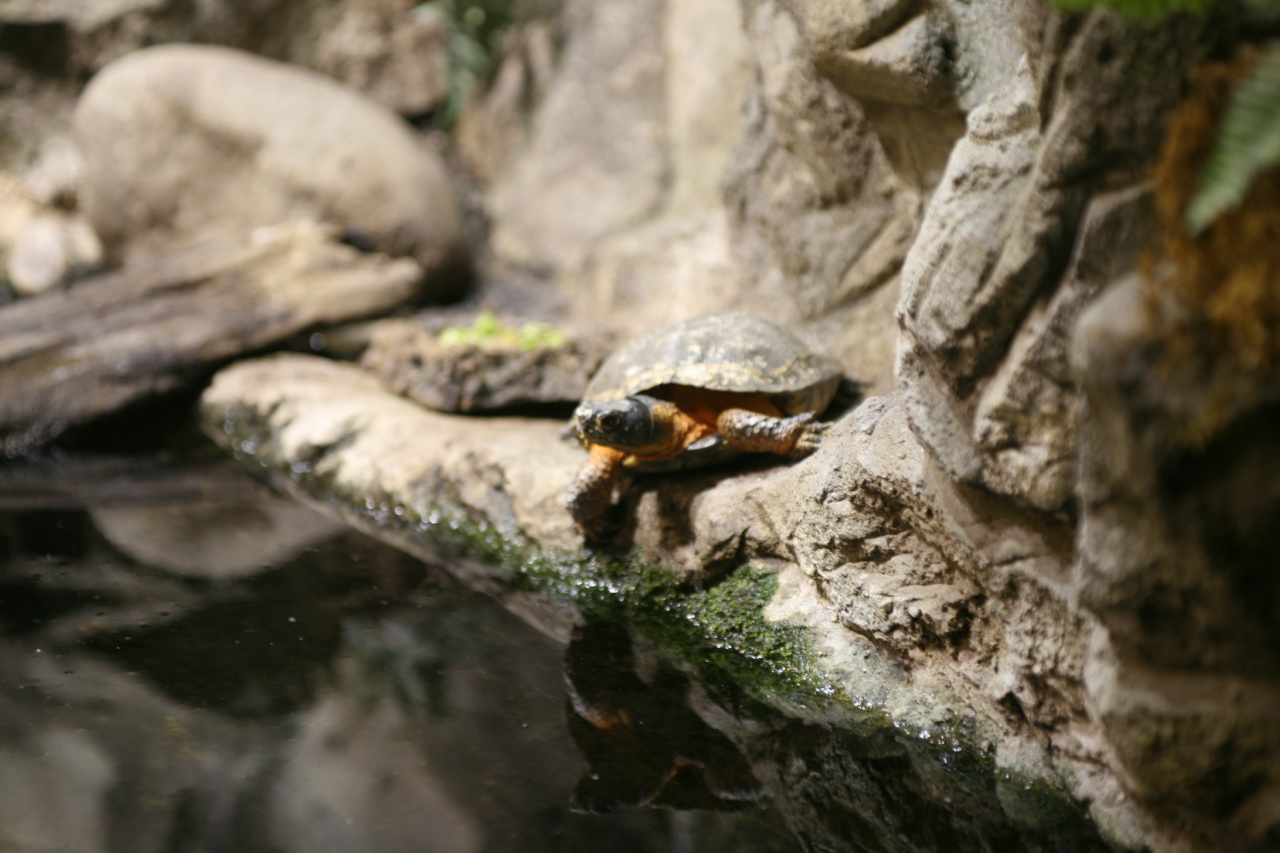
Wood Turtle (Glyptemys insculpta) is a medium-sized freshwater turtle of eastern North America. Its rough brown shell looks carved from wood, while orange or reddish skin brightens the neck and legs. Wood turtles overwinter in flowing streams but spend much of the warm season foraging on land. Slow maturity and high adult survival once sustained populations; roads, machinery, habitat fragmentation and illegal collection now reverse that balance. This guide separates well-supported biology from common assumptions and covers identification, range, habitat, diet, behavior, reproduction and conservation.
Identification
The broad brown to gray-brown upper shell has a low central keel and concentric growth ridges that give each scute a sculpted, pyramid-like texture. The lower shell is yellow with a dark blotch near the outer rear corner of each scute. The head is dark, and the throat, neck and inner legs range from yellow-orange to vivid salmon red. Very old shells may wear smooth. Adult males usually have a broader head, longer thicker tail, more domed shell and concave plastron; females usually have a flatter plastron and shorter tail.
Identification should combine body shape, markings, size, voice or movement, and location. One feature by itself can overlap with a related animal, a juvenile, or an individual in unusual light.
Photographs are most useful when they preserve scale and show several diagnostic features. Handling or repositioning a wild wood turtle for identification can cause stress and is unnecessary.
Size and physical adaptations
Wood Turtle typically measures Adult carapace 16–25 cm and weighs About 1 kg commonly. Males average slightly larger than females; body condition and regional growth rates vary.
Its useful adaptations include sculptured shell protects the body, strong limbs support stream swimming and overland travel, ectothermic basking regulates body temperature, seasonal movements connect aquatic and terrestrial foods, cold flowing water provides winter oxygen, strong spatial memory supports return to familiar sites. These traits work together in the animal’s normal setting rather than serving as isolated curiosities.
Published measurements may use different methods, life stages or sample locations. Comparing figures responsibly means checking what was measured rather than selecting the largest number available.
Range and distribution
Wood turtles occur discontinuously in eastern North America, from Nova Scotia and New Brunswick west through southern Quebec and Ontario to Minnesota, and south through New England and the Appalachian region to Virginia, West Virginia and Maryland. Local colonies are tied to suitable stream systems and can be separated by long stretches of altered habitat. The native range includes Canada, United States.
A country-level map indicates broad distribution, not continuous occupation. Climate, elevation, water, vegetation, prey, breeding sites, barriers and survey effort all affect where records occur.
Records near the edge of the range deserve careful documentation because they may reflect natural movement, improved survey coverage, accidental transport or a genuine distribution change.
Habitat
Clear, moderately flowing streams with sand, gravel or cobble bottoms, bordered by forest, shrubland, wet meadow and nesting openings.
During winter, wood turtles hibernate underwater in well-oxygenated stream pools, beneath banks or around submerged roots. In spring they bask and feed near water, then range into riparian forest, meadow, shrub thicket, wetland and field. Females need sunny, sparsely vegetated sand or gravel for nesting. Most seasonal activity remains linked to a home stream even when an individual travels well inland. Protecting a population therefore requires the feeding, shelter and breeding features that make a site usable, along with connections that allow movement.
Microhabitat matters. Shade, soil, current, moisture, shelter or host plants can determine whether a small area is usable even when the surrounding landscape appears suitable.
Diet and feeding
Wood Turtle is a opportunistic omnivore. Important foods include earthworms, slugs and snails, insects, berries and other fruits, mushrooms, leaves and tender plants. Wood turtles search both land and shallow water, eating animal prey, fungi and plants. They nose through leaf litter, take fallen berries and seize worms, slugs or insects. Some individuals stamp the ground with alternating forefeet or rock the front of the shell; earthworms emerging after the vibration may then be eaten. Seasonal abundance determines which foods dominate.
Diet changes with age, season, location and food supply. A dramatic prey record does not establish what most individuals eat most of the time; repeated field observations provide a stronger picture.
Feeding opportunities also create risk. An animal focused on prey may be less alert to predators, traffic or people, while contaminated prey can transfer pollutants through the food web.
Behavior and communication
Diurnal in the warm season; inactive underwater during winter hibernation. Individuals bask on logs, banks and forest openings, forage along habitual routes and return to favored sections of stream. They can move considerable distances across land yet show strong attachment to familiar ranges. Social encounters occur at basking, feeding and overwintering sites, but adults do not form lasting groups. At danger they withdraw into the shell or enter water.
Turtles rely mainly on visual, tactile and chemical information. Courtship includes following, circling, head movements and contact. Males may pursue or block females before mating. Scent helps individuals inspect their surroundings and recognize reproductive condition; splashing and shell contact also carry information at close range. Behavior should be interpreted in context: alarm, courtship, feeding and temperature regulation can produce very different actions from the same animal.
Daily schedules are flexible responses, not rigid rules. Weather, breeding condition, disturbance, tides or food can move activity into a different part of the day.
Reproduction and development
Mating can occur in spring or autumn, often in or near water. A mature female travels to sunny sand, gravel bars, road edges, fields or other open ground in late spring or early summer. She digs a flask-shaped nest with her hind feet, lays the eggs and covers the site. There is no parental care, and a female may skip reproduction in some years. Usually about 8–12 eggs; recorded range roughly 1–20 Hatchlings emerge in late summer or autumn, although some may remain in the nest when weather is unfavorable. Their shell is rounder and smoother than an adult’s, and the tail is proportionally long. Juveniles grow slowly and face heavy predation. Unlike many turtles, incubation temperature does not determine sex in this species.
Young animals face different risks and may use different microhabitats or food than adults. Breeding success depends on adult condition, suitable sites and the survival of offspring through vulnerable early stages.
Counts of eggs or young describe reproductive output, not the number expected to reach adulthood. Mortality is normally greatest during eggs, larval or juvenile stages.
Predators and ecological role
Wood turtles transfer energy between streams and adjacent land as they eat aquatic and terrestrial prey and are themselves eaten by predators. Eggs and hatchlings support raccoons, skunks, foxes, birds and other animals. Adults can tolerate natural predation because they live for decades, but even small increases in road, mower or collection deaths can collapse a population faster than late-maturing females can replace it. Documented or likely predators include Raccoon, Striped Skunk, Red Fox, Common Raven.
This animal is both a consumer and a food source. Its influence comes through many repeated interactions, so ecological claims should be based on measured populations rather than assumptions drawn from appearance.
Predator and prey relationships differ among places. A species can be ecologically influential without being abundant everywhere, and its role can change across its range.
Relationship with people
Roads, farm equipment, forestry work and stream crossings can kill turtles moving through their seasonal range. People help by slowing near wetlands, checking fields before mowing, protecting wide stream buffers and leaving wild turtles where found. A turtle crossing a road may be moved only a short distance in the direction it was already traveling, when doing so is safe and lawful.
Do not take, relocate long distances, mark or keep a wild wood turtle. Report sightings through the relevant state or provincial wildlife programme without publicly revealing a precise location, because location data can aid illegal collectors. Responsible observation means keeping an appropriate distance, avoiding capture or feeding, protecting habitat and following local wildlife or invasive-species guidance.
Wildlife guidance should come from the responsible local agency because collection rules, reporting requests and appropriate responses differ between native and introduced ranges.
Conservation
The IUCN Red List classifies the wood turtle as Endangered. Canada lists it as Threatened under the federal Species at Risk Act, while status varies among U.S. states. Declines are driven by adult mortality and the loss or fragmentation of both stream and upland habitat. Protecting only the water channel is insufficient because turtles also require forests, fields and nesting openings nearby. The reported global trend is Decreasing.
Important pressures include road mortality, agricultural and forestry machinery, habitat loss and fragmentation, illegal pet-trade collection, degraded water quality, nest predation and invasive plants. Global status can hide local decline or recovery, so current regional monitoring and habitat management remain necessary.
The most useful conservation action follows the documented pressure. Protecting breeding sites, reducing road deaths or limiting pollutants can require different tools in different populations.
