
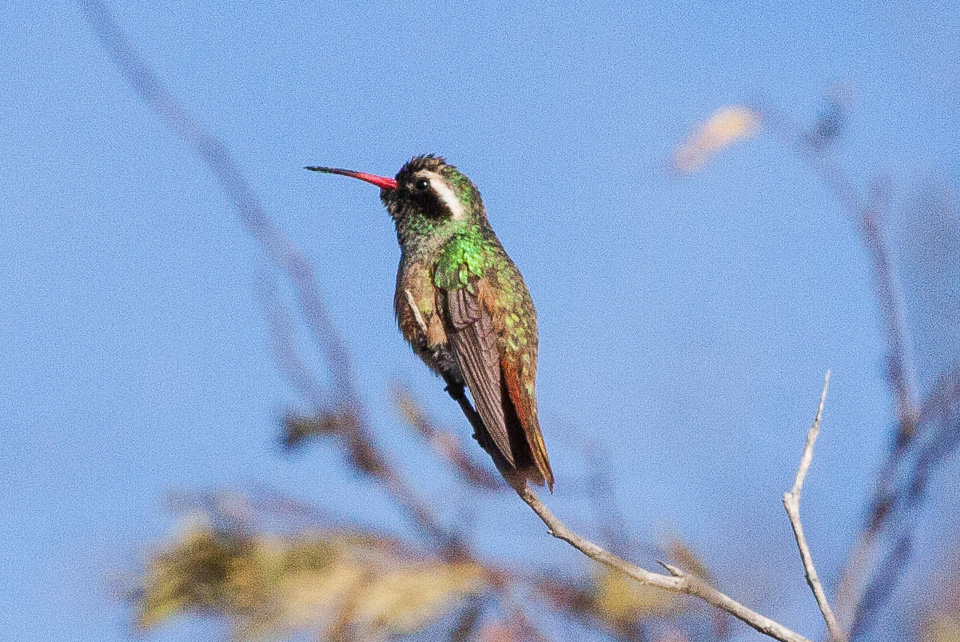
Xantus’s Hummingbird (Basilinna xantusii) is a medium-sized hummingbird endemic to Mexico’s Baja California Peninsula, where it moves between desert scrub, thorn forest, gardens, arroyos and mountain woodland. This guide separates well-supported biology from common assumptions and covers identification, range, habitat, diet, behavior, reproduction and conservation.
Identification
Adults show a broad white eyebrow and white cheek stripe separated by a dark mask. Males have an iridescent green throat, dark bluish crown, cinnamon belly and mostly red bill with a black tip. Females are duller green above, with cinnamon extending onto the throat and less iridescence. Both sexes show rufous in the tail, a useful mark in Baja. Males have a glittering green throat and darker crown; females have a buffier throat and generally duller plumage.
Identification should combine body shape, markings, size, voice or movement, and location. One feature by itself can overlap with a related animal, a juvenile, or an individual in unusual light.
Photographs are most useful when they preserve scale and show several diagnostic features. Handling or repositioning a wild xantus’s hummingbird for identification can cause stress and is unnecessary.
Size and physical adaptations
Xantus’s Hummingbird typically measures about 8–10 cm and weighs about 3–6 g. Measurements overlap between sexes and vary among individuals; the species is medium-sized for a hummingbird.
Its useful adaptations include rapid wingbeats permit hovering, shoulder joints rotate wings through a figure-eight stroke, long bill and extensible tongue reach tubular flowers, high metabolism powers sustained flight, torpor reduces overnight energy use, fine vision tracks flowers, rivals and insects. These traits work together in the animal’s normal setting rather than serving as isolated curiosities.
Published measurements may use different methods, life stages or sample locations. Comparing figures responsibly means checking what was measured rather than selecting the largest number available.
Range and distribution
Resident primarily in the southern half of Mexico’s Baja California Peninsula, especially Baja California Sur from the Vizcaíno region toward Cabo San Lucas. It is also recorded on nearby islands and occasionally wanders north into the United States and exceptionally farther along the Pacific coast. The native range includes Mexico.
A country-level map indicates broad distribution, not continuous occupation. Climate, elevation, water, vegetation, prey, breeding sites, barriers and survey effort all affect where records occur.
Records near the edge of the range deserve careful documentation because they may reflect natural movement, improved survey coverage, accidental transport or a genuine distribution change.
Habitat
Arid and semi-arid scrub, thorn forest, desert washes, palm oases, gardens, ranches and pine-oak woodland from lowlands into the Sierra de la Laguna.
The bird follows flowering plants through a mosaic of cactus scrub, wooded arroyos and gardens. Shaded washes and oases provide nest sites and insects during dry periods, while mountain slopes offer seasonally abundant blooms. Individuals defend rich flower patches but also make regular circuits among scattered plants. Protecting a population therefore requires the feeding, shelter and breeding features that make a site usable, along with connections that allow movement.
Microhabitat matters. Shade, soil, current, moisture, shelter or host plants can determine whether a small area is usable even when the surrounding landscape appears suitable.
Diet and feeding
Xantus’s Hummingbird is a nectarivore and insectivore. Important foods include flower nectar, small flies, gnats, mosquitoes, tiny beetles, spiders, other minute arthropods, sugar water at clean feeders. It hovers before flowers and extends a forked tongue rapidly into nectar tubes. Small arthropods supply protein, fat and minerals that nectar lacks; birds catch them in short aerial sallies or glean them from leaves and spider webs. A single bird may defend a productive flowering shrub, then shift locations as blossoms fade.
Diet changes with age, season, location and food supply. A dramatic prey record does not establish what most individuals eat most of the time; repeated field observations provide a stronger picture.
Feeding opportunities also create risk. An animal focused on prey may be less alert to predators, traffic or people, while contaminated prey can transfer pollutants through the food web.
Behavior and communication
Diurnal, with intense feeding after sunrise and before dusk; may enter torpor on cool nights. Xantus’s Hummingbirds are agile and often assertive around concentrated nectar. They chase rivals with chips, rattles and fast looping flights, yet may tolerate several birds where flowers are abundant. Their daily movements link desert plants, gardens and wooded drainages. Individuals perch frequently to conserve energy between feeding bouts.
A low rapid rattle and sharp high chips advertise presence and warn intruders. Wing sounds, pursuit flights, bill pointing and iridescent plumage add visual and mechanical signals during courtship and territorial encounters. Behavior should be interpreted in context: alarm, courtship, feeding and temperature regulation can produce very different actions from the same animal.
Daily schedules are flexible responses, not rigid rules. Weather, breeding condition, disturbance, tides or food can move activity into a different part of the day.
Reproduction and development
Females build, incubate and care for young without help from the male. The tiny cup is woven from soft plant fibers and spider silk, which lets it expand as nestlings grow. Lichen and bark fragments camouflage the outside. Nesting timing responds to rainfall and flowering, with much activity in late winter and spring. Usually 2 white eggs Newly hatched chicks are naked and helpless. The female broods them and delivers regurgitated nectar mixed with insects. Feathers develop rapidly, and young usually leave the nest after roughly three weeks, then continue receiving food while learning local flower routes.
Young animals face different risks and may use different microhabitats or food than adults. Breeding success depends on adult condition, suitable sites and the survival of offspring through vulnerable early stages.
Counts of eggs or young describe reproductive output, not the number expected to reach adulthood. Mortality is normally greatest during eggs, larval or juvenile stages.
Predators and ecological role
By carrying pollen between flowers, the species helps reproduce native shrubs, cacti and trees across the dry Baja landscape. It also consumes large numbers of tiny insects and becomes prey for small raptors, snakes and nest predators. Its movements connect gardens and natural vegetation, making intact arroyos and diverse flowering plants valuable habitat corridors. Documented or likely predators include Sharp-shinned Hawk, American Kestrel, Coachwhip, Gopher Snake, Domestic Cat.
This animal is both a consumer and a food source. Its influence comes through many repeated interactions, so ecological claims should be based on measured populations rather than assumptions drawn from appearance.
Predator and prey relationships differ among places. A species can be ecologically influential without being abundant everywhere, and its role can change across its range.
Relationship with people
The species readily visits flowering gardens and well-maintained feeders, supporting bird tourism in Baja California Sur. Development can remove oasis vegetation and nesting cover, while pesticides reduce insect food. Gardeners can help by growing native flowers, keeping cats indoors, avoiding insecticides and cleaning feeders frequently with plain hot water.
Observe from a respectful distance and never handle a hummingbird unless authorized for wildlife rescue. Place feeders away from windows or add collision markers, keep cats indoors and change sugar solution often in hot weather. Use four parts water to one part plain white sugar, without dye, honey or artificial sweetener. Responsible observation means keeping an appropriate distance, avoiding capture or feeding, protecting habitat and following local wildlife or invasive-species guidance.
Wildlife guidance should come from the responsible local agency because collection rules, reporting requests and appropriate responses differ between native and introduced ranges.
Conservation
The IUCN assesses Xantus’s Hummingbird as Least Concern. Its geographic range is restricted to Baja California, so protection of arroyos, oases, native flowering plants and mountain woodland remains important even while the species is not globally threatened. The reported global trend is Generally considered stable, though local habitat loss and drought can reduce resources.
Important pressures include loss of oasis and arroyo vegetation, urban and tourism development, drought and changing flower seasons, pesticide use, window collisions, free-roaming cats, wildfire and invasive plants. Global status can hide local decline or recovery, so current regional monitoring and habitat management remain necessary.
The most useful conservation action follows the documented pressure. Protecting breeding sites, reducing road deaths or limiting pollutants can require different tools in different populations.