
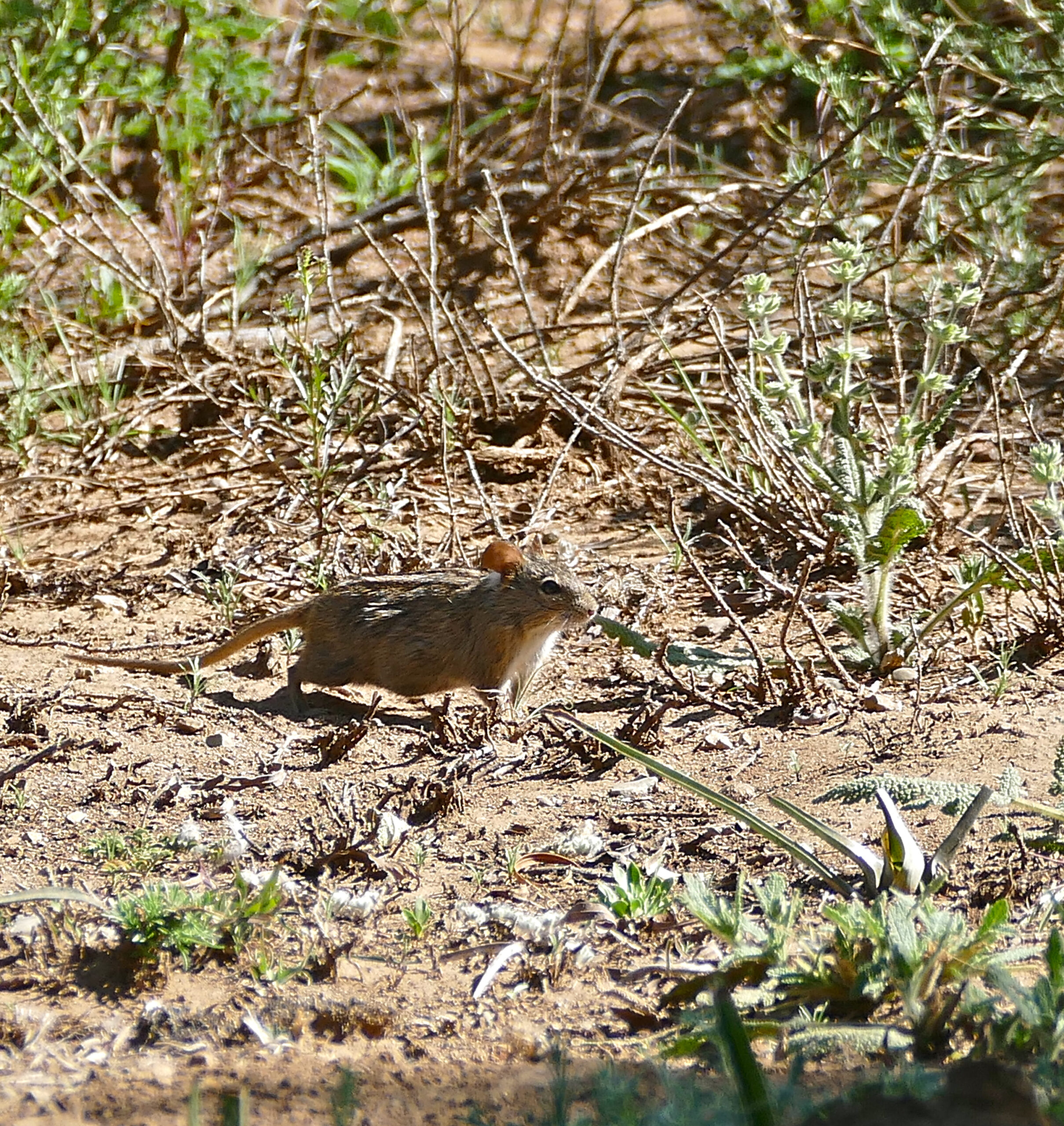
Xeric Four-striped Grass Rat (Rhabdomys pumilio) is a small southern African murid distinguished by four dark lines running from the head along the back. Modern taxonomy restricts this name mainly to xeric western populations. This guide separates well-supported biology from common assumptions and covers identification, range, habitat, diet, behavior, reproduction and conservation.
Identification
The back is yellowish brown to gray-brown with four narrow black longitudinal stripes separated by paler bands. The belly is grayish or cream, the ears are rounded and the muzzle pointed. Its tail is slim and usually shorter than the head and body. The crisp dorsal pattern separates it readily from unstriped house mice and gerbils. Males and females look similar; males can average slightly heavier in some populations, while pregnancy is the clearest external difference.
Identification should combine body shape, markings, size, voice or movement, and location. One feature by itself can overlap with a related animal, a juvenile, or an individual in unusual light.
Photographs are most useful when they preserve scale and show several diagnostic features. Handling or repositioning a wild xeric four-striped grass rat for identification can cause stress and is unnecessary.
Size and physical adaptations
Xeric Four-striped Grass Rat typically measures about 10–14 cm head–body and weighs commonly about 30–70 g. Measurements vary among regions and studies, partly because older work grouped several Rhabdomys lineages under R. pumilio.
Its useful adaptations include four dorsal stripes break up the outline in grass and shadow, daylight vision supports diurnal foraging, strong incisors open seeds and stems, compact burrows and grass nests buffer temperature, flexible omnivory follows seasonal food, torpor-like energy saving may occur during cold food-limited periods. These traits work together in the animal’s normal setting rather than serving as isolated curiosities.
Published measurements may use different methods, life stages or sample locations. Comparing figures responsibly means checking what was measured rather than selecting the largest number available.
Range and distribution
Dry western southern Africa, from western South Africa north through Namibia and central to southern Botswana into southwestern Angola. Precise limits remain under revision because several formerly combined striped-mouse lineages are now treated separately. The native range includes South Africa, Namibia, Botswana, Angola.
A country-level map indicates broad distribution, not continuous occupation. Climate, elevation, water, vegetation, prey, breeding sites, barriers and survey effort all affect where records occur.
Records near the edge of the range deserve careful documentation because they may reflect natural movement, improved survey coverage, accidental transport or a genuine distribution change.
Habitat
Xeric grassland, savanna, Succulent Karoo, fynbos edges, scrub, rocky slopes, fallow fields, gardens and agricultural margins with dense low cover.
Individuals concentrate around shrubs, grass tussocks and rocks that offer both food and rapid concealment. They create runways through vegetation and use shallow burrows or woven grass nests. Population density can rise after rain when seeds, green plants and insects become abundant, then fall sharply through drought or winter. Protecting a population therefore requires the feeding, shelter and breeding features that make a site usable, along with connections that allow movement.
Microhabitat matters. Shade, soil, current, moisture, shelter or host plants can determine whether a small area is usable even when the surrounding landscape appears suitable.
Diet and feeding
Xeric Four-striped Grass Rat is a omnivore dominated by seeds and green plant material. Important foods include grass seeds, forb seeds, leaves, stems, flowers, fruit, insects, other small invertebrates. The mouse forages alone even when it sleeps in a social group. It sits upright to manipulate seeds with the forepaws, clips vegetation with incisors and searches litter for insects. Seasonal rainfall changes the balance: green shoots and arthropods increase after rain, while dry seeds become more important during lean months.
Diet changes with age, season, location and food supply. A dramatic prey record does not establish what most individuals eat most of the time; repeated field observations provide a stronger picture.
Feeding opportunities also create risk. An animal focused on prey may be less alert to predators, traffic or people, while contaminated prey can transfer pollutants through the food web.
Behavior and communication
Diurnal, with peaks in morning and late afternoon and reduced activity during midday heat. Social organization changes with habitat and season. In harsh Succulent Karoo populations, one breeding male, several females and young may share a nest and territory while foraging separately. Other populations are less cohesive. Adults scent-mark paths and defend core areas, and young learn escape routes through dense cover. The same flexibility that aids survival also explains why conclusions from one population should not be assigned to every striped mouse.
Scent from urine and glands marks paths, nests and reproductive state. High-pitched calls, squeaks, foot movements and close-range postures regulate disputes and contact. Mothers and pups also use ultrasonic vocalizations beyond ordinary human hearing. Behavior should be interpreted in context: alarm, courtship, feeding and temperature regulation can produce very different actions from the same animal.
Daily schedules are flexible responses, not rigid rules. Weather, breeding condition, disturbance, tides or food can move activity into a different part of the day.
Reproduction and development
Breeding follows rainfall, temperature and food. In the Succulent Karoo it may be concentrated from late winter into early summer, while elsewhere it can extend into autumn. Females build grass nests and may produce several litters during a favorable season. In social populations, the resident male and other group members may huddle with pups and help defend the nest. Commonly 4–8 pups, with smaller or larger litters reported Pups are born blind and nearly naked. Fur and dorsal stripes appear as they grow, eyes open after roughly two weeks and weaning follows around three weeks. Juveniles may remain in the natal group temporarily before dispersing, depending on sex, season and population density.
Young animals face different risks and may use different microhabitats or food than adults. Breeding success depends on adult condition, suitable sites and the survival of offspring through vulnerable early stages.
Counts of eggs or young describe reproductive output, not the number expected to reach adulthood. Mortality is normally greatest during eggs, larval or juvenile stages.
Predators and ecological role
This daylight mouse transfers energy from seeds and green plants to owls, diurnal raptors, snakes, mongooses, wild cats and jackals. Seed harvesting and caching influence plant recruitment, while insect feeding helps regulate invertebrates. Burrowing and runway construction disturb small patches of soil and litter. Population booms provide a major pulse of prey after productive rains. Documented or likely predators include Black-shouldered Kite, Pale Chanting Goshawk, Cape Cobra, Small-spotted Genet, African Wildcat, Yellow Mongoose.
This animal is both a consumer and a food source. Its influence comes through many repeated interactions, so ecological claims should be based on measured populations rather than assumptions drawn from appearance.
Predator and prey relationships differ among places. A species can be ecologically influential without being abundant everywhere, and its role can change across its range.
Relationship with people
Four-striped grass rats enter crop margins, gardens and occasionally buildings, where they may eat seedlings or stored food. They are also useful research animals for social evolution, chronobiology and adaptation to aridity. Conflict prevention relies on sealed food, trimmed vegetation beside buildings and exclusion gaps rather than poison, which can kill raptors and other predators.
Do not handle wild rodents. Use gloves and ventilation when cleaning contaminated spaces, seal food in hard containers and close entry holes after confirming no animals are trapped inside. If bitten, wash the wound promptly and seek medical advice. Avoid rodenticide where owls, kestrels, mongooses or pets may consume poisoned prey. Responsible observation means keeping an appropriate distance, avoiding capture or feeding, protecting habitat and following local wildlife or invasive-species guidance.
Wildlife guidance should come from the responsible local agency because collection rules, reporting requests and appropriate responses differ between native and introduced ranges.
Conservation
The IUCN and Mammal Diversity Database list Rhabdomys pumilio as Least Concern. It remains widespread and adaptable, although taxonomy complicates range-wide trends and local populations fluctuate strongly with rainfall, grazing and vegetation cover. The reported global trend is Generally stable at species scale, with pronounced local boom-and-bust cycles.
Important pressures include loss of dense ground cover, severe drought, overgrazing, wildfire, rodenticide poisoning, predation by free-roaming cats, taxonomic uncertainty that obscures local trends. Global status can hide local decline or recovery, so current regional monitoring and habitat management remain necessary.
The most useful conservation action follows the documented pressure. Protecting breeding sites, reducing road deaths or limiting pollutants can require different tools in different populations.