
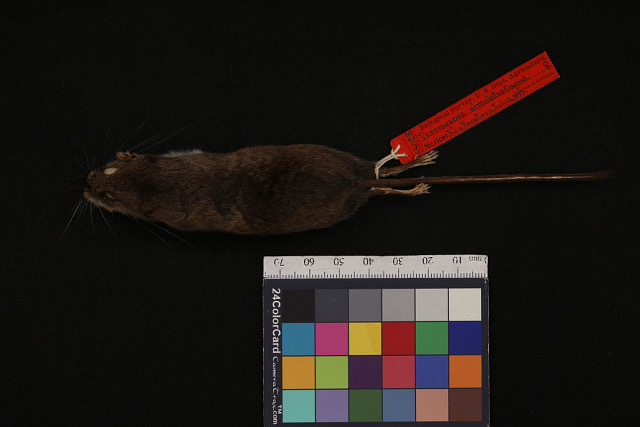
Xico Deermouse (Habromys simulatus) is a rare Mexican forest rodent known from the Sierra Madre Oriental and neighboring highlands. Its tiny range and continued loss of cloud forest place it among the most threatened members of its genus. This guide separates well-supported biology from common assumptions and covers identification, range, habitat, diet, behavior, reproduction and conservation.
Identification
The Xico Deermouse has dark brown upperparts, a sharply paler or white belly, dark ears and a long, well-haired tail. A brushy tail tip and dark marks near the hind feet help specialists separate it from other Habromys. Field identification is difficult because several Mexican cloud-forest mice have similar size and color; skull, dental and genetic evidence may be needed. Males and females are externally similar, and available samples are too small to define subtle size differences reliably.
Identification should combine body shape, markings, size, voice or movement, and location. One feature by itself can overlap with a related animal, a juvenile, or an individual in unusual light.
Photographs are most useful when they preserve scale and show several diagnostic features. Handling or repositioning a wild xico deermouse for identification can cause stress and is unnecessary.
Size and physical adaptations
Xico Deermouse typically measures head–body roughly 9–11 cm in published specimen descriptions and weighs often reported around 25–40 g, but species-wide limits are poorly documented. Few animals have been measured, so values should be treated as approximate rather than complete limits.
Its useful adaptations include long tail balances the body while climbing, broad hind feet grip wet branches and mossy trunks, dark fur blends with cloud-forest bark and litter, large ears detect predators in dense vegetation, strong incisors process seeds and plant material, whiskers guide movement at night. These traits work together in the animal’s normal setting rather than serving as isolated curiosities.
Published measurements may use different methods, life stages or sample locations. Comparing figures responsibly means checking what was measured rather than selecting the largest number available.
Range and distribution
Endemic to eastern Mexico. Confirmed and historical records come from humid mountain forests of Veracruz, Hidalgo and adjacent highland areas, generally along the eastern slopes of the Sierra Madre Oriental around 1,800–2,200 metres. Its actual occupied area is extremely small and fragmented. The native range includes Mexico.
A country-level map indicates broad distribution, not continuous occupation. Climate, elevation, water, vegetation, prey, breeding sites, barriers and survey effort all affect where records occur.
Records near the edge of the range deserve careful documentation because they may reflect natural movement, improved survey coverage, accidental transport or a genuine distribution change.
Habitat
Montane cloud forest and other cool, moist broadleaf forest with dense epiphytes, fallen wood, moss, vines and a complex understory.
The genus name and limb proportions reflect climbing ability, and animals have been captured around forest structure rather than open ground. The mouse likely uses logs, low branches, vines and dense litter as connected travel routes. Clearing the canopy dries moss, simplifies the understory and isolates the shaded microhabitats on which a small climbing rodent depends. Protecting a population therefore requires the feeding, shelter and breeding features that make a site usable, along with connections that allow movement.
Microhabitat matters. Shade, soil, current, moisture, shelter or host plants can determine whether a small area is usable even when the surrounding landscape appears suitable.
Diet and feeding
Xico Deermouse is a poorly documented omnivore. Important foods include seeds, fruit, tender plant tissue, fungi, insects, other small invertebrates. No modern field study has quantified the diet of H. simulatus. Related climbing deermice eat plant and animal foods, so seeds, fruit and arthropods are plausible, but proportions remain unknown. Its incisors grow continuously and must be worn through gnawing. Foraging probably occurs on the forest floor and within low vegetation.
Diet changes with age, season, location and food supply. A dramatic prey record does not establish what most individuals eat most of the time; repeated field observations provide a stronger picture.
Feeding opportunities also create risk. An animal focused on prey may be less alert to predators, traffic or people, while contaminated prey can transfer pollutants through the food web.
Behavior and communication
Nocturnal, based on field captures and the behavior of related Habromys species. Direct observation is extremely scarce. The long tail and climbing feet indicate agile movement through branches, vines and fallen timber, while darkness and dense cover reduce exposure to owls and small carnivores. Home-range size, territoriality and social organization have not been measured. Claims about pair bonds or group living would therefore be premature.
Species-specific signals have not been studied. Like other peromyscine rodents, it probably combines scent, touch, squeaks and ultrasonic calls, but recordings and behavioral trials are needed to confirm how adults court, defend space or recognize young. Behavior should be interpreted in context: alarm, courtship, feeding and temperature regulation can produce very different actions from the same animal.
Daily schedules are flexible responses, not rigid rules. Weather, breeding condition, disturbance, tides or food can move activity into a different part of the day.
Reproduction and development
No reliable species-specific breeding calendar has been published. Rainfall, cool temperatures and food pulses probably influence reproduction in cloud forest, but the timing and number of litters are unknown. Any conservation breeding proposal would first require basic studies of mating, nesting and nutritional needs. Unknown; related deermice often produce small litters, but no number should be assumed for this species As a placental cricetid, it presumably gives birth to blind, helpless pups in a concealed nest. The ages of fur growth, eye opening, weaning and independence have not been measured for H. simulatus.
Young animals face different risks and may use different microhabitats or food than adults. Breeding success depends on adult condition, suitable sites and the survival of offspring through vulnerable early stages.
Counts of eggs or young describe reproductive output, not the number expected to reach adulthood. Mortality is normally greatest during eggs, larval or juvenile stages.
Predators and ecological role
The Xico Deermouse probably eats seeds, fruits, fungi and invertebrates and is itself prey for owls, snakes and small mammalian carnivores. Those functions link cloud-forest plants, decomposers and predators. Because it is restricted to cool humid forest, its presence also signals surviving microclimate and structural complexity that benefit salamanders, birds, orchids and many other endemics. Documented or likely predators include Owls, Forest Snakes, Ocelot, Long-tailed Weasel, Humans.
This animal is both a consumer and a food source. Its influence comes through many repeated interactions, so ecological claims should be based on measured populations rather than assumptions drawn from appearance.
Predator and prey relationships differ among places. A species can be ecologically influential without being abundant everywhere, and its role can change across its range.
Relationship with people
The mouse does not normally damage crops or enter homes in significant numbers. Human impacts are indirect but severe: coffee expansion, pasture, logging, roads, settlements and fire replace or fragment cloud forest. Shade-grown agriculture with native canopy, riparian buffers and connected forest remnants can reduce isolation, while biological surveys help prevent tiny populations from being overlooked.
The animal is shy and poses negligible risk. Only permitted researchers should trap or handle it, using gloves and disease-safe procedures before releasing animals at the capture point. Residents should avoid rodenticide near cloud forest because poison can kill native mice and the owls and carnivores that eat them. Responsible observation means keeping an appropriate distance, avoiding capture or feeding, protecting habitat and following local wildlife or invasive-species guidance.
Wildlife guidance should come from the responsible local agency because collection rules, reporting requests and appropriate responses differ between native and introduced ranges.
Conservation
The current Mammal Diversity Database records the Xico Deermouse as Critically Endangered. Its occupied habitat is extremely restricted and fragmented, and continued conversion of Mexican cloud forest threatens the few known populations. The reported global trend is Decreasing.
Important pressures include cloud-forest clearing, agricultural expansion, pasture and settlement, logging and fuelwood collection, road construction, fire and drying forest edges, very small isolated populations, limited survey information. Global status can hide local decline or recovery, so current regional monitoring and habitat management remain necessary.
The most useful conservation action follows the documented pressure. Protecting breeding sites, reducing road deaths or limiting pollutants can require different tools in different populations.