
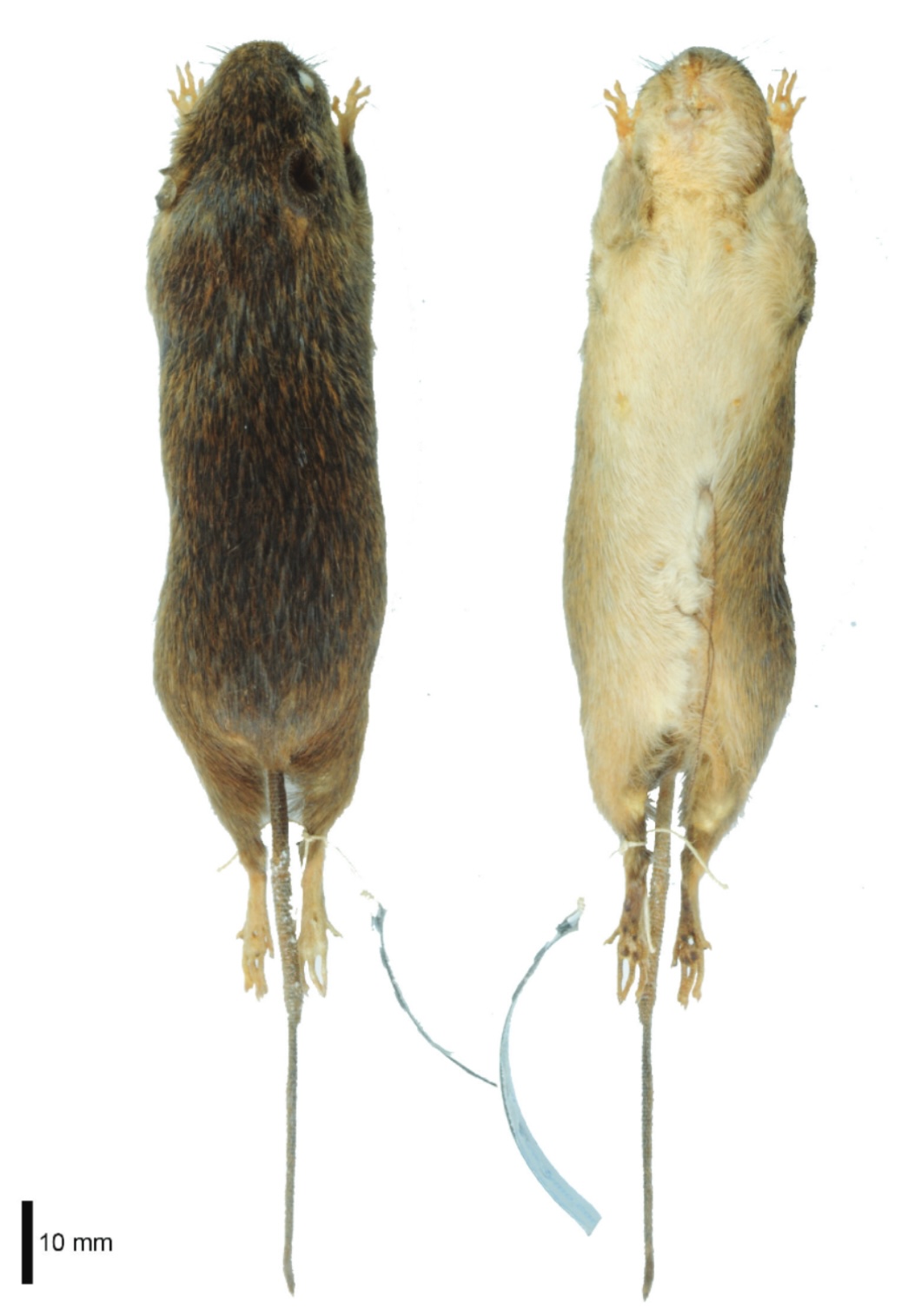
Xingu Bristly Mouse (Neacomys xingu) is a recently described species of small sigmodontine rodent from southeastern Amazonia. Scientists formally named it in 2020 after combining anatomy, measurements, geography and DNA evidence. This guide separates well-supported biology from common assumptions and covers identification, range, habitat, diet, behavior, reproduction and conservation.
Identification
The original description identifies a small bristly mouse with orangish-brown upperparts lined by stiff dark guard hairs, paler flanks and sharply contrasting white underparts. The ears are small and brown, the feet pale, and the slender tail is longer than the head and body. Specialists distinguish it from similar Neacomys by external proportions, skull and dental characters and DNA. No strong external sexual dimorphism has been documented; the available scientific sample is too limited for broad conclusions.
Identification should combine body shape, markings, size, voice or movement, and location. One feature by itself can overlap with a related animal, a juvenile, or an individual in unusual light.
Photographs are most useful when they preserve scale and show several diagnostic features. Handling or repositioning a wild xingu bristly mouse for identification can cause stress and is unnecessary.
Size and physical adaptations
Xingu Bristly Mouse typically measures documented adults have a head–body length roughly 65–82 mm and weighs about 13–20 g in the limited type series. Ranges come from a small scientific series and should not be treated as complete species limits.
Its useful adaptations include stiff dorsal hairs offer physical protection, long tail aids balance through dense ground vegetation, small body moves through leaf litter and root tangles, strong incisors open seeds and plant tissue, sensitive whiskers guide movement in darkness, cryptic brown coloring matches forest litter. These traits work together in the animal’s normal setting rather than serving as isolated curiosities.
Published measurements may use different methods, life stages or sample locations. Comparing figures responsibly means checking what was measured rather than selecting the largest number available.
Range and distribution
Known from Pará in southeastern Brazilian Amazonia, in the Xingu center of endemism between the Xingu River and the Araguaia–Tocantins river system. Confirmed localities include the Tapirapé-Aquiri National Forest and nearby landscapes; the complete limits remain poorly surveyed. The native range includes Brazil.
A country-level map indicates broad distribution, not continuous occupation. Climate, elevation, water, vegetation, prey, breeding sites, barriers and survey effort all affect where records occur.
Records near the edge of the range deserve careful documentation because they may reflect natural movement, improved survey coverage, accidental transport or a genuine distribution change.
Habitat
Tropical lowland moist evergreen forest, including mature terra firme forest and forest near lakes and streams.
Capture records place the species on or near the forest floor, where dense litter, roots, fallen wood and low vegetation provide cover. Detailed microhabitat selection has not been studied. Because most knowledge comes from survey traps, statements about climbing, burrowing or territorial use remain hypotheses rather than established facts. Protecting a population therefore requires the feeding, shelter and breeding features that make a site usable, along with connections that allow movement.
Microhabitat matters. Shade, soil, current, moisture, shelter or host plants can determine whether a small area is usable even when the surrounding landscape appears suitable.
Diet and feeding
Xingu Bristly Mouse is a presumed omnivore; species-specific diet has not been studied. Important foods include seeds, fruit pulp, small insects, other tiny invertebrates, tender plant material. No published field study has quantified the diet of N. xingu. Other bristly mice consume seeds, fruits and arthropods, so researchers expect a flexible forest-floor diet, but those genus-level observations require confirmation for this species. Its continuously growing incisors are suited to gnawing, while small hands can manipulate food in litter.
Diet changes with age, season, location and food supply. A dramatic prey record does not establish what most individuals eat most of the time; repeated field observations provide a stronger picture.
Feeding opportunities also create risk. An animal focused on prey may be less alert to predators, traffic or people, while contaminated prey can transfer pollutants through the food web.
Behavior and communication
Probably nocturnal, based on trapping and related Neacomys species, but detailed activity rhythms remain unmeasured. Almost nothing is known directly about social organization, movement or communication. Field captures suggest a secretive forest-floor mouse, and its long tail likely supports balance among roots and low stems. It should not be described as solitary, territorial or arboreal without targeted tracking. This information gap is itself important: a recently recognized species can face landscape change before its ordinary life has been observed.
Species-specific signals are unknown. Like other small cricetid rodents, it likely uses scent, touch and high-frequency calls, but acoustic recordings and behavioral studies are needed before those mechanisms can be described confidently. Behavior should be interpreted in context: alarm, courtship, feeding and temperature regulation can produce very different actions from the same animal.
Daily schedules are flexible responses, not rigid rules. Weather, breeding condition, disturbance, tides or food can move activity into a different part of the day.
Reproduction and development
No dedicated study has reported mating season, pregnancy length or litter size for N. xingu. Small tropical cricetids often time reproduction to rainfall and food pulses, but applying a precise schedule from another species would be misleading. Museum records of reproductive condition and long-term live trapping are needed. Unknown for this species Development has not been documented. As a placental mouse, newborns are expected to be altricial, requiring warmth and milk in a concealed nest, but the age of eye opening, weaning and independence remains unmeasured.
Young animals face different risks and may use different microhabitats or food than adults. Breeding success depends on adult condition, suitable sites and the survival of offspring through vulnerable early stages.
Counts of eggs or young describe reproductive output, not the number expected to reach adulthood. Mortality is normally greatest during eggs, larval or juvenile stages.
Predators and ecological role
The Xingu Bristly Mouse likely consumes and redistributes small seeds, eats invertebrates and transfers forest-floor energy to snakes, owls and mammalian carnivores. Those roles are consistent with small Amazonian rodents but have not yet been measured for this species. Its restricted distribution makes it useful evidence for the Xingu region’s evolutionary uniqueness and for the conservation value of intact forest between major rivers. Documented or likely predators include Owls, Small Cats, Snakes, Tayra, Humans.
This animal is both a consumer and a food source. Its influence comes through many repeated interactions, so ecological claims should be based on measured populations rather than assumptions drawn from appearance.
Predator and prey relationships differ among places. A species can be ecologically influential without being abundant everywhere, and its role can change across its range.
Relationship with people
The species is too small and obscure to be hunted or traded regularly. Human effects arise mainly through forest conversion, logging, roads, mining, hydroelectric development and fires that penetrate fragmented forest. Surveys before development are important because ordinary rapid assessments may identify tiny Neacomys only to genus, hiding a range-restricted species.
This shy mouse poses little direct danger. Researchers should use gloves, approved live traps and disease-safe handling protocols, then release animals at the capture point when permits require. Residents should avoid handling any wild rodent and should store food securely without using broad poisons that harm native predators. Responsible observation means keeping an appropriate distance, avoiding capture or feeding, protecting habitat and following local wildlife or invasive-species guidance.
Wildlife guidance should come from the responsible local agency because collection rules, reporting requests and appropriate responses differ between native and introduced ranges.
Conservation
Neacomys xingu has not yet received a global IUCN Red List assessment. Its known range overlaps an Amazonian region experiencing deforestation, roads, mining and fire, but available records are insufficient to infer population size or trend. The reported global trend is Unknown.
Important pressures include deforestation for agriculture and pasture, forest fragmentation, road construction, mining, hydroelectric and transmission infrastructure, wildfire entering degraded forest, lack of species-specific survey data. Global status can hide local decline or recovery, so current regional monitoring and habitat management remain necessary.
The most useful conservation action follows the documented pressure. Protecting breeding sites, reducing road deaths or limiting pollutants can require different tools in different populations.