
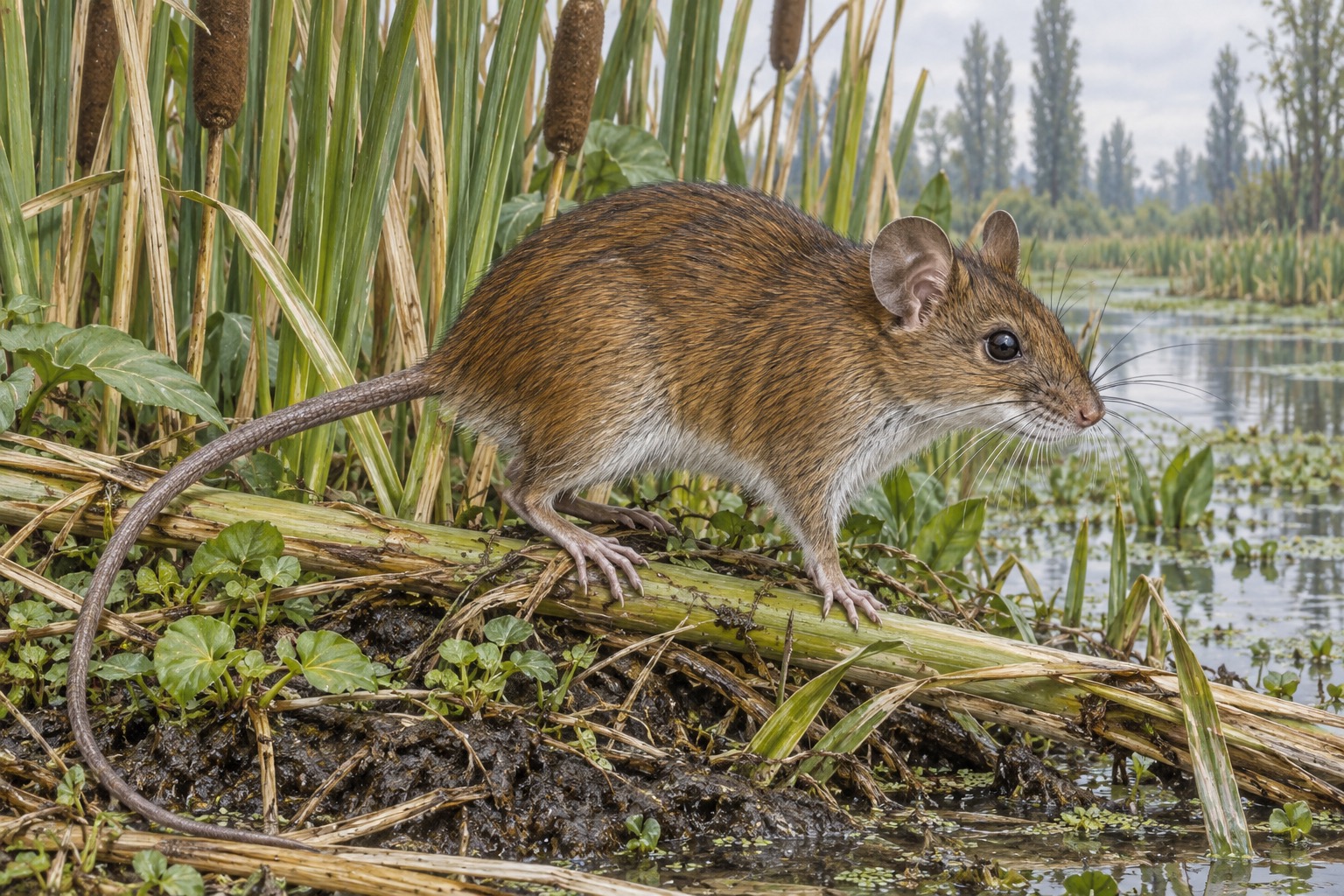
Xochimilco Marsh Rice Rat (Oryzomys fulgens) is a recently restored species of marsh rice rat known from the Basin of Mexico. Two females captured in Xochimilco in 2014 allowed researchers to compare living animals with the 19th-century holotype and recognize the species again. This guide separates well-supported biology from common assumptions and covers identification, range, habitat, diet, behavior, reproduction and conservation.
Identification
A slender rice rat with glossy tawny to ochraceous-brown upperparts, paler flanks, white to gray-white underparts, large ears, long hind feet and a long tail. The tail exceeds head–body length and is darker above than below. Specialists distinguish it from lowland Mexican rice rats by overall size, skull proportions, molars and its isolated high-elevation wetland range. Too few confirmed specimens are known to describe sexual dimorphism; the 2024 study compared a male holotype with a female from Xochimilco and noted only limited differences.
Identification should combine body shape, markings, size, voice or movement, and location. One feature by itself can overlap with a related animal, a juvenile, or an individual in unusual light.
Photographs are most useful when they preserve scale and show several diagnostic features. Handling or repositioning a wild xochimilco marsh rice rat for identification can cause stress and is unnecessary.
Size and physical adaptations
Xochimilco Marsh Rice Rat typically measures confirmed specimens have head–body length around 14–16 cm and weighs published weight data are extremely limited and no reliable species range is established. Only a handful of verified animals are known, so measurements must not be generalized into firm species limits.
Its useful adaptations include long hind feet support movement through wet vegetation, long tail balances the body while climbing reeds, water-resistant guard hairs protect the coat, sensitive whiskers guide travel at night, strong incisors process seeds and stems, omnivory can track seasonal wetland foods. These traits work together in the animal’s normal setting rather than serving as isolated curiosities.
Published measurements may use different methods, life stages or sample locations. Comparing figures responsibly means checking what was measured rather than selecting the largest number available.
Range and distribution
Endemic to the Basin of Mexico. Historical evidence points to wetlands around Tepepan, Tlalpan and Xochimilco; the only recently confirmed locality is the chinampa and canal zone near San Gregorio Atlapulco in Xochimilco, Mexico City, at roughly 2,240 metres elevation. The native range includes Mexico.
A country-level map indicates broad distribution, not continuous occupation. Climate, elevation, water, vegetation, prey, breeding sites, barriers and survey effort all affect where records occur.
Records near the edge of the range deserve careful documentation because they may reflect natural movement, improved survey coverage, accidental transport or a genuine distribution change.
Habitat
High-elevation temperate wetland with canals, marshes, temporary flooded areas, cattail beds and traditional chinampa agriculture.
The two modern animals were captured beside a canal in dense Typha cattails within the chinampa zone. Reed beds provide food, cover and routes above wet ground. Canals preserve fragments of the once extensive lake system, while cultivated plots can add edge habitat. Concrete banks, polluted water and removal of emergent plants break that narrow habitat network. Protecting a population therefore requires the feeding, shelter and breeding features that make a site usable, along with connections that allow movement.
Microhabitat matters. Shade, soil, current, moisture, shelter or host plants can determine whether a small area is usable even when the surrounding landscape appears suitable.
Diet and feeding
Xochimilco Marsh Rice Rat is a presumed omnivore; species-specific diet has not been quantified. Important foods include wetland grass seeds, cattail seeds and shoots, aquatic and terrestrial insects, snails and other small invertebrates, fruit and green plant material. No study has yet analyzed stomach contents or feeding choices of O. fulgens. Other Oryzomys combine seeds and green plants with insects, snails and small aquatic prey, but the proportions for this species remain unknown. Its long feet and tail allow it to forage along reed stems, floating vegetation and muddy banks without remaining exposed in open water.
Diet changes with age, season, location and food supply. A dramatic prey record does not establish what most individuals eat most of the time; repeated field observations provide a stronger picture.
Feeding opportunities also create risk. An animal focused on prey may be less alert to predators, traffic or people, while contaminated prey can transfer pollutants through the food web.
Behavior and communication
Probably nocturnal, consistent with related rice rats, but direct activity tracking is unavailable. The species is so rarely encountered that movement, home range and social life are unknown. Related rice rats swim, climb reeds and use dense marsh cover, making those reasonable research questions rather than confirmed facts. The modern capture in cattails shows a close association with wetland vegetation. Conservation plans should retain continuous reed margins until radio-tracking clarifies its exact needs.
Species-specific calls and scent behavior have never been studied. Small oryzomyine rodents generally use scent, touch, squeaks and ultrasound, but researchers still need recordings and observation before assigning a communication system to O. fulgens. Behavior should be interpreted in context: alarm, courtship, feeding and temperature regulation can produce very different actions from the same animal.
Daily schedules are flexible responses, not rigid rules. Weather, breeding condition, disturbance, tides or food can move activity into a different part of the day.
Reproduction and development
Nothing reliable is published about mating season, gestation or litter size. Wetland food and rainfall probably influence reproduction, but the tiny sample prevents inference. Surveys that record age, sex and reproductive condition without removing many animals are essential for estimating recruitment. Unknown As a placental cricetid, newborns are expected to be blind and dependent in a concealed nest. Nest placement, growth rate, eye opening, weaning and juvenile dispersal have not been documented.
Young animals face different risks and may use different microhabitats or food than adults. Breeding success depends on adult condition, suitable sites and the survival of offspring through vulnerable early stages.
Counts of eggs or young describe reproductive output, not the number expected to reach adulthood. Mortality is normally greatest during eggs, larval or juvenile stages.
Predators and ecological role
The rice rat probably transfers energy from seeds, plants and invertebrates to owls, snakes and small carnivores while moving seeds through the marsh. Its survival in chinampas shows how traditional food production can coexist with native wetland biodiversity when canals and vegetation remain intact. As the only recognized high-elevation temperate Oryzomys, it also represents a unique evolutionary branch. Documented or likely predators include Barn Owl, Long-tailed Weasel, Water Snakes, Domestic Cat, Humans.
This animal is both a consumer and a food source. Its influence comes through many repeated interactions, so ecological claims should be based on measured populations rather than assumptions drawn from appearance.
Predator and prey relationships differ among places. A species can be ecologically influential without being abundant everywhere, and its role can change across its range.
Relationship with people
Xochimilco’s canals and chinampas are both working cultural landscape and wildlife refuge. Urban expansion, untreated wastewater, plastic, pesticides, fires and removal of cattails shrink habitat. Introduced black rats may compete with or transmit disease to native rice rats, while cats and dogs add predation. Clean canals, vegetated banks, responsible chinampa farming and invasive-species control can benefit both residents and wildlife.
The animal is not aggressive and should never be captured by visitors. Researchers require permits, gloves and low-stress trapping protocols. Residents can protect food without poison, keep cats indoors and report unusual native rodents to local conservation authorities. Any bite from a wild mammal should be washed and medically assessed. Responsible observation means keeping an appropriate distance, avoiding capture or feeding, protecting habitat and following local wildlife or invasive-species guidance.
Wildlife guidance should come from the responsible local agency because collection rules, reporting requests and appropriate responses differ between native and introduced ranges.
Conservation
The reinstated species has not yet received a global IUCN assessment. Researchers regard it as facing serious conservation risk because only three modern or historical individuals are documented, its known range is confined to Xochimilco and threats are intense. The reported global trend is Unknown, but habitat extent and quality have declined severely.
Important pressures include urban expansion, wetland drainage and channel modification, water pollution, removal of cattails and bank vegetation, invasive black rats, free-roaming cats and dogs, pesticides and rodenticides, fire and catastrophic flooding. Global status can hide local decline or recovery, so current regional monitoring and habitat management remain necessary.
The most useful conservation action follows the documented pressure. Protecting breeding sites, reducing road deaths or limiting pollutants can require different tools in different populations.