
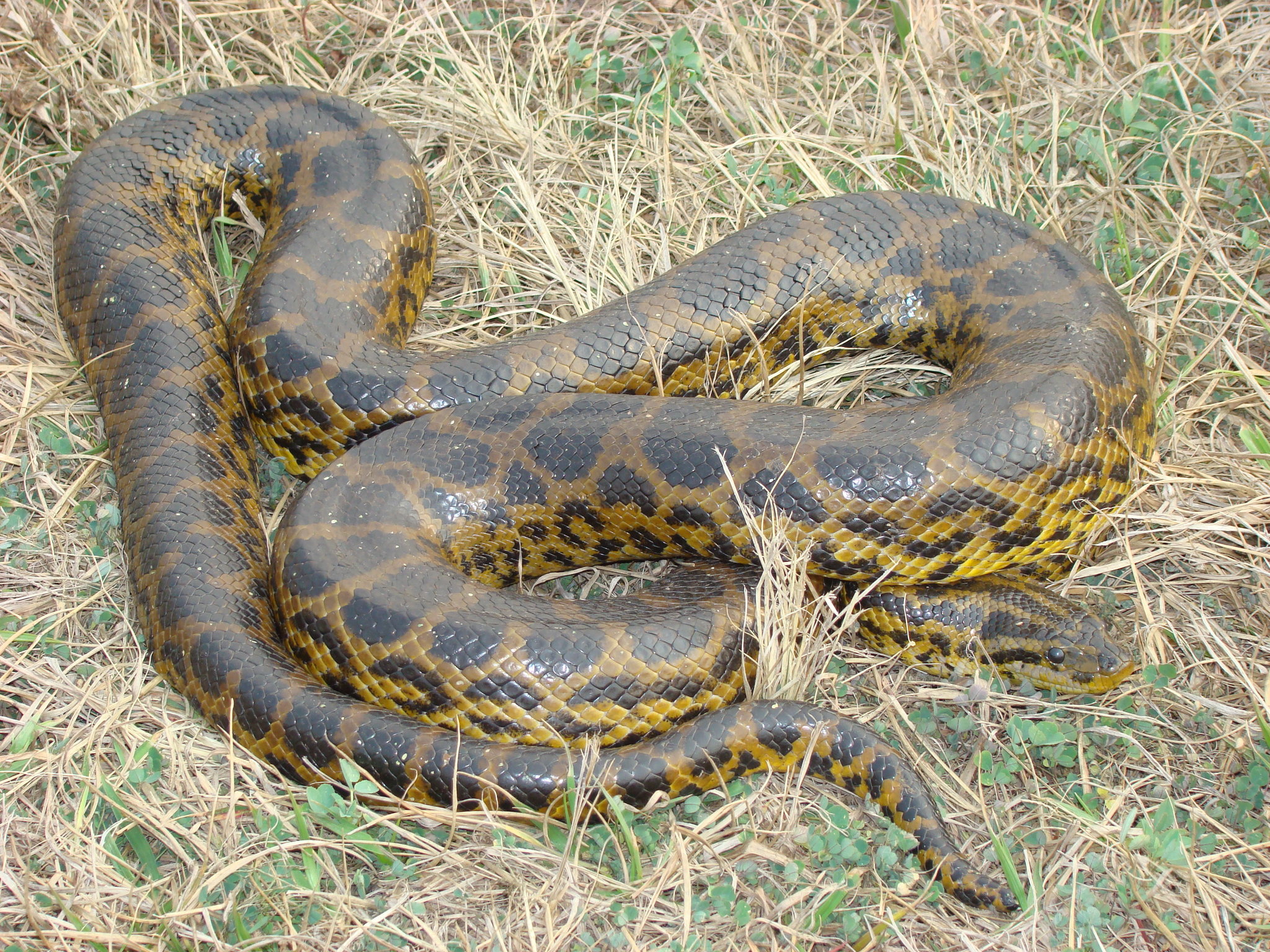
Yellow Anaconda (Eunectes notaeus) is a large boa native to the Paraguay–Paraná river system and neighboring wetlands. It spends much of its life close to water, where a broad diet and powerful swimming ability make it one of the region’s leading predators. This guide separates well-supported biology from common assumptions and covers identification, range, habitat, diet, behavior, reproduction and conservation.
Identification
The ground color ranges from mustard yellow and yellow-green to tan. Dark brown or black oval saddles run along the back, with smaller spots and streaks on the sides. The head is relatively narrow but strongly muscled, the eyes and nostrils sit high for watching and breathing at the surface, and the body is thick with a comparatively short tail. Those bold dark blotches on a yellow background usually separate it from the olive-green green anaconda. Females are substantially longer and much heavier than males. This female-biased size difference is characteristic of anacondas and allows mature females to produce large litters.
Identification should combine body shape, markings, size, voice or movement, and location. One feature by itself can overlap with a related animal, a juvenile, or an individual in unusual light.
Photographs are most useful when they preserve scale and show several diagnostic features. Handling or repositioning a wild yellow anaconda for identification can cause stress and is unnecessary.
Size and physical adaptations
Yellow Anaconda typically measures males commonly 2–3 m; females commonly 3–4 m, with exceptional individuals exceeding 4.5 m and weighs often about 25–55 kg in large adults, with exceptional females heavier. Sex, age, season and whether a female is gravid strongly affect mass; exceptional records should not be treated as typical adult size.
Its useful adaptations include eyes and nostrils positioned high on the head, strong swimming muscles and a laterally compressed tail, dark disruptive blotches among reeds and shadows, heat-sensitive labial pits help locate warm prey, backward-curving teeth hold slippery animals, powerful coils stop prey circulation. These traits work together in the animal’s normal setting rather than serving as isolated curiosities.
Published measurements may use different methods, life stages or sample locations. Comparing figures responsibly means checking what was measured rather than selecting the largest number available.
Range and distribution
Native to the southern half of central South America, especially the Paraguay River drainage, Pantanal and lower Paraná basin. Confirmed range includes northern Argentina, Paraguay, southern and western Brazil and southeastern Bolivia; records extend into Uruguay near connected wetlands. The native range includes Argentina, Bolivia, Brazil, Paraguay, Uruguay.
A country-level map indicates broad distribution, not continuous occupation. Climate, elevation, water, vegetation, prey, breeding sites, barriers and survey effort all affect where records occur.
Records near the edge of the range deserve careful documentation because they may reflect natural movement, improved survey coverage, accidental transport or a genuine distribution change.
Habitat
Marshes, swamps, seasonally flooded grasslands, slow rivers, oxbow lakes, wooded stream margins and dense aquatic vegetation.
Water supports nearly every part of its life. An anaconda may rest in floating plants or muddy shallows, travel through flooded grassland, and wait beside paths used by birds and mammals. During dry periods it concentrates around permanent pools and channels. It can move over land between wetlands, but its heavy body is far more agile in water. Seasonal flooding opens feeding habitat and connects populations across the broad floodplain. Protecting a population therefore requires the feeding, shelter and breeding features that make a site usable, along with connections that allow movement.
Microhabitat matters. Shade, soil, current, moisture, shelter or host plants can determine whether a small area is usable even when the surrounding landscape appears suitable.
Diet and feeding
Yellow Anaconda is a carnivore and opportunistic ambush predator. Important foods include fish, water birds and their eggs, turtles, caimans, capybaras and nutria, small deer and peccaries, other snakes. The snake waits concealed in water or vegetation, strikes quickly and secures prey with recurved teeth. It wraps one or more coils around the animal and tightens when the prey exhales or struggles. Constriction interrupts blood circulation and rapidly deprives the brain of oxygen; the snake does not need to crush bones. Flexible jaw joints, stretchy ligaments and independently moving lower jaws allow it to swallow prey whole, usually head first. A large meal may support it for weeks.
Diet changes with age, season, location and food supply. A dramatic prey record does not establish what most individuals eat most of the time; repeated field observations provide a stronger picture.
Feeding opportunities also create risk. An animal focused on prey may be less alert to predators, traffic or people, while contaminated prey can transfer pollutants through the food web.
Behavior and communication
Most active at dusk and night, though basking and hunting also occur by day when temperature and water conditions are favorable. Yellow anacondas are generally solitary outside the breeding season. They regulate body temperature by shifting between sun-warmed banks, shallow water and shaded vegetation. In water they swim with smooth lateral waves and may remain motionless with only the top of the head visible. On land they move more slowly and defensively. When threatened they may hiss, strike, release musk or retreat into deep water rather than pursue a person.
Chemical information is central. The forked tongue samples scent particles and carries them to the vomeronasal organ, allowing a snake to follow prey or a potential mate. Touch is important during courtship, while ground and water vibrations warn of approaching animals. Anacondas have no external ears but detect low-frequency vibration through the jaw and body. Behavior should be interpreted in context: alarm, courtship, feeding and temperature regulation can produce very different actions from the same animal.
Daily schedules are flexible responses, not rigid rules. Weather, breeding condition, disturbance, tides or food can move activity into a different part of the day.
Reproduction and development
Courtship commonly occurs as seasonal water and temperature conditions change. A receptive female releases chemical signals that attract several males, which may form a slow-moving breeding aggregation around her. Males use pelvic spurs and body contact while competing for position. Females invest heavily in a reproductive cycle and may skip later seasons while rebuilding energy reserves. Usually about 20–40 live young, but reported litters range from a few to more than 70 The species is viviparous: embryos develop inside the mother and young are born alive rather than hatching from a laid nest of eggs. Newborns are fully formed, roughly 50–70 cm long, and receive no parental care after birth. They begin taking small fish, frogs, lizards and rodents while avoiding many wetland predators.
Young animals face different risks and may use different microhabitats or food than adults. Breeding success depends on adult condition, suitable sites and the survival of offspring through vulnerable early stages.
Counts of eggs or young describe reproductive output, not the number expected to reach adulthood. Mortality is normally greatest during eggs, larval or juvenile stages.
Predators and ecological role
As a large generalist predator, the yellow anaconda links aquatic and terrestrial food webs. It consumes fish, reptiles, birds and mammals and in turn provides food for scavengers after an unfinished kill. Juveniles support raptors, caimans and mammalian predators. By taking abundant wetland prey it helps shape behavior and energy flow across floodplains, while its own seasonal movements depend on intact networks of pools, channels, grassland and gallery forest. Documented or likely predators include Yacare Caiman, Jaguar, Black-and-white Tegu, Raptors, Humans.
This animal is both a consumer and a food source. Its influence comes through many repeated interactions, so ecological claims should be based on measured populations rather than assumptions drawn from appearance.
Predator and prey relationships differ among places. A species can be ecologically influential without being abundant everywhere, and its role can change across its range.
Relationship with people
People encounter yellow anacondas while fishing, ranching and traveling through wetlands. Some are killed from fear or struck by vehicles on floodplain roads. Their skins have entered international trade, and Argentina has operated a regulated management program intended to link legal harvest with monitoring and habitat incentives. Wetland drainage, fire, pollution and dams can be more damaging over time than direct encounters. Protecting connected flood cycles benefits snakes, fisheries, birds and local livelihoods.
Observe from a substantial distance and never try to touch, feed, corner or pull an anaconda from the water. It is nonvenomous, but a defensive bite can be deep and a large animal can constrict with great force. Keep children and pets away, give the snake an open escape route and contact trained wildlife authorities if removal is necessary. Any bite requires prompt medical cleaning and evaluation. Responsible observation means keeping an appropriate distance, avoiding capture or feeding, protecting habitat and following local wildlife or invasive-species guidance.
Wildlife guidance should come from the responsible local agency because collection rules, reporting requests and appropriate responses differ between native and introduced ranges.
Conservation
Widely used conservation databases list the yellow anaconda as Least Concern because it occupies a broad range and persists in extensive wetlands. Local populations can still decline where marshes are drained, fires intensify or snakes are killed. International commercial trade is monitored under CITES Appendix II. The reported global trend is Not well quantified across the entire range.
Important pressures include wetland drainage and river alteration, deliberate killing through fear, road mortality, unmanaged skin and pet trade, severe fire and drought, water pollution, loss of vegetated wetland corridors. Global status can hide local decline or recovery, so current regional monitoring and habitat management remain necessary.
The most useful conservation action follows the documented pressure. Protecting breeding sites, reducing road deaths or limiting pollutants can require different tools in different populations.